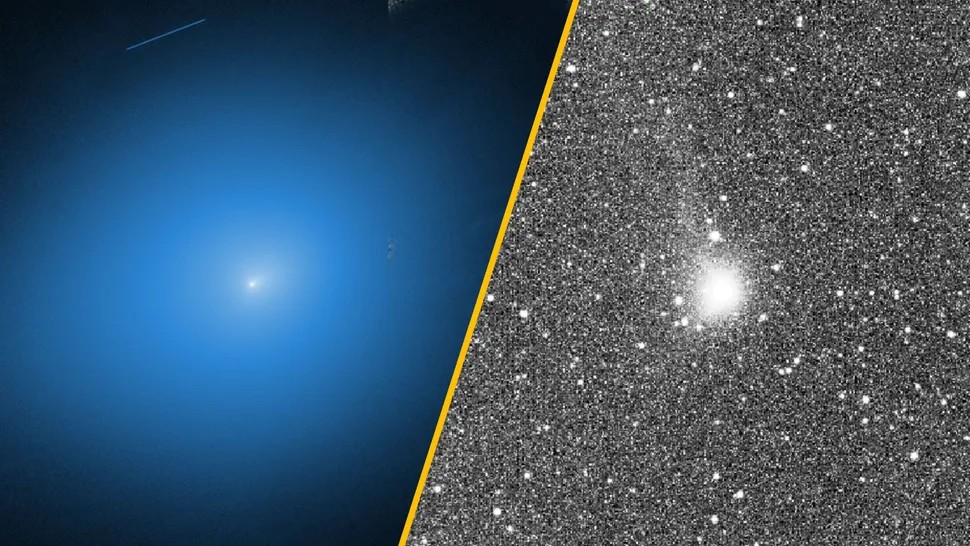
Interstellar Comet 3I/ATLAS
Comet 3I/ATLAS is the third confirmed interstellar object to visit our solar system, following 1I/ʻOumuamua in 2017 and 2I/Borisov in 2019. Designated with the “3I/” prefix, it was first spotted on July 1, 2025, by the Asteroid Terrestrial-impact Last Alert System (ATLAS) telescope in Río Hurtado, Chile. Its hyperbolic orbital path—indicating it originated from another star system—confirmed its interstellar nature just days later on July 2, 2025. NASA and international partners have launched an extensive observation campaign, leveraging multiple spacecraft and telescopes to study this rare visitor as it hurtles through our neighborhood at speeds up to 137,000 miles per hour (220,000 km/h).
Key Orbital Details and Timeline
- Origin and Path: 3I/ATLAS likely formed billions of years ago in another star system and was ejected into interstellar space. It’s approaching from the direction of the constellation Sagittarius in the Milky Way’s center. Unlike solar system comets, its trajectory won’t loop around the Sun; it’ll exit our solar system after this flyby.
- Perihelion (Closest to Sun): October 30, 2025, at about 1.4 AU (130 million miles or 210 million km)—just inside Mars’ orbit.
- Closest to Mars: Late September 2025, observed closely by NASA’s MAVEN orbiter.
- Closest to Earth: December 19, 2025, at 1.8 AU (170 million miles or 270 million km)—far enough to pose no threat.
- Size Estimate: Nucleus likely 1,400 feet (440 meters) to 3.5 miles (5.6 km) wide, making it potentially the largest known interstellar object.
As of December 9, 2025, the comet is outbound and visible to telescopes, with its activity (coma and tail) increasing as it warmed near the Sun. Early signs of cometary behavior may date back to May 2025, per NASA’s TESS observations.
NASA’s Multi-Mission Observation Campaign
NASA has coordinated a solar system-wide effort, using over a dozen assets to capture data on 3I/ATLAS’s composition, trajectory, and behavior. This includes ultraviolet imaging of hydrogen halos, dust analysis, and tail evolution—offering insights into extrasolar chemistry. Highlights:
| Psyche (en route to asteroid Psyche) | Sept. 8–9, 2025 | Four images over 8 hours from 33 million miles (53 million km); refined trajectory data. |
| Lucy (en route to Trojan asteroids) | Sept. 16, 2025 | Stacked images from 240 million miles (386 million km); detailed coma and tail structure. |
| MAVEN (Mars orbiter) | Sept. 28, 2025 | Ultraviolet composite of hydrogen atoms around the comet, just before Mars flyby—first targeted interstellar observation by a heliophysics mission. |
| Hubble Space Telescope | Late July & Nov. 30, 2025 | Initial blue-blur image constrained size; November shot from 178 million miles (286 million km) shows increased activity and reddish dust coma. |
| James Webb Space Telescope (JWST) | July–August 2025 | Analyzed gas composition: unusually high CO₂ (10–20% of volatiles) but normal CO-to-water ratio, hinting at a CO₂-rich nucleus or limited water sublimation. |
| PUNCH (Polarimeter to Unify Corona/Heliosphere) | August–October 2025 | Tracked tail evolution every ~1 minute for weeks, even when behind the Sun from Earth’s view; measured polarization for dust particle insights. Photobombed by 3I/ATLAS during comet 2025 R2 observations. |
| STEREO (Solar Terrestrial Relations Observatory) | Sept. 11–25, 2025 | Stacked visible-light images revealed faint comet despite low expectations; colorized to show structure. |
| TESS (Transiting Exoplanet Survey Satellite) | May–July 2025 | Detected early activity at 6.4 AU from Sun, pre-discovery. |
Composition and Scientific Insights
- Activity: Steady brightening with no outbursts or fragmentation (unlike 2I/Borisov). Reddish coma suggests dust similar to solar system comets. Possible cryovolcanoes are speculated due to the coma’s “weirdness.”
- Uniqueness: High CO₂ levels set it apart, potentially revealing formation conditions in its home system, older than our solar system.
- Collaborations: ESA’s Juice, Mars Express, ExoMars Trace Gas Orbiter, and SOHO contributed images, including five-instrument Juice data from November 2025.
Visibility and Safety
3I/ATLAS is too distant for naked-eye viewing but observable with amateur telescopes through December. It poses zero risk to Earth. For real-time images and updates, check NASA’s Comet 3I/ATLAS page.
This visitor is a cosmic time capsule—NASA’s data will inform exoplanet formation models for years. If you’re stargazing, aim toward its current position in the southern sky!
—–