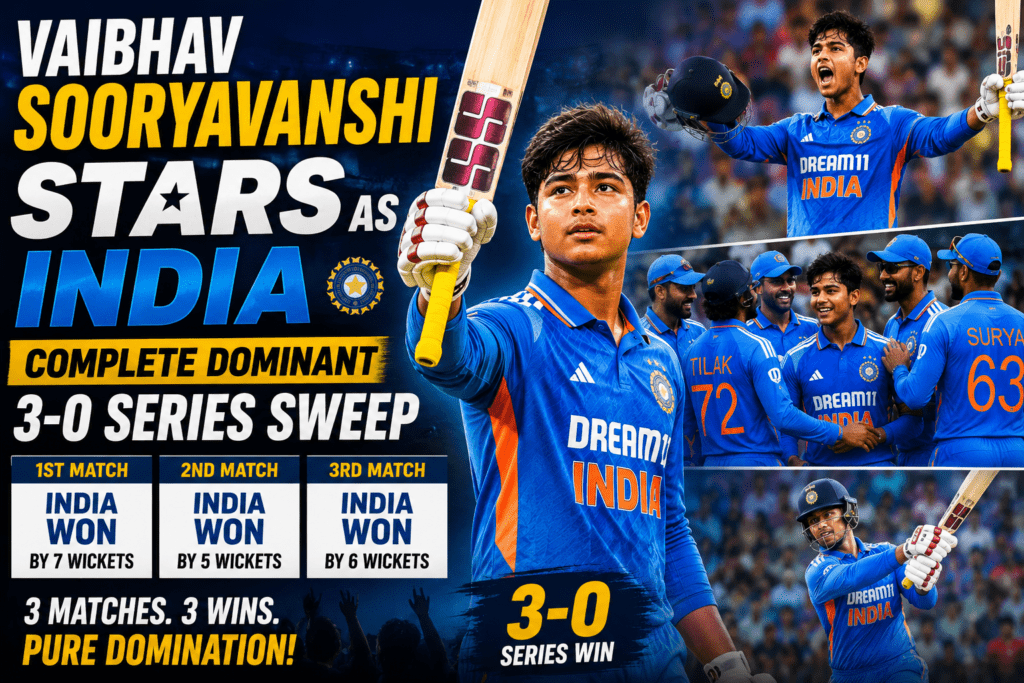
In the soft evening light of the Harare Sports Club, a 15-year-old from Bihar reminded the cricket world why the future of Indian batting looks brighter than ever. Vaibhav Sooryavanshi’s composed yet explosive 81 off 49 balls laid the foundation for India’s 192 for 5, and the bowlers, led by Mayank Yadav’s sharp 3 for 29, restricted Zimbabwe to 157 for 7. The 35-run victory completed a dominant 3-0 T20I series sweep and delivered captain Shreyas Iyer his first series win in charge after a difficult start to his leadership tenure.
The result was more than just another whitewash against a weaker opponent. It marked a complete turnaround for a side that had arrived in Zimbabwe reeling from successive T20I series defeats in Ireland (0-2) and England (0-4). Under Iyer, India had lost six consecutive matches on the road. In Harare, they rediscovered their swagger, their intent, and, most importantly, a young batter capable of carrying the batting order on his young shoulders.
A Measured Masterclass on a Sluggish Surface
Asked to bat first on a surface that offered less pace and carry than the previous games, India needed a different approach. Sooryavanshi, who had announced himself with a blistering 50 off just 19 balls in the series opener, adapted brilliantly. The early overs were not a free-for-all. He took time to settle, scoring only 11 runs from his first 10 deliveries and 26 from his first 20. On a pitch that demanded respect, the teenager showed a maturity far beyond his years.
The early loss of Abhishek Sharma for 2, once again dismissed by Blessing Muzarabani, could have unsettled a less composed batter. Instead, Sooryavanshi found an ideal partner in Ishan Kishan. The pair added 75 runs for the second wicket, mixing calculated aggression with smart strike rotation. Kishan contributed a fluent 29 before falling to Sikandar Raza shortly after the drinks break, but by then India had a solid platform.
Sooryavanshi reached his second T20I half-century off 31 balls. What followed was a display of power and innovation that has become his signature. He punched a well-directed yorker from Brad Evans straight down the ground for four. He launched Zimbabwe captain Sikandar Raza for a towering 102-metre six. He unfurled a reverse sweep against Wessly Madhevere for another boundary. Eight fours and four sixes later, he had taken India to a position of strength.
A 50-run partnership with captain Shreyas Iyer (27 off 18) further consolidated the innings. Sooryavanshi looked set for a maiden international century when Evans produced a stunning diving catch at long-off off Madhevere’s bowling to dismiss him for 81. The knock ended in the 15th over, but the damage had been done. Rinku Singh’s brisk 25 not out off 14 balls provided the finishing flourish as India closed on 192 for 5. Brad Evans was Zimbabwe’s most successful bowler with 2 for 41.
At just 15 years and a few months old, Sooryavanshi had become the first batter from a full-member nation to score two international fifty-plus scores before turning 16. He finished the series with 151 runs at an average of 50.33 and a strike rate of 196.10. The numbers only partially tell the story. What stood out was his ability to adapt. The same player who had torn apart bowling attacks with pure power in the IPL and in the series opener now showed he could construct an innings when conditions demanded it.
Bowlers Finish the Job
Defending 193 on a surface that was beginning to slow further, India’s bowlers needed to be disciplined. Mayank Yadav set the tone immediately. He dismissed Brian Bennett with the very first ball of the innings, a sharp delivery that the opener could only edge. The early breakthrough set the tone for the chase.
Zimbabwe never truly recovered. Regular wickets prevented any meaningful partnerships from developing. Yadav finished with excellent figures of 3 for 29, while Yash Thakur claimed 2 for 45. The pacers used the conditions intelligently, mixing pace, length, and variations to keep the batters guessing. Only Ryan Burl offered sustained resistance, remaining unbeaten on 54 off 43 balls. Wesley Madhevere made 28, but the rest of the batting order could not provide the acceleration required.
India’s fielding was sharp throughout. Sooryavanshi himself contributed with a sharp catch at slip off Yadav’s bowling early in the innings. The collective effort ensured that Zimbabwe’s chase never gathered serious momentum. They finished on 157 for 7, falling short by 35 runs.
The Broader Context of a Young Phenomenon
Sooryavanshi’s rise has been nothing short of meteoric. In the 2026 Indian Premier League, he finished as the leading run-scorer with 776 runs in 16 matches for Rajasthan Royals at a staggering strike rate of 237.30. That performance earned him a senior India call-up. He made his T20I debut against England as India’s youngest international cricketer at 15 years and 99 days. The early returns in England were modest—scores of 14, 13 and 15—before he was dropped for the final match of that series. Many young players would have struggled to recover from such a setback so early in their careers. Sooryavanshi responded with two match-winning half-centuries in Zimbabwe.
His series haul of 151 runs, the Player of the Match award in the final game, and the Player of the Series honour completed a dream tour. After the match he spoke with quiet confidence: “Yes, it’s truly a dream come true moment. Getting my first Man of the Match and Man of the Series awards, I’m very happy. In all three matches, I tried to give the team a good start. If I got a good start, then I wanted to make the innings bigger. That was my only approach.”
The maturity in that statement mirrors the maturity in his batting. At an age when most players are still navigating age-group cricket, Sooryavanshi is already shaping senior international matches. His ability to clear the boundary with ease, combined with an improving game awareness, makes him a unique talent. The 102-metre six against Raza was not just a highlight-reel moment; it was a statement of intent and power that few 15-year-olds possess.
Iyer’s First Series Win and India’s Recovery
For Shreyas Iyer, the series carried extra significance. Appointed captain after a transitional period for the T20 side, he had endured a difficult start. The losses in Ireland and England raised questions about the team’s direction and the balance of the side. In Zimbabwe, Iyer found answers. He won the toss in the final match and chose to bat, a decision that paid off handsomely. His own contribution of 27 off 18 provided useful support in the middle order, and his calm leadership on the field helped the bowlers execute their plans.
The series also offered positive signs for several other players. Ishan Kishan looked more assured at the top. Rinku Singh continued to show his finishing ability. The pace attack, particularly Mayank Yadav, looked sharp and hungry. The collective performance suggested that the setbacks in Europe had not dented the group’s confidence permanently.
India’s return to the top of the ICC T20I rankings, knocking England off the summit in the process, added a symbolic touch to the victory. Rankings fluctuate, but the manner of the whitewash—clinical, professional, and built around a young star—sent a clear message about the depth of talent available to the national side.
Looking Ahead
The Zimbabwe series will be remembered as the moment Vaibhav Sooryavanshi truly announced himself on the international stage. Two half-centuries, a series award, and a leading role in a 3-0 sweep represent an extraordinary achievement for a player of his age. More importantly, the way he constructed his 81—patient early, explosive later, and innovative throughout—suggested a batter with the tools to succeed across conditions and against stronger opposition.
Challenges will come. Opposition teams will study him more carefully. Surfaces will vary. The pressures of consistent international cricket will test even the most gifted young players. Yet the early evidence is compelling. Sooryavanshi possesses rare power, improving game awareness, and the temperament to adapt. Those are the ingredients of a long and successful career.
For Indian cricket, the series offered reassurance after a difficult period. The team rediscovered its winning ways under a new captain. The bowling unit showed discipline. The batting order found a reliable and destructive presence at the top. And above all, a teenage prodigy lit up Harare with performances that will be talked about for years.
As the players packed up after the final match, the scoreboard told a simple story: India 192 for 5, Zimbabwe 157 for 7. Behind those numbers lay a more compelling narrative—one of recovery, of leadership finding its feet, and of a 15-year-old who refused to be overawed by the occasion. Vaibhav Sooryavanshi was the star. India completed the sweep. And cricket, once again, found a new name to watch with anticipation and excitement.
The road ahead remains long and demanding. Stronger teams, tougher pitches, and higher expectations await. But on a July evening in Harare, a young batter from Bihar showed that the future of Indian cricket is already here, and it is in very safe hands..
==