
Artificial intelligence (AI) has emerged as one of the most transformative forces in manufacturing and broader industry. What began as isolated experiments in predictive maintenance and computer vision has evolved into a foundational technology reshaping production systems, supply chains, product design, quality control, and workforce dynamics worldwide. As part of the ongoing Industry 4.0 and emerging Industry 5.0 paradigms, AI enables factories to become adaptive, self-optimising, and increasingly autonomous. From predictive analytics that prevent costly downtime to generative design tools that accelerate innovation and computer vision systems that achieve near-perfect defect detection, AI is delivering measurable gains in productivity, quality, sustainability, and resilience.
This article examines the core applications of AI in manufacturing, quantifies its benefits and challenges, and surveys real-world deployments across major industrial nations—including China, the United States, Germany, Japan, South Korea, India, and others. Drawing on recent data from McKinsey, Deloitte, World Economic Forum Lighthouse factories, and national industry reports (as of 2025–2026), it provides a comprehensive overview of how AI is being applied globally and what the path forward looks like.
1. The Foundations: AI Within Industry 4.0 and Beyond
Industry 4.0, coined in Germany around 2011, describes the integration of cyber-physical systems, the Internet of Things (IoT), cloud computing, big data, and AI into manufacturing. AI serves as the “cognitive layer” that turns vast streams of sensor and operational data into actionable intelligence. Key enabling technologies include:
- Machine learning and deep learning for pattern recognition and prediction.
- Computer vision for inspection and guidance of robots.
- Digital twins—virtual replicas of physical assets or entire factories that allow simulation and optimisation.
- Generative AI and large language models for design, documentation, and operator assistance.
- Edge AI for real-time decision-making on the factory floor without constant cloud connectivity.
- Agentic AI and physical AI (humanoid and collaborative robots) that can plan, act, and adapt autonomously.
By 2025–2026, the global AI-in-manufacturing market was estimated in the range of $7–8 billion, with projections reaching $34–36 billion by 2030 at compound annual growth rates exceeding 38–42 per cent. Asia-Pacific leads in scale (particularly robot installations and certain market shares), while North America and Europe show strong growth in advanced applications and industrial AI platforms.
Manufacturers that successfully scale AI beyond pilots report significant returns: reduced downtime of 30–50 per cent or more, defect rate reductions of 40–90 per cent in specific use cases, productivity gains of 15–70 per cent in optimised lines, and energy savings of 10–40 per cent. World Economic Forum “Lighthouse” factories—sites recognised for advanced digital and AI deployment—consistently demonstrate these outcomes at scale.
2. Core Applications of AI in Manufacturing
AI is applied across the entire manufacturing value chain.
Predictive and Prescriptive Maintenance
Sensors continuously monitor vibration, temperature, pressure, and acoustic signals. Machine learning models detect anomalies and predict the remaining useful life of equipment, allowing maintenance to be scheduled before failures occur. Siemens’ Senseye platform, for example, has reduced downtime by up to 50–85 per cent and maintenance costs by around 40 per cent in various deployments. Similar systems at automotive and process industry plants convert reactive “firefighting” into planned interventions, extending asset life and improving overall equipment effectiveness (OEE).
Quality Control and Computer Vision
High-resolution cameras combined with deep learning models inspect products at speeds and accuracies far beyond human capability. Defect detection rates have improved dramatically—Toyota has driven miss rates toward zero in visual inspection, while other firms report 49 per cent reductions in defect rates within months of deployment. In electronics and semiconductor manufacturing, AI identifies microscopic flaws that would otherwise escape detection. Federated learning approaches (used by companies such as Huawei) allow models to improve across sites without sharing sensitive raw data.
Process Optimisation and Autonomous Control
AI models optimise parameters in real time—furnace temperatures, chemical dosing, machining speeds, or assembly sequences. In China’s CITIC Pacific Special Steel, AI prediction of blast furnace behaviour increased throughput by 15 per cent while cutting energy use by 11 per cent. Digital twins enable “what-if” simulations so operators or autonomous systems can test interventions virtually before applying them on the physical line. Some facilities are progressing toward “self-healing” operations in which AI detects deviations and corrects them with minimal human intervention.
Supply Chain and Production Planning
AI forecasts demand more accurately, optimises inventory, and dynamically reschedules production in response to disruptions. Procter & Gamble’s Rakona plant in the Czech Republic used advanced analytics to cut inventory 43 per cent and boost productivity 160 per cent over three years. Samsung employs AI to scan global news and data for supply-chain risks, reducing strategy formulation time from more than a day to roughly two hours. Agentic AI is beginning to monitor multi-tier suppliers and autonomously propose mitigation actions for geopolitical, weather, or tariff risks.
Generative Design and Product Development
Engineers use generative AI to explore thousands of design alternatives constrained by weight, strength, cost, and manufacturability goals. Simulation times that once took days can now be accelerated dramatically—BMW and Siemens reported 30-times speedups in aerodynamic simulations using advanced GPU-accelerated tools. This shortens time-to-market and improves product performance.
Robotics, Collaborative Robots (Cobots), and Humanoids
AI equips robots with perception, planning, and adaptation capabilities. Collaborative robots work safely alongside humans; more advanced systems handle unstructured environments. Tesla has deployed Optimus humanoid prototypes in its factories for logistics and assembly tasks. Foxconn has achieved high levels of automation (over 90 per cent unmanned operation on some lines) through AI-driven robotics and digital twins. BMW has tested Figure humanoid robots and is rolling out NVIDIA Omniverse-based digital twins across its global network.
Workforce Augmentation and Knowledge Capture
AI copilots interface with standard operating procedures, reducing mean time to repair and accelerating technician onboarding (examples include nearly 40 per cent reductions reported in Indian pharmaceutical manufacturing). Generative AI digitises the tacit knowledge of experienced workers, helping address skilled-labour shortages.
Sustainability and Energy Management
AI optimises energy consumption, reduces scrap, and supports circular-economy goals. Coca-Cola’s Singapore plant cut Scope 2 emissions 34 per cent while raising throughput 28 per cent and labour productivity 70 per cent through machine-learning forecasting, robotics, and advanced scheduling. Similar gains appear across Lighthouse sites worldwide.
3. Global Landscape: Adoption and National Approaches
AI adoption in manufacturing is uneven but accelerating. Large firms lead; small and medium-sized enterprises (SMEs) often lag due to cost, data readiness, and skills gaps. Below is a survey of major countries and regions.
China: Scale, Speed, and State-Driven Industrial Intelligence
China dominates industrial robot installations (approximately 295,000 units in 2024, over half the global total) and is aggressively integrating AI. Government programs such as the Industrial Brain initiative create unified data platforms and encourage AI applications across provinces. Companies like CATL, Foxconn Industrial Internet, and steel producers deploy dozens of AI use cases per site. Results include major productivity jumps (e.g., 190 percent labor productivity improvement and 45 per cent cost reduction at a Foxconn Vietnam site that supports Chinese supply-chain resilience) and energy savings. China’s strength lies in rapid scaling from pilot to enterprise-wide deployment, supported by domestic technology ecosystems and large domestic markets. Challenges include data quality consistency and geopolitical restrictions on advanced chips.
United States: Innovation Leadership and Private Investment
The U.S. leads in private AI investment (hundreds of billions of dollars cumulatively) and advanced applications. Tesla, GE, Lockheed Martin, Amazon, and Intel deploy AI extensively—Tesla for autonomous factory robots and process optimisation, GE for predictive maintenance and aerospace applications, Amazon for robotic picking systems with force feedback and vision. U.S. manufacturers show relatively high AI penetration in production processes compared with many peers. Digital twins, agentic AI for supply-chain resilience, and physical AI (humanoids and mobile robots) are priority areas. Federal and private initiatives continue to expand data-centre and AI infrastructure capacity. Adoption is strong among large firms but more variable among smaller manufacturers.
Germany: Industrial AI, Digital Twins, and the Mittelstand Challenge
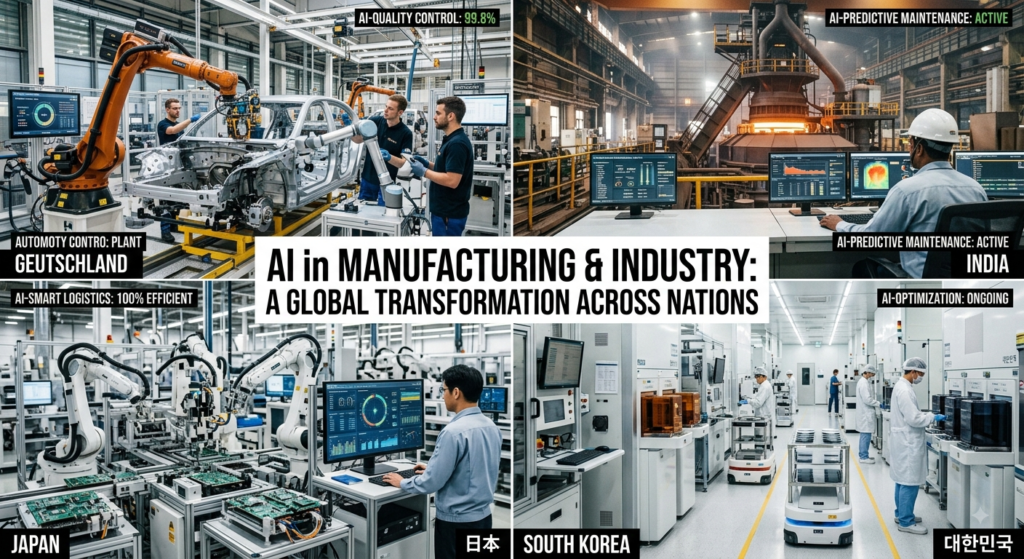
Germany, birthplace of Industry 4.0, emphasises high-value, precision manufacturing. Siemens is a global leader—its Amberg and Erlangen electronics factories operate with extremely low error rates (under 0.001 per cent in some metrics), extensive digital twins, and over 100 AI algorithms. Predictive maintenance platforms and industrial copilots are widely offered to customers. BMW uses AI for quality control, factory planning (neuro-symbolic approaches combining AI with expert rules), and Omniverse digital twins. Bosch invests heavily in AI for quality. Germany launched an Industrial AI Cloud powered by thousands of advanced GPUs to serve European manufacturers. The government projects that widespread industrial AI adoption could add at least one percentage point to annual real GDP growth. Challenges remain in scaling across the Mittelstand (SME sector) and competing with the speed of U.S. and Chinese investment.
Japan: Precision, Robotics Heritage, and Knowledge Transfer
Japan combines a world-leading robotics stock with careful AI integration. Toyota has implemented AI image inspection to drive miss rates toward zero and developed internal platforms so factory engineers can build and maintain models. Bridgestone reported productivity doubling through AI production planning. Hitachi uses generative AI to capture veteran technicians’ knowledge, raising fault-diagnosis accuracy to around 90 per cent. Kawasaki and others apply AI to maintenance and inspection of large machinery. Japan focuses on human-AI collaboration and quality excellence rather than pure labour replacement, reflecting demographic pressures from an ageing workforce.
South Korea: Electronics, Semiconductors, and Supply-Chain Intelligence
Samsung and other Korean firms apply AI across semiconductor, display, and electronics manufacturing for quality inspection, process control, and supply-chain risk detection. High robot density and advanced 5G/private network infrastructure support real-time AI. South Korea shows rapid growth in AI adoption metrics and invests heavily in smart factories. The country is also advancing AI-enabled logistics and production scheduling.
India: Emerging Power with Leapfrog Potential
India’s AI-in-manufacturing market is projected to grow rapidly (from roughly $1.2 billion to $8 billion by 2030 in some estimates). Production Linked Incentive schemes and “China+1” diversification attract investment. Lighthouse examples include Unilever and pharmaceutical manufacturers deploying AI copilots and vision systems. Challenges include infrastructure gaps, skills shortages, and legacy systems, yet AI tools offer a path for competitiveness without requiring every factory to become fully automated from the start. MSME-focused programs aim to raise digital maturity.
Other Notable Deployments
- Singapore and Southeast Asia: Coca-Cola Singapore achieved substantial throughput, productivity, and emissions improvements. Foxconn Vietnam reported dramatic productivity and cost gains.
- Sweden, Türkiye, Czech Republic, Mexico, Vietnam, Switzerland: Multiple WEF Lighthouse factories demonstrate AI and 4IR technologies delivering double-digit productivity and quality gains, often with large-scale workforce upskilling.
- Brazil and Latin America: Programs such as Brasil Mais Produtivo support SME digital transformation; digital-twin and process-control AI deployments (e.g., at consumer-goods plants) unlock capacity without physical expansion.
4. Quantified Benefits and Economic Impact
Across successful deployments, common outcomes include:
- Downtime reductions of 30–85 per cent.
- Defect-rate improvements of 25–97 per cent in targeted processes.
- Productivity and throughput gains of 15–190 per cent (site- or line-specific).
- Energy and emissions reductions of 10–42 per cent.
- Inventory reductions of 40 per cent or more.
- Faster time-to-market and shorter onboarding times.
At the macroeconomic level, AI adoption is expected to contribute meaningfully to industrial productivity growth. Germany’s estimates of GDP impact illustrate the potential; similar analyses in other countries point to competitive advantages for early and effective adopters. The market itself is expanding rapidly, attracting investment in industrial AI platforms, edge hardware, and specialised software.
5. Challenges and Barriers to Widespread Adoption
Despite proven value, many manufacturers remain stuck in pilot mode. Key obstacles include:
Data Quality, Quantity, and Integration
Industrial data is often noisy, siloed, or incomplete. Legacy equipment may lack sensors or use proprietary protocols. Building the data foundation required for reliable AI is frequently the largest early investment.
Skills and Organisational Change
Shortage of data scientists, AI engineers, and domain experts who understand both manufacturing and algorithms is widespread. Workforce resistance or fear of job displacement must be managed through transparent communication, upskilling, and redesign of roles toward supervision, exception handling, and continuous improvement.
Cost and ROI Uncertainty
Upfront costs for sensors, connectivity, computing infrastructure, and integration can be high, especially for SMEs. While many use cases show strong returns, scaling requires sustained investment and change management.
Trust, Explainability, and Safety
In safety-critical or regulated environments, black-box models are problematic. Demand is rising for explainable AI, physics-informed models, and robust validation. Cybersecurity risks increase when AI systems connect to operational technology networks.
Interoperability and Standards
Heterogeneous systems from different vendors complicate seamless AI deployment. Progress on standards helps but remains incomplete.
Ethical and Societal Considerations
Job displacement concerns, algorithmic bias in quality or hiring tools, energy consumption of large models, and concentration of AI capabilities among a few technology providers all require attention. Responsible AI frameworks and human-in-the-loop designs are becoming standard expectations.
Surveys consistently show that while a large majority of manufacturers view AI as essential, only a minority have scaled successful use cases enterprise-wide. Success factors include strong leadership commitment, clear prioritisation of high-value use cases, investment in data platforms, cross-functional teams, and iterative scaling from lighthouse sites.
6. Future Outlook: Toward Agentic, Physical, and Sustainable AI
Looking ahead to 2030 and beyond, several trends will define the next phase:
- Agentic AI will move beyond recommendations to autonomous planning and execution of complex workflows (supply-chain adjustments, production reconfiguration, maintenance orchestration), with humans remaining “in the loop” for oversight.
- Physical AI and humanoid robots will expand from logistics and simple assembly into more unstructured tasks, though robust, cost-effective series maturity will take time.
- Foundation models and industrial large language models trained on manufacturing data will lower barriers to entry and enable more natural interaction between operators and systems.
- Digital twins at scale and the industrial metaverse will allow virtual commissioning of entire factories and continuous optimisation.
- Sustainability integration will become non-negotiable; AI will be judged not only on productivity but on carbon, water, and material efficiency.
- Democratisation for SMEs through cloud platforms, low-code tools, and shared data ecosystems will broaden participation.
- Geopolitical and supply-chain considerations will drive regionalisation of AI infrastructure and talent development (e.g., European industrial AI clouds, U.S. and Asian semiconductor and robotics capacity).
National strategies will continue to diverge: China’s emphasis on scale and industrial platforms, the U.S. on innovation and private capital, Europe’s focus on trustworthy and sovereign industrial AI, and Asia’s blend of robotics leadership with rapid digitalisation.
7. Conclusion: An Imperative for Competitiveness and Resilience
AI is no longer optional for manufacturers seeking to remain competitive. The technology delivers concrete improvements in efficiency, quality, flexibility, and sustainability when implemented thoughtfully. Global leaders—from Siemens and BMW in Germany, Tesla and GE in the United States, Toyota and Hitachi in Japan, Samsung in South Korea, Foxconn and CATL in China and its network, to emerging Lighthouse sites in India, Singapore, Vietnam, and beyond—demonstrate that the returns are real and scalable.
The journey requires more than technology purchases. It demands data readiness, skilled people, organisational agility, ethical guardrails, and a long-term commitment to continuous learning. Countries and companies that invest in these foundations will shape the next era of industrial production. Those that delay risk falling behind in productivity, resilience, and the ability to attract talent and capital.
As AI systems grow more capable—moving from narrow tools to collaborative partners and, eventually, more autonomous agents—the factories of the future will be characterised by higher human potential rather than its replacement. Workers will be augmented by intelligent systems that handle repetitive analysis and routine decisions, freeing people for creativity, complex problem-solving, and oversight of increasingly sophisticated production ecosystems. In this sense, AI in manufacturing is not merely a technological upgrade; it is a fundamental redefinition of how industry creates value in the 21st century.
The evidence from dozens of countries and hundreds of factories is clear: the transformation is already underway. The question for manufacturers and policymakers is no longer whether to adopt AI, but how quickly and how wisely they can scale it for lasting competitive and societal benefit.