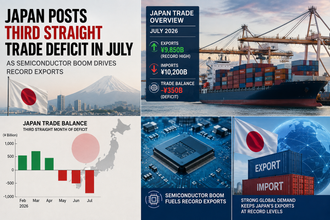


TOKYO — Japan posted its third straight monthly trade deficit in July, preliminary data from the Ministry of Finance showed on Thursday, August 20, 2026. The shortfall widened to 634.5 billion yen (about $4 billion), the largest monthly gap since January, as imports outpaced export growth. Exports still rose 23.2 per cent year-on-year to a record 11.5118 trillion yen, beating market expectations for the fifth straight month and marking the strongest increase since October 2022.
That dual narrative of energy-driven import pressure and AI-fueled export resilience underscores the structural challenges and opportunities facing the world’s third-largest economy. While soaring crude oil costs—exacerbated by Middle East conflict disruptions and a persistently weak yen—pushed the import bill to an all-time high, strong global demand for semiconductors, semiconductor manufacturing equipment, and automobiles provided a critical counterweight. Economists noted that the deficit, though wider than June’s revised 409.9 billion yen shortfall, came in narrower than the consensus forecast of around 680 billion yen, offering a modestly positive signal amid elevated geopolitical and inflationary risks.
Record Exports Driven by Chips and Cars
Exports rose for an 11th consecutive month, reaching their highest level since comparable statistics began in 1979. The 23.2 per cent increase accelerated from June’s 19.3 per cent gain and comfortably exceeded the median economist forecast of 19.9 per cent. In volume terms, shipments expanded a more modest 5.2 per cent, indicating that much of the value surge stemmed from higher prices and the yen’s depreciation, which made Japanese goods more competitive overseas while inflating yen-denominated revenues.
The standout performer was semiconductor-related equipment, where shipments surged 49.1 per cent by value. This explosive growth reflected sustained global investment in artificial intelligence infrastructure, data centres, and advanced logic and memory chips. Industry observers pointed to continued strong demand from major markets, including China, Taiwan, South Korea, and the United States, for Japanese precision tools used in etching, deposition, inspection, and other critical fabrication processes. Japan’s semiconductor equipment makers have long held a significant global market share, and the AI boom has amplified their contribution to the trade balance.
Passenger cars and related automotive products also contributed solidly, with exports rising around 21 per cent. Strong demand from the United States and other markets for Japanese vehicles, including hybrids and certain electric models, helped offset broader softness in some traditional manufacturing categories. Electronic components more broadly joined the upswing, reinforcing Japan’s position as a critical supplier in global technology supply chains.
By destination, the geographic distribution of growth was broad-based. Shipments to China, Japan’s largest trading partner, increased 25.8 per cent. Exports to the United States climbed 22 per cent, while those to the European Union rose 19.1 per cent. Broader shipments to Asia expanded approximately 24.5 per cent. These figures illustrate how Japan has navigated complex geopolitical currents, including U.S.-China technology tensions and varying regional growth rates, while capitalising on the yen’s weakness—trading near multi-decade lows against the dollar at the time of the data release.
The export resilience arrives against a backdrop of subdued domestic demand in Japan. Recent GDP data for the April-June quarter showed the economy expanding for a third consecutive period, with overseas shipments helping to offset soft private consumption and business investment. The continued strength in July trade figures bolsters the case that external demand remains a primary engine of growth.
Imports Surge to Record on Energy Costs and Diversification
Imports jumped 27.8 per cent year-on-year to a record 12.1463 trillion yen, accelerating from June’s 25.4 per cent rise and exceeding forecasts of roughly 26.5 per cent. This marked the strongest import growth since November 2022 and the highest absolute level on record. The surge was driven predominantly by energy, particularly crude oil, amid ongoing disruptions linked to conflict in the Middle East.
Crude oil import values soared, with some reports citing an 87.8 per cent increase in value terms even as volumes rose a more moderate 5.5 per cent—the first volume increase in four months. The unit price in yen terms climbed sharply, reflecting both higher international oil prices and the weak Japanese currency. Japan, which relies on imports for nearly all of its oil, has been forced to diversify supply sources after disruptions to shipping through the Strait of Hormuz. Oil imports from the Middle East fell 32.8 per cent by volume, while purchases from alternative suppliers, including a dramatic increase from the United States, rose substantially. One data point indicated U.S. crude volumes surging more than ninefold in certain measures, reaching levels not seen in decades of comparable statistics.
Beyond energy, imports of semiconductors and electronic components from Asia, non-ferrous metals, and other industrial materials also contributed to the higher bill. Domestic demand received support from government stimulus measures introduced in late 2025, which helped sustain industrial activity and inventory rebuilding even as household spending remained cautious.
The combination of elevated energy costs and yen depreciation has intensified inflationary pressures. Import prices feed into producer and consumer costs, complicating the Bank of Japan’s efforts to normalise monetary policy after years of ultra-loose settings. At the same time, the higher import bill has kept the trade balance in deficit territory for three straight months—the longest such streak in recent periods—and the largest monthly shortfall since the start of the year.
Context: Geopolitics, Currency, and Policy
The July data cannot be understood in isolation from broader geopolitical and macroeconomic forces. The Middle East conflict, involving tensions that effectively constrained passage through the Strait of Hormuz earlier in the year, triggered a sharp rise in crude oil, petrochemical, and commodity prices. For an energy-import-dependent nation like Japan, this translated directly into a higher trade deficit and elevated input costs for manufacturers and households alike. Diversification efforts—shifting toward U.S., Australian, and other non-Middle Eastern suppliers—have mitigated volume risks but at the expense of higher logistics and purchase costs.
Simultaneously, the yen’s prolonged weakness has acted as a double-edged sword. It has boosted the competitiveness of Japanese exports and inflated the yen value of overseas sales, contributing to the record export figures. Yet it has also made imports more expensive, amplifying the energy price shock and contributing to cost-of-living pressures that have constrained domestic consumption. At the time of the data release, the yen traded around 158 per dollar, remaining near levels that have periodically prompted market speculation about official intervention.
Policymakers face a delicate balancing act. The Bank of Japan has been gradually normalising policy, having raised rates earlier in the cycle. Markets have increasingly priced in the possibility of a further increase as soon as the September meeting, supported in part by resilient exports and signs that underlying inflation risks remain tilted to the upside. Strong export performance provides the central bank with greater room to manoeuvre, as external demand helps support overall economic activity even if higher rates dampen domestic investment or consumption. At the same time, persistent trade deficits and energy vulnerability underscore the need for longer-term structural reforms, including energy security diversification, greater domestic production capacity in strategic sectors, and efforts to revitalise household demand.
Economist Koya Miyamae of SMBC Nikko Securities noted that rising crude oil prices are likely to keep Japan’s trade balance in the red and projected that the full-year 2026 trade deficit could exceed 5 trillion yen. Other analysts highlighted that while value growth looks impressive, the more modest volume increases suggest underlying demand is solid but not explosive, and that continued reliance on price and currency effects carries risks if the yen strengthens or global demand softens.
Historical Perspective and Structural Trends
Japan’s trade statistics have long reflected its dual identity as a manufacturing powerhouse and a resource-poor island nation. The country has run periodic deficits during periods of high energy prices or strong domestic growth, while enjoying surpluses when export industries dominate. The current stretch of deficits—extending the pattern seen in the first half of 2026, when the half-year shortfall narrowed but remained in the red for a tenth consecutive half-year period—highlights the lingering impact of energy market volatility.
Both exports and imports hitting record highs in value terms is notable. Comparable data dating to 1979 show that July 2026 set new benchmarks, driven by the combination of higher global prices, currency effects, and genuine volume growth in high-value categories such as semiconductor equipment. First-half 2026 data had already shown exports reaching a record for that period, fueled by vehicles and semiconductors, while Middle East oil imports declined amid earlier disruptions.
The semiconductor story is particularly significant. Japan’s equipment makers have benefited from the multi-year AI investment cycle, with industry forecasts earlier in 2026 pointing to strong double-digit growth in equipment sales. The 49.1 per cent jump in July equipment shipments is consistent with that broader trend and positions Japanese firms as essential enablers of global technology advancement. Automotive exports, a traditional strength, continue to provide ballast even as the industry navigates the transition to electrification and evolving trade rules in key markets.
Market and Economic Implications
Financial markets reacted constructively to the data. The Nikkei 225 rose following the release, supported by the better-than-expected export performance and evidence of continued industrial competitiveness. The yen edged slightly weaker, consistent with the narrative of resilient external demand and ongoing currency pressures.
For the broader economy, the figures reinforce the view that exports remain a vital support. With private consumption and capital spending showing uneven recovery, overseas demand has helped deliver positive GDP growth. Looking ahead, the sustainability of this dynamic will depend on several factors: the trajectory of the AI and technology investment cycle, the path of energy prices and Middle East stability, the yen’s exchange rate, and the success of domestic policy measures in stimulating household spending and investment.
Risks remain elevated. A further escalation or prolongation of Middle East tensions could keep energy costs high and logistics disrupted. A sharper-than-expected slowdown in major export markets, particularly China or the United States, would test the resilience of Japanese manufacturers. Conversely, continued AI-driven demand, successful energy diversification, and any stabilisation or modest strengthening of the yen could improve the trade balance over time while supporting corporate earnings.
Policymakers in Tokyo will continue to monitor these developments closely. Fiscal stimulus introduced previously has helped shore up demand, while the Bank of Japan’s gradual normalisation path aims to balance inflation control with growth support. The July trade data, with its mix of deficit and record exports, encapsulates the current Japanese economic moment: vulnerable to external energy and currency shocks, yet competitive and adaptive in high-value manufacturing sectors that the world continues to need.
In summary, Japan’s July trade figures paint a picture of an economy navigating headwinds with notable strengths. The third consecutive monthly deficit reflects the heavy toll of elevated energy import costs amid geopolitical disruption and a weak currency. At the same time, the fifth month of accelerating export gains, powered by semiconductors and automobiles and culminating in record shipment values, demonstrates the enduring vitality of Japan’s industrial base. How these forces evolve in the coming months will shape not only the trade balance but the broader trajectory of growth, inflation, and policy in 2026 and beyond.