
WASHINGTON — The United States on Monday launched an unprecedented campaign to isolate the Islamic Republic of Iran, escalating economic pressure in an ongoing nearly six-month conflict. Officials said the move expands secondary sanctions, targets key sectors of Iran’s economy, and warns trading partners of severe consequences for continued engagement.
Treasury Secretary Scott Bessent, speaking at a press conference in Washington on August 24, 2026, announced the start of “Operation Economic Outcast,” calling it an “economic D-Day” and an “economic onslaught” designed to sever every remaining financial lifeline sustaining the Iranian regime and the Islamic Revolutionary Guard Corps (IRGC). “Our objective is to sever every economic lifeline that sustains this tyrannical regime until Tehran stands alone,” Bessent declared. The measures come as the Trump administration seeks to break a military and diplomatic deadlock that has disrupted global energy flows, particularly through the Strait of Hormuz, and driven oil prices higher for much of the year.
The announcement included the imposition of sanctions on nearly 60 entities, individuals, and vessels across multiple jurisdictions accused of enabling Iran’s illicit nuclear and missile technology procurement, cyber operations, and oil-revenue generation networks. More significantly, the Treasury Department issued new sectoral determinations under existing executive authorities targeting five critical areas that Iran has allegedly exploited: digital assets, technology, gold, aviation, and shipping. These determinations broaden the scope of secondary sanctions, exposing foreign persons and entities operating in or supporting these sectors to potential U.S. penalties, including exclusion from the dollar-based financial system.
Bessent emphasised a “zero-leakage approach,” stating that Treasury has mapped every node, facilitator, and network Iran has used to smuggle oil and evade prior sanctions. Countries maintaining business ties with Iran have been given defined timelines to shut down identified activities. Failure to comply, he warned, would trigger unilateral U.S. action. “Any entity that facilitates money laundering on behalf of Iran will be removed from the U.S. dollar system. The clock is ticking,” Bessent said. He specifically noted that every branch of Iran’s Bank Melli must be shuttered and previewed a major sanctions announcement targeting a financial institution by the end of the week. However, he declined to name it or the specific countries under pressure.
The move stops short of immediately designating major Chinese financial institutions long suspected of facilitating Iranian oil trade, a deliberate choice Bessent justified by noting the need to avoid destabilising the global financial system while giving partners a “cure period.” “Why would I want to blow up the global financial system?” he asked. President Donald Trump has reportedly begun calling world leaders with specific requests to cease interactions with the Iranian regime, though officials refused to identify the counterparts.
Iran responded defiantly. Tehran vowed retaliation, with an economy minister declaring that “enemies should wait for attack.” Iranian officials said major trading partners, particularly China, would resist U.S. pressure. China, Iran’s largest oil buyer, stated that sanctions do not help and vowed to protect its own interests. Iranian Foreign Minister Abbas Araqchi previously dismissed threatened measures as evidence of American desperation following military setbacks, while other officials warned of potential halts to oil exports through the Strait of Hormuz and the Persian Gulf if economic pressure intensified.
The sanctions expansion occurs against the backdrop of a conflict that has already constrained shipping through the Strait of Hormuz, a chokepoint that previously handled roughly one-fifth of global oil supplies. A U.S. naval blockade and related military actions have sharply reduced Iranian seaborne oil exports, contributing to elevated energy prices and supply concerns worldwide. Analysts note that while Iran has long operated under extensive sanctions dating back decades, the combination of kinetic pressure, blockade, and now intensified secondary measures aims to close remaining evasion channels involving shadow fleets, third-country intermediaries, and alternative payment systems including cryptocurrencies.
Market Reactions: Oil Prices Slip Despite Heightened Risks
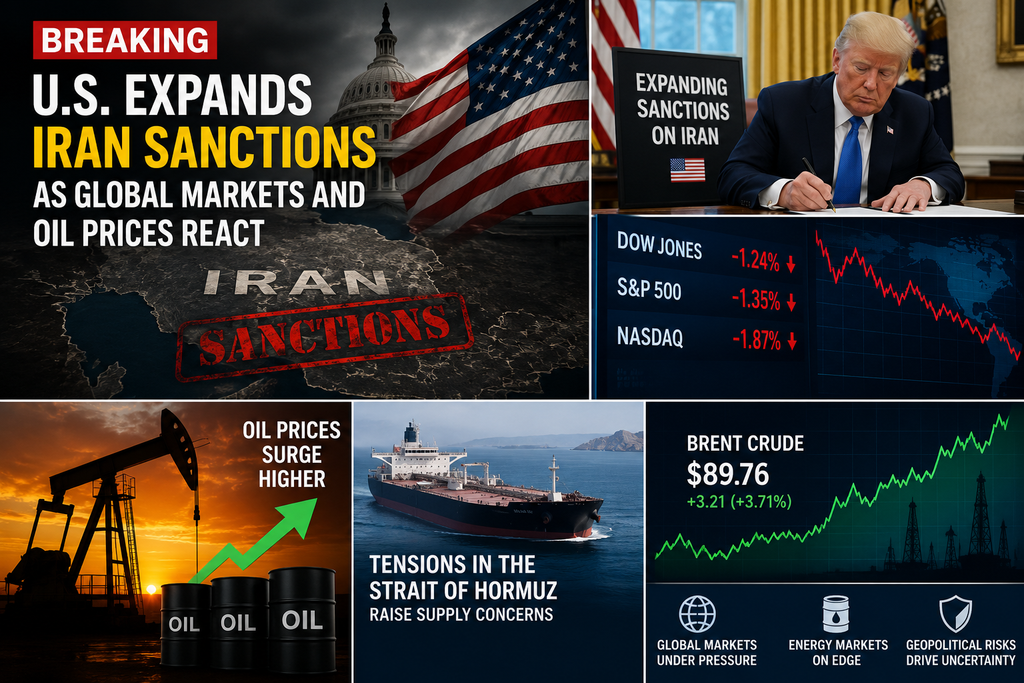
Global oil markets initially reacted with profit-taking rather than a sharp upward spike. On Monday, Brent crude futures settled down more than $2 a barrel, or about 2.35 per cent, to $92.17, while U.S. West Texas Intermediate (WTI) crude fell a similar percentage to $85.01. The declines followed two consecutive weeks of gains exceeding 5 per cent, driven by stalled peace talks and ongoing Hormuz disruptions. Investors appeared to view the sanctions announcement as largely priced in or marginal in immediate impact, given that the most severe secondary penalties were deferred and major Chinese banks were not yet targeted.
By Tuesday, prices stabilised and recovered modestly. Brent rose about 0.3 per cent to around $92.44, and WTI gained roughly 0.4 per cent to $85.38 in early trading, as markets assessed the longer-term implications. Commodity strategists at firms such as ING noted that traders treated the U.S. effort to nudge partners away from Iranian trade as incremental rather than market-moving in the short term. However, risks remain elevated. Morgan Stanley analysts have raised Brent forecasts, projecting a peak near $100 per barrel in the fourth quarter. The International Energy Agency indicated it is not currently discussing a second release from strategic reserves.
Broader equity markets showed mixed to weaker sentiment. U.S. stock futures declined ahead of the announcement, with technology-heavy indices under particular pressure amid concurrent concerns including Nvidia earnings and Federal Reserve remarks at the Jackson Hole symposium. Asian technology stocks also weighed on global sentiment. Energy-related equities and shipping firms faced heightened scrutiny given the sectoral focus on aviation and shipping.
The sanctions come as consumers already feel the pinch. U.S. average gasoline prices have risen significantly since the conflict began in late February, reaching levels around $4.09–$4.10 per gallon according to AAA tracking, up sharply from pre-war figures near $3. Diesel prices have climbed even more steeply in some periods, reflecting refining margins and supply constraints. Higher energy costs have fueled inflation concerns and contributed to bond market volatility earlier in the conflict.
Details of the New Measures and Enforcement Approach
Treasury’s Office of Foreign Assets Control (OFAC) described the five sectoral determinations as unprecedented in scope under Executive Order 13902, which targets certain Iranian economic sectors. By designating digital assets, technology, gold, aviation, and shipping, the U.S. expands its ability to impose sanctions on any foreign person operating in or providing services that support these areas when linked to Iran. This accelerates enforcement and increases secondary sanctions risk for banks, traders, insurers, shipping companies, technology firms, and commodity dealers worldwide.
The nearly 60 designations target networks of brokers, companies, and vessels operating across the UAE, Hong Kong, China, Singapore, Switzerland, Europe, and other regions involved in transporting Iranian oil and channelling revenue to the IRGC-Qods Force and other regime elements. Officials highlighted prior successes in freezing substantial Iran-linked cryptocurrency holdings and disrupting shadow fleet operations. Additional steps included suspending certain licenses authorising remittance payments to Iran.
Bessent stressed coordination with partners and a whole-of-government approach. The campaign builds on earlier actions, including a naval blockade of Iranian ports and previous rounds of designations against weapons-procurement networks and shipping insurers. The United Arab Emirates, long one of Iran’s largest trading partners, had already announced a suspension of all trade with Iran in the preceding week, a development U.S. officials cited as a positive signal they expect others to follow.
Critics and analysts question the ultimate effectiveness. Iran has demonstrated resilience and adaptability under decades of sanctions, frequently standing up new front companies, reflagging vessels, and routing trade through intermediaries. Bloomberg Economics analysts noted that a key test will be whether Washington follows through against large Chinese financial and energy institutions. With a potential Trump-Xi meeting scheduled for late September, aggressive moves against Chinese banks could complicate broader bilateral economic discussions, including rare earths and tariffs.
Geopolitical Context and the Ongoing Conflict
The sanctions announcement arrives as the U.S.-Iran war nears the six-month mark. What began with joint U.S.-Israeli strikes in late February has evolved into a protracted confrontation involving military operations, a naval blockade, and now intensified economic warfare. Control of the Strait of Hormuz remains contested, with Iran issuing repeated warnings to shipping and listing vessels it claims have violated its rules. Recent incidents, including projectile strikes on tankers near Oman, underscore persistent risks to commercial traffic.
Diplomatic efforts have stalled. Pakistan’s army chief visited Tehran for mediation talks around the time of the announcement, while Oman’s foreign minister was scheduled to travel to Iran. Iranian President Masoud Pezeshkian has called for diplomatic solutions, but hardline voices within the regime have rejected economic pressure and threatened further disruption of energy exports. U.S. Defence Secretary Pete Hegseth indicated that military options remain on the table even as the administration pivots toward economic coercion.
The conflict has already reshaped global energy dynamics. Reduced Iranian exports and Hormuz constraints have tightened supplies, supporting higher prices despite some alternative flows from Iraq, Qatar, and other producers. Saudi and other Gulf producers have navigated complex security environments. The U.S. Strategic Petroleum Reserve stands at multi-decade lows, limiting buffer capacity. Analysts warn that any Iranian decision to fully close or further restrict Hormuz with missiles or drones could drive prices substantially higher, potentially toward $120–$150 levels in extreme scenarios, though current flows have kept benchmarks closer to the low-to-mid $90s for Brent.
Historical Parallel and Sanctions Architecture
U.S. sanctions on Iran form one of the most comprehensive regimes in modern history, layered over decades since the 1979 Islamic Revolution. Primary sanctions largely prohibit U.S. persons from nearly all Iran-related transactions. Secondary sanctions extend pressure to foreign parties, threatening loss of access to the U.S. financial system—a powerful tool given the dollar’s dominance in global trade and oil settlements. Previous maximum-pressure campaigns under earlier administrations significantly reduced Iranian oil exports at times, though China and others continued discounted purchases.
The current “Operation Economic Outcast” seeks to close remaining gaps by expanding sectoral coverage and accelerating enforcement. Digital assets have emerged as a key evasion vector; prior freezes of hundreds of billions in Iran-linked crypto illustrate the focus. Gold trading, technology procurement for dual-use applications, aviation support, and maritime logistics form parallel channels. By issuing formal determinations, Treasury lowers the evidentiary bar for future designations and signals seriousness to intermediaries.
Enforcement will rely on a combination of public designations, private warnings to foreign governments and institutions, intelligence sharing, and potential use of authorities to cut entities off from correspondent banking relationships. Bessent’s reference to Bank Melli branches worldwide underscores the extraterritorial reach. Success will depend on compliance by key hubs in the UAE, Singapore, Hong Kong, Turkey, India, and especially China.
Broader Economic and Global Implications
Beyond oil, the sanctions carry implications for global trade, financial stability, and geopolitical alignments. Secondary sanctions risk creates compliance headaches for multinational banks, insurers, commodity traders, and technology firms. Increased due diligence costs and de-risking could further fragment trade networks. Countries heavily reliant on Iranian energy or commercial ties face difficult choices between U.S. market access and regional relationships.
Inflationary pressures from elevated energy costs already affect households and industries in importing nations. Higher diesel and jet fuel prices raise transportation and logistics expenses, feeding into food and goods prices. Central banks monitoring inflation may face complicated policy trade-offs if energy shocks persist. Emerging markets with limited fiscal buffers are particularly vulnerable.
China’s response will be pivotal. As the dominant buyer of discounted Iranian crude, Beijing has historically resisted full compliance with U.S. secondary sanctions. Official Chinese statements rejecting the utility of sanctions and affirming protection of national interests suggest limited immediate cooperation. However, the risk of targeted measures against Chinese entities—especially if a major bank is designated later this week—could test the resilience of bilateral economic ties. India, Turkey, and other buyers will also watch developments closely.
Shipping markets face dual pressures: physical risks in the Gulf and heightened sanctions compliance scrutiny. Insurance premiums for voyages near Hormuz have already risen. Aviation sanctions could affect any remaining commercial or support flights linked to Iranian networks. Technology restrictions may complicate dual-use exports. Gold markets could see shifts if Iranian-linked trading is further disrupted.
Analyst and Expert Perspectives
Market participants largely described Monday’s price action as profit-taking after a strong run rather than panic over immediate supply loss. “The market seems largely unfazed by Washington’s push for tighter economic pressure on Iran,” ING strategists observed, viewing the measures as incremental. SEB analyst Bjarne Schieldrop noted that prices around $93 rather than $120–150 suggest sufficient oil continues to flow through the broader Persian Gulf region. A genuine closing of Hormuz would represent a far more severe shock.
Geopolitical risk analysts highlight the dual-track U.S. strategy of military containment plus economic isolation. Success in forcing Iranian concessions remains uncertain given the regime’s historical willingness to endure economic hardship and its capacity for asymmetric responses, including proxy activity and maritime harassment. Domestic Iranian economic pain—already severe from prior sanctions, currency depreciation, and inflation—could intensify, potentially affecting regime stability, though past episodes have not produced decisive political change.
Energy economists point to structural tightness in global oil balances. Spare capacity among OPEC+ producers is limited, and demand recovery in key economies continues. Any sustained reduction in Iranian barrels, even if partially offset by other producers, supports a higher price floor. Longer-term, accelerated energy transition investments or strategic stockpile management could mitigate impacts, but short-term volatility is likely.
Looking Ahead
The coming days and weeks will test the credibility of the U.S. warnings. The promised sanctions on a major financial institution, the specific timelines given to individual countries, and any follow-through against Chinese or other high-profile entities will determine whether markets reassess the risk premium. Iranian retaliatory threats, potential further disruptions to Hormuz shipping, and diplomatic mediation efforts by regional players such as Pakistan and Oman will also shape the trajectory.
President Trump’s administration has characterised the economic campaign as the decisive phase of the conflict, aiming to isolate Tehran and compel terms favourable to the United States. Iranian leaders portray the measures as ineffective and provocative. Global markets, meanwhile, continue to balance supply fears against the reality of current flows and the deferred nature of the most severe secondary penalties.
As of Tuesday, August 25, 2026, oil prices hovered near recent levels, equities digested the news alongside other macroeconomic catalysts, and diplomatic channels remained active even as economic pressure intensified. The full impact of Operation Economic Outcast will unfold over time, contingent on enforcement rigour, partner compliance, and Iranian responses. What is clear is that the United States has signalled an uncompromising determination to close remaining economic avenues for the Iranian regime, raising the stakes for all parties involved in one of the most consequential geopolitical and energy confrontations of the decade.
The expansion of sanctions marks a significant chapter in the long history of U.S.-Iran economic confrontation, one that now intersects directly with an active military conflict and global energy security. Markets have so far reacted with caution rather than alarm, but the potential for further escalation—whether through stricter enforcement, Iranian countermoves, or broader geopolitical fallout—keeps risk premiums elevated and ensures that developments in this crisis will remain a central focus for investors, policymakers, and energy consumers worldwide in the months ahead.