
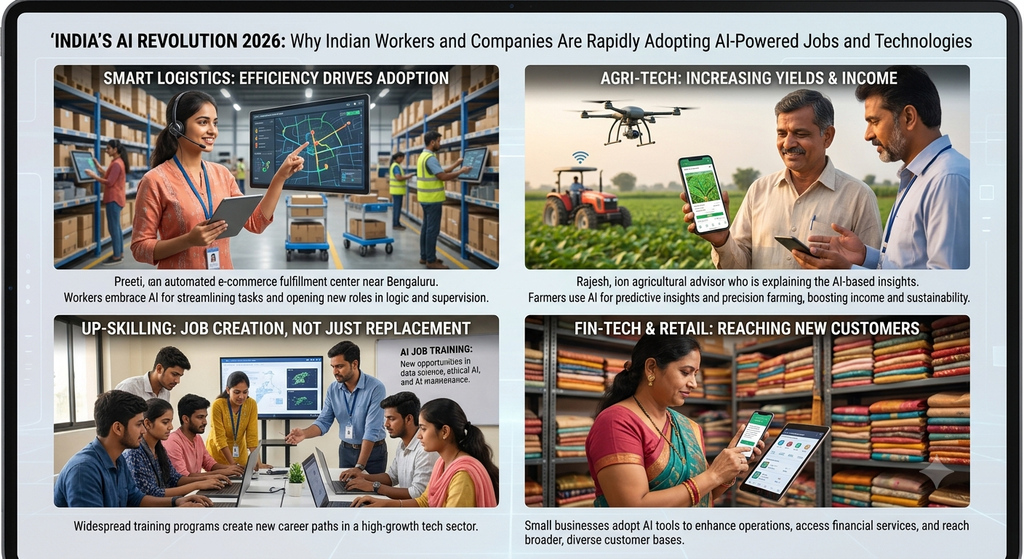
In the bustling tech corridors of Bengaluru, the expanding Global Capability Centres of Hyderabad, and emerging hubs in places like Vijayawada and Jaipur, a profound shift is underway. By September 2026, India has firmly established itself as one of the world’s largest and fastest-growing AI talent ecosystems. With approximately 9.2 lakh AI professionals—comprising about 2.57 lakh in core AI roles and the rest in AI-embedded positions—the country is not merely adopting artificial intelligence but accelerating toward an AI-powered economy at a pace that outstrips many global peers.
This is the story of AI jobs in India 2026: a surge driven by companies racing from pilots to production-scale deployment, workers aggressively upskilling, and a national recognition that the future of work hinges on mastering AI skills India needs most. Central to this transformation are AI agents—autonomous systems that handle complex workflows—and a broader redefinition of future jobs and artificial intelligence careers.
What explains India’s distinctive speed? A combination of demographic advantages, aggressive corporate investment, government initiatives under the IndiaAI Mission, high workplace adoption rates, and the sheer scale of its technology services industry has created conditions for rapid acceleration. Indian workers and companies are not waiting for disruption to arrive; they are actively reshaping roles around AI to capture productivity gains, global competitiveness, and new opportunities.
The Scale of the Shift: From Experimentation to Execution
Data from multiple 2026 reports paints a clear picture of momentum. Quess Corp’s India AI Workforce Analysis 2026 estimated India’s AI workforce at 9.2 lakh professionals, placing the country among the global leaders. Of these, core AI talent accounts for roughly 28 per cent. In the three months preceding the mid-2026 analysis, there were about 3.5 lakh active AI-related job postings. Demand has shifted decisively: employers now prioritise professionals who can deploy, govern, integrate, and scale AI within real business workflows rather than those focused solely on experimentation.
Projections for the full year underscore the intensity. AI hiring in India was expected to reach nearly 380,000 roles in 2026—a 32 per cent year-on-year increase from roughly 290,000 in 2025. Generative AI and LLM-related skills saw particularly sharp jumps, while specialised areas such as LangChain, RAG (Retrieval-Augmented Generation), MLOps, LLMOps, and AI governance rose in prominence as organisations moved into production.
AI engineering roles alone rose 51 per cent in the past year according to LinkedIn data shared in 2026, with India accounting for a substantial share of the global addition of AI-related jobs since 2023. NITI Aayog’s roadmap earlier projected demand for AI talent growing to over 1.25 million by around 2026–27 at a compound annual growth rate of about 25 per cent, with potential to unlock up to four million new “AI-first” jobs over five years.
Critically, more than 70 per cent of India’s AI workforce now sits outside traditional specialist roles. Nearly one-third of demand is emerging from business functions—operations, customer service, marketing, finance, governance, and workforce management. Customer operations alone could see 45–60 per cent of workflows augmented by AI. This horizontal spread explains why the transformation feels pervasive rather than confined to research labs or pure tech firms.
Global Capability Centres lead with a high share of core AI activity, IT services firms industrialise deployment at scale, and enterprises embed AI directly into decision-making. The result is a talent landscape where execution capability matters more than pure innovation for many roles.
Why India Is Moving Faster
Several structural factors distinguish India’s trajectory.
First, workplace adoption is exceptionally high. BCG’s AI at Work 2026 report found India among the global leaders: 95 per cent of frontline employees used AI at least several times a week (versus a 74 per cent global average), and managers and leaders ranked at the top for regular usage. Among regular users, 70 per cent reported saving a full workday (eight hours) every week—far above the global average of 42 per cent. Another study indicated 80 per cent of Indian employees use AI multiple times a week, with 41 per cent using it nearly daily. Michael Page’s Talent Trends 2026 noted that 73 per cent of professionals use generative AI at work, up sharply from previous years.
These productivity gains create a powerful incentive. Companies that integrate AI effectively can deliver more with existing headcount or redirect talent to higher-value work. At the same time, Indian workers report higher job satisfaction linked to AI use and express greater openness to AI agents performing substantial portions of their tasks.
Second, the demographic and educational base provides scale. India produces a large number of engineers and STEM graduates annually and possesses one of the world’s largest pools of technology talent. Young professionals and those in Tier-2 and Tier-3 cities are accessing AI tools and learning opportunities faster than earlier technology waves. LinkedIn data highlighted surprising growth in places like Vijayawada (46 per cent rise in AI engineering roles in one year), while cities such as Jaipur, Indore, and Mysuru are emerging as serious talent centres. Nearly 25 per cent of AI learners now come from non-technical fields, and women are expanding AI’s footprint in HR, academia, marketing, and other functions, often reporting substantial salary jumps after upskilling.
Third, corporate response has been decisive. Major IT firms trained hundreds of thousands of employees: TCS trained 350,000 on AI and related technologies in one recent period, Wipro trained 220,000, and Infosys expanded programmes through initiatives like Springboard. GCCs and product companies compete aggressively for specialised talent. Start-ups are embedding AI into consumer products across education, healthcare, finance, and customer support, often building on foundational models while developing agentic capabilities.
Fourth, government policy reinforces the momentum. The IndiaAI Mission focuses on computing infrastructure, skills, innovation, and positioning India as a global AI talent magnet. Emphasis on embedding AI literacy in education, building a national reskilling engine, and attracting international expertise creates supportive conditions.
Finally, competitive pressure from global markets and the need to maintain India’s position in IT services and capability centres accelerate adoption. As AI agents begin handling routine coding, testing, documentation, and support tasks that once formed the base of the traditional hiring pyramid, firms must evolve or risk losing relevance.
The Rise of AI Agents: The New Workforce Layer
No element of the 2026 landscape is more transformative than AI agents. These systems go beyond chatbots or simple automation; they plan, use tools, call APIs, maintain context, and execute multi-step workflows with increasing autonomy.
Demand metrics are striking. Job postings requiring skills in LangChain, CrewAI, or AI agents skyrocketed by more than 300 per cent between early 2025 and March 2026 in some analyses. Agentic AI Developer roles showed year-on-year hiring growth of 260 per cent in certain reports; related titles such as AI Software Engineer focused on agentic systems, GenAI and Agentic AI Engineer, Agentic AI Architect, and RAG and Agentic AI Lead also posted triple-digit percentage gains.
By some estimates, around 40 per cent of enterprise software applications were expected to embed task-specific AI agents by the end of 2026. Over 90 per cent of Indian organisations were looking to use AI agents by mid-2026 in one IDC-linked analysis, with 40 per cent already having implemented agentic AI and nearly half planning adoption in the following year. SAP’s Value of AI Report 2026 noted that 67 per cent of Indian businesses were piloting agentic use cases and 85 per cent believed agentic AI held moderate-to-very-high potential to transform their operations.
In the IT services industry, leaders have signalled a fundamental change. When executives discuss having an equal number of AI agents as human employees or describe the traditional pyramid of junior execution talent flattening into a diamond shape, they are describing a world in which agents handle significant portions of repetitive work while humans focus on supervision, exception handling, domain expertise, process redesign, and higher-order problem-solving.
Roles in agentic application development, multi-agent orchestration, tool calling, RAG and context engineering, AgentOps and runtime operations, AI safety and governance, and evaluation/quality assurance now dominate newer postings. Frameworks such as LangChain, LangGraph, AutoGen, CrewAI, vector databases, and strong API integration skills have become core requirements.
India’s strength here is notable: the country accounts for a significant share of global AI agent deployments and hosts a growing ecosystem of agentic AI companies. Consumer openness is high—Adobe’s 2026 report found nearly 60 per cent of Indian consumers interested in creating personal AI agents, the highest in the Asia-Pacific region surveyed—creating pull from both enterprise and consumer sides.
AI Skills India: What the Market Demands
The skills landscape has evolved rapidly. Technical foundations remain essential—Python continues to be the lingua franca—but the emphasis has shifted toward production readiness: building reliable agents, implementing RAG pipelines, managing MLOps/LLMOps, ensuring governance and safety, and integrating AI into existing enterprise systems.
Beyond pure technical roles, AI fluency is becoming a baseline expectation across functions. Marketers use generative tools for content and personalisation; operations professionals automate workflows; finance and compliance teams leverage AI for analysis and monitoring; HR uses it for screening and talent insights. Soft skills—critical thinking, domain expertise, the ability to supervise and correct AI outputs, collaboration with AI systems, and ethical judgment—are repeatedly cited as differentiators.
Upskilling yields measurable returns. Scaler’s India AI Workforce Report 2026 found professionals reporting average salary increases of 147 per cent after AI-focused learning, with early-career professionals seeing even higher gains around 155 per cent. Women transitioning into AI-enabled careers reported average jumps of 145 per cent in some segments. AI skills command wage premiums, and jobs requiring them have grown significantly faster than the broader market.
Yet a skills gap persists. While 94 per cent of surveyed Indians may use AI, only about 20 per cent have built applications, agents, or automations. Core AI supply lags demand, with particular shortages in specialised agentic, generative, and governance talent. Reports have projected shortfalls potentially exceeding a million professionals if upskilling does not accelerate. Companies identify talent shortages and data quality/integration issues as major barriers to scaling.
Entry-level roles face the sharpest restructuring. Routine coding, basic testing, simple support, and documentation are increasingly augmented or handled by AI, leading some firms to moderate fresher hiring even as overall AI-related recruitment rises. New pathways are opening in AI application development, agent implementation, platform engineering, cybersecurity, data engineering, and AI governance. Graduates and early-career professionals who demonstrate AI-native mindsets and practical project experience have clear advantages.
Sectoral and Regional Diffusion
The transformation is not limited to pure technology firms. Banking and financial services use AI for fraud detection, credit analytics, and customer service; manufacturing for predictive maintenance and quality; healthcare for imaging and records; retail and e-commerce for personalisation and demand forecasting; and marketing for content and performance analytics. GCCs and IT services act as multipliers, building reusable platforms and delivering solutions to global clients.
Geographically, while Bengaluru continues to lead in absolute numbers of AI roles (around 26 per cent in some tallies), Hyderabad is growing rapidly among Tier-1 cities, and Tier-2 centres are gaining traction. This diffusion broadens access and reduces concentration risks.
Challenges Amid Acceleration
The speed creates frictions. The talent gap risks becoming a bottleneck if core specialised supply does not expand. Entry-level disruption raises questions about traditional career ladders and the need for redesigned training pipelines that emphasise AI collaboration from the start. Data quality, integration challenges, unclear ROI in some deployments, security, and ethical concerns remain practical hurdles.
There is also a mismatch between the existing workforce composition (heavier on AI-embedded roles) and current demand (heavier on core execution talent). Continuous reskilling is essential; one-time programmes will not suffice.
At the same time, evidence suggests AI is creating more specialised jobs than it displaces in net terms in many analyses of India, even as the nature of work changes. The catch is that the new roles require different skills, and adaptation is uneven.
Outlook for Future Jobs and Artificial Intelligence Careers
Looking ahead, future jobs in India will increasingly blend human judgment with AI capabilities. Artificial intelligence careers will span pure technical tracks (agentic developers, MLOps specialists, AI architects, safety and governance experts) and hybrid paths (AI product managers, domain specialists who orchestrate agents, consultants who redesign processes, and leaders who set strategy).
Salary data already reflects premiums: entry-level AI/ML roles often start in the 8–15 LPA range and rise substantially with experience and specialisation, with senior and highly specialised positions commanding significantly higher compensation, particularly in Bengaluru and product-oriented environments.
The most resilient professionals will combine technical fluency, domain knowledge, and the ability to work effectively with AI agents—supervising, evaluating, and improving them. Companies that treat AI skilling as a continuous operating capability rather than a one-off initiative will build durable advantages.
India’s combination of scale, adoption velocity, entrepreneurial energy, and policy focus positions it to convert disruption into opportunity. The 2026 data shows workers and companies are already moving faster than many expected—driven by visible productivity gains, competitive necessity, and the practical utility of AI agents.
The AI revolution in India is no longer a forecast. It is measurable in the 9.2 lakh professionals already in place, the hundreds of thousands of open roles, the rapid rise of agentic skills, the spread beyond traditional tech centres and engineering backgrounds, and the daily use of AI tools by a large share of the workforce. Those who build relevant AI skills India demands—particularly around AI agents—will shape the next chapter of AI jobs in India in 2026 and beyond, defining the character of future jobs and artificial intelligence careers for years to come.
The pace is set. The opportunity is large. The workers and companies adapting most effectively are already pulling ahead.