
New Delhi / Mumbai, September 10, 2026
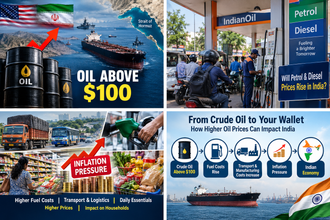
Brent crude oil surged past the psychologically critical $100-a-barrel mark this week, settling near $101 after the latest escalation in the six-month-old conflict between the United States and Iran. The renewed wave of attacks has reignited fears of prolonged disruption to oil flows through the Strait of Hormuz, pushing energy costs back to the center of global economic concern. Global markets reacted sharply: Brent rose more than 3% on Wednesday, West Texas Intermediate climbed above $96, and energy prices once again dominated economic headlines across continents.
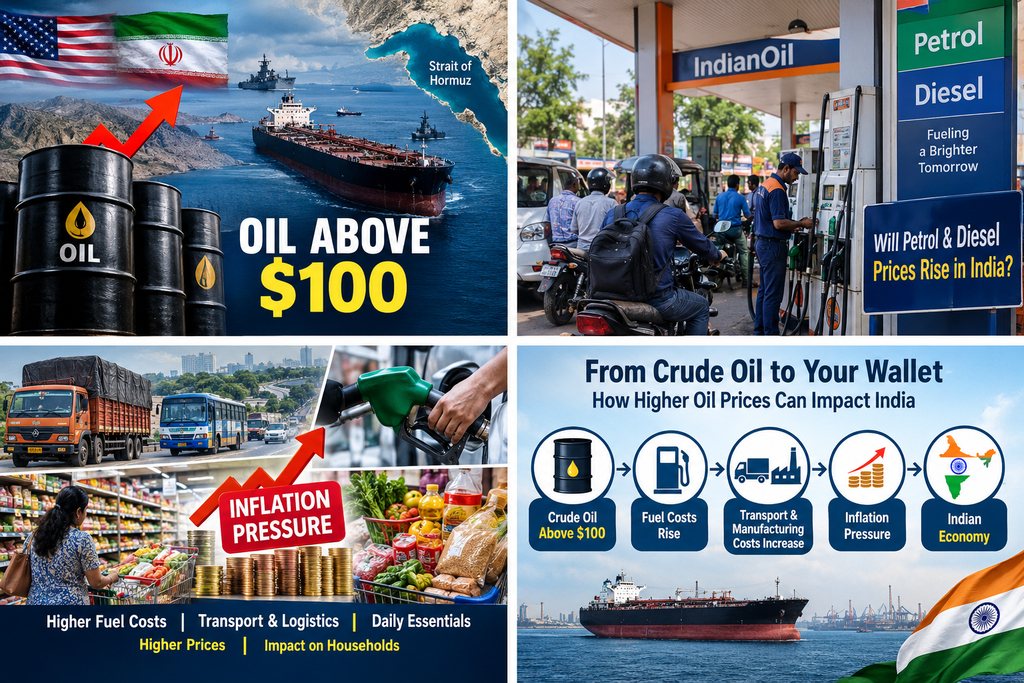
For India, the world’s third-largest oil importer and consumer, the stakes are immediate and broad. The country imports roughly 85–90% of its crude oil requirements. Higher international prices directly swell the import bill, pressure the current account, weigh on the rupee, squeeze oil marketing companies (OMCs), and — depending on the extent of pass-through — feed into retail fuel prices, transportation costs, food inflation and broader consumer prices. Petrol and diesel rates have so far remained stable at the pump even as crude has climbed, but the under-recoveries being absorbed by state-owned retailers are mounting rapidly. Analysts warn that sustained prices above $100 could force further retail hikes, rekindle inflationary pressures and slow growth at a time when the economy is already navigating elevated energy costs from the earlier phases of the conflict.
The Latest Escalation and Oil’s Return Above $100
The conflict, which began with US and Israeli actions against Iran earlier in 2026, has already caused severe and lasting disruption to Middle East oil exports. Shipping through the Strait of Hormuz — which normally carries about one-fifth of global oil supply — has been heavily constrained for months. Estimates suggest that around 10 million barrels per day of oil exports remain missing or severely disrupted relative to pre-war levels. While some producers outside the region (the United States, Canada, Guyana) have increased output, the International Energy Agency and private trackers have pointed to a net global supply shortfall this year.
After a relatively quieter period in August that allowed Brent to ease below $90, hostilities flared again. On Tuesday, US Central Command announced the destruction of five Iranian tankers. Iran responded with claims of attacks on multiple vessels and a US facility. Concurrently, Houthi strikes hit Saudi energy infrastructure. The cumulative effect was immediate: Brent breached $100 for the first time since late July and closed at multi-month highs. Market participants noted that the global inventory cushion has thinned and that refined-product markets (especially diesel) remain tight because of earlier disruptions to refining capacity in the region and Russia.
Oil has already risen more than 60% year-to-date in some benchmarks and remains well above pre-war levels near $70. Analysts at major banks have flagged the possibility of further spikes toward $120 if Hormuz flows deteriorate further, though some also note that demand destruction and eventual diplomatic de-escalation could cap the upside. For now, the dominant narrative is one of elevated and volatile energy prices.
India’s Exposure: Import Dependence and the Rising Bill
India’s structural vulnerability is well known. Crude oil accounts for a large share of the merchandise import bill. In the April–July period of the current fiscal year, the crude oil import bill surged more than 56% year-on-year to $63.4 billion even though volumes were roughly flat at about 81.9 million tonnes. The Indian crude basket — a blend of sweet and sour grades — recently crossed $100 and has traded in the $100–109 range in recent days. Every sustained $10-per-barrel increase in the average crude price is estimated to add roughly $13–18 billion to the annual import bill, depending on exchange rates and volumes.
The current account deficit (CAD) is the clearest macroeconomic transmission channel. Higher oil prices widen the merchandise trade deficit. Services exports and remittances provide a substantial offset, but they cannot fully neutralise a sharp and prolonged rise in energy costs. Recent forecasts already pointed to a widening CAD in FY27 relative to the relatively contained levels of the previous year. Sustained crude above $90–100 has led some agencies to project the CAD rising toward 1.7–2.2% of GDP, compared with sub-1% readings in more benign periods. A wider CAD, combined with any softening in capital inflows, can put downward pressure on the rupee, raising the local-currency cost of all dollar-denominated imports and creating a feedback loop.
India has diversified its crude sources over the past several years, reducing reliance on any single supplier and, for a period, taking advantage of discounted Russian barrels. The Hormuz crisis forced further rapid adjustments, with refiners increasing purchases from alternative routes and non-Gulf suppliers. Russian volumes have fluctuated with sanctions developments, while West Asian supplies have been constrained by the security situation. The net result is higher average acquisition costs and greater logistical complexity. Direct Iranian crude purchases remain minimal because of US sanctions, but the broader market impact of Iranian export disruptions and Chinese buying of remaining Iranian barrels still influences global prices that India pays.
Petrol and Diesel Prices: The Immediate Consumer Question
Retail prices of petrol and diesel in India have not moved in lockstep with every swing in international crude. After remaining largely frozen for an extended period, state-owned OMCs implemented several rounds of increases earlier in 2026 as under-recoveries mounted. By early September 2026, petrol in Delhi stood at approximately ₹102.12 per litre and diesel at ₹95.20 per litre. In Mumbai, the rates were higher — around ₹111.21 for petrol and ₹97.83 for diesel — reflecting differences in state taxes and other local factors. Prices in other major cities (Bengaluru, Hyderabad, Kolkata, Chennai) ranged correspondingly higher or lower depending on state levies.
Despite the latest jump in crude above $100, pump prices remained unchanged on September 9. This stability is temporary. Industry calculations indicate that OMCs are currently losing roughly ₹5 per litre on petrol and as much as ₹23 per litre on diesel at prevailing international prices and exchange rates. Cumulative under-recoveries, if left unaddressed, strain the balance sheets of Indian Oil, Bharat Petroleum and Hindustan Petroleum and ultimately the broader public-sector finances through lower dividends and potential capital support needs.
Historically, the government and OMCs have used a combination of tools: gradual retail price increases, reductions in central excise duties (used aggressively in earlier shocks), and absorption of losses. Excise duties still provide some buffer, but the headroom is finite. Analysts note that a sustained Indian basket near or above $105–110 would make further retail hikes increasingly likely if under-recoveries are not to balloon further. Even modest cumulative increases of ₹5–10 per litre have measurable effects on inflation and household budgets.
Impact on Consumers
For ordinary households, the effects are both direct and indirect. Direct fuel costs for personal vehicles rise with any pump-price increase. Two-wheeler and car owners in urban and semi-urban areas feel the pinch immediately in monthly fuel budgets. Commercial vehicle operators and the logistics sector face higher diesel costs that are eventually passed on through freight rates. Because road transport carries the overwhelming majority of India’s freight, higher diesel prices raise the cost of moving almost everything — agricultural produce, industrial goods, consumer durables and e-commerce packages.
Food prices are particularly sensitive. Higher transportation costs amplify the impact of any weather-related or supply-side pressure on vegetables, fruits, pulses and other essentials. Cooking gas (LPG) and CNG prices have also been adjusted in previous rounds; further increases would raise household energy expenditure for cooking and urban public transport. Rural households that rely on diesel for irrigation pumps and transportation of produce face a dual burden. Urban middle-class families experience the combined effect through higher commute costs, more expensive food, and elevated prices of manufactured goods that incorporate energy and logistics costs.
At the lower end of the income distribution, the impact is regressive. Fuel and transportation form a larger share of expenditure for poorer households, and any rise in food inflation hits them hardest. Government schemes and targeted subsidies can mitigate some of the pain, but they add to the fiscal burden at a time when oil-related revenues and public-sector enterprise performance are under stress.
Inflation Dynamics
Fuel has a dual role in India’s Consumer Price Index (CPI). Petrol, diesel and other fuels enter the index both directly (through the transport and household fuel components) and indirectly through their influence on the prices of almost all other goods and services. Recent CPI readings have already shown the imprint of earlier fuel-price adjustments and elevated energy costs. Retail inflation rose to 4.45% in July 2026 (from 4.38% in June), remaining within the Reserve Bank of India’s 2–6% tolerance band but above the 4% midpoint target for a second consecutive month. Food inflation has been running higher, while core measures have also faced upward pressure from logistics and input costs.
Quantitative estimates from rating agencies and banks suggest that a ₹7.5–10 per litre cumulative increase in petrol and diesel can add 30–50 basis points or more to headline CPI once full pass-through occurs, with additional indirect effects through freight and manufacturing costs. Road freight accounts for a large share of logistics costs, and diesel itself constitutes a significant portion of operating expenses for truckers. Manufacturers facing higher energy and transport costs tend to pass them on where demand allows, supporting core inflation. The Reserve Bank’s own analysis has long indicated that a 10% rise in global crude prices can lift domestic inflation by around 20 basis points under typical pass-through assumptions, with the exact magnitude depending on the policy response and the exchange rate.
If crude remains elevated and further retail hikes materialise, the risk is that inflation stays sticky above the midpoint of the target band for longer. This would complicate the monetary policy calculus. The RBI has emphasised the importance of anchoring inflation expectations; a renewed oil shock tests that commitment. At the same time, growth considerations remain relevant — higher interest rates to combat second-round inflation effects could dampen investment and consumption just as higher energy costs are already acting as a headwind.
Broader Economic and Fiscal Implications
Beyond inflation and the current account, the oil shock affects growth, corporate performance and the fiscal balance. Higher energy costs reduce real disposable income and can slow private consumption, especially of discretionary items. Industrial production and manufacturing margins come under pressure from elevated input and logistics costs. The aviation sector faces higher jet-fuel expenses, while power and fertiliser producers (who use oil-linked or energy-intensive processes) also feel the impact. Fertiliser subsidies may rise if feedstock and energy costs increase, adding another claim on the Budget.
Oil marketing companies’ under-recoveries translate into lower profits, reduced tax contributions and potentially lower dividend flows to the government. In previous episodes, the Centre has cut excise duties to limit the retail-price impact, forgoing substantial revenue. That option remains available but carries a fiscal cost. State governments, which levy VAT on fuel, face their own trade-offs between revenue and consumer relief.
The rupee’s performance is another transmission channel. A wider CAD and higher oil import demand for dollars can weaken the currency, raising the rupee cost of crude even if the dollar price stabilises. Currency depreciation also feeds into imported inflation more broadly. Equity markets have already shown sensitivity to oil spikes and geopolitical headlines; sustained high prices tend to weigh on rate-sensitive and consumption-oriented sectors while benefiting upstream energy producers.
On the positive side, India’s economy has become somewhat less oil-intensive over time through efficiency gains, a shift toward services, and gradual electrification of transport. Strategic petroleum reserves and diversified import sources provide limited buffers. Strong services exports and remittances continue to support the external accounts. Nevertheless, the scale of the current disruption and the height of oil prices mean that the net impact remains negative for growth, inflation and the balance of payments in the near term.
Policy Options and the Road Ahead
Policymakers face a familiar but difficult balancing act. Completely shielding consumers by absorbing all under-recoveries is fiscally expensive and ultimately unsustainable if prices stay high. Full and immediate pass-through would protect OMC balance sheets and the fiscal position but would deliver a sharper inflation shock and hit household budgets harder. The middle path — staggered, calibrated retail increases combined with selective duty adjustments, targeted support for vulnerable groups, and continued diplomatic efforts to secure diversified supplies — has been the preferred approach so far.
Longer-term responses include accelerating the energy transition (renewables, electric mobility, green hydrogen), expanding strategic reserves, deepening relationships with a wider set of oil and gas suppliers, and improving energy efficiency across the economy. In the immediate term, close monitoring of Hormuz traffic, Saudi and other Gulf production responses, and any diplomatic signals from Washington and Tehran will determine whether oil prices stabilise, retreat, or climb further.
For Indian consumers, the practical question is straightforward: will the next few weeks bring another round of petrol and diesel price increases? The answer depends on how long crude remains above $100, the trajectory of the rupee, the willingness of OMCs and the government to continue absorbing losses, and the broader inflation and growth picture. As of mid-September 2026, with Brent hovering above the century mark and under-recoveries already material, the probability of further upward adjustments at the pump has risen. Households, transporters and businesses would be well advised to prepare for higher energy costs in the months ahead, while hoping that de-escalation in the Gulf eventually brings relief to global markets and, with it, some respite for the Indian economy.
The US–Iran conflict has already rewritten energy-market assumptions for 2026. Its latest intensification serves as a stark reminder that India’s growth trajectory, inflation path and external balances remain closely tied to events thousands of kilometres away in the Persian Gulf. Managing that vulnerability — through a combination of short-term damage control and longer-term structural resilience — will be one of the defining economic challenges of the remainder of the year.