
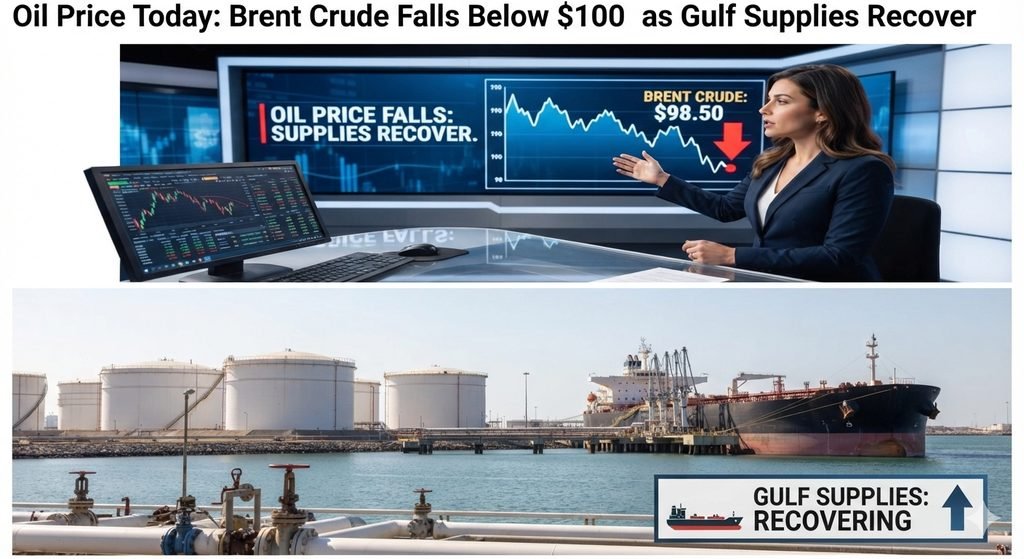
London, October 1, 2026 – Global oil markets experienced a notable retreat on Thursday as Brent crude futures slipped firmly below the psychologically important $100-per-barrel threshold, settling in the mid-to-high $90s amid clear evidence that Persian Gulf oil exports have substantially recovered toward pre-conflict levels. The decline marked a sharp correction after a robust September rally that had pushed prices higher on lingering fears of prolonged supply disruptions from the Middle East conflict.
At the latest readings, Brent crude for December delivery was trading near $96.90 to $97.40 a barrel, down roughly 1% to 1.2% on the day after having briefly hovered above $100 earlier in the week and closing the previous session near or above $98–$103 depending on the contract and timing. West Texas Intermediate (WTI) crude followed suit, falling about 1.3–1.4% to the $89–$90 range. These moves reversed some of the gains from Wednesday and capped what had been a strong monthly advance for Brent of around 14% in September, its largest monthly gain since July.
The primary catalyst for the sell-off was a series of analyst and tracking reports indicating that oil flows out of the Persian Gulf had bounced back dramatically. Goldman Sachs estimated that Gulf oil exports, including “dark” shipments with transponders switched off, reached approximately 23.3 million barrels per day over the past week—matching the region’s average for 2025. This recovery included a sharp rebound in Saudi Arabian exports, which more than doubled in September and exceeded the previous year’s average levels for that month. JPMorgan and data firm Kpler offered corroborating assessments: Kpler noted Hormuz-related flows approaching 80% of pre-war volumes in some metrics, while JPMorgan put estimates as high as 98% via the chokepoint in certain analyses. Alternative routes, including Saudi Arabia’s East-West Pipeline and loadings from the Red Sea port of Yanbu, which resumed after earlier restarts, played a significant role in offsetting earlier losses through the Strait of Hormuz.
The broader context remains a complex and still-fragile Middle East energy landscape shaped by the conflict that erupted earlier in 2026 between Iran and a U.S.-led coalition, with associated impacts on shipping through the Strait of Hormuz and related infrastructure. For months, Gulf production and exports had been constrained, with substantial volumes shut in and cumulative losses measured in the billions of barrels. Inventories worldwide drew down to buffer the shortfall, and prices had carried a substantial geopolitical risk premium. The recent rebound in crude flows has eased those immediate supply fears, even as refined product exports—particularly gasoline, diesel, and jet fuel—have lagged behind crude recovery due to refinery outages and the higher risks associated with transporting more flammable products.
Market participants also digested a surprise rise in U.S. crude inventories. The Energy Information Administration reported a build of 922,000 barrels to 427.3 million barrels in the week ended September 25, contrary to expectations of a modest draw. Combined with the Gulf recovery, this data reinforced a near-term bearish bias for many traders. Analysts noted that the market’s structure has shown signs of easing tightness: the backwardation between nearby WTI contracts narrowed notably, suggesting reduced near-term scarcity pressures compared with levels seen just weeks earlier.
Despite the drop below $100, prices remain elevated relative to pre-conflict norms and long-term averages. Brent’s 52-week range stretches from roughly $58.72 to $126.41, reflecting the extreme volatility of 2026. Goldman Sachs maintained a medium-term forecast calling for Brent to moderate toward $85 by year-end 2026 and around $80 in 2027, citing the Gulf recovery and softer Chinese import demand. However, the bank and other observers continue to flag the risk of renewed escalation that could damage additional energy infrastructure and send prices sharply higher again. “We still worry about renewed potential escalation,” Goldman analysts noted, underscoring that diplomatic progress remains incomplete.
Diplomatic efforts between the United States and Iran remain a critical wildcard. Talks aimed at restoring normal maritime passage through Hormuz and related arrangements have been on-again, off-again, with Qatar often mediating. Recent reports indicated Iran had received a U.S. response to proposals involving phased reopenings and eased blockades, yet a durable ceasefire or full normalisation has not materialised. Traders continue to price in residual risk: even as crude flows recover via escorted transits and alternative routes, commercial and strategic inventories have been depleted by hundreds of millions of barrels since the conflict’s early stages, leaving a thinner buffer against any fresh disruption.
The International Energy Agency’s recent assessments had painted a more cautious picture earlier, projecting significant year-on-year supply declines for 2026 due to deferred full Gulf recovery into 2027. Updated tracking, however, shows that the pace of export rebound in September exceeded many prior expectations. Saudi loadings from Ras Tanura and other terminals increased sharply, and overall regional crude exports approached levels not seen since the early months of the conflict. Non-Gulf producers, particularly in the Americas, have also contributed incremental supply, partially offsetting the earlier shortfalls.
For consuming nations, especially in Asia, the price retreat offers some relief after months of elevated import costs. Freight rates for crude into Japan and other markets had soared amid the disruptions, making certain cargoes among the world’s most expensive. Lower benchmark prices should ease pressure on fuel prices downstream, though product market tightness may limit the full pass-through in the near term. In Europe and the United States, the drop could temper inflationary impulses from energy, though broader macroeconomic factors—including interest rate expectations and demand signals from China—will continue to influence the outlook.
Volatility is likely to persist. Oil markets have swung between gains and losses as each new data point on flows, inventories, or diplomatic headlines shifts the balance. September’s strong monthly performance for Brent demonstrated how quickly risk premiums can reassert themselves; Thursday’s decline illustrates how rapidly they can compress when physical supply evidence improves. Analysts at firms including Trade Nation and CIBC Private Wealth have described the recent flow reports as directionally correct even if exact volumes remain difficult to verify in real time due to the complexities of tracking “dark” shipping and alternative routes.
Looking ahead, the market’s attention will remain fixed on several key variables. First is the sustainability of the Gulf export recovery: can flows through Hormuz and bypass routes hold at current elevated levels without further incidents? Second is the trajectory of U.S.-Iran negotiations and any tangible steps toward durable shipping security. Third is the response of OPEC+ producers; the group has limited immediate flexibility given that conflict-related constraints have already prevented some quota volumes from reaching markets, and its next meeting is scheduled for early October. Fourth is demand-side developments, particularly Chinese buying patterns and the impact of higher prices earlier in the year on global consumption.
Refinery margins and product cracks had reached elevated levels during the disruption period, incentivising higher runs where feedstock was available. As crude availability improves, those dynamics may normalise, potentially pressuring product prices relative to crude. Meanwhile, the depletion of inventories noted by various trackers means that any setback in Gulf flows would likely trigger a rapid price response.
In summary, Thursday’s decline in Brent crude below $100 reflects a meaningful easing of the most acute supply anxieties that had dominated oil markets for much of 2026. The recovery in Persian Gulf exports to near 2025 average levels, supported by Saudi Arabia’s sharp rebound and alternative routing, has provided tangible evidence that physical barrels are returning. Coupled with a U.S. inventory build, this has prompted traders to reduce the geopolitical risk premium, at least temporarily. Yet the underlying conflict remains unresolved, refined product supplies lag, and inventory buffers are thinner than before. As a result, oil prices are unlikely to settle into a calm range quickly. Market participants will continue to navigate a landscape defined by incomplete recovery, diplomatic uncertainty, and the ever-present possibility of renewed escalation—keeping volatility elevated even as the headline price has retreated from recent highs.
The coming days and weeks will test whether the current recovery in Gulf supplies proves durable enough to sustain prices in the $90s or whether fresh geopolitical or operational setbacks push the market back toward and potentially beyond the $100 mark once more. For now, the dominant narrative is one of cautious relief: supplies are recovering, prices have eased below a key threshold, and the worst of the immediate shortage fears have receded—though the broader energy security challenges of 2026 are far from fully resolved.