
WASHINGTON — With Election Day for the 2026 midterm elections set for Tuesday, November 3, 2026, millions of Americans are navigating a patchwork of state rules to ensure their voices are heard in races that will decide control of the U.S. House of Representatives, a third of the Senate seats, dozens of governorships, and countless state and local offices. Voter registration remains the essential first step. Unlike many democracies with national voter rolls, the United States leaves registration almost entirely to the states, creating a complex landscape of deadlines, methods, identification requirements, and eligibility rules that can differ sharply from one border to the next.
As of late October 2026, some states have already closed regular registration windows while others still allow same-day registration through Election Day itself. Advocacy groups, election officials, and civic organizations are urging eligible citizens not to wait. “Registration is the gateway to participation,” said one election administrator in a recent briefing. “Miss the deadline in your state and you may lose the chance to vote in one of the most consequential midterms in years.”
Why the 2026 Midterms Matter
Every seat in the House of Representatives is on the ballot. Thirty-three Senate seats and 39 governorships are also contested. Control of Congress hangs in the balance, as do the direction of state policies on everything from education and taxation to voting access itself. Midterm turnout has historically lagged presidential years, making registration drives especially critical for younger voters, recent movers, newly naturalized citizens, and those who have never participated before.
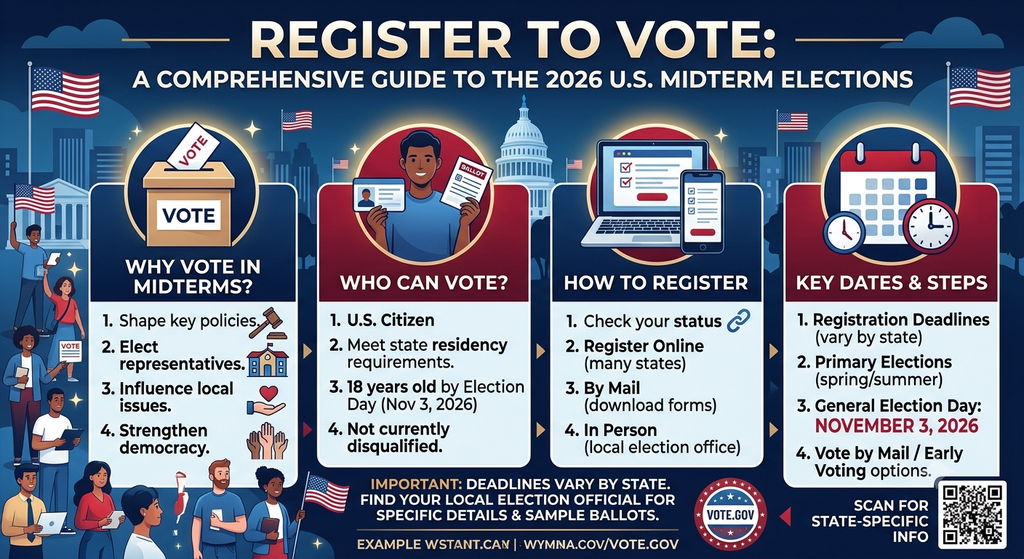
The National Voter Registration Act of 1993 (often called the “Motor Voter” law) requires states to offer registration opportunities at motor vehicle offices and certain public assistance agencies, and it caps the registration deadline for federal elections at no more than 30 days before Election Day. Beyond that baseline, states set their own rules. Nineteen states plus the District of Columbia currently allow some form of Election Day or same-day registration. North Dakota remains the sole state without a traditional voter registration system.
How to Register: The Basic Pathways
The federal government maintains Vote.gov as the central starting point. Visitors select their state or territory and are directed to official instructions for online, mail, or in-person registration. Most states now offer online registration for those who possess a state driver’s license or non-driver identification card. Applicants without those documents can usually register by mail using the National Mail Voter Registration Form produced by the U.S. Election Assistance Commission, or they can appear in person at a local election office, library, or designated agency.
Eligibility is consistent at the federal level: applicants must be U.S. citizens, meet the state’s minimum age (usually 18 by Election Day, though some states allow 17-year-olds to register if they will turn 18 in time), and reside in the state and locality where they seek to vote. Most states also require that the person not be currently serving a sentence for a felony or have been adjudicated mentally incompetent regarding the capacity to vote. Restoration of rights after a felony conviction varies widely; some states restore voting rights automatically upon release from prison, others upon completion of parole or probation, and a few require additional application or waiting periods.
Once registered, voters should verify their status through their state’s online lookup tool. Changes of name, address, or party affiliation must be reported before the relevant deadline. Moving across state lines requires a new registration in the destination state. The old state is generally required to allow a voter who moved too late to re-register the chance to vote in the presidential general election under certain conditions, but that protection does not automatically extend to midterms.
Deadlines: A State-by-State Reality Check
There is no single national registration deadline. For the November 3, 2026 general election, many states set their cutoff between late September and mid-October. As of mid-to-late October 2026, deadlines had already passed in several states that require registration roughly 30 days in advance, including Alaska (October 4), Arizona, Arkansas, Florida, Georgia, Indiana, Kentucky, Louisiana (for certain races), Mississippi, Ohio, Rhode Island, South Carolina, Tennessee, and Texas. In those jurisdictions, unregistered eligible citizens can no longer register for the general election through ordinary channels.
Other states maintain later windows. Alabama’s deadline fell on October 19. California, Pennsylvania, and Michigan closed online and mail registration around the same date, though California and several others continue to offer conditional or same-day registration at polling places or early-voting sites. Colorado, Connecticut, Hawaii, Idaho, Illinois, Iowa, Maine, Maryland, Minnesota, Nevada, New Hampshire, Utah, Vermont, Virginia, Washington, Wisconsin, Wyoming, and the District of Columbia allow registration on Election Day itself or during early voting periods, often with proof of residency.
Mail registration rules add another layer. Some states accept forms postmarked by the deadline; others require the form to be received by that date. Online systems typically close at midnight on the deadline day in the state’s local time. Election officials repeatedly advise mailing forms at least a week early because the Postal Service does not guarantee same-day postmarks.
Primary deadlines earlier in 2026 varied even more widely. Some states held primaries in March, others in May, June, or August, each with its own registration cutoff. Voters who registered for a primary generally remain registered for the general election unless they moved or their status changed.
Identification, Citizenship Verification, and Recent Legal Changes
Most states require some form of identification at the polls, ranging from photo ID to non-photo documents such as utility bills. A growing number of states have added or strengthened documentary proof-of-citizenship requirements for registration. As of 2026, roughly a dozen states have laws on the books requiring applicants in at least some circumstances to present a passport, birth certificate, naturalization papers, or similar documents. Implementation varies. Some states apply the requirement only when citizenship cannot be verified through existing databases; others impose it more broadly. Federal courts have blocked or limited certain versions of these laws in the past, and litigation continues in multiple jurisdictions.
Automatic voter registration (AVR) systems, in which eligible citizens are registered or offered registration when they interact with motor vehicle or other government agencies unless they opt out, have expanded in recent years. Same-day registration has also grown, reducing the risk that eligible voters are turned away for missing an earlier deadline. At the same time, some states have tightened list-maintenance practices, required more frequent purges of inactive voters, or limited the methods by which third-party groups can collect registration forms.
Military and overseas voters operate under the Uniformed and Overseas Citizens Absentee Voting Act. They can register and request ballots through the Federal Voting Assistance Program (FVAP.gov) using the Federal Post Card Application. Special timelines and electronic transmission options apply.
Practical Steps for Prospective Voters
- Confirm eligibility under your state’s rules.
- Visit Vote.gov or your state election website and begin the registration process online if available.
- If online registration is unavailable or you lack the required ID, download the National Mail Voter Registration Form, complete it carefully following the state-specific instructions, sign it, and mail it with sufficient postage.
- Keep a copy of the completed form and any confirmation number or receipt.
- Check your registration status a few weeks later through the official state portal.
- Note early voting dates, absentee ballot request deadlines, and return deadlines for your preferred voting method.
- If you move, update your registration promptly.
- Contact your local election office with questions; phone numbers and email addresses appear on state election websites.
Civic organizations, libraries, community centers, and high schools frequently host registration drives. Colleges often provide assistance to students. Public assistance offices and DMV locations remain required registration sites under federal law.
Challenges and Equity Concerns
Advocates point to persistent barriers. Strict deadlines disadvantage people with irregular work schedules, those recovering from illness or natural disasters, recent movers, and individuals without reliable internet or transportation. Proof-of-citizenship rules can burden citizens who lack ready access to birth certificates or passports, particularly older Americans, low-income residents, and people born at home or abroad. Language access remains uneven; while federal law requires materials in certain languages in covered jurisdictions, practical availability varies.
Conversely, election integrity proponents argue that registration deadlines and verification measures protect the accuracy of voter rolls and public confidence. They note that most states already require applicants to affirm citizenship under penalty of perjury and that database checks and periodic list maintenance are standard administrative tools.
Turnout data from recent cycles show that states with same-day registration and automatic registration tend to post higher participation rates, particularly among younger and lower-propensity voters. Whether those patterns hold in 2026 will depend on campaign intensity, weather, competitive races, and the effectiveness of get-out-the-vote efforts.
Looking Ahead
Registration is only the beginning. Once on the rolls, voters must still decide how and when to cast their ballots—early in person, by mail, or on Election Day. Polling place locations, hours, and identification rules also differ by jurisdiction. Provisional ballots offer a safety net for voters whose eligibility is questioned at the polls, though they are counted only after verification.
For those who have already registered, the most important remaining tasks are to confirm that the record is current, learn the deadlines for their preferred voting method, and plan accordingly. For those who have not, time is of the essence in many states. Election officials across the country emphasize a simple message: check your status today, register if you are eligible and not yet on the rolls, and do not assume that a past registration remains valid after a move or name change.
The 2026 midterms will test the resilience of America’s decentralized election system. With control of Congress and the direction of state governments at stake, the quiet administrative act of registering to vote carries outsized democratic weight. Eligible citizens who complete the process ensure that, whatever the outcome on November 3, the electorate reflects the broadest possible range of the American public.
Official resources remain the most reliable sources of information. Voters are encouraged to rely on Vote.gov, their state election office websites, and local election officials rather than unofficial social media graphics or third-party summaries that may contain outdated or inaccurate dates. In a system defined by state variation, the only universal rule is diligence. Register early, verify often, and prepare to participate.