
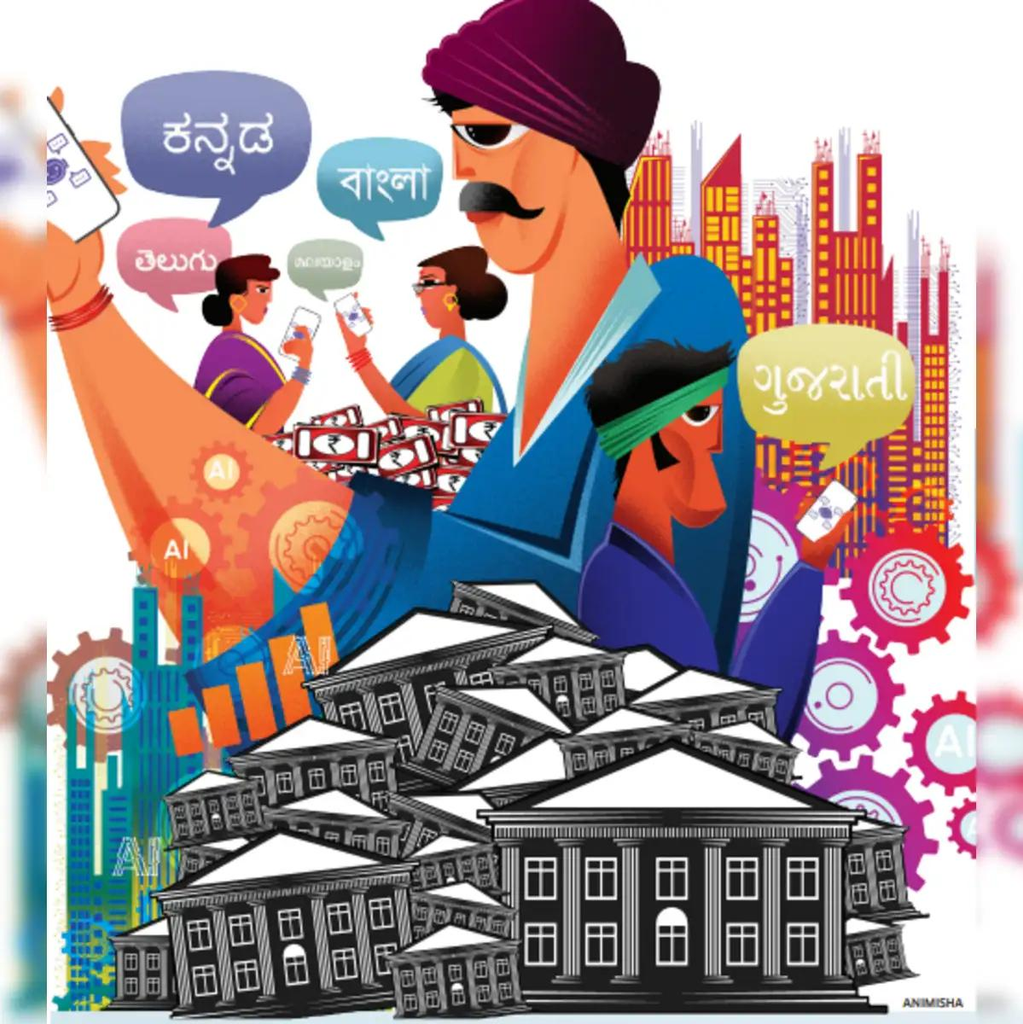
In a significant step toward linguistic inclusion in India’s capital markets, the Securities and Exchange Board of India (SEBI) on November 3, 2026, signed a Memorandum of Understanding with the Digital India BHASHINI Division (DIBD). The agreement aims to make regulatory services, investor education materials, market disclosures, and grievance mechanisms accessible in regional Indian languages through artificial intelligence-powered tools.
The MoU was signed by SEBI Whole-Time Member Sandip Pradhan and DIBD Chief Executive Officer Amitabh Nag in the presence of senior officials from both organisations. It came into force the same day. Under the partnership, SEBI will leverage BHASHINI’s language translation APIs, models, and tools—including Automatic Speech Recognition (ASR), Text-to-Speech (TTS), Machine Translation, and Optical Character Recognition (OCR)—to deliver its public-facing services in regional languages. The collaboration will also enrich BHASHINI’s language models with securities market-related terminology, improving accuracy for domain-specific financial language.
This development arrives at a time when India’s retail investor base continues to expand rapidly, particularly in smaller towns and non-metropolitan regions where English is not the primary language of communication. Language has long acted as a barrier to informed participation in the securities markets. Circulars, risk disclosures, product explanations, and complaint processes have historically been available primarily in English, with limited high-quality regional language support. The SEBI-BHASHINI partnership seeks to change that equation by embedding indigenous AI language technology into the regulatory and investor-facing infrastructure.
BHASHINI: India’s National Language AI Infrastructure
BHASHINI, short for BHASHa INterface for India, is the Government of India’s flagship AI-powered language technology platform. Launched in July 2022 under the Ministry of Electronics and Information Technology (MeitY), it functions as national-scale Digital Public Infrastructure for language. It is designed to break down language and digital barriers by enabling real-time text and voice translation, speech recognition, and related capabilities across Indian languages.
The Digital India BHASHINI Division operates as an independent unit under the Digital India Corporation, a Section 8 not-for-profit company established by MeitY. BHASHINI supports text capabilities in 36 Indian languages and voice capabilities in 22–23 Indian languages, covering the 22 languages listed in the Eighth Schedule of the Constitution, along with additional languages and 35 international languages in some configurations. It powers hundreds of government platforms, processes millions of AI inferences daily, and has enabled billions of cumulative inferences. Its open APIs and models allow government departments, public sector entities, and private organisations to integrate multilingual capabilities without building language technology from scratch.
The platform’s core technologies map directly to the needs of a regulator like SEBI. Automatic Speech Recognition converts spoken queries or complaints in regional languages into text that systems can process. Text-to-Speech can read out circulars, alerts, or educational content in natural-sounding regional voices. Machine Translation handles conversion of official documents, FAQs, and market updates between English and Indian languages or between Indian languages. Optical Character Recognition extracts text from scanned filings, older paper documents, or image-based notices so they can be translated and made searchable.
By feeding securities market terminology—terms related to trading, mutual funds, derivatives, risk disclosures, KYC processes, grievance redressal, and regulatory compliance—into BHASHINI’s models, the partnership aims to reduce translation errors that often plague financial content. Generic translation systems frequently struggle with specialised vocabulary, leading to ambiguity or loss of precision that can mislead investors. Domain adaptation addresses that gap.
Why Language Matters in Capital Markets
India’s capital markets have witnessed dramatic growth in retail participation over the past decade, driven by digital platforms, mutual fund SIPs, dematerialised accounts, and greater awareness. Millions of new investors have entered the markets from Tier-2, Tier-3, and rural areas. Many of these investors are more comfortable operating in Hindi, Tamil, Telugu, Bengali, Marathi, Gujarati, Kannada, Malayalam, or other regional languages than in English.
Yet critical information—offer documents, scheme information documents, risk factors, corporate announcements, SEBI circulars, and investor alerts about fraud or mis-selling—has often remained English-centric. This creates an information asymmetry. Investors who cannot fully comprehend complex disclosures may make suboptimal decisions, fall prey to aggressive selling, or remain unaware of their rights and complaint mechanisms. Voice-first and regional-language interfaces lower the barrier to entry and ongoing engagement.
The partnership has the potential to transform several touchpoints. Investor education content on SEBI’s websites and apps could become available in multiple languages with both text and audio options. Grievance portals could accept complaints via voice in regional languages and provide status updates or guidance in the same language. Market-wide alerts and scam warnings could reach a wider audience faster. Intermediate platforms such as stock brokers, mutual fund distributors, and investment apps may also benefit indirectly as the quality of underlying language models improves through the injection of market-specific terminology.
Broader Momentum in Financial Services Multilingual AI
The SEBI-BHASHINI MoU does not stand in isolation. It forms part of a wider pattern of collaboration between BHASHINI and financial sector institutions. The Reserve Bank of India signed an MoU with DIBD earlier in 2026 to advance multilingual access to banking and financial services, including work toward a domain-specific “Banking BHASHINI” model. Punjab National Bank partnered with BHASHINI to integrate multilingual AI into its digital banking ecosystem. The Pension Fund Regulatory and Development Authority has also collaborated to strengthen language capabilities in the pension sector.
These initiatives reflect a recognition that financial inclusion is incomplete if language remains a barrier. Digital banking, UPI, Aadhaar-enabled services, and account opening have brought formal finance to hundreds of millions. The next frontier is ensuring that customers can understand products, terms, risks, and recourse mechanisms in languages they use daily. Voice interfaces are particularly powerful in a country where literacy levels and smartphone usage patterns vary widely, and where many users prefer speaking over typing.
For the securities markets specifically, better language access could support SEBI’s long-standing goals of investor protection and market development. Informed investors are better placed to assess risk, compare products, and report misconduct. Clearer communication may also reduce the volume of avoidable complaints arising from misunderstanding rather than genuine grievances. Over time, richer multilingual data and interactions could feed back into better supervision and policy design.
Implementation Pathways and Expected Capabilities
While the MoU establishes the framework, specific timelines for public rollout of individual services have not been announced. Integration is expected to proceed in phases. Initial efforts may focus on high-impact, high-visibility areas such as translation of key investor education materials, FAQs, and circulars, followed by voice-enabled grievance interfaces and real-time assistance tools.
Technical work will involve mapping SEBI’s existing digital platforms to BHASHINI APIs, testing translation quality for financial content, creating or refining glossaries of market terms, and ensuring that audio output sounds natural and accurate across dialects where possible. Data contribution through initiatives such as Bhashadaan can further improve models by incorporating authentic securities-market language samples.
The partnership also positions SEBI’s materials as training data that strengthens the national language infrastructure. Accurate handling of specialised vocabulary in one domain benefits other users of the same models, creating positive externalities across government and private sector applications.
Potential Impact on Retail Investors and Market Participants
For a first-time investor in a smaller city who prefers interacting in Hindi or a regional language, the difference could be substantial. Instead of relying on intermediaries to explain English documents or navigating incomplete translations, the investor could access official explanations, risk warnings, and process guidance directly in a familiar language, including through voice. This reduces dependence on potentially conflicted intermediaries for basic information and increases the likelihood that key messages reach the intended audience.
Brokers, mutual fund houses, and fintech platforms may find it easier to offer consistent multilingual experiences when the underlying regulatory content and terminology models improve. Standardised, high-quality translations of regulatory language can raise the baseline quality of communication across the ecosystem. Startups working on voice AI for financial services already operate in this space; a regulator-backed push for domain-adapted models can accelerate reliable adoption.
There are also implications for compliance and enforcement. Clearer communication of rules and obligations in multiple languages can support better adherence. When investors and intermediaries both operate with a shared understanding of requirements, disputes and violations arising from language gaps may decline.
Challenges and Considerations
Several practical challenges remain. Translation quality for highly technical or legalistic financial language must meet exacting standards; even small errors can alter meaning in material ways. Dialects and code-mixing (switching between languages or mixing English terms) are common in everyday speech and require robust handling. Voice interfaces must work reliably across noisy environments, varying accents, and different device capabilities.
Privacy and data security considerations apply when speech is converted to text or when user interactions are processed through AI systems. Integration with legacy systems at the regulator and across market participants will require careful engineering. Measuring actual impact—whether improved language access leads to better-informed decisions, higher complaint resolution rates, or broader participation—will need thoughtful metrics and evaluation.
Adoption will depend not only on technology availability but on awareness, user interface design, and trust. Investors need to know that official multilingual options exist and that the information is authoritative. Continuous refinement based on real usage data will be essential.
Part of a Larger AI and Digital Inclusion Story
The SEBI-BHASHINI partnership sits within India’s broader push to develop indigenous AI capabilities and deploy them for public good. Language technology is a foundational layer. By treating multilingual AI as Digital Public Infrastructure rather than proprietary closed systems, the government aims to create shared resources that multiple sectors can build upon. Similar collaborations with departments handling industry, investment promotion, public procurement, and other domains illustrate the horizontal nature of the approach.
For capital markets, the initiative reinforces the idea that modern regulation includes accessibility. As markets grow more sophisticated and more digitally native, the ability to communicate effectively with a linguistically diverse population becomes a core regulatory capability rather than an optional add-on.
Looking ahead, successful implementation could set a template for other financial regulators and market infrastructure institutions. It may encourage deeper investment in domain-specific language models for finance, insurance, pensions, and related areas. Over time, voice-first, multilingual interfaces could become the expected standard for official financial communication in India rather than an exception.
The November 3 agreement marks the formal beginning of closer cooperation between SEBI and the Digital India BHASHINI Division. The real test will lie in execution—how quickly and accurately services become available, how well domain terminology is handled, and whether retail investors across language communities experience a tangible improvement in access to clear, reliable information. If the partnership delivers on its promise, it will represent a meaningful advance in making India’s capital markets more inclusive and in demonstrating the practical power of indigenous AI language technology at national scale.
In a country of extraordinary linguistic diversity, technology that meets people in their own languages is not merely convenient. It is a prerequisite for genuine participation. The SEBI-BHASHINI collaboration is an important step in that direction for one of the most consequential domains of economic life: the securities markets that channel savings into productive investment and shape the financial future of millions of households.