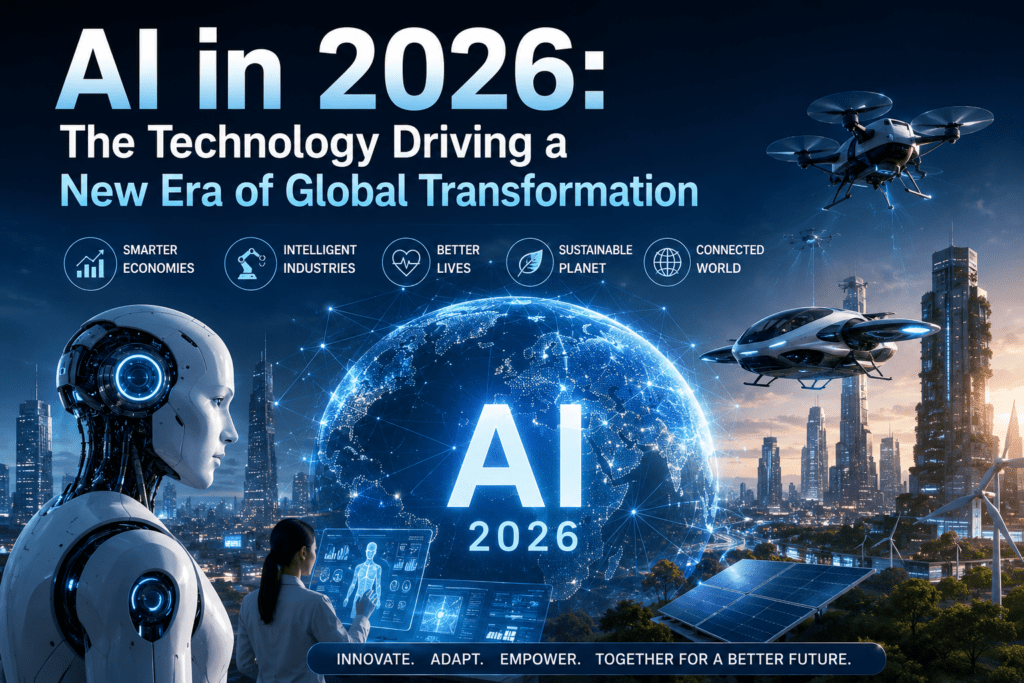
The AI Revolution in 2026: Transforming Humanity, Industries, and the Planet – A Comprehensive News Report
June 12, 2026
In 2026, artificial intelligence defines our era. No longer limited to labs or speculation, AI affects every part of life. It powers personalised healthcare, often outperforming specialists. Autonomous agents now manage complex enterprise workflows. This report reviews AI’s current state, breakthroughs, sectoral impacts, ethical dilemmas, regulation, societal changes, environmental costs, and future paths. Using recent developments, it shows both promise and challenges.
The Current Landscape: AI as Partner, Not Just a Tool
As of mid-2026, AI has moved from hype to practical partnership. Microsoft identifies seven trends showing AI as a collaborative force. It boosts teamwork, enhances security, speeds research, and improves infrastructure. Agentic AI stands out in discussions for its reasoning and autonomous task execution. Improved context, memory, and self-verification help agents pursue long-term goals beyond single tasks.
Open-source models are democratizing access, challenging the dominance of tech giants. Moonshot AI’s Kimi K2.5 and Alibaba’s Qwen3 series exemplify trillion-parameter models optimised for efficiency, running effectively on consumer hardware in some cases. Video generation has matured dramatically with tools like OpenAI’s Sora 2 and Google’s Veo 3.1, enabling high-fidelity, editable multimodal content.
Image: Futuristic AI neural network glowing in a digital cosmos, symbolising interconnected intelligence.
Physical AI, including humanoid robots, is moving from demos to deployments, with NVIDIA and Hyundai deepening collaborations in robotics and manufacturing. Edge AI brings intelligence to devices, reducing latency and enhancing privacy.
Breakthroughs Defining 2026
Several breakthroughs are reshaping capabilities:
- Agentic and Multi-Agent Systems: From copilots to full workflows, AI agents now orchestrate complex processes. Context engineering and improved memory drive this shift, enabling reliability in real-world applications.
- Multimodal and Generative Advances: Generative video and image tools are production-ready. Diffusion transformers power creative tools, while models handle text, image, audio, and video seamlessly. Netflix’s integration in series like El Eternauta marks mainstream adoption.
- Open-Source Momentum: Models like DeepSeek-V4-Pro with 1.6 trillion parameters (using Mixture-of-Experts for efficiency) reduce reliance on closed systems. This accelerates innovation across coding, reasoning, and specialised domains.
- Efficiency and Hardware Innovations: Custom AI chips from Meta and others, alongside quantum computing edging toward viability, address scaling challenges. Energy-efficient architectures counterbalance massive compute demands.
- Scientific Discovery Acceleration: AI contributes to breakthroughs in materials science, drug discovery (compressing timelines from 15 to 5 years), and protein folding via successors to AlphaFold.
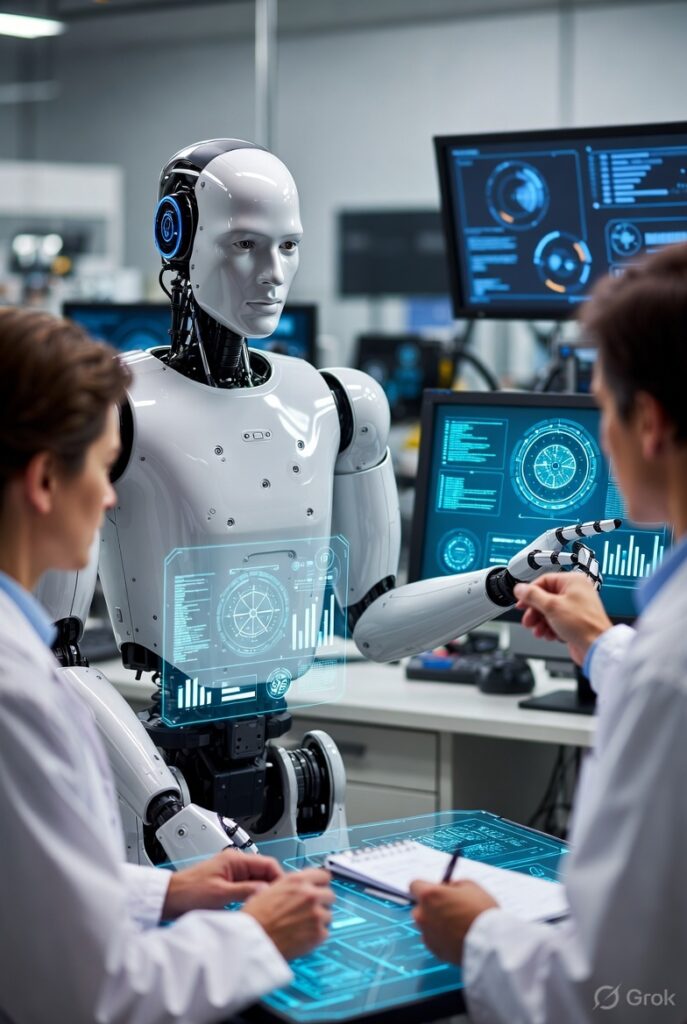
Image: Humanoid robot collaborating with scientists in a high-tech lab.


These advances are not without trade-offs. Reliability, security, and verification remain critical, as models still hallucinate or fail in edge cases. Self-verification mechanisms are emerging as a key 2026 focus.
Sectoral Transformations
Healthcare: AI is revolutionising diagnostics, personalised medicine, and operations. Accuracy in cancer detection has improved by nearly 40% in some applications. Drug discovery benefits from AI simulations, potentially saving billions annually. However, regulatory scrutiny intensifies for clinical tools, with mental health chatbots facing restrictions due to harm allegations. 94% of healthcare organisations view AI as core.
Finance: Adoption surged to 72%, powering forecasting, risk management, fraud detection, and personalised banking. AI enhances inclusion but raises concerns over market manipulation and bias. Automation handles routine tasks, freeing experts for strategy.
Education: K-12 prioritises instructional tools; higher education integrates AI across academics and administration. Personalised learning paths adapt to students, but challenges include equity, over-reliance, and preserving critical thinking.
Creative Industries: Generative AI boosts productivity, with nearly half of professionals using it daily for ideation and iteration. Video, image, and audio tools transform content creation, but authenticity becomes paramount amid deepfakes. Human creativity remains irreplaceable for emotional depth. The market for generative AI in creatives grows exponentially.
Image: Artist using AI tools to create a digital masterpiece.

Other Sectors: Manufacturing, retail, transportation, and agriculture see automation gains. Physical AI and IoT integration drive efficiency.
Job Market and Economic Impacts
AI reshapes more jobs than it replaces. In the US, 50-55% of jobs will transform over the next 2-3 years through augmentation. While 10-15% face substitution risks, net job creation is projected globally (e.g., WEF estimates more new roles than displaced by 2030). AI skills command wage premiums up to 56%. However, transitions challenge workers in routine cognitive and manual tasks.
Big Tech’s $159 billion bond issuance funds AI infrastructure, signalling massive investment. Productivity gains fuel GDP growth, but displacement in specific sectors (e.g., 16,000 US jobs monthly linked to AI) requires reskilling.
Ethical Concerns, Regulations, and Governance
Ethics dominates discourse. Bias, privacy, transparency, and accountability persist. The EU AI Act will fully enforce in 2026, classifying high-risk systems with strict requirements. The US emphasises innovation with a lighter federal touch, favouring state-level and executive actions. Global efforts like UNESCO’s recommendations and UN dialogues seek harmonisation.
Provenance tools for AI-generated content and governance frameworks gain traction. Mental health AI faces tighter oversight. Sovereignty concerns drive national models and data localisation.
Image: Global AI ethics symposium with diverse experts.

Risks include misalignment, persuasion capabilities (Scott Alexander’s warnings of AGI influence), and power concentration. Positive scenarios envision utopian productivity; negative ones highlight loss of control or societal divides.
Environmental Footprint: The Hidden Cost
AI’s infrastructure exacts a heavy toll. Data centres consume vast amounts of electricity (projected 945 TWh by 2030), water (trillions of litres for cooling), and land. Carbon emissions rival those of nations like Argentina. Many facilities are located in water-stressed areas, exacerbating scarcity. Waste heat recovery and renewable integration offer mitigation paths, but growth outpaces solutions.
Communities resist due to noise, pollution, and resource strain. Sustainable AI practices—efficient models, green data centres—become imperative.
Image: AI data centre contrasted with environmental impact.

Societal Shifts and Everyday Life
AI chatbots personalise shopping and assistance. Education personalises learning. Entertainment generates content on demand. Yet, concerns over dependency, “AI psychosis,” mental health, and authenticity rise. Authenticity marketing counters generative flood. AI literacy becomes essential.
Geopolitics intensifies: US-China competition, sovereignty pushes, and regulatory fragmentation define the landscape.
Future Horizons: Toward AGI and Beyond?
No AGI in 2026, per experts, but timelines compress. Predictions vary: significant milestones in agentic systems, potential R&D automation. Scott Alexander estimates 25% chance of transformative AI by 2027. Preparation for scenarios—from productivity booms to existential risks—is key.
Investment bubbles may correct, but momentum persists. Focus shifts to evaluation, reliability, and human-AI symbiosis.
Conclusion: Navigating the AI Epoch
2026 marks AI’s maturation into an indispensable, yet scrutinised, force. Benefits in health, productivity, and discovery are tangible; risks in ethics, jobs, environment, and control demand vigilance. Stakeholders—governments, businesses, individuals—must collaborate on responsible development. Education, governance, and innovation will determine whether AI amplifies human potential or disrupts it uncontrollably.
The revolution is here. Humanity’s response will shape the century. As trends like agentic systems and multimodal generation accelerate, the imperative is clear: harness AI’s power while safeguarding our values, planet, and future.