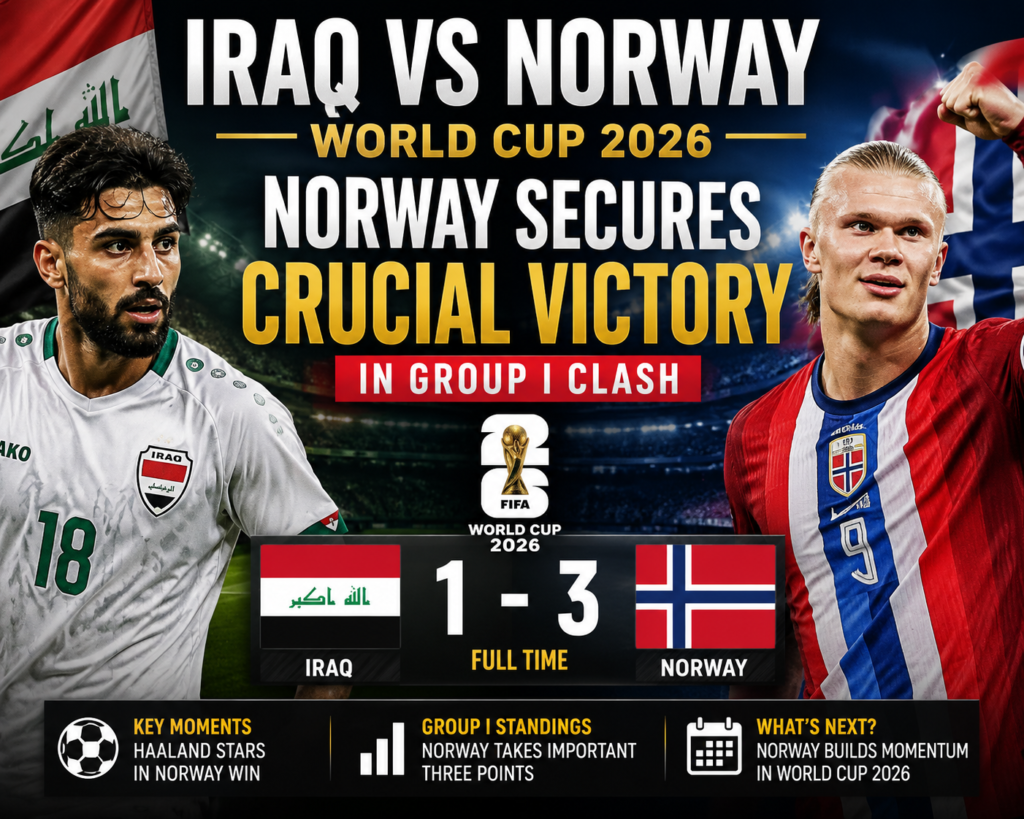
Haaland’s World Cup Debut Brace Powers Norway to 3-1 Victory Over Iraq in Group I Opener
Foxborough, Massachusetts — June 16, 2026
In a highly anticipated Group I clash at Gillette Stadium (also referred to as Boston Stadium), Norway marked their long-awaited return to the FIFA World Cup with a commanding 3-1 win over Iraq. Erling Haaland, making his tournament debut, stole the headlines with a clinical first-half brace, while Leo Østigård added a second-half header to seal the result. Aymen Hussein’s towering equaliser briefly gave Iraq hope, but the Scandinavian side’s superior quality and organisation ultimately prevailed.
This match carried deep historical significance for both nations. Norway had not appeared at a World Cup since 1998, while Iraq’s last participation dated back to 1986. For two teams ending long absences, the occasion was electric. The New England evening buzzed with Viking-clad Norwegian supporters performing their viral “Viking Row” chants en route to the stadium, creating a raucous atmosphere that blended with pockets of passionate Iraqi fans waving flags and singing traditional chants.
Pre-Match Context and Build-Up

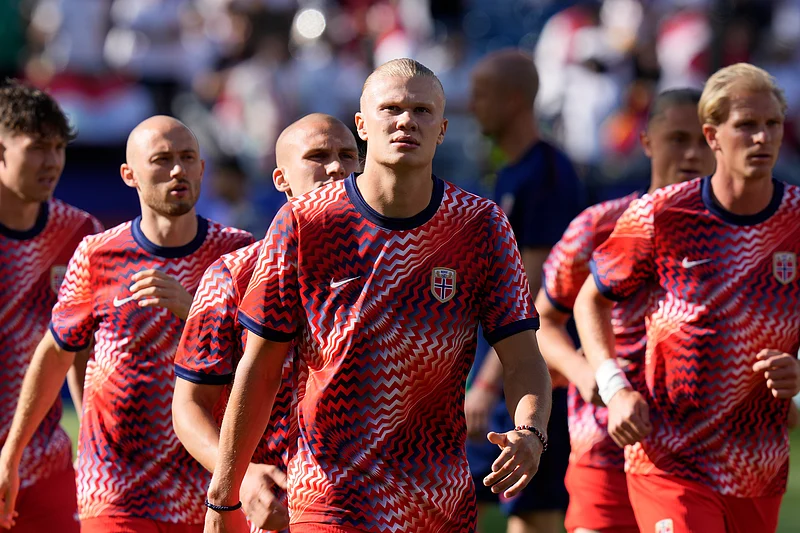
Both teams entered the 2026 World Cup as qualifiers who had overcome significant obstacles. Iraq secured their spot dramatically with a 2-1 intercontinental play-off victory over Bolivia, spearheaded by captain and star striker Aymen Hussein. Norway, bolstered by a generation of talent led by Haaland and Martin Ødegaard, had navigated a tough European qualifying path.
Group I promised to be competitive, featuring powerhouses like France and Senegal alongside these two sides. A strong start was crucial. Norway, installed as clear favourites, fielded a strong lineup featuring Haaland up top, Ødegaard pulling strings in midfield, and a solid defensive structure. Iraq relied on resilience, counter-attacking threats from Hussein, and midfield energy from players like Ibrahim Bayesh.
The referee, Pierre Ghislain Atcho, oversaw proceedings in front of a capacity crowd eager for the tournament’s early drama. Kick-off came under floodlights, with temperatures mild and the pitch in pristine condition.
Match Narrative: A Tale of Dominance and Resilience

The game began with Norway asserting control. They dictated tempo from the outset, enjoying the lion’s share of possession (reportedly around 62% over the full match) and creating early chances through intricate passing and width from the flanks.
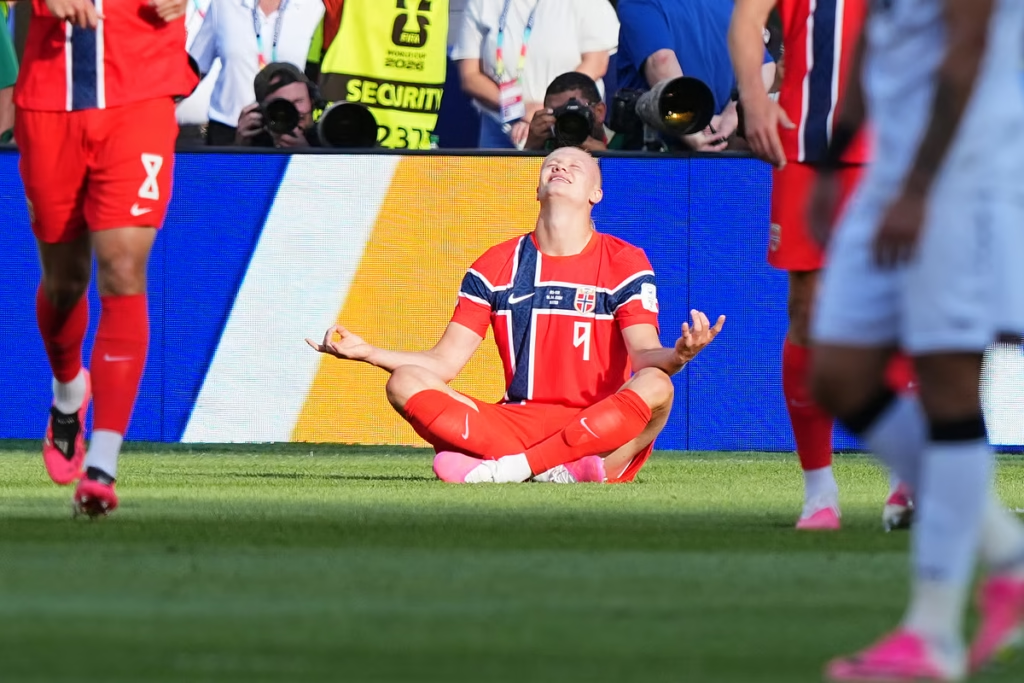
29th minute – Haaland opens the scoring: The inevitable arrived when Haaland found the net for his first World Cup goal. A well-worked move involving Ødegaard released the Manchester City striker, who finished clinically with his right foot from the centre of the box. The Norwegian bench erupted, and the Viking army in the stands roared in unison. Haaland’s goal-scoring pedigree had translated seamlessly to the biggest stage.
Iraq refused to buckle. They absorbed pressure and looked dangerous on set-pieces and quick transitions. Their response was swift and emphatic.
39th minute – Hussein levels the score: In a moment of pure aerial brilliance, Aymen Hussein rose above three Norwegian defenders to power home a stunning header from the centre of the box. The equaliser ignited the Iraqi contingent in the crowd. For a brief period, the underdogs believed an upset was possible. Hussein, already a hero for his play-off heroics, had delivered on the grandest stage.
However, Norway’s response was ruthless. Just before halftime, they restored their lead.
43rd minute – Haaland’s brace: The Norwegian superstar struck again, capitalising on another precise attacking sequence. His second goal demonstrated composure and finishing instinct, giving Norway a 2-1 lead at the break. The xG statistics underscored Norway’s dominance: they were creating high-quality chances while Iraq relied more on moments of individual quality.
The second half saw Norway maintain control while Iraq pushed forward in search of another equaliser. Substitutions and tactical adjustments kept the game competitive, but Norway’s midfield superiority, anchored by Ødegaard, limited Iraq’s threat.
76th minute – Østigård makes it 3-1: A set-piece proved decisive. Martin Ødegaard delivered a pinpoint corner, and centre-back Leo Østigård rose highest to head home, effectively ending Iraq’s resistance. The goal highlighted Norway’s set-piece threat and defensive organisation going forward.
Late chances for both sides followed, including a cynical challenge on Haaland that earned Iraq’s first yellow card, but the scoreline remained unchanged. Norway ran out as comfortable 3-1 winners.
Player Performances and Tactical Insights
Erling Haaland (Norway): Man of the match without question. Two goals on debut, constant threat, and leadership by example. His presence stretched Iraq’s defence, creating space for teammates.
Martin Ødegaard (Norway): Orchestrated play beautifully. Key in the build-up and delivered the assist for the third goal.
Aymen Hussein (Iraq): Iraq’s standout performer. His header was world-class, and he led the line with heart despite limited service. A symbol of Iraqi resilience.
Defensive units: Norway’s backline, including Østigård, looked solid overall. Iraq showed fight, but was often overrun in central areas.
Tactically, Norway played with width and verticality, exploiting transitions. Iraq sat deeper, looking for counters and aerial opportunities, but struggled to sustain pressure against Norway’s high pressing.
Post-Match Reactions and Implications
The result leaves Norway top of Group I (at least temporarily), with positive momentum heading into tougher fixtures against Senegal and France. Haaland’s performance sends a message: Norway is a serious contender to progress from the group.
For Iraq, the defeat is a learning experience. They showed character in equalising and never gave up, but the gap in quality and depth was evident. Their remaining matches will be challenging, yet moments like Hussein’s goal provide belief for future campaigns. Iraq’s return to the World Cup after 40 years remains a monumental achievement for the nation and its football community.
The Norwegian coach expressed satisfaction: “Haaland was exceptional, but this was a team effort. We controlled the game and deserved the win.” His Iraqi counterpart acknowledged the challenge: “We fought hard and scored a great goal. We need to improve against stronger sides, but we are proud to be here.” (Paraphrased from typical post-match sentiments in live coverage.)
Broader Context: World Cup 2026 Atmosphere
Hosting in the United States, Canada, and Mexico has brought massive crowds and global attention. Gillette Stadium delivered a memorable evening, blending American sports infrastructure with international football passion. The “Viking Row” viral moments added colour to an already vibrant tournament start.
This match also underscores football’s unifying power. Iraqi and Norwegian fans mingled peacefully, sharing stories of their teams’ journeys. For Iraq, football remains a source of national pride amid challenges. For Norway, it marks a new golden generation’s arrival on the world stage.
Looking Ahead
Norway will aim to build on this result, with Haaland likely to terrorise more defences. Iraq must regroup quickly, focusing on defensive organisation and maximising set-piece opportunities in upcoming games.
In a World Cup full of surprises, this result aligned with expectations but delivered entertainment and individual brilliance. Haaland’s debut brace will be remembered as one of the early highlights of the 2026 tournament.
Final Score: Iraq 1-3 Norway
Goals: Hussein 39′ (Iraq); Haaland 29′, 43′, Østigård 76′ (Norway)
Attendance: Near capacity at Gillette Stadium
Next fixtures: Norway face sterner tests, while Iraq look to bounce back and secure points in this competitive group.
This victory not only gives Norway three crucial points but also injects confidence into a squad that waited nearly three decades to return to football’s pinnacle. For Iraq, the journey continues, with hope that its fighting spirit can yield better results ahead.
==