India Monsoon Report 2026: A Detailed Analysis of the Southwest Monsoon Season
Executive Summary
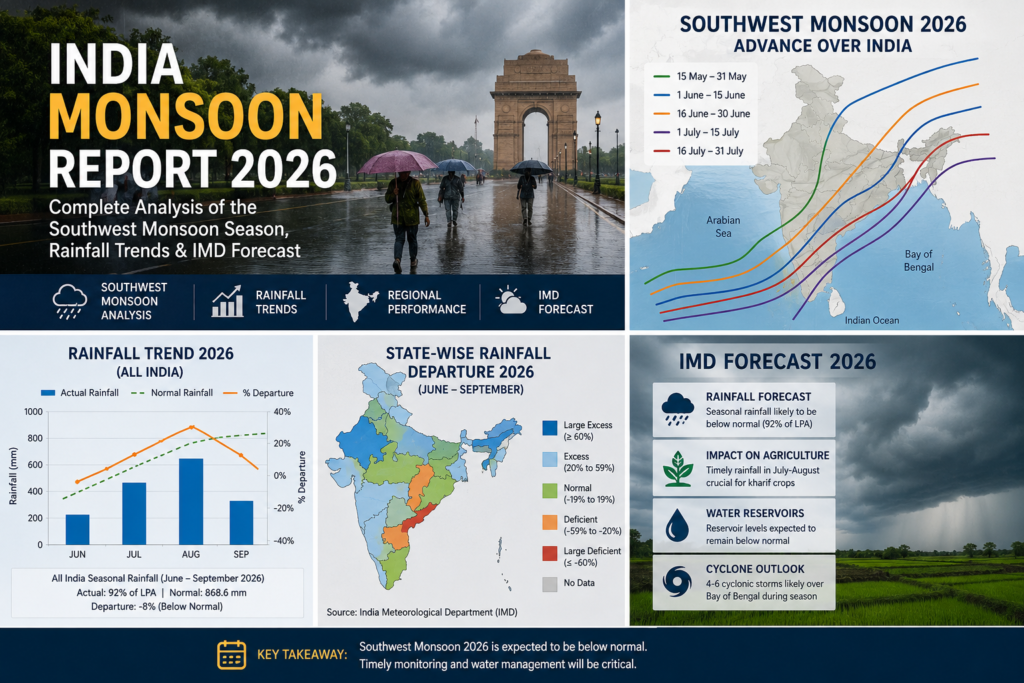
The Southwest Monsoon of 2026 has emerged as a challenging season for India, characterised by a delayed and uneven onset, significant rainfall deficits in the initial phases, and an overall forecast of below-normal precipitation. The India Meteorological Department (IMD) has revised its long-range forecast to project seasonal rainfall (June-September) at approximately 90% of the Long Period Average (LPA), with an 84% probability of below-normal or deficient conditions. This marks the first below-normal forecast in several years, influenced heavily by the developing El Niño conditions in the Pacific Ocean.
As of early July 2026, the monsoon has advanced across much of the country, but cumulative rainfall shows deficits of around 40-47% in many periods, with central and peninsular regions hit hardest. While Northeast India is expected to receive near-normal rainfall, most other homogeneous regions face below-normal prospects. This report provides a comprehensive overview, covering historical context, meteorological drivers, regional performance, sectoral impacts, climate change linkages, and policy recommendations. The analysis underscores the critical need for adaptive strategies in agriculture, water management, and disaster preparedness.
Introduction to the Indian Monsoon System
The Indian Summer Monsoon (ISM), also known as the Southwest Monsoon, is one of the most vital climatic phenomena globally, delivering approximately 70-80% of India’s annual rainfall between June and September. It sustains agriculture for over half of India’s farmland, replenishes reservoirs, supports hydropower, and influences the livelihoods of more than a billion people. The monsoon originates from the differential heating between the Indian landmass and the Indian Ocean, drawing moisture-laden winds from the southwest.
Key features include:
- Onset: Typically begins over Kerala around June 1, advancing northward.
- Active and Break Phases: Periods of heavy rain interspersed with drier spells.
- Withdrawal: Starts from northwest India in September.
The LPA for all-India monsoon rainfall (1971-2020 base) is about 87 cm. Deviations significantly impact GDP, food security, and inflation. In 2026, the onset over Kerala occurred around June 4, slightly delayed, followed by a sluggish advance due to unfavourable atmospheric conditions.
Historical Context and Variability
India’s monsoon has exhibited significant variability over decades. Long-term records show multi-decadal epochs of above- and below-average rainfall. The period from the late 19th to mid-20th century included wetter phases, while recent decades have seen increased extremes.
Notable past events:
- Deficient monsoons like 2002 and 2009 led to droughts and economic stress.
- Above-normal years (e.g., recent good performances in 2024-2025) boosted agricultural output.
Spatial heterogeneity is pronounced: the Western Ghats, Northeast, and central India receive heavy orographic rainfall, while the northwest regions are drier. Trends indicate no strong long-term decline in total seasonal rainfall nationally, but shifts include more intense heavy rainfall events, prolonged dry spells, and regional drying in parts of central and southern India.
Interannual variability is driven by phenomena like El Niño-Southern Oscillation (ENSO), Indian Ocean Dipole (IOD), and Madden-Julian Oscillation (MJO). In 2026, a developing El Niño has been a dominant suppressor.
2026 Monsoon Forecast and Meteorological Drivers
Initial Forecast (April 2026): IMD predicted 92% of LPA (below normal).
Updated Forecast (May 29, 2026): Revised downward to 90% of LPA (±4%), with 60% chance of deficient rainfall (≤89% LPA). Regional breakdown:
- Northeast India: Normal (94-106% LPA).
- Northwest, Central, South Peninsula: Below normal (<92-94% LPA).
- Monsoon Core Zone (key agricultural areas): Below normal.
Key Drivers:
- El Niño: Warming in the equatorial Pacific weakens the monsoon circulation by altering the Walker Circulation and reducing moisture transport. A developing El Niño in 2026 raised concerns early.
- Weak MJO and Somali Jet: Suppressed convective activity and weaker cross-equatorial flow.
- Western Disturbances: Provided some relief in northern regions, but insufficient for overall revival.
- IOD: Neutral conditions offered a limited positive influence.
Progress as of Early July 2026:
- The monsoon advanced progressively but stalled in June, covering most parts by late June. Press releases noted advances into Maharashtra (including Mumbai), Telangana, Odisha, Chhattisgarh, etc., around June 23-24.
- As of late June, weekly and cumulative deficits stood at ~42-47% nationally. Central India faced ~55-62% deficits in early phases.
- July outlook: Below normal rainfall expected, though conditions favour further advance into northern and western states.
Satellite imagery showed clear skies over large areas despite official coverage, indicating weak activity.
Regional Analysis
1. Northwest India (Rajasthan, Punjab, Haryana, Delhi, etc.):
- Slower advance but aided by western disturbances. Expected below-normal overall. Some pockets may see normal rains. Reservoirs and rabi residues provide buffers, but kharif sowing is delayed.
2. Central India (Madhya Pradesh, Maharashtra, Chhattisgarh):
- Severely affected with high deficits (up to 62% in June phases). The core monsoon zone faces risks to rainfed crops like soybean, cotton, and pulses. Stalling over southern Maharashtra was notable.
3. South Peninsula (Kerala, Karnataka, Tamil Nadu, Andhra, Telangana):
- Onset in Kerala on June 4. Deficits in interior regions; coastal areas are relatively better, but still below normal. Eastern parts may fare slightly better.
4. East & Northeast India:
- Better performance expected, with normal rainfall in the Northeast. Sub-Himalayan West Bengal and Sikkim saw heavy spells. Advances into Bihar, Jharkhand, and Odisha were noted in late June.
5. Western Ghats and Himalayan Regions:
- Orographic enhancement provided localised heavy rains, but the overall distribution was uneven. Risks of landslides in hilly areas.
Cumulative data highlights spatial variability, with deficits most acute in rain-dependent central and western belts.
Sectoral Impacts
Agriculture and Food Security:
- Kharif sowing lagged, particularly for rice, pulses, oilseeds, and coarse cereals. Rainfed areas (~52% of net sown area) are most vulnerable.
- Projected yield drops of 5-8% for key crops could elevate food inflation to 7-9%. Pulses and soybeans are high-risk.
- Government contingency plans cover ~300 districts, with a focus on high-priority (low irrigation) areas. Buffer stocks of rice and wheat provide a cushion.
Water Resources:
- Reservoir levels were above 10-year averages initially, offering some relief, but sustained deficits could strain supplies for irrigation and drinking water.
Economy:
- Agriculture contributes ~15-18% to GDP but supports more livelihoods. Weak monsoon could shave growth, increase rural distress, and pressure fiscal spending on subsidies or relief.
- Inflation and rural demand contraction are anticipated.
Health and Environment:
- Prolonged dry spells exacerbate heatwaves. Poor air quality in non-rainy periods. Flood risks in active phases remain for the Northeast and the coasts.
Socio-Economic:
- Impacts on small and marginal farmers, women in agriculture, and tribal communities in rainfed zones. Migration and debt risks rise.
Climate Change Linkages
Climate change is altering monsoon dynamics. While total seasonal rainfall may increase modestly in future projections (due to higher atmospheric moisture), variability intensifies:
- More extreme rainfall events and longer dry spells.
- Westward expansion of monsoon rains into arid zones observed in some studies.
- Anthropogenic forcings (GHGs, aerosols, land-use changes) influence trends. Historical data shows increased heavy rain frequency offsetting moderate rain declines in central India.
For 2026, while not solely attributable to long-term change, the interplay with natural variability like El Niño amplifies risks. Projections suggest wetter monsoons by mid-to-late century but with greater unpredictability, demanding robust adaptation.
Government Response and Adaptation Measures
- IMD’s real-time monitoring and extended range forecasts.
- Agricultural ministries activating drought contingency plans, promoting drought-resistant seeds, and micro-irrigation.
- Water conservation: Rainwater harvesting, watershed management.
- Insurance schemes like PMFBY for risk mitigation.
- Long-term: National Adaptation Fund, climate-smart agriculture, and improved forecasting via models.
Challenges remain in equitable distribution and ground-level implementation.
Future Outlook and Recommendations
As of July 2, 2026, the coming weeks are critical. Revival in July-August could mitigate deficits, but persistent El Niño effects warrant caution. A deficient season would test resilience, while timely rains could still yield average outcomes in better-performing regions.
Recommendations:
- Enhance Monitoring: Integrate AI, satellite data, and local observations.
- Agricultural Resilience: Accelerate shift to climate-resilient varieties, efficient irrigation (e.g., drip, sprinkler), and diversified cropping.
- Water Management: Build storage, promote conservation, and inter-basin transfers where feasible.
- Policy Integration: Link monsoon forecasts tightly with fiscal planning, subsidies, and MSP adjustments.
- Research and International Cooperation: Deepen understanding of ENSO-monsoon teleconnections and collaborate on global climate models.
- Community Level: Awareness campaigns, early warning systems, and insurance penetration.
In conclusion, the 2026 monsoon highlights India’s vulnerability to climatic variability amid a changing climate. While challenges are significant, proactive measures and technological advancements offer pathways to greater resilience. Sustained investment in sustainable development will ensure the monsoon remains a boon rather than a periodic threat to India’s progress.
References: Drawn from IMD releases, PIB, news analyses, and scientific literature (2026 data).
====