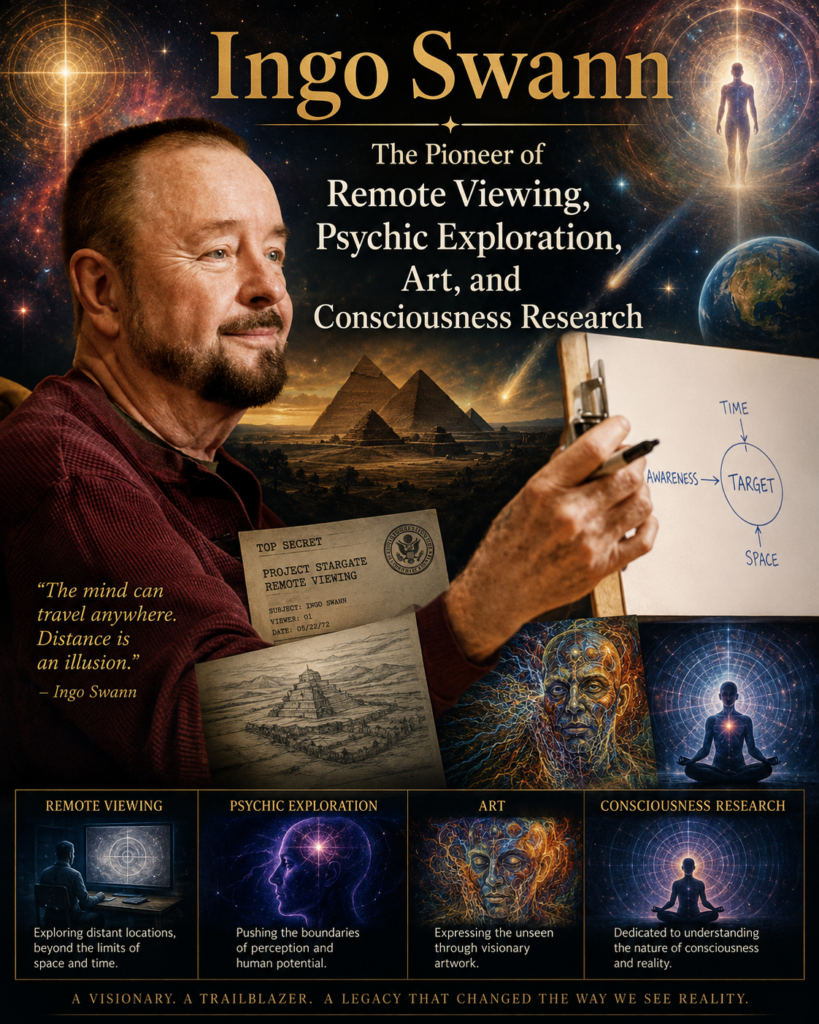
Ingo Swann: The Pioneer of Remote Viewing, Psychic Explorer, Artist, and Consciousness Researcher
Ingo Douglas Swann (September 14, 1933 – January 31, 2013) stands as one of the most influential and controversial figures in the history of parapsychology. Credited with coining the term “remote viewing” and playing a central role in developing Controlled Remote Viewing (CRV), Swann’s work bridged the worlds of art, science, intelligence, and the exploration of human consciousness. His claims of extrasensory perception (ESP), out-of-body experiences (OBEs), and psychokinesis (PK) were rigorously tested by researchers at institutions like the Stanford Research Institute (SRI) and funded in part by the U.S. government through programs like the Stargate Project. While sceptics dismiss much of his work as pseudoscience or methodological artefact, proponents hail him as a visionary who demonstrated the untapped potential of the human mind.
This article explores Swann’s life in depth: his early experiences, artistic career, groundbreaking experiments, theoretical contributions, books, artistic legacy, and enduring impact. It examines both the evidence supporting his abilities and the criticisms, aiming for a balanced, comprehensive portrait of a man who challenged conventional understandings of perception and reality.
Early Life and Formative Experiences
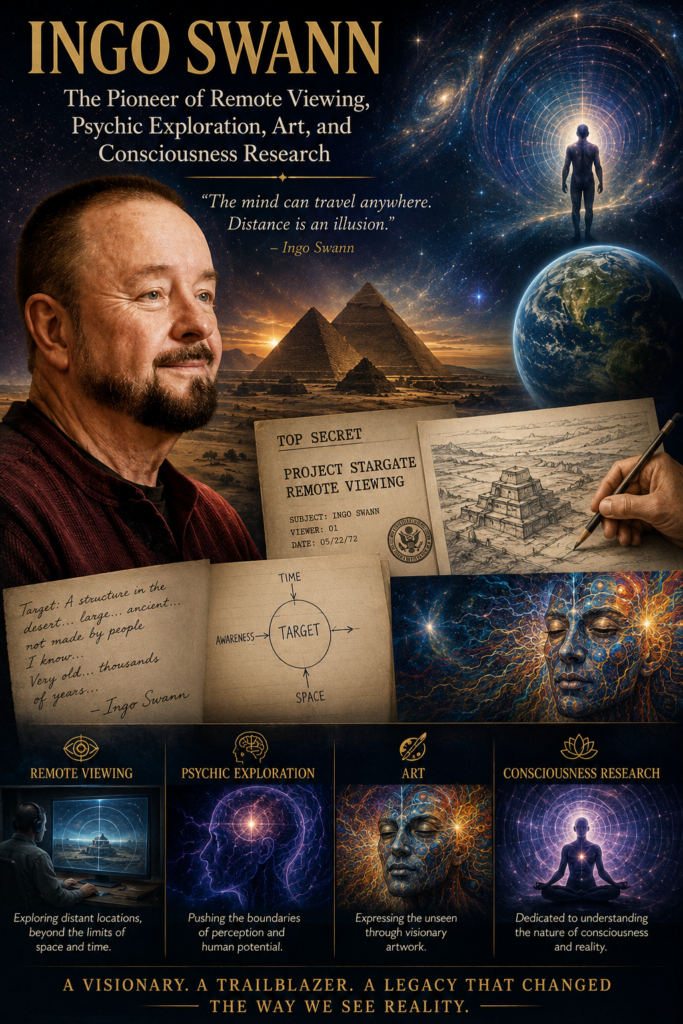
Ingo Swann was born in Telluride, Colorado, a rugged mining town high in the Rocky Mountains. His father worked as a truck driver, and he had two sisters. Life in this isolated, high-altitude environment fostered a deep attunement to nature, intuition, and subtle environmental cues—skills that Swann later connected to his psychic development. He claimed early psychic experiences, including out-of-body sensations during a tonsillectomy at age three, after which he began perceiving colourful auras around objects. By age nine, he described mentally travelling to the Milky Way.
Swann earned a bachelor’s degree in biology from Westminster College in Salt Lake City, Utah. He served three years in the U.S. Army during the Korean War era, stationed in the Far East. After his military service, he moved to New York City, where he worked at the United Nations Secretariat from 1958 to 1969. During this period, he pursued creative endeavours, writing erotic fiction and developing his skills as a painter. His art often featured symbolic, visionary themes that reflected his interest in perception and the unseen.
Swann’s path into parapsychology crystallised in the early 1970s. A 1971 photography experiment at a party reportedly captured a ball of light above his head in a darkened room, drawing attention to his abilities. This led him to volunteer for research at the American Society for Psychical Research (ASPR) in New York at age 37. His childhood experiences and a growing dissatisfaction with materialist worldviews propelled him forward. He was also involved with Scientology, achieving the level of Operating Thetan, which he linked to enhanced exteriorization (controlled OBEs). He later distanced himself from the organisation but retained influences from its ideas on consciousness.
Entry into Parapsychology: Psychokinesis and Early ESP Research
Swann’s initial tests focused on psychokinesis (mind-over-matter). At the ASPR, psychologist Gertrude Schmeidler tested him on influencing the temperature of insulated graphite samples using a thermistor setup with strict controls. Swann repeatedly produced statistically significant effects, with analyses suggesting he altered temperatures in a field around the target, sometimes with compensatory changes at a distance. Psychological factors, rather than physical distance, appeared to modulate the effect size.
He collaborated with Cleve Backster on experiments involving plant consciousness. Attached to a polygraph, plant leaves showed stress responses when Swann visualised harming them (e.g., burning or applying acid), with effects fading as if the plants “learned” the threat was not real. Swann also influenced electrical conductivity in graphite and electron release in pressurised gases, demonstrating what he called “psi probes.”
At SRI, upon arrival in 1972, physicist Harold Puthoff tested Swann on a heavily shielded magnetometer (quark detector) buried in concrete. Swann reportedly altered the magnetic field and even stopped the output for about 45 seconds through mental visualisation. Accounts vary slightly—Puthoff and others described clear anomalies uncorrelated with environmental factors—but the results impressed enough to draw CIA interest. Swann also influenced random number generators (RNGs) in tests with Charles Honorton and others, achieving significant scores, especially at a distance.
These PK experiments established Swann as a high-performing subject, blending his artistic visualisation skills with disciplined mental focus.
The Birth of Remote Viewing
Swann is widely credited with originating the term “remote viewing” and pioneering its controlled application. In 1971–1972, working with researchers at ASPR and then SRI (with Harold Puthoff and Russell Targ), he demonstrated the ability to describe distant locations using only geographical coordinates.
Early experiments involved “travelling” to random map coordinates. In one set of ten trials with ten targets, Swann achieved seven hits. Controls tightened: coordinates were encrypted, and targets included secret military sites verifiable only by satellite. Success rates remained high, suggesting more than geographical memory or cueing. Swann proposed coordinate-based remote viewing (later Controlled Remote Viewing or CRV), minimising sensory input and conscious interference to access subconscious perceptions.
A landmark 1972 out-of-body experiment at ASPR, directed by Karlis Osis, involved Swann describing objects on a high shelf while wired to an EEG. Blind judging matched his descriptions and sketches with high accuracy (odds estimated at 40,000 to 1 in some analyses). Brain activity showed elevated alpha waves during successes.
Swann’s work directly influenced the CIA’s interest. Puthoff and Targ’s reports circulated, leading to funding for SRI programs that evolved into the Stargate Project (and related efforts), running for over two decades. Swann helped train military viewers and refine protocols, contributing to a multi-stage CRV methodology emphasising structured stages: ideograms, sensory impressions, analytical overlay reduction, and detailed sketching.
The Jupiter Probe and Planetary Remote Viewing
One of Swann’s most famous claims occurred on April 27, 1973. He proposed viewing Jupiter before NASA’s Voyager missions. In a recorded session, after requesting silence, he described atmospheric bands of crystals (likened to Saturn’s rings but closer in), liquid interiors, high winds, colourful clouds, and a mountainous horizon. He noted thin rings around the planet.
Voyager 1 confirmed Jupiter’s rings in 1979—thin and previously unknown or unconfirmed in detail. Later, Galileo’s data supported ammonia ice crystals in the atmosphere. Critics argue rings were hypothesised beforehand, and descriptions were vague or retrofitted, but proponents view it as striking corroboration of non-local perception. Swann also viewed Mars and other targets, reporting water and other features later aligned with some NASA findings.
These sessions highlighted Swann’s method: entering a focused state, allowing impressions to emerge, and sketching/describing without immediate analysis.
Collaboration with Scientists, Government Programs, and Broader Research
At SRI, Swann collaborated extensively with Puthoff and Targ. Their work attracted CIA and military attention amid Cold War fears of Soviet psi research. Swann’s coordinate method became foundational for operational remote viewing. He participated in viewing encrypted or distant targets, with some results reportedly aiding intelligence (though declassified documents show mixed utility overall).
Other researchers studied him: Michael Persinger exposed Swann to magnetic fields, correlating 7-Hz occipital activity with accuracy in hidden-target tasks. Neuropsychological and MRI data suggested atypical parieto-occipital organisation in his right hemisphere, hinting at neurological correlates for his abilities.
Swann worked with Jacques Vallée on mineral sample viewing via early ARPAnet, achieving strong results. Charles Tart’s protocols showed evidence of telepathy and precognition in Swann’s performance. William Roll tested distant hearing during OBEs.
He emphasised that remote viewing was a trainable skill rooted in natural human perception, not a rare supernatural talent. His CRV protocols stressed discipline, feedback, and reducing “analytical overlay” (conscious guessing).
Artistic Career and Creative Output
Swann was first and always an artist. His paintings—symbolic, vibrant, often cosmic or perceptual in theme—are held in collections like the American Visionary Art Museum (Baltimore) and the Smithsonian National Air and Space Museum. Works like The Light Bringer exemplify his visual intuition.
His art and psychic work intertwined: sketching during sessions was both data collection and creative expression. He viewed perception as an artistic process—disciplined attention yielding novel insights.
Books and Theoretical Contributions
Swann authored numerous books blending memoir, instruction, theory, and speculation:
- To Kiss Earth Goodbye (early autobiography).
- Everybody’s Guide to Natural ESP (practical methods for unlocking innate abilities).
- Your Nostradamus Factor (future-seeing potential).
- Penetration: The Question of Extraterrestrial and Human Telepathy (1998, updated editions)—a provocative exploration of UFOs, lunar anomalies, and consciousness, drawing on his sessions.
- Psychic Sexuality, Secrets of Power (multi-volume on empowerment vs. societal depowerment), The Great Apparitions of Mary, and Remote Viewing: The Real Story (memoir detailing the program’s history, politics, and “soap opera”).
His writings argue that psychic abilities are universal but suppressed by culture, education, and power structures. He advocated rigorous, scientific study of consciousness while critiquing materialism. Archives at the University of West Georgia preserve his papers.
Criticisms and Sceptical Perspectives
Swann’s work faced significant scrutiny. Sceptics like James Randi and Milbourne Christopher questioned controls, suggesting possible cueing, cherry-picking, or fraud. Jupiter descriptions are debated: prior hypotheses existed, and some details (e.g., surface dunes) conflict with modern knowledge of Jupiter’s gaseous nature. Stargate overall yielded inconsistent intelligence value, leading to its 1995 termination.
Methodological issues—small samples, subjective judging, file-drawer effects—plague parapsychology broadly. Swann’s Scientology ties raised bias concerns. However, some experiments (e.g., Schmeidler’s PK, Persinger’s correlations) used tight protocols, and declassified documents show genuine interest from scientists.
Swann himself acknowledged challenges in replication and the role of belief/psychological state. He positioned his work as exploratory, not definitive proof.
Legacy and Cultural Impact
Swann died in New York City on January 31, 2013, at age 79. His influence persists in remote viewing communities, consciousness studies, and popular culture (e.g., inspiring elements in films like The Men Who Stare at Goats). Military viewers like Joseph McMoneagle are trained under related protocols. His estate and official site promote a creator-centred view of his work.
Swann challenged reductionist science, suggesting human perception extends beyond senses into non-local realms. Whether one views him as a genuine psychic pioneer, skilled visualizer, or product of experimental flaws, his contributions sparked decades of research and debate on consciousness.
In an era of renewed interest in psi phenomena, UAPs, and neurophenomenology, Swann’s life invites us to question limits. As he wrote, daring to disagree with conventional truths about human potential may open new frontiers of understanding. His art, writings, and protocols remain resources for those exploring the mind’s deeper capacities.
==