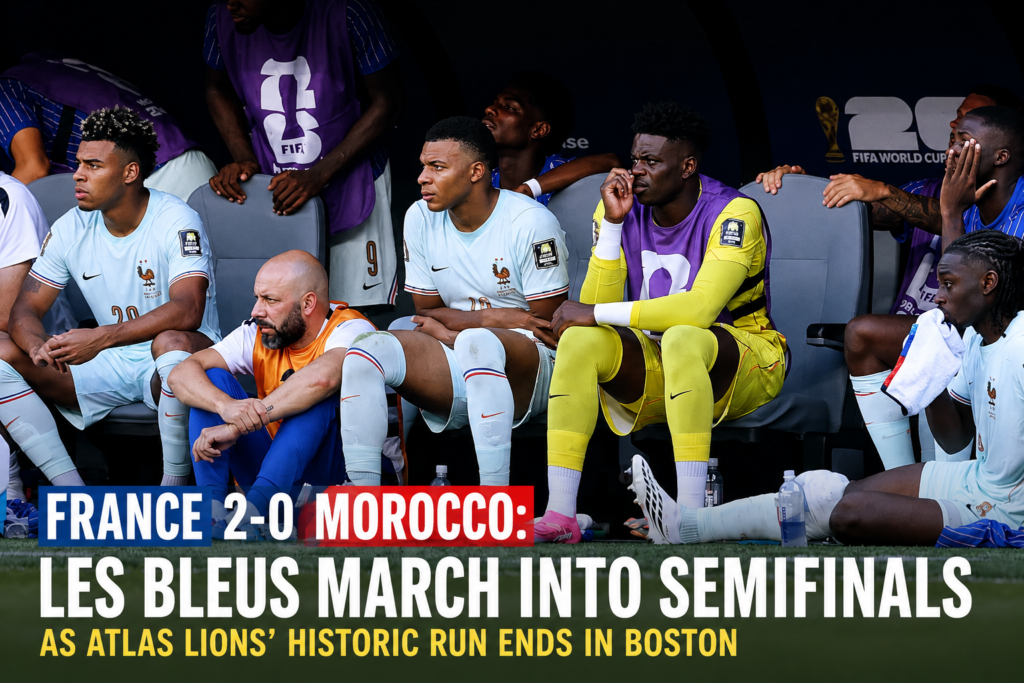
France 2-0 Morocco: Les Bleus March into Semifinals as Atlas Lions’ Historic Run Ends in Boston
Boston, July 9, 2026 – In a quarter-final clash dripping with narrative weight, defending champions France overcame a resilient Morocco side 2-0 at Boston Stadium (Gillette Stadium, Foxborough) to book their place in the 2026 FIFA World Cup semifinals. Second-half strikes from Kylian Mbappé and Ousmane Dembélé proved decisive on a night when Morocco’s defensive organisation and counter-attacking threat pushed the European powerhouse to the limit for long periods.
The result marks France’s third consecutive semifinal appearance at the World Cup and extends their remarkable knockout-stage unbeaten run. For Morocco, the dream of becoming the first African nation to reach a World Cup final came to an end, but their campaign – echoing their fairy-tale 2022 run – has once again elevated the Atlas Lions on the global stage.
Pre-Match Context: A Rematch Four Years in the Making
This was no ordinary quarter-final. Four years earlier, in the 2022 semifinals in Qatar, France had edged Morocco 2-0 with goals from Theo Hernández and Randal Kolo Muani, ending the Atlas Lions’ extraordinary journey to fourth place. Many of the same protagonists returned in 2026, but the context had evolved.
France arrived in North America as favourites, boasting a squad of terrifying depth. Kylian Mbappé, now 27 and captain, had already surpassed Olivier Giroud as France’s all-time top scorer. Supporting him were in-form attackers like Ousmane Dembélé (fresh off a stellar club season), Michael Olise, Bradley Barcola, and midfield anchors Aurélien Tchouaméni and Eduardo Camavinga. Didier Deschamps, in what could be his final tournament, fielded a side blending youth and experience, with William Saliba and Dayot Upamecano forming one of the tournament’s meanest defensive partnerships.
Morocco, under their coach, had once again defied expectations. After topping a tough group and dispatching Canada 3-0 in the Round of 16, they brought a mix of European-based talent and domestic stars. Achraf Hakimi remained the heartbeat on the right flank, while midfielders like Azzedine Ounahi and Sofiane Amrabat provided steel and creativity. Forward lines featuring players like Soufiane Rahimi and Brahim Díaz offered pace and guile. Morocco’s identity – compact defending, rapid transitions, and unbreakable spirit – made them dangerous opponents.
The atmosphere in Boston was electric. A sell-out crowd of over 65,000 featured a sea of blue, white, and red alongside significant Moroccan support waving red flags and chanting throughout. The North American hosts embraced the occasion, turning Gillette Stadium into a cauldron reminiscent of European nights.
Team News and Tactical Setup
Deschamps opted for a 4-3-3 formation: Mike Maignan in goal; a back four of Jules Koundé, Saliba, Upamecano, and Theo Hernández; a midfield trio of Tchouaméni, Camavinga, and Antoine Griezmann (in a deeper creative role); and an attacking front of Dembélé, Mbappé, and Olise.
Morocco mirrored with a disciplined 4-2-3-1 or 5-4-1 shape depending on the phase, prioritising compactness. Hakimi and left-back Noussair Mazraoui provided width, while the central defence, led by experienced figures, aimed to frustrate France’s stars. Goalkeeper Yassine Bounou (Bono) was expected to be heroic once more.
The stage was set for a tactical battle: France’s technical superiority and pressing versus Morocco’s organisation and set-piece threat.
First Half: Mbappé Misses Penalty, Morocco Hold Firm
The match began at a high tempo. France dominated possession from the outset, probing with quick passes and Mbappé’s runs in behind. Morocco sat deep but looked dangerous on the break, with Hakimi’s overlapping runs posing early questions.
The game’s first major flashpoint arrived in the 18th minute. Dembélé, lively on the right, danced past two defenders and was clipped inside the box. The referee pointed to the spot. Mbappé stepped up, confidence personified after his tournament haul. But Bounou guessed correctly, diving low to his right to palm away the penalty. The Moroccan fans erupted; France had been denied a dream start.
Undeterred, Les Bleus continued to press. Griezmann orchestrated from midfield, spraying diagonals, while Tchouaméni won duels and sprayed progressive passes. Saliba and Upamecano were imperious, snuffing out rare Moroccan forays.
Morocco grew into the half. Around the 35th minute, a swift counter saw Ounahi release Rahimi, whose shot was well saved by Maignan. Hakimi’s crosses caused occasional panic, but France’s defence held. Mbappé, frustrated by the miss, still created chances, forcing a smart save from Bounou after cutting inside.
As the half drew to a close, the score remained 0-0. France had 62% possession and multiple chances, but Morocco’s resilience – typical of their tournament – kept them in it. Deschamps would have demanded more cutting edge at the break, while Morocco’s coach praised the discipline but urged better transition execution.
Second Half: France’s Quality Shines Through
The second period opened with France increasing its intensity. Subtle tactical shifts saw more rotation in attack. In the 52nd minute, the deadlock broke.
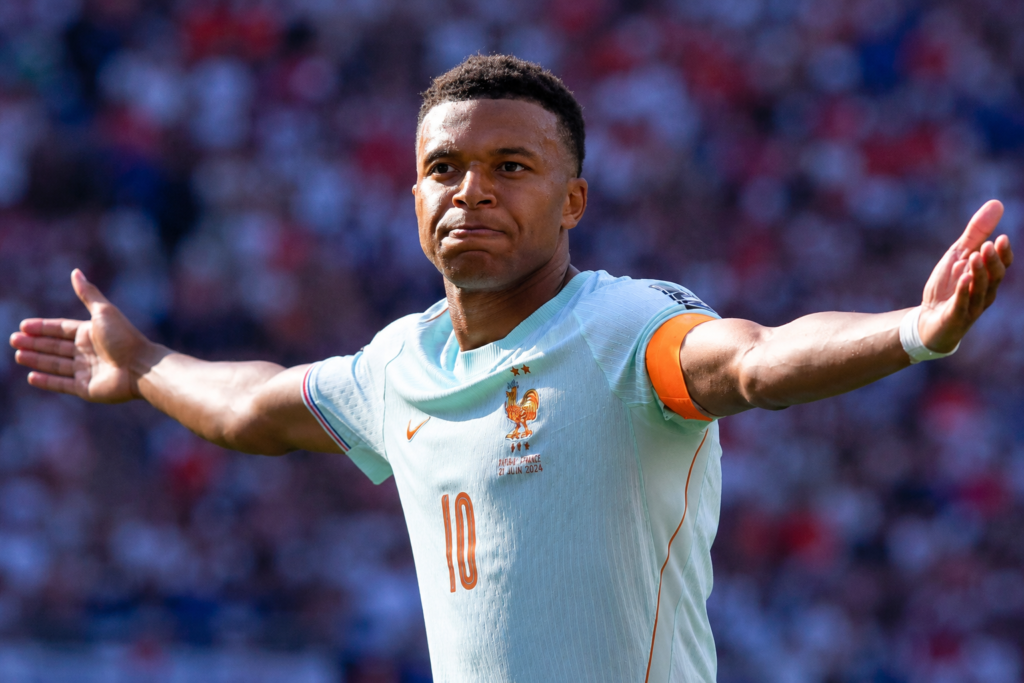
A flowing move started with Camavinga winning the ball in midfield and feeding Griezmann. The veteran played a perfectly weighted pass into the channel for Mbappé. The captain accelerated, evading a sliding challenge, and unleashed a low drive across Bounou into the far corner. 1-0 France. The stadium exploded in blue. Mbappé, celebrating his landmark World Cup goal (reportedly his 20th in the competition), pointed to the sky – a moment of redemption after the penalty miss.
Morocco responded bravely. They pushed higher, seeking an equaliser. Hakimi’s runs became more frequent, and substitute entries added fresh legs. A dangerous free-kick delivery tested Maignan, who claimed confidently. Amrabat and Ounahi battled tirelessly in midfield, but France’s press recovered quickly.
The second goal arrived in the 71st minute, effectively sealing the contest. Dembélé, tormentor-in-chief on the right, received from Olise, cut inside on his left foot, and curled a magnificent effort into the top corner from 20 yards. Bounou had no chance. 2-0. Dembélé’s club form translated perfectly to the international stage, adding another layer to France’s attacking options.
Morocco refused to capitulate. Late surges produced half-chances, but France’s defence, marshalled by Saliba (who won nearly every aerial and ground duel), remained rock-solid. Maignan made a crucial late save to preserve the clean sheet. Full-time: France 2, Morocco 0.
Key Performances and Player Ratings
Kylian Mbappé (France) – 9/10: Man of the Match. Goal, constant threat, leadership. His pace and finishing remain world-class.
Ousmane Dembélé (France) – 8.5/10: Dazzling dribbling and the decisive second goal. Unplayable at times.
William Saliba (France) – 8/10: Defensive masterclass. Read the game perfectly.
Achraf Hakimi (Morocco) – 7.5/10: Tireless, created Morocco’s best moments. World-class full-back.
Yassine Bounou (Morocco) – 7/10: Heroic penalty save and several other stops. No blame for goals.
Azzedine Ounahi (Morocco) – 7/10: Creative spark in a difficult evening.
Other notables: Tchouaméni’s midfield control (8/10), Griezmann’s vision, and Morocco’s central defenders, who limited clear-cut chances despite the scoreline.
Tactical Analysis: Quality Over Resilience
France’s victory was built on superior squad depth, pressing intensity, and clinical finishing. Deschamps’ side controlled the tempo, forced errors, and capitalised on moments of individual brilliance. Their ability to absorb pressure and transition rapidly proved decisive.
Morocco’s setup was intelligent – low block, high pressing triggers, and wide overloads via full-backs. They limited France to fewer clear chances than expected and forced the penalty save. However, the lack of a clinical No. 9 and fatigue in the latter stages (after a demanding campaign) told. Their transitions were sharp but lacked the final polish against elite defending.
Set pieces were a minor factor; France defended them well, while Morocco’s delivery was occasionally wasteful.
Post-Match Reactions
A composed Didier Deschamps said: “We knew it would be tough – Morocco are a special team with great spirit. The penalty miss changed nothing in our approach; we stayed patient and clinical when it mattered. Kylian and Ousmane were outstanding. Now we focus on the semi-final.”
Mbappé added, “Missing the penalty hurt, but the team believed. Scoring and winning for France is always special. We have more to give.”
On the Moroccan side, Hakimi reflected: “We gave everything. France is the champion for a reason. To reach the quarters again and compete like this makes me proud of this group and our nation. We go home with heads high and build for the future.”
Moroccan fans chanted in support long after the whistle, acknowledging their heroes’ efforts.
Broader Implications and Tournament Context
France advances to face the winner of Spain vs. Belgium in the semifinals. A potential final against Argentina (still alive in the other half) looms as a mouth-watering prospect, echoing 2022.
For Morocco, elimination ends a campaign that rekindled national pride. Their run has inspired a generation across Africa and the Arab world, proving that tactical discipline and collective belief can challenge football’s traditional powers. Players like Hakimi, Ounahi, and emerging talents will return stronger, with club careers enhanced.
The 2026 World Cup quarter-finals have lived up to the hype, showcasing the expanded format’s competitiveness. France remain favorites for a third star, but nights like this remind everyone of football’s unpredictability.
Historical Significance and Legacy
This match adds another chapter to the France-Morocco football rivalry. From 2022’s semifinal heartbreak to 2026’s quarter-final repeat, the ties symbolise broader themes: European football’s resource advantage versus emerging nations’ resilience and diaspora talent.
France’s continued success under Deschamps cements its status as the team of the 2018-2026 era. Mbappé’s legacy grows with each tournament goal. For Morocco, the “fourth place in 2022, quarters in 2026” arc sets the foundations for future deep runs, perhaps even a title challenge in years to come.
Fan and Media Perspectives
Social media exploded post-match. French fans celebrated with memes of Mbappé’s redemption and Dembélé’s curler. Moroccan supporters flooded timelines with pride messages: “You made history again. Atlas Lions forever.”
International media praised the contest’s quality. Analysts highlighted France’s “ruthless efficiency” and Morocco’s “unyielding spirit.” Pundits debated whether Morocco could have nicked a goal on another night, but consensus favoured Les Bleus’ superiority.
In Boston’s streets, mixed celebrations: French expats and locals partied, while Moroccan communities reflected on a valiant effort with dignity.
Looking Ahead: Semifinal Preparations
France will recover, analyse the video, and prepare for a likely high-stakes semi. Depth allows rotation – vital after a gruelling campaign. Deschamps may tweak personnel based on the opponent.
Morocco returns home to parades and reflection. Investment in youth academies and infrastructure, already accelerated post-2022, will likely intensify.
Statistical Deep Dive
- Possession: France 58% – Morocco 42%
- Shots: France 14 (6 on target) – Morocco 8 (3 on target)
- Passes: France completed over 550 with 88% accuracy; Morocco completed 420 at 82%.
- Duels Won: France edged overall, but Morocco was competitive in midfield.
- Expected Goals (xG): France approx. 1.8 – Morocco 0.7 (estimated based on chances).
- Mbappé: 1 goal, 3 key passes, 5 dribbles.
- Clean sheet for France – their third of the knockout stage.
These numbers underscore France’s control without total dominance, highlighting Morocco’s competitiveness.
The Human Stories
Behind the scores lie personal journeys. Mbappé, carrying France’s attack since 2018, continues to evolve as a leader. Hakimi balances superstar status with national duty. Young Moroccan fans in the stands, waving flags inherited from 2022, represent football’s power to unite.
Injuries, form dips, and off-field pressures tested both squads. The match embodied resilience: France overcoming the penalty miss; Morocco refusing to fold despite trailing.
Conclusion: Champions Advance, Legends Forged
France 2-0 Morocco was a quarter-final of high quality, tactical nuance, and emotional resonance. Les Bleus progress as deserved winners, their blend of talent and mentality shining brightest when it mattered. Morocco exits with honour, its legacy secure as a trailblazer.
As the 2026 World Cup hurtles toward its climax, this result reaffirms France’s pedigree while celebrating Morocco’s enduring impact. Semifinals await, where new heroes will emerge. For now, Paris dreams of another star, Rabat of future glory..
===