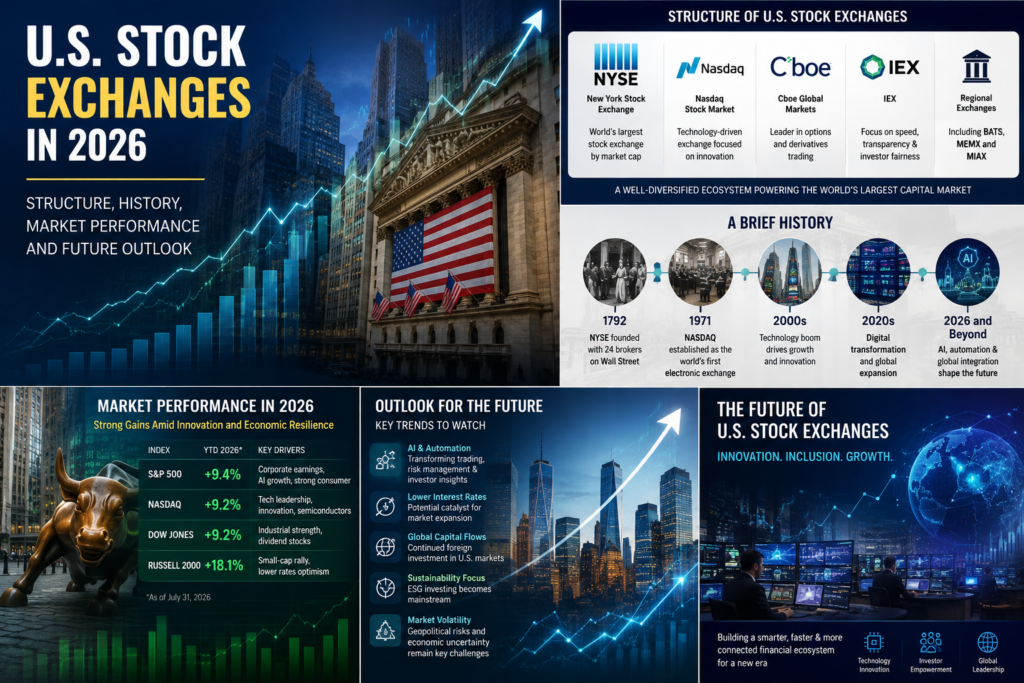
New York / Washington, August 1, 2026 — The United States stock market remains the dominant force in global finance, a vast ecosystem of exchanges, regulators, investors, and companies that channels capital, prices risk, and reflects the health of the world’s largest economy. By mid-2026, the combined market capitalisation of U.S. public companies stood near $75 trillion, underscoring its scale. Major indexes closed the final trading session of July near 52,486 for the Dow Jones Industrial Average, 7,490 for the S&P 500, and 25,374 for the Nasdaq Composite, reflecting a year marked by artificial-intelligence optimism, geopolitical tensions, earnings strength, and shifting sector leadership.
This report examines the architecture of U.S. stock exchanges, their historical evolution, regulatory framework, current market dynamics, key participants, structural changes, and the challenges and opportunities ahead. It draws on official data, exchange disclosures, regulatory filings, and market performance through the first half and early third quarter of 2026, setting up the sections that follow.
Historical Foundations: From Buttonwood Tree to Electronic Dominance
The origins of organised stock trading in the United States date to May 17, 1792, when 24 brokers signed the Buttonwood Agreement under a buttonwood tree on Wall Street in New York. They agreed to trade only among themselves at fixed commission rates, laying the groundwork for what became the New York Stock Exchange (NYSE). The exchange formalised over the 19th century amid the growth of railroads, industrial enterprises, and banking, surviving panics, wars, and the Civil War.
For much of its history, the NYSE operated as a member-owned organisation with a physical trading floor where specialists matched orders. It remained the preeminent venue for large, established companies. The 20th century brought progressive regulation after the 1929 crash and the Great Depression. The Securities Act of 1933 required disclosure for public offerings, while the Securities Exchange Act of 1934 created the Securities and Exchange Commission (SEC) and established exchanges as self-regulatory organisations (SROs) under federal oversight.
Nasdaq emerged in 1971 as the National Association of Securities Dealers Automated Quotations system, the world’s first fully electronic stock market. Created under the National Association of Securities Dealers (NASD, later split into Nasdaq for trading and FINRA for broker regulation), it automated quotes for over-the-counter stocks. Eventually, it evolved into a full national securities exchange. Nasdaq attracted growth companies, particularly in technology, and registered as an independent exchange in the mid-2000s.
Key structural shifts followed. Decimalisation in 2001 reduced tick sizes and compressed spreads. The Unlisted Trading Privileges Act of 1994 allowed any exchange to trade stocks listed elsewhere, fostering competition. Electronic trading platforms, alternative trading systems (dark pools), and high-frequency trading transformed execution. Ownership also changed: the NYSE demutualised, merged with Archipelago, became part of NYSE Euronext, and is now owned by Intercontinental Exchange (ICE). Nasdaq, Inc. operates as a publicly traded technology and exchange company.
By 2026, the U.S. equity market features roughly 29 national securities exchanges registered under Section 6 of the Exchange Act, plus numerous alternative trading systems and dark pools. Primary listing venues remain the NYSE and Nasdaq, with significant activity on Cboe platforms, IEX, MEMX, and newer entrants such as the Texas Stock Exchange (approved in 2025) and 24X National Exchange, which offers extended hours.
Market Structure and Major Exchanges
U.S. equity trading is highly fragmented yet interconnected. Stocks listed on one exchange can trade on any of the others or off-exchange venues. Trade reporting occurs on three tapes: Tape A for NYSE-listed securities, Tape C for Nasdaq listings, and Tape B for others (including many ETFs and smaller companies).
New York Stock Exchange (NYSE): Often called the “Big Board,” the NYSE maintains a hybrid model combining electronic trading with a physical floor at 11 Wall Street. It historically favoured larger, more established companies and continues to list blue-chip industrial, financial, and consumer firms. Ownership rests with ICE. Listing standards emphasise financial thresholds, public float, and corporate governance. The NYSE and its affiliates (NYSE Arca for ETFs, NYSE American for smaller companies) handle substantial volume.
Nasdaq Stock Market: Fully electronic from inception, Nasdaq is the preferred venue for technology, biotechnology, and growth companies. It operates three tiers—Global Select Market (highest standards), Global Market, and Capital Market—with varying financial and liquidity requirements. As of late 2025 and into 2026, Nasdaq listed thousands of companies and exchange-traded products. Its parent company provides market technology worldwide and operates exchanges in the Nordics and Baltics.
Other notable venues include multiple Cboe exchanges (BYX, BZX, EDGA, EDGX), Investors Exchange (IEX, known for its speed bump to mitigate latency advantages), MEMX, MIAX platforms, Long-Term Stock Exchange, and newer competitors seeking differentiated models such as extended hours or specialised listings. Dark pools and wholesale market makers handle a significant share of volume, particularly for retail orders, raising ongoing debates about transparency and price discovery.
Trading hours traditionally run 9:30 a.m. to 4:00 p.m. Eastern Time, with pre- and post-market sessions. Proposals for near-24-hour trading advanced in 2025–2026, with 24X already offering extended equity trading and Nasdaq and others pursuing regulatory approval for broader continuous access, partly to serve global investors in different time zones.
Indexes serve as primary benchmarks. The Dow Jones Industrial Average tracks 30 large blue-chip stocks (price-weighted). The S&P 500 covers approximately 500 large-cap companies (market-cap weighted) and is widely regarded as the best single proxy for the overall U.S. market. The Nasdaq Composite includes nearly all Nasdaq-listed stocks and is heavily weighted toward technology. The Russell 2000 focuses on smaller companies. Sector and thematic indexes, plus thousands of ETFs, allow granular exposure.
Regulation: The SEC and Self-Regulatory Framework
The SEC is the primary federal regulator, charged with protecting investors, maintaining fair, orderly, and efficient markets, and facilitating capital formation. Created by the 1934 Act, it oversees exchanges as SROs, broker-dealers, investment advisers, clearing agencies, transfer agents, and public company disclosure. Exchanges must file rule changes for SEC review and enforce their own listing and trading rules, subject to Commission oversight. FINRA regulates broker-dealers.
Core statutes include the Securities Act of 1933 (primary offerings and antifraud provisions), the Exchange Act of 1934 (secondary markets, registration, and ongoing reporting), the Investment Company Act and Investment Advisers Act of 1940, and later legislation addressing market structure, derivatives, and systemic risk. Public companies file periodic reports (10-K annual, 10-Q quarterly, 8-K current events), proxy statements, and beneficial ownership disclosures. Insider trading, market manipulation, and fraud are prohibited.
Circuit breakers and Limit Up-Limit Down mechanisms help manage volatility. Market-wide circuit breakers halt trading at declines of 7%, 13%, and 20% in the S&P 500. Single-stock bands prevent extreme moves outside dynamic ranges.
Listing standards on major exchanges require minimum market capitalisation or equity, public float, shareholder distribution, share price, and corporate governance (independent directors, audit committees, etc.). Continued listing criteria prevent delisting of failing companies, though reverse splits and other measures are sometimes used. Recent proposals in 2026 include higher minimum market-value thresholds and minimum trading-price standards.
Scale, Participants, and Capital Formation
U.S. equities represent the largest and deepest capital market globally. As of early July 2026, the total market value of U.S.-based public companies listed on NYSE, Nasdaq, and certain OTC markets reached approximately $75.3 trillion, after substantial gains in 2025. The United States accounts for a dominant share—often cited near or above 60%—of global free-float market capitalisation in broad indexes.
Thousands of companies are listed or report as public issuers. IPO activity rebounded strongly after quieter years: 2024 saw improvement, 2025 recorded hundreds of deals, and 2026 proceeded with solid proceeds amid AI-related enthusiasm, though deal counts varied by quarter. Listing standards and competition between NYSE and Nasdaq influence issuer choice; technology and growth firms often prefer Nasdaq, while more mature companies may choose the NYSE.
Investors range from individual retail traders (facilitated by zero-commission brokers and fractional shares) to massive institutional players—pension funds, mutual funds, ETFs, hedge funds, sovereign wealth funds, and endowments. Passive investing via index funds and ETFs has grown dramatically, concentrating ownership and influencing price discovery and volatility patterns. Active managers still play key roles in research and capital allocation.
Market makers, high-frequency trading firms, and wholesalers provide liquidity. Clearing and settlement occur primarily through the Depository Trust & Clearing Corporation (DTCC) systems, with T+1 settlement now standard.
Performance in 2025–2026: AI Optimism Amid Volatility
2025 delivered strong returns for major indexes despite tariff-related uncertainty and other headwinds earlier in the year. The S&P 500, Nasdaq, and Dow all posted double-digit gains, powered in significant part by artificial intelligence-related stocks and the so-called Magnificent Seven (or similar mega-cap technology cohort).
2026 opened with continued momentum but experienced sharp volatility. Geopolitical developments, including tensions involving Iran, produced sell-offs early in the year, with indexes declining around 10% at points before recovering. By the end of the second quarter, indexes recorded some of their strongest quarterly performances in years: the Nasdaq 100 advanced roughly 18% in one three-month stretch, while the S&P 500 and Dow also posted solid gains. Small-cap indexes such as the Russell 2000 showed periods of outperformance.
Year-to-date into late July and early August 2026, leadership rotated at times. Technology and semiconductors drove much of the earlier advance, supported by earnings from major AI infrastructure beneficiaries. Later periods saw relative strength in other sectors as investors digested valuation concerns, supply-chain strains (notably affecting certain hardware makers), rising Treasury yields, and oil-price movements. As of the July 31 close, the Dow traded near 52,486 (up modestly on the day), the S&P 500 near 7,490, and the Nasdaq Composite near 25,374. Bond yields climbed, with the 10-year Treasury approaching multi-year highs amid inflation and growth debates.
Concentration remains a defining feature. A handful of mega-cap technology and AI-related companies account for a large share of index returns and market capitalisation. This concentration amplifies both upside during growth phases and downside risk during rotations or disappointments. Passive flows reinforce the trend by directing capital proportionally into the largest names.
Volatility spikes have tended to be shorter in recent years compared with earlier decades, partly due to policy responses, market structure, and the willingness of investors to buy dips. Yet dispersion among individual stocks has often been elevated even when index volatility appears moderate.
Economic Role and Broader Impact
U.S. stock exchanges perform essential economic functions. They enable companies to raise equity capital for expansion, research, acquisitions, and innovation without the fixed obligations of debt. Secondary markets provide liquidity, allowing investors to enter and exit positions and establishing continuous price signals that inform capital allocation across the economy. Public markets impose disclosure and governance discipline that can improve accountability.
Pension funds, 401(k) plans, and individual retirement accounts depend heavily on equity returns for long-term growth. Corporate executives use stock as compensation and acquisition currency. The health of the equity market influences consumer and business confidence, wealth effects, and monetary policy considerations at the Federal Reserve.
Internationally, U.S. exchanges attract foreign issuers seeking deeper capital pools, higher valuations, and prestige, often via American Depositary Receipts or direct listings. Global investors allocate heavily to U.S. equities for growth exposure and perceived institutional quality.
Challenges and Structural Debates
Several ongoing issues shape policy and market debate. Market fragmentation and the role of dark pools raise questions about transparency and the quality of displayed prices. The growth of passive investing alters dynamics of price discovery and can amplify concentration. High-frequency and algorithmic trading improve efficiency for many but create concerns about fairness and flash events.
Valuation levels, especially for growth and technology stocks, prompt periodic warnings about sustainability. Geopolitical risks, inflation, interest-rate paths, fiscal policy, and supply-chain constraints (including those related to AI infrastructure) introduce uncertainty. Regulatory proposals continue around trading hours, listing standards, order handling, and best execution.
Competition among exchanges intensifies with new entrants and technology differentiation. Simultaneously, private markets have grown, offering capital to companies that delay or forgo public listings, potentially reducing the pool of traditional IPOs over longer horizons.
Cybersecurity, operational resilience, and climate-related disclosures add layers of complexity for both issuers and intermediaries.
Outlook
As of August 2026, the U.S. stock market stands at a high absolute level after multi-year advances, supported by technological transformation—particularly artificial intelligence—corporate earnings resilience, and the structural advantages of depth, liquidity, and institutional frameworks. Near-term performance will depend on the path of inflation and interest rates, the durability of AI-related capital spending and productivity gains, geopolitical developments, and the breadth of market participation beyond mega-cap leaders.
Longer-term, the exchanges are likely to continue evolving toward greater electronic efficiency, potentially longer trading hours, refined listing criteria, and intensified competition. Their central role in capital formation and price discovery appears secure, provided regulation balances investor protection with the need for vibrant, innovative markets.
The United States stock exchanges are not merely trading venues; they form a critical piece of national economic infrastructure. Their ability to adapt—while preserving transparency, fairness, and resilience—will help determine how effectively American capital markets continue to finance innovation and growth in the decades ahead.
[ This report synthesises publicly available market data, regulatory information, and performance figures current as of early August 2026. Markets are dynamic; readers should consult primary sources and professional advice for investment decisions.]