


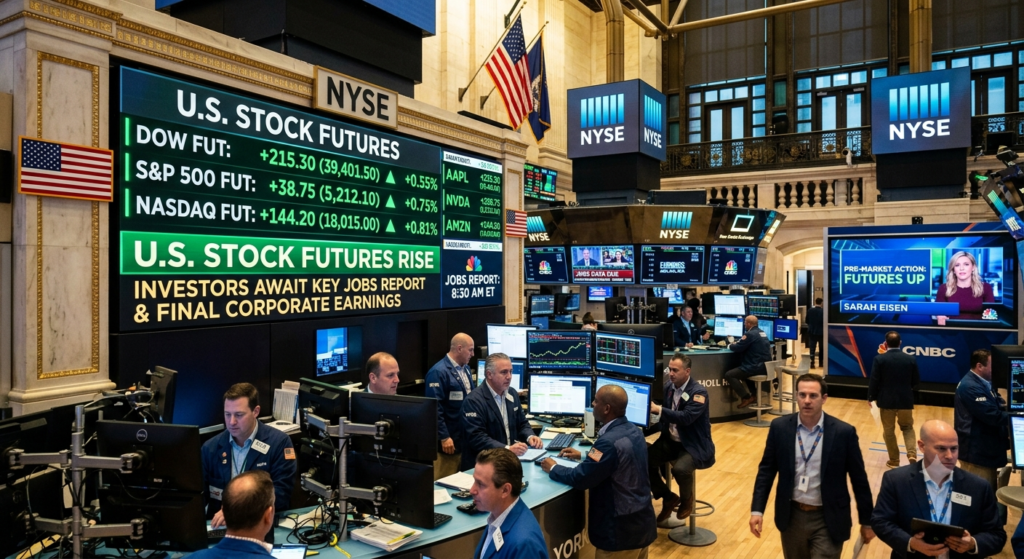
U.S. equity futures advanced early Monday as investors positioned for a pivotal week dominated by the July employment report and a dense slate of corporate earnings releases that will help shape the trajectory of the market into the second half of August. Futures linked to the Dow Jones Industrial Average rose approximately 265 points, or about 0.9 per cent. S&P 500 futures gained roughly 0.55 per cent, while Nasdaq-100 futures climbed nearly 0.93 percent in early trading. The moves followed a solid finish on Friday, when the three major indexes closed higher: the Dow advanced 276.97 points, or 0.53 per cent, to 52,485.03; the S&P 500 rose 0.7 per cent to 7,489.72; and the Nasdaq Composite surged 1 per cent to 25,373.85.
The upward bias in futures reflected a cautious optimism among market participants who are balancing expectations for continued strength in corporate profits against uncertainty surrounding the labour market and the Federal Reserve’s policy path under Chair Kevin Warsh. After a volatile stretch in recent weeks marked by swings in technology shares, shifting rate-hike probabilities, and geopolitical developments involving energy markets, traders entered the new week seeking clearer signals from both macroeconomic data and company-specific results.
The July nonfarm payrolls report, scheduled for release on Friday, August 7, stands as the week’s most closely watched economic event. Consensus estimates from various surveys pointed to a modest rebound in hiring after June’s weaker-than-expected gain of 57,000 jobs. FactSet and other compilations projected an increase of around 87,500 positions, while Reuters and Bloomberg surveys clustered near 85,000 to 91,000. The unemployment rate was expected to edge higher to 4.3 per cent from 4.2 per cent in June. Average hourly earnings were anticipated to show continued moderate growth, a metric of particular interest given the Fed’s ongoing focus on inflation dynamics.
A stronger-than-expected payrolls number, especially if accompanied by firmer wage growth, could reinforce expectations that the central bank might lean toward another rate increase as early as its September meeting. Fed funds futures had already been pricing meaningful odds of a hike, fluctuating in the range of roughly 60 to 70 per cent depending on the day. Conversely, a soft print that continues the cooling trend seen in June could ease pressure on policymakers and provide support for growth-oriented equities, particularly in the technology and consumer discretionary sectors that have driven much of the market’s performance this year. Intermediate data points earlier in the week—including the ADP private payrolls report, JOLTS job openings, and weekly initial jobless claims—will offer incremental clues and likely contribute to day-to-day volatility.
Corporate earnings remain an equally important driver. More than one-quarter of S&P 500 companies are scheduled to report results during the week of August 3–7, extending a second-quarter reporting season that has so far delivered robust profit growth. Aggregated figures tracking companies that have already reported alongside estimates for the remainder suggested year-over-year adjusted earnings growth on the order of 29 per cent or higher, with some measures pointing even stronger. Revenue growth has also been solid, supported by resilience in consumer spending, ongoing capital expenditure in artificial intelligence infrastructure, and operational efficiencies across multiple industries.
High-profile names dominate the calendar. On Monday, investors will scrutinise results from Palantir Technologies after the close, with attention centred on commercial AI software demand, government contract momentum, and forward guidance. Marriott International reports in the premarket, offering insight into travel and leisure trends. Other Monday reports include Tyson Foods, ON Semiconductor, Snap, Vertex Pharmaceuticals, and several energy and industrial names. Tuesday brings a heavier load, featuring Advanced Micro Devices, whose results will be parsed for data-centre GPU and CPU demand, MI350 series progress, and AI-related commentary. SpaceX is also scheduled to deliver its first quarterly report as a publicly traded company, a closely watched event given the stock’s post-IPO volatility and the potential implications for risk appetite across high-growth names. Additional Tuesday reports include Caterpillar, McDonald’s, Merck, Pfizer, and others that span industrials, consumer staples, and healthcare.
Midweek highlights include Eli Lilly, Walt Disney, Uber Technologies, Shopify, and Novo Nordisk, among many others. The breadth of the reporting schedule means sector-level performance could diverge sharply depending on individual beats or misses and the tone of management commentary. Technology and semiconductor companies continue to command outsized attention because of their influence on the major indexes and the lingering debate over the sustainability of AI-driven capital spending. Healthcare names, particularly those tied to obesity and diabetes treatments, remain in focus amid high valuations and competitive dynamics. Industrial and energy companies will provide read-throughs on manufacturing activity, commodity prices, and capital spending plans.
The backdrop for this week’s events includes a labour market that has shown clear signs of cooling without collapsing. June’s payrolls figure of 57,000 marked a notable slowdown from earlier months, and prior-period revisions had been downward. Participation rates and other underlying measures suggested some softening in labour force dynamics. At the same time, the economy has continued to demonstrate resilience in consumer spending and corporate investment, particularly in technology. Inflation has remained above the Federal Reserve’s 2 per cent target, keeping policymakers cautious. Chair Warsh and other officials have emphasised data dependence and avoided firm forward guidance, leaving markets to interpret each new release for clues about the balance of risks between growth and price stability.
Geopolitical developments have also influenced sentiment. Reports of potential de-escalation involving Iran and the Strait of Hormuz contributed to sharp declines in crude oil prices over the weekend and into Monday, with West Texas Intermediate and Brent futures retreating several percentage points. Lower energy costs can ease inflationary pressures and support consumer purchasing power, though they also weigh on energy-sector equities and related equipment providers. Equity markets have generally welcomed the prospect of reduced oil-price spikes, viewing them as a net positive for broader risk assets in the near term.
Investor positioning heading into the week appeared constructive but selective. The strong Friday close, led in part by technology and growth shares, suggested that buyers were willing to step in on dips and ahead of potential catalysts. Volatility measures had moderated somewhat from recent peaks, though the combination of labour data and earnings still carried the potential for sharp intraday moves. Bond yields remained elevated by historical standards, with the 10-year Treasury yield hovering near multi-year highs in recent sessions, reflecting both growth expectations and persistent inflation concerns. Higher yields tend to pressure valuations for long-duration growth stocks, creating a natural tension with the optimistic earnings narrative.
Market participants are also monitoring secondary economic indicators released throughout the week. Monday’s ISM Manufacturing PMI and construction spending data will provide early reads on industrial activity. Later reports on factory orders, trade balances, and services-sector activity will flesh out the picture of economic momentum. Any notable divergence between soft and hard data could amplify reactions to the Friday jobs report.
Analysts have offered a range of scenarios for how the week might unfold. A “Goldilocks” outcome—modest job growth that is neither strong enough to force an immediate hawkish shift nor weak enough to raise recession fears—would likely be received favourably by equity investors. Strong earnings beats accompanied by constructive guidance, especially from AI-exposed companies, could extend the recent rebound in technology shares. Disappointments on either the macro or micro front, however, risk reintroducing volatility and prompting rotations out of richly valued segments into more defensive areas.
The second-quarter earnings season overall has been characterised by a high beat rate, with a substantial majority of companies exceeding analyst estimates so far. Margin expansion in several sectors has supported profit growth even where revenue gains have been more moderate. Looking ahead, investors will listen carefully for management commentary on demand trends into the second half of the year, the impact of any residual supply-chain or shipping disruptions, capital allocation plans, and the trajectory of AI-related investments. Guidance will be particularly important given elevated valuations and the market’s sensitivity to changes in the interest-rate outlook.
Broader market structure continues to feature concentrated leadership. A relatively small number of large-capitalisation technology and growth companies account for a significant portion of index returns and earnings growth. This concentration amplifies the importance of results from companies such as those reporting this week and keeps the focus on whether the AI narrative can broaden to a wider set of beneficiaries. At the same time, smaller-capitalisation stocks and value-oriented sectors have at times lagged, reflecting higher sensitivity to economic growth and financing costs.
International developments provide additional context. Asian markets opened mixed to lower in some sessions amid concerns over technology valuations and regional economic data. European equities have tracked global risk sentiment, with attention on local inflation readings and central-bank communications. Currency markets have reacted to shifting rate expectations, with the dollar index fluctuating as traders reassess the path of U.S. policy relative to other major economies.
Commodity markets remain intertwined with the equity narrative. Beyond oil, industrial metals and agricultural prices will be watched for signals about global demand. Gold has oscillated as investors weigh safe-haven demand against the opportunity cost of higher yields. Any sustained move in the dollar or energy complex could feed back into equity sector performance and inflation expectations.
As the week progresses, trading volumes and options activity around key data and earnings events are likely to rise. Market makers and algorithmic strategies often adjust positioning in anticipation of binary outcomes such as the payrolls print. Institutional investors will update models and portfolio allocations based on the evolving information set. Retail participation, while secondary to institutional flows in aggregate, can still influence individual names that capture public attention.
Historical patterns offer limited guidance but some perspective. August has at times been a seasonally challenging month for equities, though strong earnings momentum and supportive monetary conditions can override seasonal tendencies. The current environment differs from prior cycles because of the unique combination of elevated AI investment, a labour market in transition, and a Federal Reserve still navigating the final stages of its inflation fight under new leadership.
Risks remain two-sided. On the upside, continued earnings strength, cooling but stable labour data, and any further easing of geopolitical tensions could support further gains and potentially new highs for the major indexes. On the downside, a hot jobs report that solidifies rate-hike expectations, combined with any high-profile earnings misses or cautious guidance, could trigger profit-taking and a broader reassessment of valuations. Liquidity conditions, while generally adequate, can thin around major events, amplifying price moves.
Investors preparing for the week have largely focused on the interplay between growth and policy. The jobs report will inform the growth side of the equation and the Fed’s reaction function. Earnings will speak to corporate health and the durability of the current expansion. Together, these inputs will help determine whether the recent recovery in risk appetite can extend or whether a more defensive posture becomes warranted.
In the hours leading into Monday’s open, the tone in futures markets suggested that participants were inclined to give the benefit of the doubt to the constructive scenario, at least initially. Whether that optimism survives the full week of data and results will depend on the actual numbers and the accompanying narratives from company executives and economic officials. For now, the directional bias in equity futures remains upward as the market braces for one of the more consequential stretches of the summer trading calendar.
The coming days will test the resilience of the equity rally that has characterised much of 2026 to date. With indexes near or approaching elevated levels, the margin for error is narrower than it was earlier in the year. Precision in interpreting the labour-market data and parsing earnings commentary will be essential. Market participants who successfully navigate the dual catalysts of jobs and earnings stand to gain clearer insight into the path of both the economy and corporate America in the months ahead. Those who misjudge the signals risk being caught on the wrong side of potentially sharp moves.
Beyond the immediate headlines, longer-term themes continue to shape portfolios. The adoption of artificial intelligence across industries remains a multi-year story that has already produced substantial returns for early leaders and is now being tested for breadth and sustainability. Demographic and productivity trends influence labour-market dynamics in ways that single monthly reports can only partially capture. Fiscal policy, debt levels, and global trade patterns form a broader backdrop that will outlast any single week’s data.
As trading begins in earnest on Monday, attention will shift from futures indications to actual price action in the cash market. Opening gaps, early sector rotations, and reactions to the first batch of earnings will set the tone. Subsequent sessions will layer on additional information until Friday’s jobs report delivers the week’s final major catalyst. In an environment where both macroeconomic and microeconomic narratives are evolving rapidly, flexibility and disciplined risk management remain paramount for investors seeking to capitalise on the opportunities while navigating the uncertainties that define this stage of the market cycle.
The upward pointing of stock futures at the start of the week encapsulates the prevailing sentiment: cautious hope that the combination of steady corporate results and manageable labour-market data can sustain the positive momentum established at the end of the previous week. Realisation of that hope, or disappointment relative to it, will unfold over the next five trading days and likely influence positioning well into the remainder of August and beyond.
==