
Native plants are surging in popularity across North America. Gardeners, landscapers, and homeowners are increasingly choosing species that evolved in local ecosystems over exotic ornamentals. This shift is driven by practical benefits—lower water and fertiliser needs, greater resilience to regional weather extremes—and by growing awareness of biodiversity loss, especially among pollinators like monarch butterflies, native bees, and hummingbirds. Sales data from native nurseries, Google search trends, and industry reports from 2025–2026 show consistent demand for certain standouts. These plants deliver beauty, ecological value, and relatively easy care when matched to the right site.
North America spans diverse climates, from eastern woodlands and prairies to southwestern deserts and Pacific coasts. “Native” is most meaningful at the ecoregion or state level rather than continent-wide. Still, several species or genera appear repeatedly on bestseller lists, Perennial Plant Association selections, and regional recommendations because of their adaptability, showiness, and wildlife support.
Cardinal Flower (Lobelia cardinalis)
Cardinal flower ranks among the top sellers in multiple 2025 nursery reports. Its brilliant scarlet tubular flowers, held in tall spikes from midsummer into fall, are unmistakable. Plants typically reach 2–4 feet (occasionally taller in ideal conditions) with lance-shaped green or bronzed leaves. It is native across much of eastern and central North America, from southeastern Canada through the eastern and central United States into parts of the Southwest and south into Mexico and Central America. Hardiness generally spans USDA zones 3–9.
This moisture-loving perennial thrives in rich, consistently moist to wet soils in full sun to partial shade. In hotter climates, it benefits from afternoon shade. It is ideal for rain gardens, pond edges, stream banks, or low spots that hold water after rain. Once established, it needs little fertiliser and is generally unpalatable to deer and rabbits. Short-lived as an individual plant in some gardens, it often self-sows or can be divided to maintain colonies. Hummingbirds are its primary pollinators; butterflies and bees also visit. All parts contain alkaloids and are toxic if ingested, so site it away from areas where pets or small children might sample foliage.
Its vivid colour and vertical form make it a dramatic late-season focal point in mixed borders or naturalistic plantings. Pair it with other moisture-tolerant natives such as Joe-Pye weed or swamp milkweed for continuous interest.
Butterfly Weed and Other Milkweeds (Asclepias tuberosa and relatives)
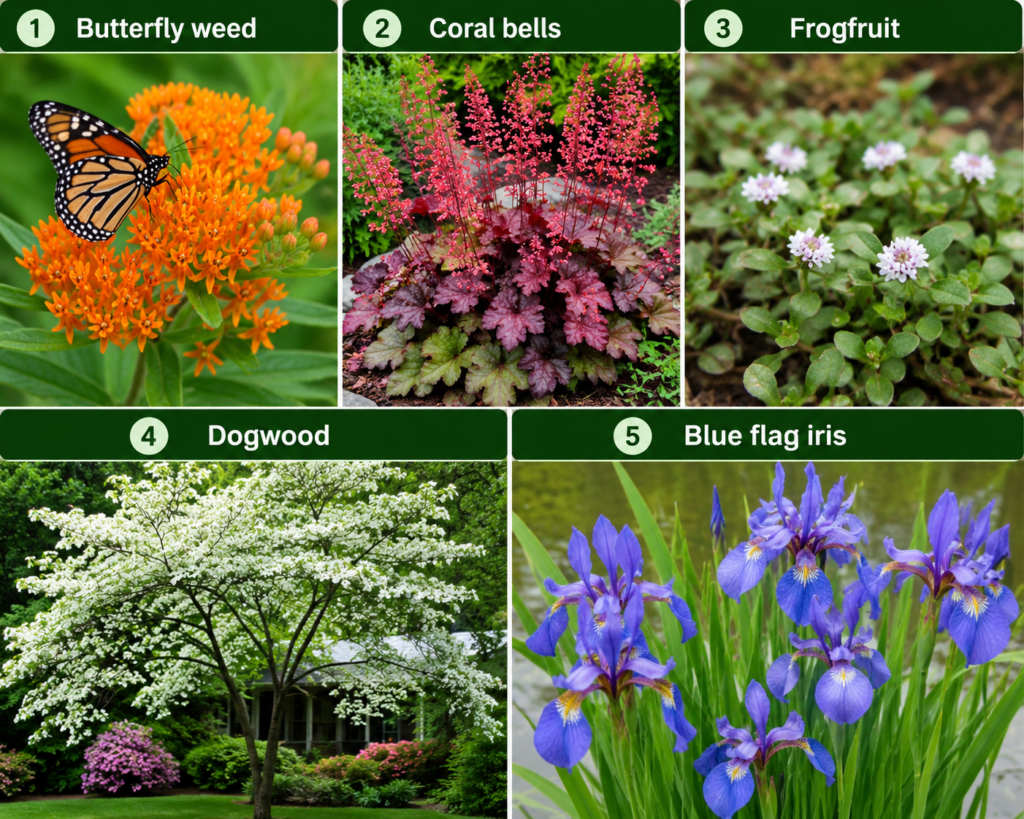
Milkweeds, especially butterfly weed (Asclepias tuberosa), have been heavily promoted as the National Garden Bureau’s 2025 “Year of the Asclepias.” Declining monarch populations have made these plants cultural icons as well as garden staples. Butterfly weed produces dense clusters of bright orange to yellow-orange flowers from early to late summer on 1–2.5-foot plants with narrow, lance-shaped leaves. It is native across much of the eastern two-thirds of the United States and into parts of Canada, preferring dry to medium, well-drained soils and full sun. Hardiness is typically zones 3–9.
Unlike many milkweeds, butterfly weed has a deep taproot and, once established, thrives in lean, sandy, or rocky conditions; it dislikes wet feet and is drought-tolerant. It is a larval host plant for monarchs (and some other butterflies) and provides abundant nectar for a wide range of pollinators including bees, hummingbirds, and other butterflies. Seed pods are ornamental and useful in dried arrangements. Aphids can appear but rarely require intervention if beneficial insects are present. Because of the taproot, it is best planted young and left undisturbed.
Other popular milkweeds include common milkweed (A. syriaca) for larger prairie-style plantings and swamp milkweed (A. incarnata) for wetter sites. Avoid tropical milkweed (A. curassavica) in regions where it can disrupt monarch migration. Planting milkweed supports the entire monarch life cycle and signals a broader commitment to habitat gardening.
Wild Bergamot / Bee Balm (Monarda fistulosa)
Wild bergamot consistently appears near the top of sales lists. This mint-family perennial forms clumps 2–4 feet tall with aromatic, grey-green foliage and shaggy lavender-pink flower heads from midsummer into fall. Native across much of North America (absent from some far-western and far-southeastern areas), it grows in prairies, open woods, fields, and roadsides. It tolerates dry to medium soils, full sun to light shade, and a range of soil types, including clay, once established. Zones 3–9 are typical.
The flowers attract long-tongued bees, butterflies, hummingbirds, and specialised insects. Leaves have a pleasant oregano-like scent and have traditional medicinal and culinary uses (often called Oswego tea). Powdery mildew can occur in humid conditions with poor air circulation; choosing open sites and avoiding overhead watering helps. It spreads by rhizomes and self-seeding but is rarely aggressive in average garden soils. Deadheading prolongs bloom, and leaving some seed heads provides winter interest and food for birds. Its combination of fragrance, colour, and wildlife value makes it a reliable mid-border or meadow plant.
Wild Columbine (Aquilegia canadensis)
Eastern red or wild columbine is another frequent top seller. Nodding red-and-yellow flowers with distinctive spurs appear in spring to early summer on plants 1–3 feet tall with delicate, fern-like foliage. Native to eastern North America from Canada southward, it grows along woodland edges, on rocky slopes, and in open woods. It prefers partial shade to full sun (with adequate moisture in hotter areas) and well-drained soils of moderate fertility. Zones 3–8 are standard.
Hummingbirds are strongly attracted to the flowers. Plants are relatively short-lived (often 3–5 years) but self-sow readily when conditions suit them, creating naturalising colonies. Leaf miners can mark foliage on some columbines, though A. canadensis is often less affected than hybrids. It combines beautifully with spring ephemerals, ferns, and later-blooming woodland natives. Its early colour bridges the gap between spring bulbs and summer perennials.
Additional High-Demand Natives
Several other species and genera appear repeatedly in trend reports and regional lists:
- Mountain mint (Pycnanthemum muticum and relatives): The 2025 Perennial Plant of the Year in some circles, this aromatic plant forms dense clusters of small white to pinkish flowers that are exceptional pollinator magnets. It thrives in full sun to part shade and medium to moist soils.
- Oakleaf hydrangea (Hydrangea quercifolia): A southeastern native shrub with large oak-shaped leaves, white summer flower panicles that age to pink or bronze, and outstanding fall colour and winter bark. It is trending widely according to search data and performs in partial shade with moist, well-drained soil.
- Switchgrass (Panicum virgatum): A versatile warm-season native grass valued for texture, movement, fall colour, and habitat. Cultivars expand its use in formal and naturalistic designs.
- Black-eyed Susan (Rudbeckia hirta and related species) and purple coneflower (Echinacea purpurea): Classic prairie flowers with long bloom periods, strong pollinator appeal, and drought tolerance once established. They self-sow and are easy starters for new native gardeners.
- Asters (Symphyotrichum spp.) and goldenrods (Solidago spp.): Essential late-season nectar sources. Many compact or non-aggressive forms are available.
- Little bluestem (Schizachyrium scoparium): A clumping grass with blue-green summer foliage that turns coppery or reddish in fall; excellent for dry, sunny sites and winter structure.
- Serviceberry (Amelanchier spp.): A multi-season small tree or large shrub offering spring flowers, edible berries for birds and people, and fall colour.
Regional specialities also trend locally—desert marigold and fairy duster in the Southwest, various penstemons and columbines in the Rockies, and coastal or woodland species on the Pacific and Atlantic edges.