
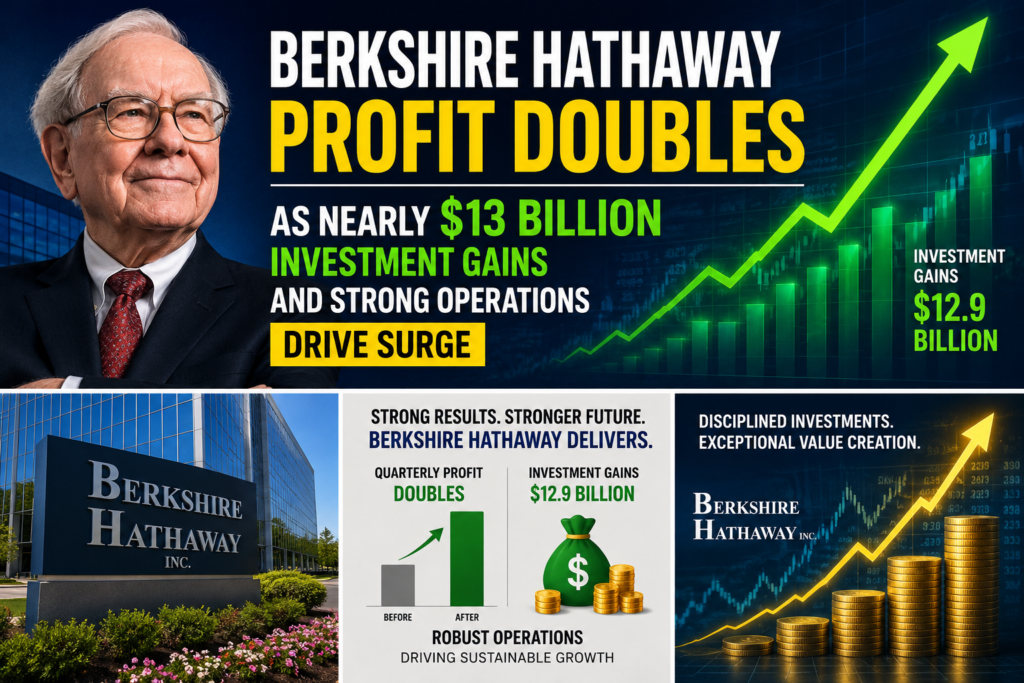
OMAHA, Neb. — Berkshire Hathaway Inc. reported second-quarter net earnings that more than doubled year over year, driven by a nearly $13 billion investment gain and solid results from its diverse operating businesses, underscoring the conglomerate’s enduring strength under new leadership while highlighting a notable shift in capital deployment.
The Omaha-based company, long associated with legendary investor Warren Buffett and now steered by Chief Executive Officer Greg Abel with Buffett remaining as chairman, posted net income attributable to shareholders of $25.67 billion for the three months ended June 30, 2026. That figure represented a 107.5% increase from $12.37 billion in the same period of 2025. On a per-share basis, net earnings equated to $17,868 for each Class A equivalent share, up from $8,601 a year earlier.
Operating earnings, the metric Berkshire emphasises as a better reflection of underlying business performance because it excludes the often-volatile effects of investment gains and losses, rose 16.3% to $12.98 billion from $11.16 billion. These results exceeded the limited analyst expectations available for the company, which does not provide formal guidance and is followed by relatively few Wall Street firms in the traditional sense.
The sharp rise in reported net income was heavily bolstered by after-tax investment gains of $12.68 billion, predominantly stemming from unrealised appreciation in Berkshire’s massive portfolio of equity securities. By comparison, the year-earlier quarter included investment gains of about $4.97 billion. Berkshire has long cautioned investors that such gains and losses—driven largely by mark-to-market accounting on stocks it intends to hold for the long term—are generally meaningless for evaluating periodic economic performance and introduce significant volatility into GAAP results.
In the official release, the company reiterated this longstanding view: investment gains and losses regularly include significant unrealised amounts from changes in market prices and foreign currency exchange rates, and they have caused, and will continue to cause, substantial fluctuations in reported earnings.
Strong Operational Backbone Across Key Segments
Beneath the headline investment boost, Berkshire’s operating businesses delivered broad-based improvement. After-tax earnings from manufacturing, service, and retailing operations climbed 24.1% in the second quarter to $4.47 billion, fueled by gains in industrial products manufacturing and various services businesses. Burlington Northern Santa Fe (BNSF), the major railroad subsidiary, posted a 6.3% increase in after-tax earnings to $1.56 billion, benefiting from higher shipping volumes of consumer, agricultural, and energy products along with improved operating efficiencies, even as fuel costs rose.
Berkshire Hathaway Energy (BHE) delivered particularly strong growth, with after-tax earnings rising 26.9% to $891 million. Higher margins at U.S. utilities and natural gas pipelines, along with tax credits, supported the advance, partially offset by softer results in other energy operations.
Insurance results were more mixed. Underwriting earnings declined modestly to $1.73 billion from $1.99 billion a year earlier. GEICO, the auto insurer, saw pretax underwriting profit fall as claims and other costs rose, though primary insurance and reinsurance segments showed improvement. Insurance investment income also slipped 9.1% to $3.06 billion, reflecting lower interest rates on the large portfolio of short-term holdings. Overall insurance float—the net liabilities assumed under insurance contracts—stood at approximately $177.5 billion at quarter-end, up slightly from year-end 2025.
Total revenues for the quarter rose about 10% to $101.8 billion from $92.5 billion, with growth across sales and service revenues, railroad transportation, and utilities and energy operations. For the first six months of 2026, net earnings reached $35.77 billion compared with $16.97 billion a year earlier, while operating earnings advanced to $24.33 billion from $20.80 billion.
Capital Allocation: Deploying the Cash Hoard
One of the most closely watched elements of the report was Berkshire’s aggressive deployment of cash under Abel’s leadership. After building a record cash and cash-equivalent position that approached $380–$397 billion in prior periods, the company reduced the pile to approximately $365 billion by the end of June (with some figures citing around $359–$365 billion including related Treasury bill considerations).
In the second quarter alone, Berkshire spent roughly $32 billion of its cash reserves. This included becoming a net buyer of publicly traded equities by nearly $20 billion after 14 consecutive quarters as a net seller. A notable transaction was an additional approximately $10 billion investment in Alphabet Inc., the parent of Google and YouTube, elevating it among Berkshire’s largest holdings. The company also accelerated share repurchases, buying back about $4.5 billion of its own stock in the second quarter and an additional $3.3 billion in July, bringing the recent total well above $7–$8 billion. These buybacks followed a near two-year hiatus and marked a clear change from the more restrained approach in the final years of Buffett’s active CEO tenure.
Subsequent to the quarter end, Berkshire completed the acquisition of Taylor Morrison Home Corporation, a homebuilder, for about $6.8 billion in cash (enterprise value around $8.5 billion). Earlier transactions, including the purchase of Occidental Petroleum’s chemical business (OxyChem), further illustrated the willingness to put capital to work when opportunities meeting Berkshire’s value criteria appeared.
Analysts and longtime observers noted that this activity represented a meaningful evolution. For years, Berkshire had struggled to find large-scale acquisitions or equity investments that met its exacting standards of quality and price, leading to the enormous cash buildup. Abel, who assumed the CEO role at the start of 2026 after Buffett’s planned transition, has signalled continuity with Buffett’s principles while demonstrating readiness to act more decisively on both buybacks and external investments.
Context of the Leadership Transition and Buffett’s Influence
The second-quarter results arrived against the backdrop of the historic leadership handoff. Warren Buffett, who built Berkshire into one of the world’s most valuable companies over more than six decades, stepped down as CEO effective January 2026, with Greg Abel—previously vice chairman overseeing non-insurance operations—taking the helm. Buffett remains chairman and a significant influence, and the company has emphasised that the culture of decentralised management, long-term orientation, and disciplined capital allocation remains intact.
In prior periods under Buffett’s final quarters, Berkshire had reported strong operating results in some segments while navigating challenges such as insurance catastrophe losses, lower interest income as rates fluctuated, and periodic impairments (including on Kraft Heinz in 2025). The current quarter’s operating growth of more than 16% and the return to net equity purchases and accelerated buybacks suggested that Abel’s early tenure has maintained momentum while addressing the “problem” of excess cash that Buffett himself often discussed candidly at annual meetings.
Shareholders’ equity rose substantially, reaching approximately $748 billion by June 30, 2026, reflecting both earnings retention and the effects of investment performance. Berkshire’s insurance subsidiaries continue to generate substantial float that can be invested for the long term, providing a structural advantage few other companies match.
Market and Investor Implications
Berkshire’s Class A and Class B shares have long traded at premiums reflecting the company’s reputation for compounding capital at attractive rates over decades. The latest results, combining operational resilience with meaningful capital returns via buybacks and selective investments, were generally viewed positively by market participants. The company continues to downplay the importance of quarterly net income volatility, urging focus on the intrinsic value of its collection of businesses and the long-term trajectory of operating earnings.
Insurance remains the foundational engine, generating both underwriting profits (when pricing and claims trends cooperate) and substantial investment income from the float. The railroad and energy businesses provide relatively stable cash flows tied to the broader U.S. economy and infrastructure needs. The manufacturing, service, and retailing group—encompassing dozens of subsidiaries ranging from industrial products to consumer-facing operations such as NetJets and various retailers—offers diversification and growth potential, as evidenced by the strong 24% quarterly advance.
Challenges persist. Lower short-term interest rates have pressured insurance investment income. GEICO continues to navigate a competitive auto insurance market with elevated claims costs in some periods. Macroeconomic uncertainty, consumer spending patterns, and potential catastrophe losses remain watch points for the insurance and consumer-exposed businesses. Geopolitical and currency fluctuations can also affect reported results through both operations and the investment portfolio.
Nevertheless, Berkshire’s fortress balance sheet, with hundreds of billions in liquidity even after recent deployments, positions it uniquely to weather downturns or seize opportunities that may arise if asset prices become more attractive. The decision to resume and then accelerate buybacks when the stock offered what management viewed as reasonable value, alongside selective large equity purchases and bolt-on acquisitions, signals confidence in the company’s ability to compound capital effectively.
Broader Economic and Industry Perspective
Berkshire’s performance offers a window into several segments of the American economy. Strength at BNSF points to healthy freight volumes in key categories. Energy results reflect utility rate environments, natural gas demand, and the benefits of certain tax incentives. Manufacturing and services growth suggests resilience in industrial and business-to-business activity. Softness at GEICO highlights ongoing pressures in personal auto insurance, a sector that has faced rising repair costs, severity trends, and competitive dynamics for several years.
The conglomerate structure itself remains a point of fascination and occasional debate. Critics sometimes argue that size has become an impediment to outsized returns, while supporters point to the decades-long track record of value creation and the advantages of permanent capital and decentralised management. Abel’s early moves to reduce cash and increase equity exposure, while maintaining the insurance-driven float model, appear designed to address concerns about capital efficiency without abandoning core principles.
Looking ahead, Berkshire does not provide forward guidance in the conventional sense. Management has historically stressed that results will vary with economic conditions, insurance underwriting cycles, investment market movements, and the occasional large acquisition. Capital expenditures at BNSF and BHE are expected to remain elevated to support infrastructure and growth. The company continues to evaluate opportunities across public equities, private businesses, and its own shares.
For the first half of 2026, the combination of improved operating earnings and the swing to significant investment gains produced a substantial increase in reported profitability. Cash deployment accelerated, buybacks resumed in meaningful size, and the equity portfolio saw net additions after a long period of net sales. These developments, occurring in Abel’s first full year as CEO, mark a transitional chapter that investors will monitor closely for signs of continuity and evolution.
Berkshire Hathaway’s latest quarterly report reaffirms its status as a unique entity in corporate America: a collection of high-quality businesses generating substantial cash, paired with an investment portfolio and capital allocation discipline that has compounded wealth for shareholders over generations. While the near-term headline was dominated by the doubling of profit on the back of nearly $13 billion in investment gains, the more durable story lies in the 16%-plus growth in operating earnings and the purposeful reduction of excess cash through buybacks, stock purchases, and acquisitions. As the company navigates the post-Buffett CEO era, the second-quarter results provide early evidence that the institutional strengths Buffett cultivated remain firmly in place.
The full financial statements and notes, available on Berkshire’s website, provide extensive detail on segment performance, investment activity, and balance-sheet items for those seeking deeper analysis. As always with Berkshire, the most important metrics remain the long-term trajectory of intrinsic value per share and the consistency of capital allocation decisions rather than any single quarter’s GAAP bottom line.
===