

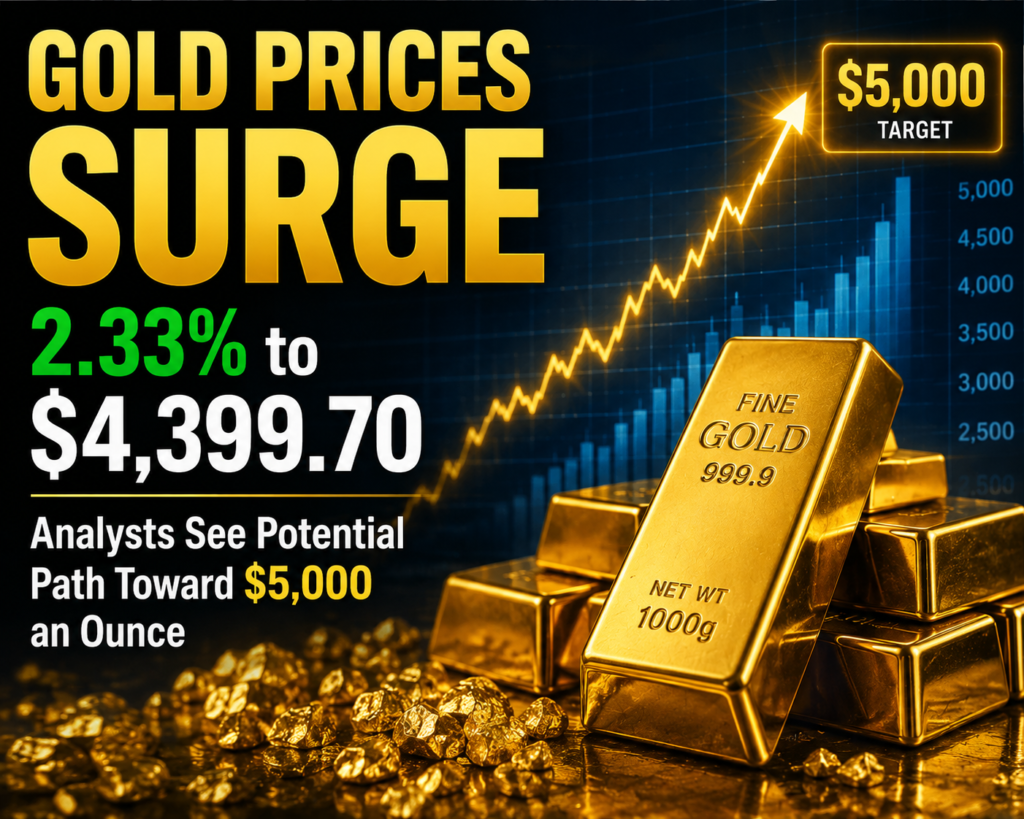
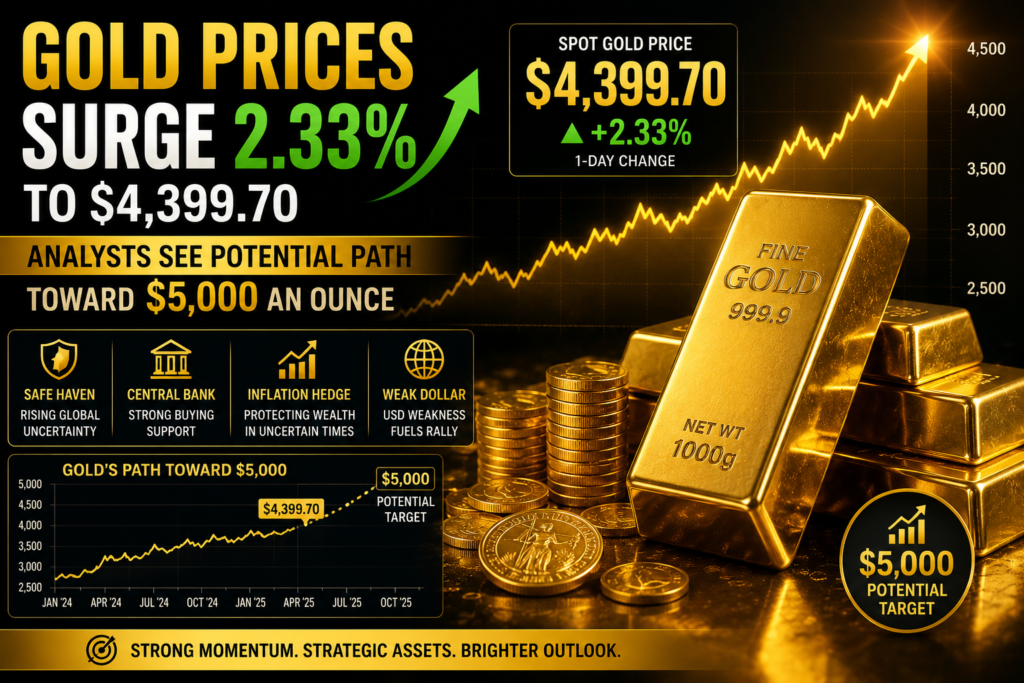
Gold prices staged a sharp advance on the latest trading session, climbing 2.33 per cent to settle at $4,399.70 per ounce. The move marked one of the strongest single-day gains in recent months and reinforced a broader recovery that has lifted the precious metal more than 7 per cent over the past week. Market participants pointed to a combination of weaker-than-expected U.S. economic data, renewed safe-haven demand, and persistent structural buying from central banks and Asian investors as the primary drivers. Analysts across major banks and research houses are increasingly confident that the rally has further room to run, with several forecasting a sustained push toward the psychologically important $5,000 level in the coming quarters.
The latest surge follows a period of consolidation after gold’s dramatic rollercoaster earlier in 2026. The metal had soared to an intraday record above $5,500 per ounce in late January amid heightened geopolitical tensions, only to retreat toward and briefly below the $4,000 mark by late June as inflation concerns, shifting Federal Reserve expectations, and profit-taking weighed on sentiment. The subsequent recovery has been steady rather than explosive, but the most recent acceleration suggests that the corrective phase may be giving way to a renewed uptrend.
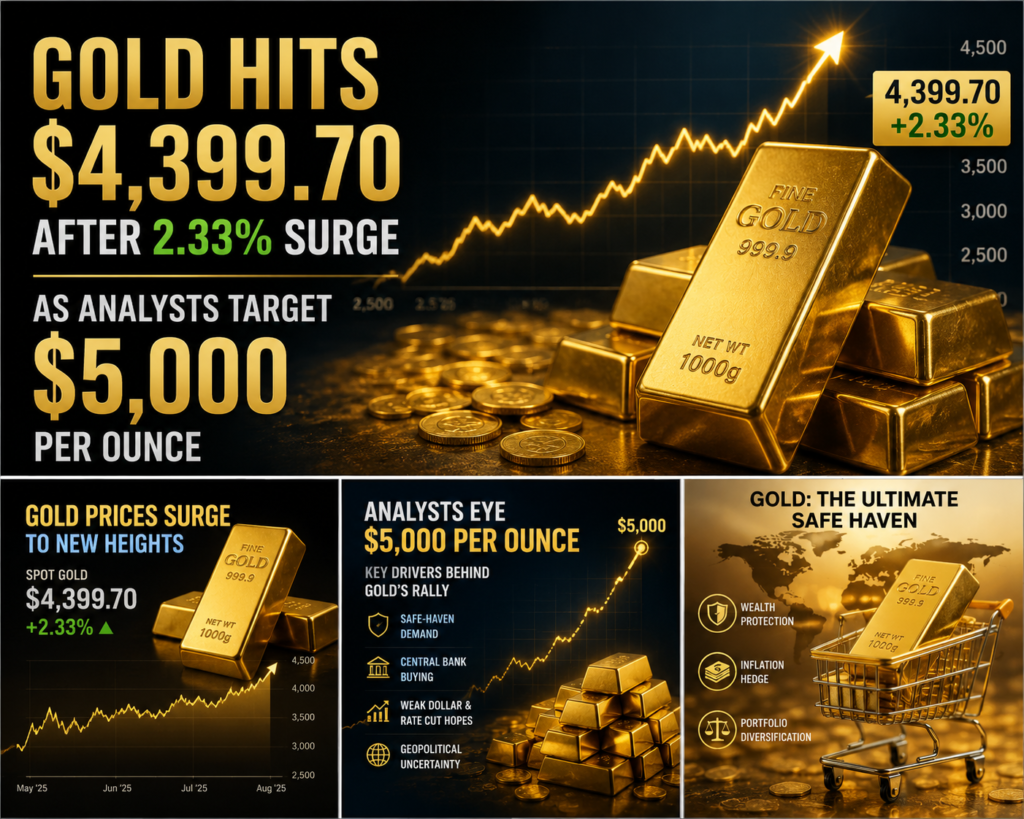
Spot gold’s advance to $4,399.70 came against a backdrop of softer U.S. labour market readings. Nonfarm payrolls data showed a contraction of 23,000 jobs in the latest month, far below consensus expectations of an 80,000 increase, while previous figures were revised lower. The disappointment reduced the probability that the Federal Reserve would deliver an additional rate hike this year, lowering the opportunity cost of holding non-yielding assets such as gold. Real yields edged lower in response, and the U.S. dollar softened modestly against a basket of major currencies, providing additional support for the metal priced in dollars.
Broader market dynamics reinforced the move. Crude oil prices declined amid optimism that tensions in the Middle East might ease, reducing near-term inflationary pressure and further dimming the odds of aggressive monetary tightening. Equity markets showed mixed performance, with volatility remaining elevated enough to sustain demand for traditional hedges. Gold-backed exchange-traded funds recorded inflows in several key jurisdictions, particularly in Europe and parts of Asia, reversing earlier outflows that had accompanied the mid-year correction.
Central bank activity continues to provide a durable floor under prices. Official sector purchases remained robust through the second quarter, with net buying estimated at nearly 289 tonnes—an increase of more than 60 per cent year over year according to World Gold Council data. A recent survey of central bankers found that a record 45 per cent of respondents expected to increase their gold reserves over the next twelve months, while 89 percent anticipated that global official holdings would rise. Poland, China, and several other emerging-market institutions have been among the more consistent buyers. These purchases are largely strategic and relatively price-insensitive, helping to absorb physical supply even when investment demand fluctuates.
Asian physical demand has also reasserted itself. Chinese investors, both retail and institutional, have returned to the market as prices stabilised above $4,000. Jewellery and bar-and-coin demand in India and other regional centres, while sensitive to high absolute prices, has shown resilience when local currencies weaken, or inflation concerns intensify. The structural shift toward greater gold allocations in Asian portfolios is viewed by many strategists as a multi-year trend rather than a cyclical phenomenon.
Analyst commentary has grown more constructive. UBS strategists described the recent rally as having “support” and projected that gold prices could move toward $5,000 per ounce in the first half of 2027. Their base case assumes that inflation gradually moderates, allowing the Federal Reserve to hold rates steady this year before resuming an easing cycle next year. Lower policy-rate expectations would reduce real yields, weigh on the dollar, and encourage renewed investment demand. Central bank buying is expected to continue providing a floor.
Goldman Sachs has maintained a constructive medium-term outlook, citing emerging-market central bank diversification as a key structural anchor. The bank’s earlier end-2026 target near $4,900 remains in place, with risks skewed to the upside should private investor diversification accelerate or fiscal concerns in major economies intensify. Other houses, including Bank of America, JPMorgan, and Standard Chartered, have published forecasts clustering in the $4,800 to $5,200 range under various scenarios. Consensus among metals analysts surveyed in recent months has centred near $4,900 for the end of 2026, though the path is expected to remain volatile.
World Gold Council research emphasises that gold’s next sustained move will depend on the interaction of several factors rather than any single driver. Real interest rates, the strength of the U.S. dollar, economic growth expectations, continued central bank purchases, and sustained demand from Asian investors and consumers are identified as the primary variables. A second wave of elevated inflation cannot be ruled out, but higher inflation alone is unlikely to produce another record-breaking rally. The critical question is how real rates, the dollar, and growth expectations respond. If tighter policy eventually slows growth and pushes longer-dated yields lower, the backdrop for gold would improve. Conversely, a stronger dollar and higher real rates could cap near-term upside.
Historical context helps frame the current advance. Gold has delivered substantial cumulative gains over the past several years, rising more than 150 per cent from levels prevailing five years earlier and more than 220 percent over a ten-year horizon. The metal’s performance has been underpinned by successive waves of monetary expansion, geopolitical shocks, and a gradual erosion of confidence in purely fiat reserve systems. The freezing of Russian central bank reserves in 2022 is widely viewed as a turning point that accelerated official-sector diversification into gold. That structural demand has persisted even as cyclical factors—interest rates, the dollar, and risk sentiment—have produced sharp interim swings.

Supply dynamics remain supportive. Global mine production has increased only modestly, rising roughly 2 per cent in recent periods even as prices have remained elevated. Recycling has picked up at higher price levels but has not fully offset the gap between official and investment demand on the one hand and primary supply on the other. The result is a market that continues to clear at higher absolute prices than those prevailing in previous cycles.
Technical analysts note that the latest breakout above multi-week consolidation ranges and the 52-week moving average has improved the chart structure. Resistance is cited in the $4,493–$4,533 zone and higher toward $4,855–$4,894, while support is seen near $4,175 and the psychologically important $4,000 area. A sustained close above the recent highs would open the path toward a retest of the year’s earlier peaks and, ultimately, the $5,000 threshold. Momentum indicators have improved from oversold conditions earlier in the summer, though they are not yet at extremes that would signal an immediate exhaustion of the rally.
Market participants are also watching upcoming data closely. The next U.S. consumer price index report is viewed as a potential catalyst that could either reinforce or challenge the current narrative of moderating inflation pressure. Any surprise to the upside could revive rate-hike expectations and temporarily pressure gold, while a softer reading would likely extend the recent gains. Geopolitical developments remain an ever-present wildcard. Renewed escalation in existing conflicts or fresh shocks elsewhere could quickly reprice risk and drive further safe-haven flows into the metal.
For investors, the implications of a move toward $5,000 are significant. At that level, gold would represent a substantial revaluation of a traditional portfolio diversifier and inflation hedge. Many institutional allocation models still treat gold as a relatively small satellite holding. Even modest increases in target weights across large pools of capital could generate meaningful additional demand. Retail investors, particularly in markets where local-currency gold prices have already reached new highs, continue to treat the metal as both a store of value and a vehicle for long-term savings.
Jewellery demand remains the most price-sensitive segment of the market. High absolute prices have already constrained volumes in several traditional consuming countries. Further appreciation would likely intensify that pressure, though the impact on overall market balance is partially offset by the relative inelasticity of official-sector and investment demand. Technology and industrial uses, while smaller in absolute terms, continue to provide a steady baseline of consumption.
Currency effects add another layer of complexity. A weaker U.S. dollar makes gold more affordable for non-dollar buyers and has historically correlated with higher dollar prices for the metal. Fiscal deficits in major economies and concerns about long-term currency debasement continue to feature in strategic discussions among both official and private investors. Gold’s status as a neutral reserve asset with no counterparty risk remains a key attraction in an environment of elevated geopolitical and financial uncertainty.
Looking ahead, most strategists caution that the path to $5,000 is unlikely to be linear. Periods of consolidation or sharp pullbacks are to be expected as markets digest economic data, central bank communications, and shifts in risk appetite. The medium-term case, however, rests on the persistence of structural demand and the potential for cyclical factors—lower real rates, a softer dollar, or renewed growth concerns—to align more favourably. In the words of one widely cited research note, gold is “not done.” The combination of official buying, Asian physical interest, and residual safe-haven demand provides a foundation that has so far proved resilient even through significant interim corrections.
The latest 2.33 per cent advance to $4,399.70 has restored a measure of confidence after months of range-bound trading. Whether the metal can convert the current momentum into a sustained push toward $5,000 will depend on the evolution of the macro environment in the months ahead. For now, the balance of opinion among analysts has shifted back toward the constructive side of the ledger, and the market appears prepared to test higher levels should the supporting factors continue to align.
In the broader context of global financial markets, gold’s resurgence serves as a reminder of its dual role as both a monetary asset and a hedge against uncertainty. As central banks continue to diversify reserves, private investors reassess portfolio allocations, and geopolitical risks remain elevated, the yellow metal retains a unique position. The climb to $4,399.70 is the latest chapter in a multi-year story of revaluation. The next chapters will determine whether the $5,000 milestone becomes a temporary peak or a new baseline for the world’s oldest store of value.
==