
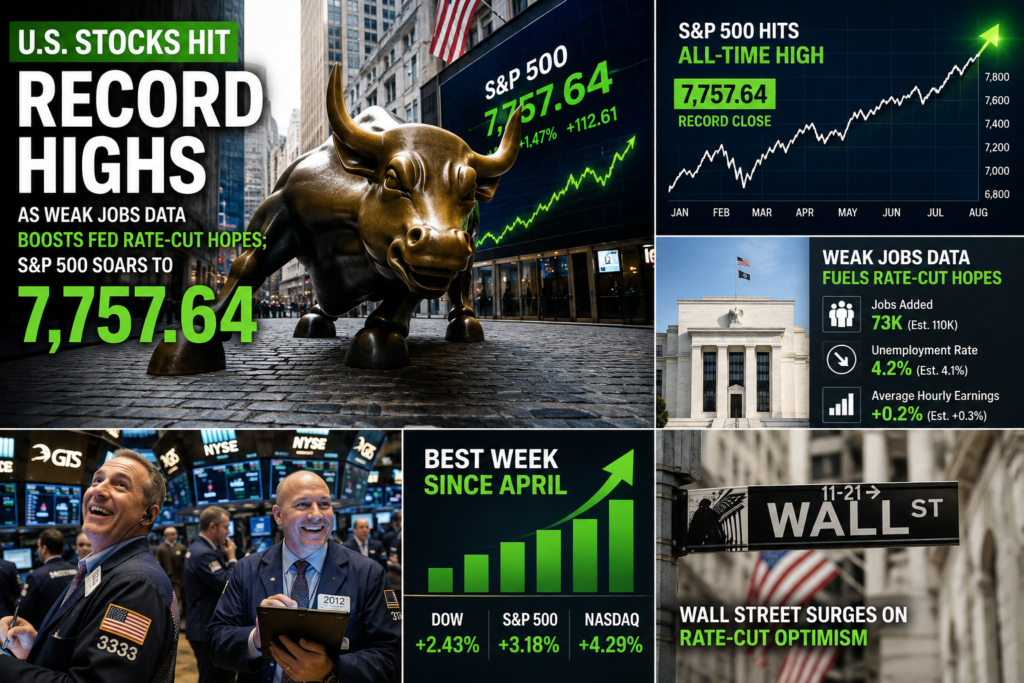
NEW YORK — U.S. equities advanced broadly on Friday, August 7, 2026, propelling the S&P 500 to a fresh record closing high and delivering the major indexes their strongest weekly percentage gains since mid-April. The advance was fueled by a surprisingly weak July employment report that sharply reduced market expectations for a Federal Reserve interest-rate increase at the central bank’s September meeting, alongside continued strength in corporate earnings and signs of easing geopolitical tensions in the Middle East.
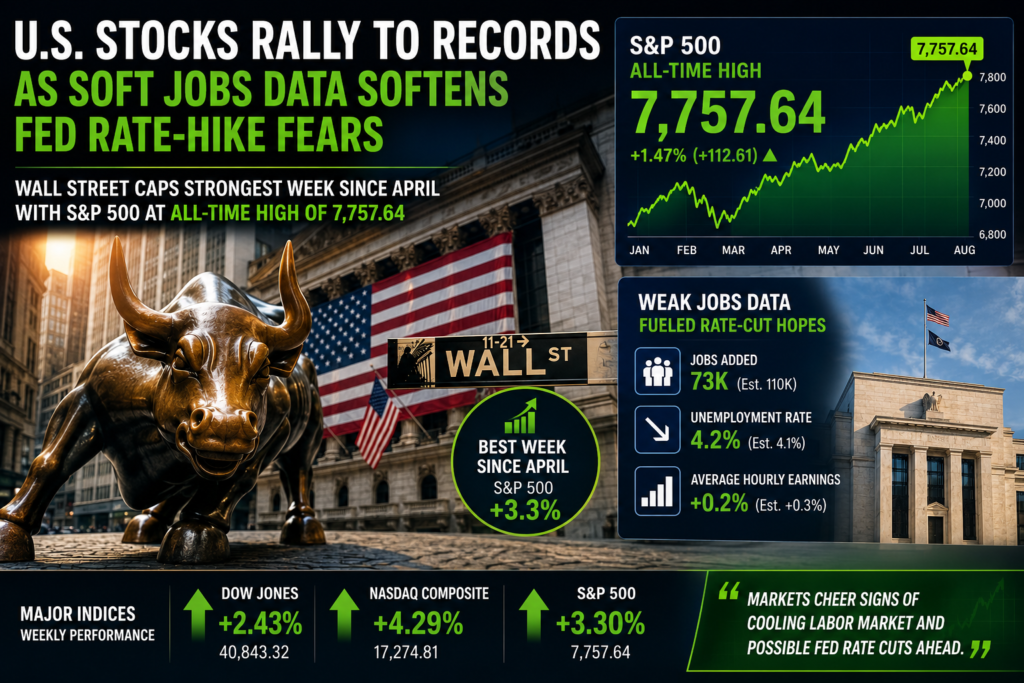
The S&P 500 rose 47.68 points, or 0.62 per cent, to close at 7,757.64. The tech-heavy Nasdaq Composite climbed 342.26 points, or 1.30 per cent, to 26,690.62. The Dow Jones Industrial Average added 151.83 points, or 0.28 per cent, finishing at 54,036.93. For the week, the S&P 500 gained 3.58 per cent, the Nasdaq advanced 5.19 per cent, and the Dow rose 2.96 per cent.
The catalyst for the session’s gains was the Labour Department’s report that nonfarm payrolls fell by 23,000 in July, far below the consensus forecast of an 80,000 increase. Prior months’ figures were revised substantially lower as well, subtracting a combined 103,000 jobs from previously reported totals for May and June. The unemployment rate edged down to 4.1 per cent from 4.2 percent in June, largely because workers left the labour force. Private-sector employment rose by 30,000 while government payrolls declined by 53,000, with notable losses in local government education and retail trade. Health care continued to add jobs, though at a slower pace.
The softer labour-market data quickly shifted rate expectations. According to the CME FedWatch tool, the probability of a rate hike at the Fed’s next meeting fell to about 44 per cent, down from 55 per cent the previous session and 67 percent a week earlier. Treasury yields declined, with the 10-year yield falling to around 4.64–4.65 per cent, providing a further tailwind for equities.
A Market Driven by Data, Earnings, and Geopolitics
Friday’s session capped a powerful rebound that began earlier in the week. Strong corporate results, particularly from artificial-intelligence-related and technology companies, had already lifted sentiment. Of the 436 S&P 500 companies that had reported earnings through Friday morning, 85.1 per cent topped analyst expectations, well above the long-term average of roughly 68 percent since 1994, according to LSEG data. This breadth of beats helped temper earlier concerns that heavy capital spending on AI infrastructure might not yet be translating into sufficient returns.
At the same time, signs of diplomatic progress toward a potential peace deal involving Iran helped cool oil prices. Lower energy costs eased one source of inflation pressure that had kept the possibility of tighter monetary policy alive under new Federal Reserve Chair Kevin Warsh. Warsh, who assumed leadership earlier in 2026, has largely eschewed traditional forward guidance, leaving markets more dependent on incoming economic data and individual policymakers’ comments.
“You probably have to lower rates to kind of stimulate job growth, but if you lower rates, you’re going to also stimulate inflation. So you’re kind of in a pickle at this point, and yet the market’s just taken off because earnings have been stellar,” said Tom Siomades, chief market economist at AE Wealth Management. “The market should be reacting to weak job numbers and higher inflation and the possibility of a slow-growth economy that may need to have rates raised rather than cut, and yet it’s not. We’re setting records, so go figure.”
Standout Performers and Sector Dynamics
Individual stocks amplified the indexes’ moves. Collaboration-software maker Atlassian soared 35.3 percent—its largest single-day percentage gain on record—after reporting stronger-than-expected fourth-quarter results and forecasting higher revenue. Vacation-rental platform Airbnb jumped 17.4 per cent, becoming the top performer in the S&P 500 after beating second-quarter revenue estimates and citing robust global travel demand, including potential benefits tied to major sporting events. Chipmaker Microchip Technology gained 13.9 per cent, its best day in more than 15 months, on an upbeat revenue outlook.
Elon Musk’s SpaceX, which went public in a record offering in June, surged 15.8 per cent. The move came a day after the expiration of the first tranche of post-IPO share lockup restrictions, easing one source of selling pressure that had weighed on the stock. Other technology and growth names participated, with semiconductor and software shares generally firm.
Not every name participated. Ad-technology firm Trade Desk plunged 21.9 per cent after issuing a weaker-than-expected third-quarter revenue outlook, making it the worst performer in the S&P 500. Breadth overall remained constructive: advancing issues outnumbered decliners by roughly 2.5-to-1 on the New York Stock Exchange and more than 2-to-1 on the Nasdaq. The S&P 500 recorded nine new 52-week highs against one new low, while the Nasdaq Composite saw 123 new highs and 77 new lows. Trading volume was moderate at about 16.94 billion shares.
Sector leadership favoured industrials and materials, while communication services and energy lagged. The broader narrative remained one of resilience in large-cap growth and technology, supported by AI-related optimism and solid fundamental results, even as the labour market showed clear signs of cooling.
Economic Backdrop and the Warsh Fed
The July employment report fits into a picture of moderating job growth. Average monthly payroll gains in 2026 have slowed markedly compared with earlier years. The labour force participation rate dipped, and the employment-to-population ratio edged lower. While the unemployment rate decline offered some surface comfort, the details—especially the large downward revisions and government-sector weakness—pointed to a labour market that is no longer a source of overheating.
This environment complicates the Federal Reserve’s dual mandate. Inflation has remained above the 2 per cent target for an extended period, influenced in part by earlier supply disruptions linked to Middle East tensions. Under Warsh, the Fed has kept the federal funds rate in a range of 3.50–3.75 per cent and has avoided providing explicit near-term policy guidance. Policymaker projections earlier in the year had shown a meaningful number of officials anticipating at least one rate increase in 2026. The soft jobs data has now reduced the near-term probability of such a move, though inflation readings in the coming weeks will be critical.
Lower oil prices, helped by hopes for progress on reopening key shipping routes, have provided some relief on the inflation front. Gold prices rose on the day, reflecting both safe-haven demand and the shift in rate expectations. The dollar’s reaction was mixed as yields fell.
Weekly Context and Longer-Term Perspective
Friday’s gains completed a robust week that reversed earlier summer volatility. The Nasdaq, in particular, recovered ground after a pullback that had taken it roughly 10 per cent below its prior peak at one point. Year-to-date, the major indexes have delivered solid advances: the S&P 500 is up approximately 13 per cent, the Nasdaq around 15 percent, and the Dow roughly 12 percent, according to available data. The S&P 500 has notched multiple record closes in 2026, reflecting both earnings resilience and investor willingness to look past near-term macroeconomic soft patches.
The strength has been concentrated at times in mega-cap technology and AI beneficiaries, though the latest earnings season has shown broader participation. Analysts note that the median earnings beat has been healthy, reducing reliance on a handful of names. Still, valuation levels remain elevated by historical standards, leaving the market sensitive to any deterioration in the growth or inflation outlook.
Investor Sentiment and What Comes Next
Market participants largely interpreted the jobs report as reducing the risk of an imminent policy mistake. A pause or more accommodative stance would support equity multiples, particularly for longer-duration growth assets. At the same time, some observers caution that a meaningfully weaker labour market could eventually signal broader economic softness, especially if consumer spending slows.
Next week’s calendar includes inflation data that will test the sustainability of the rally. Investors will scrutinise whether price pressures continue to ease in tandem with the labour market. Corporate earnings reports will continue to trickle in, offering further evidence on the durability of the AI and technology spending cycle.
Geopolitical developments remain a wild card. Any tangible progress toward de-escalation in the Middle East would likely keep energy prices contained and support risk assets. Conversely, renewed tensions could revive inflation concerns and pressure the Fed toward tighter policy.
Broader Implications
The combination of record equity levels, moderating employment growth, and elevated but potentially peaking inflation creates a complex backdrop for households, businesses, and policymakers. For investors, the environment rewards selectivity—favouring companies with strong balance sheets, pricing power, and exposure to structural themes such as artificial intelligence, while remaining mindful of valuation and macroeconomic risks.
Retail and institutional flows have continued to support equities, with the strong weekly performance drawing attention from global investors. International markets generally followed Wall Street higher, though performance varied by region depending on local economic conditions and currency moves.
In summary, Friday’s session illustrated the market’s current preference for soft landing scenarios over hard data that might force aggressive policy action. The S&P 500’s new high at 7,757.64, the Nasdaq’s solid advance, and the Dow’s steady climb reflect confidence that corporate America can continue to deliver even as the labour market cools. Whether that confidence proves well-placed will depend on the inflation path, the Fed’s reaction function under Chair Warsh, and the ongoing evolution of geopolitical and technological trends that have defined the 2026 market narrative so far.
The week’s gains provide a strong foundation heading into the second half of August, but volatility is unlikely to disappear entirely. Investors will remain data-dependent, parsing every employment, inflation, and earnings release for clues about the trajectory of growth, prices, and monetary policy. For now, the bulls hold the upper hand, and the major indexes are trading at or near historic peaks.
–