
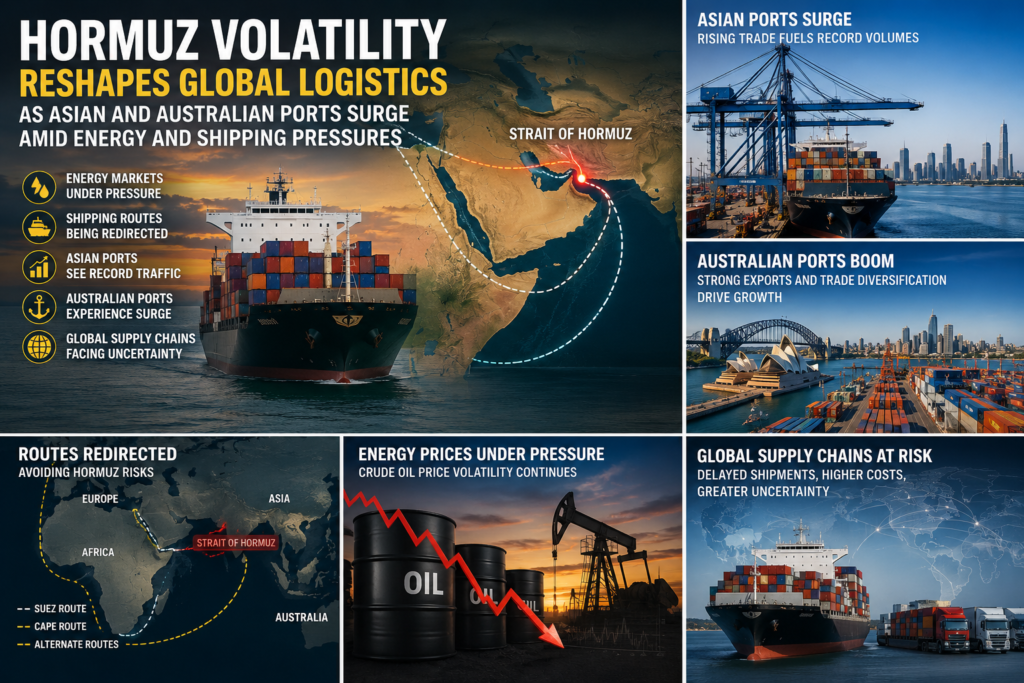
In the summer of 2026, the world’s most critical energy artery remains under severe strain while alternative logistics hubs farther afield post record gains. Shipping through the Strait of Hormuz continues to face acute volatilities driven by geopolitical friction, forcing multinationals to pivot toward longer alternative transit lines and absorb elevated energy risk premiums. At the same time, port operators in South Asia and Australia are capitalising on robust non-domestic cargo demand, delivering massive revenue increases as global trade patterns realign around the disruptions.
The dual pressures—chokepoint insecurity in the Persian Gulf and opportunistic expansion at secondary gateways—illustrate a broader reconfiguration of global logistics and energy security. What began as a sharp escalation in late February 2026 has evolved into a prolonged contest over maritime control, with cascading effects on oil and gas flows, insurance markets, freight rates, and corporate supply-chain strategies. Meanwhile, terminals from India’s west coast to Australia’s northern reaches are absorbing diverted volumes and structural growth in containerised and bulk trades, turning geopolitical risk into commercial opportunity.
Strait of Hormuz: From Critical Artery to Contested Chokepoint
Prior to the outbreak of hostilities on 28 February 2026, the Strait of Hormuz routinely handled roughly 20 million barrels per day of oil and petroleum products—approximately one-quarter of global seaborne oil trade and a significant share of LNG, LPG, and refined products. Daily vessel transits averaged 100–140 ships. That baseline collapsed almost immediately as Iran threatened and then restricted commercial traffic, followed by reciprocal military actions and a U.S. naval blockade targeting Iranian-linked shipping.
==
By March and April, average daily flows through the strait had plunged to a fraction of normal levels. Cumulative supply losses from Middle East producers exceeded 1.3 billion barrels in the early months of the crisis. Benchmark crude prices spiked dramatically; North Sea Dated briefly touched an all-time high near $144 per barrel. Jet fuel and diesel experienced even steeper gains as Gulf product exports were severed.
A fragile memorandum of understanding signed in mid-June between the United States and Iran briefly raised hopes of normalisation. Transits rose, war-risk premiums eased from peaks above 5–10 per cent of hull value toward 2 percent, and some Gulf producers began drawing down accumulated stocks. Yet the agreement proved short-lived. Renewed Iranian attacks on commercial vessels in early July, followed by U.S. retaliatory strikes on Iranian targets, collapsed the ceasefire. By late July and into August, daily commodity-related transits had fallen again to single-digit averages in some periods—far below the pre-war norm of more than 100 vessels. AIS-visible traffic remained approximately 90 per cent below baseline levels, with significant dark activity and ship-to-ship transfers becoming more common.
As of early August 2026, the strait functions under a de facto dual constraint: Iranian assertions of control and a reimposed U.S. naval blockade. Limited traffic continues along certain corridors, particularly those coordinated with Omani waters, but standard commercial operations remain commercially unviable for most owners. The International Maritime Organisation has maintained advisories against transit, and thousands of seafarers have faced prolonged delays or stranding at various points in the crisis.
Shipping Route Volatilities and Corporate Adaptation
Multinational energy companies, commodity traders, and industrial end-users have responded with a rapid reconfiguration of logistics. The most immediate adjustment has been the large-scale diversion of tanker traffic around the Cape of Good Hope. Voyages that once took roughly 20–25 days from the Gulf to East Asia or Europe now require 10–14 additional days and substantially higher bunker costs—estimates range from $1.1 million to $2.5 million extra per round trip for large crude carriers. Capacity utilisation across the global tanker fleet has tightened as vessels spend more time at sea, reducing effective supply.
Saudi Arabia has maximised use of its East-West Pipeline (Petroline), which can move up to 7 million barrels per day to the Red Sea port of Yanbu, and has explored further capacity expansions. The UAE has accelerated work on additional pipeline capacity to Fujairah on the Gulf of Oman coast, aiming to double non-Hormuz export capability, with target operational dates in 2027. Iraq has pursued negotiations to expand or reactivate northern pipeline routes toward Turkey’s Mediterranean coast at Ceyhan. These overland and alternative maritime pathways cannot fully replace the volume once carried through Hormuz, but they have prevented a complete cutoff of Gulf supply.
Beyond physical rerouting, companies have adjusted inventory strategies, diversified sourcing toward Atlantic Basin producers (U.S. Gulf Coast, Brazil, Guyana, West Africa), and increased reliance on floating storage. Some Asian refiners have sought alternative crude grades, while European buyers have drawn more heavily on North Sea, U.S., and Mediterranean supplies. The result is a more fragmented and expensive energy logistics system in which the marginal barrel carries a structural risk premium.
Containerised trade has also felt secondary effects. Diversions away from the Persian Gulf and related Red Sea/Bab el-Mandeb pressures have increased congestion at key transhipment hubs such as Colombo and Singapore, with knock-on delays for Indian exporters reliant on those gateways. Indian ports themselves have experienced gate and yard congestion as cargo seeks alternative paths.
Energy Risk Premiums: Insurance, Freight, and Cost Structures
War-risk insurance has become one of the most visible price signals of the crisis. Pre-conflict hull war-risk rates for Hormuz transit hovered around 0.25 per cent of vessel value or lower. At the height of hostilities, quotes reached 5–10 per cent, translating into multi-million-dollar premiums for a single VLCC transit. Brief ceasefire periods saw rates halve, only to rebound with each new escalation. By mid-to-late summer 2026, market indications remained elevated in the 2–8 per cent range or higher depending on vessel nationality, ownership, and exact routing, with cargo war insurance proving stickier than hull cover.
These premiums feed directly into higher delivered energy costs. Freight rates on affected routes have reflected both longer distances and risk adders. Spot VLCC earnings on key trades have at times more than doubled year-on-year. LNG carriers have faced even sharper rate spikes during periods of constrained availability. Energy-intensive industries—petrochemicals, aviation, shipping itself, and heavy manufacturing—have absorbed higher input costs or passed them downstream, contributing to inflationary pressure in multiple economies.
Multinationals have responded by expanding their risk-management toolkits. Long-term charter coverage, dual-sourcing contracts, strategic stock builds, and greater use of financial hedges have become standard. Some firms have accelerated investments in energy efficiency and electrification precisely to reduce exposure to volatile hydrocarbon logistics. Others have relocated or diversified production footprints away from the most exposed supply chains.
International Port Expansion: South Asia and Australia Capitalise
While the Persian Gulf endures disruption, port operators elsewhere are recording robust growth driven by non-domestic cargo demand. In South Asia, India’s major private port operator Adani Ports and Special Economic Zone (APSEZ) provides a clear illustration. For the full financial year 2026 (ending March 2026), APSEZ reported revenue of ₹38,736 crore, up 25 per cent year-on-year, with EBITDA rising 20 percent to ₹22,851 crore. The company handled a record 500.8 million metric tonnes of cargo, an 11 per cent increase, becoming the first Indian integrated transport operator to surpass 500 MMT in a single year.
International operations contributed meaningfully. Revenue from the international ports segment rose 34 per cent to ₹4,539 crore, supported by the consolidation of North Queensland Export Terminal (NQXT) in Australia beginning in the fourth quarter and the ramp-up of Colombo West International Terminal (CWIT) in Sri Lanka. International port margins expanded sharply—to 28.6 per cent for the full year and as high as 42 per cent in the final quarter—reflecting higher utilisation and favourable cargo mixes. Quarterly international revenue jumped 58 per cent year-on-year in Q4.
These gains reflect both structural demand growth in the region and opportunistic capture of volumes displaced by Middle East uncertainties. Indian major ports overall handled approximately 950 million tonnes in FY26, up about 7 per cent, with containers, oil products, and certain bulk commodities leading. Policy support—including asset monetisation programs, public-private partnerships, and capacity additions at facilities such as Vizhinjam (India’s first dedicated transhipment terminal)—is positioned to reduce reliance on foreign hubs and lower logistics costs for domestic manufacturers.
Australian terminals have similarly benefited. The integration of NQXT into APSEZ’s portfolio underscores the attractiveness of Australian bulk export capacity, particularly for commodities serving Asian markets. Broader East Asia and Pacific port systems face multi-year investment needs estimated by the World Bank at around $12 billion annually through 2040 to accommodate projected container and non-container growth, with Australia participating in the regional capacity build-out. Container throughput at key Australian ports showed positive year-on-year gains in late 2025, and landside fee structures have continued to rise, supporting operator revenues even as volume growth moderates.
South Asian and Australian ports are not merely passive beneficiaries. Operators are actively expanding berth capacity, deepening channels, improving rail and hinterland connectivity, and developing logistics parks and special economic zones. In India, projects such as the outer harbour expansion at VO Chidambaranar (Tuticorin) aim to position southern terminals as major transhipment hubs, while Mumbai Port is diversifying into cruise, real estate, and logistics infrastructure to broaden its revenue base beyond traditional cargo.
The result is a measurable shift in relative competitiveness. As Hormuz-related delays and costs persist, shippers value reliability and alternative gateways more highly. Ports that can offer deep-water access, efficient turnaround, and multimodal links capture both diverted short-term volumes and longer-term structural traffic growth tied to manufacturing diversification and commodity demand.
Broader Market and Strategic Implications
The combination of Hormuz pressure and secondary-port strength is accelerating several structural trends. First, energy security strategies are tilting toward geographic diversification of supply and greater use of pipelines and overland corridors that avoid maritime chokepoints. Second, the insurance and freight markets are embedding higher baseline risk premia for Middle East trades, permanently altering the cost calculus for some cargoes. Third, logistics networks are becoming more multi-nodal, with greater emphasis on redundancy across the Indian Ocean, Southeast Asia, and Australia.
For multinationals, the operational playbook now routinely includes scenario planning for extended chokepoint closures, dual-route contracting, and closer collaboration with port operators outside traditional hubs. Governments in producer and consumer nations alike are accelerating infrastructure that reduces single-point-of-failure exposure—whether Saudi and UAE pipeline expansions, Indian transhipment capacity, or Australian bulk terminal upgrades.
Looking ahead, the trajectory of the Hormuz situation remains the dominant uncertainty. A durable political settlement could restore substantial volumes and compress risk premiums within months. Continued low-level conflict or periodic re-escalation would prolong elevated costs, sustain diversionary pressures, and further entrench the competitive position of alternative ports and routes. In either case, the logistics and energy systems of 2026 are already more expensive, more complex, and more geographically distributed than those that existed at the start of the year.
The pressures are real and ongoing. Companies and countries that adapt fastest—by securing alternative transit capacity, managing insurance and freight exposure, and partnering with high-growth port operators in South Asia and Australia—will emerge with more resilient supply chains. Those that cling to pre-crisis assumptions risk continued disruption and margin erosion. In the current environment, flexibility is not merely an operational preference; it is a strategic necessity.