
Washington / Ankara / Dubai — August 12, 2026
In a stark illustration of the threats posed by Iran and its regional proxies, President Donald Trump was secretly transferred from Air Force One to a smaller military aircraft during his departure from Turkey last month, according to multiple U.S. officials and reports from major American news organisations. The operation, involving a catering truck and decoy planes, followed intelligence indicating a credible Iranian threat, including the potential use of missiles against the presidential aircraft. Occurring against the backdrop of a five-month-old conflict between the United States and Iran, the incident underscores security concerns surrounding the American presidency and the broader geopolitical standoff that continues to disrupt global energy markets and maritime trade routes.
The plane swap, first reported by The Washington Post, The New York Times, CNN, and CBS News in recent days, took place on July 8, 2026, as Trump concluded his attendance at a NATO summit in Ankara. Trump had arrived in Turkey aboard a newly donated Boeing 747-8 from Qatar, intended for use as Air Force One after extensive retrofitting. Amid intelligence assessments of a threat from Iran and its allied proxies, U.S. Secret Service and military officials implemented an extraordinary contingency plan.
Publicly, Trump announced that he would depart on an older version of Air Force One “for old time’s sake,” allowing U.S. service members in the United Kingdom an opportunity to view the new Qatari-gifted aircraft. Video footage captured the president boarding the legacy presidential jet in view of the press. Unbeknownst to most of those on board, including journalists in the press pool and some White House staff, Trump was then transferred via an elevated airport catering truck to a smaller Air Force C-32A aircraft, the type typically used by the vice president and senior officials. The older Air Force One, the Qatari-gifted plane, and the C-32A all departed separately for the United Kingdom. Upon arrival, Trump was discreetly moved back onto the older Air Force One, deplaned in view of reporters, and then transferred to the Qatari plane for the final leg home to Washington.
Officials described the threat as credible and specific enough to warrant the ruse within hours of its assessment. Some reports indicated Israeli intelligence contributions regarding potential Iranian proxy activity, including the possible presence of individuals with shoulder-fired missiles near the summit area. No missiles were ultimately fired, and the operation marked the first such decoy effort during Trump’s current presidency. The president later confirmed elements of the account, stating that he deferred to Secret Service and military recommendations. “I go by Secret Service and the military. They wanted me to go in a different flight, different plane,” Trump told reporters. “I just have to do what they say.”
The episode has raised questions about the security features of the Qatari-donated aircraft, which lacks the full suite of defensive systems on the long-serving Air Force One fleet, as well as about the risks potentially faced by those left aboard the decoy plane. It also highlights the enduring Iranian determination to target high-value American assets and leadership figures, a pattern dating back to the 2020 U.S. drone strike that killed Iranian commander Qassem Soleimani. Iranian-aligned groups have maintained assassination lists that include Trump, and the president has repeatedly acknowledged being a priority target.
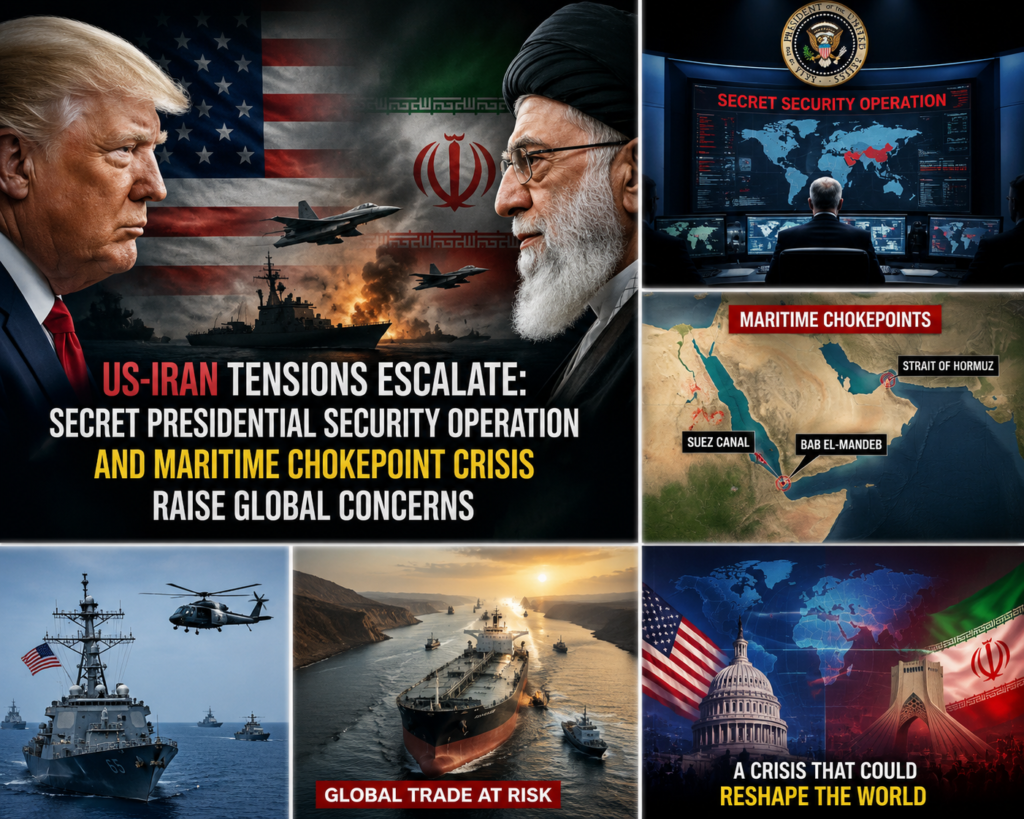
This personal security crisis for the American commander-in-chief unfolds within a larger theatre of confrontation. Since late February 2026, the United States and Iran have been engaged in direct and proxy conflict following Israeli and U.S. strikes on Iranian targets. The war has centred heavily on control of the Strait of Hormuz, the narrow waterway through which roughly one-fifth of global oil and liquefied natural gas supplies traditionally flow. Iran has effectively closed or severely restricted the strait, declaring it under its operational control and threatening or attacking vessels that do not comply with its traffic schemes or permissions.
Iranian officials have maintained firm conditions for any reopening. On August 11, Mohsen Rezaei, a top Iranian security official recently appointed as second-in-command of the body coordinating security and foreign policy, stated that the Strait of Hormuz would remain closed unless the United States accepts Tehran’s demands. These include the release of Iran’s frozen assets, an end to regional conflicts including those in Lebanon and Gaza, the lifting of sanctions, and other concessions. “As long as America does not change its behaviour and does not accept Iran’s conditions, the Strait of Hormuz will not be opened,” Rezaei said, according to Iranian media. This position followed parallel U.S. demands from President Trump for Iranian compensation related to decades of casualties from Iranian-backed actions.
Talks mediated by Oman have produced some progress on technical aspects, such as defining shipping lanes and coordinates, with Iranian Foreign Ministry statements suggesting a joint announcement could be near if external parties do not interfere. However, Tehran has insisted that any such arrangement with Oman does not equate to reopening the strait to unrestricted international traffic without broader U.S. compliance. The United States, for its part, has maintained a naval blockade, redirecting commercial vessels, boarding ships, and conducting strikes on Iranian coastal radar, anti-ship missile sites, air defences, and IRGC naval assets whenever Iran attacks commercial shipping. CENTCOM has reported striking dozens of targets in successive waves, including more than 80 in one overnight operation in early July.
The resulting uncertainty has kept shipping volumes through the strait far below pre-war levels. Carriers have diverted vessels around the Cape of Good Hope, lengthening voyages and elevating costs. Oil prices have responded accordingly. On August 11, Brent crude futures rose 1.4 per cent to settle near $88.91 per barrel, while U.S. crude gained 1.3 per cent to around $83.20, amid renewed pessimism about a quick resolution. Earlier spikes of 3 per cent occurred when Iranian officials reiterated hardline conditions. Markets remain sensitive to every report of vessel attacks or diplomatic breakdowns.
Parallel risks have intensified in the Red Sea and the Bab al-Mandeb Strait, the southern gateway linking the Red Sea to the Gulf of Aden and Indian Ocean. Iran-aligned Houthi forces in Yemen have renewed and expanded attacks on shipping, particularly targeting vessels linked to Saudi Arabia or perceived as supporting the U.S.-led coalition. On August 11, Yemen’s Transport Ministry and Coast Guard reported that a suspected Houthi attack on a small Egyptian-owned cargo vessel in the Bab al-Mandeb killed four crew members and two rescuers. These were described as the first shipping deaths attributed to the Houthis since the broader Iran conflict began. Houthi media claimed attacks on Saudi military-equipment carriers, while maritime sources tracked additional strikes.
The Houthis declared a naval blockade on Saudi shipping in the Red Sea in July and have struck oil installations and ports along Saudi Arabia’s Red Sea coast, including sites near Jizan and Yanbu. Yanbu has become a critical alternative export route for Saudi crude seeking to avoid the closed Strait of Hormuz. Reduced traffic through Bab al-Mandeb—by as much as one-fifth in some periods—has forced further diversions and increased reliance on longer routes. Saudi Arabia has responded by assembling a multinational maritime defence coalition and supporting strikes by the internationally recognised Yemeni government against Houthi positions. The risk of reigniting Yemen’s civil war, largely paused since a 2022 truce, adds another layer of instability.
These dual chokepoint crises—Hormuz under Iranian control and Bab al-Mandeb under Houthi pressure—compound the economic and strategic pressures on global energy markets and supply chains. Insurers have raised war-risk premiums dramatically. Shipping companies face higher fuel costs, longer transit times, and the constant calculation of whether to risk transit or divert. Gulf states, while seeking to avoid direct entanglement, have seen Iranian and Houthi actions spill over into attacks on infrastructure in Bahrain, Kuwait, and elsewhere, prompting defensive responses and complicating regional diplomacy.
The plane-swap incident in Turkey serves as a vivid personalisation of these systemic threats. Turkey’s proximity to Iran and the presence of Iranian-aligned networks made the NATO summit a high-risk venue. Intelligence of a missile threat—whether from Iranian territory, proxy forces, or operatives on the ground—forced American protective details to improvise at the highest level. The successful execution of the ruse without public knowledge until weeks later demonstrates both the competence of the U.S. security apparatus and the seriousness with which Iranian intentions are assessed.
Analysts note that the episode undercuts narratives of Iranian military exhaustion. Despite sustained U.S. and Israeli strikes on Iranian command-and-control, missile production, air defences, and naval assets, Tehran retains the capacity to generate credible threats against the U.S. president and to impose costs on global commerce through asymmetric means. Proxy forces such as the Houthis provide deniable tools that extend Iranian reach into the Red Sea without requiring direct Iranian naval presence.
Diplomatic pathways remain narrow. Trump has alternated between public optimism about imminent deals and sharp criticism of Iranian “duplicity.” Iranian officials continue to frame any Hormuz arrangement as contingent on comprehensive U.S. concessions rather than isolated technical fixes. Oman’s mediation offers a channel, yet mutual demands for compensation, asset releases, sanctions relief, and an end to regional conflicts create interlocking obstacles. Meanwhile, tit-for-tat strikes continue at a lower intensity, with each side calibrating responses to avoid uncontrolled escalation while signalling resolve.
The human and economic toll continues to mount. Shipping crews face lethal risks in the Bab al-Mandeb. Oil consumers worldwide confront elevated prices. Regional populations endure the secondary effects of disrupted trade and heightened military activity. For the United States, the protection of its commander-in-chief has required extraordinary measures that, while successful in this instance, reveal the persistent vulnerability inherent in high-level travel through contested regions.
Looking ahead, the trajectory of US-Iran tensions hinges on whether diplomatic channels can produce verifiable de-escalation or whether further kinetic exchanges and proxy actions will deepen the crisis. The secret plane operation of July 8 stands as a cautionary marker: even as leaders gather for alliance summits, the shadow of Iranian threats can force the most powerful nation on earth into elaborate deceptions simply to ensure the safe transit of its president. Concurrently, the firm Iranian stance on the Strait of Hormuz and the lethal Houthi campaign in the Red Sea keep two of the world’s most critical maritime arteries under severe strain, with direct consequences for energy security, global trade, and regional stability.
As of mid-August 2026, neither the personal security concerns surrounding the American presidency nor the maritime restrictions enforced by Iran and its allies show signs of imminent resolution. The coming weeks will test whether negotiation can prevail over confrontation, or whether the cycle of threats, strikes, and economic pressure will intensify further. For now, the elaborate ruse that safely extracted President Trump from Turkey and the ongoing closure of vital waterways together define a period of elevated US-Iran tension with far-reaching security and economic implications.