

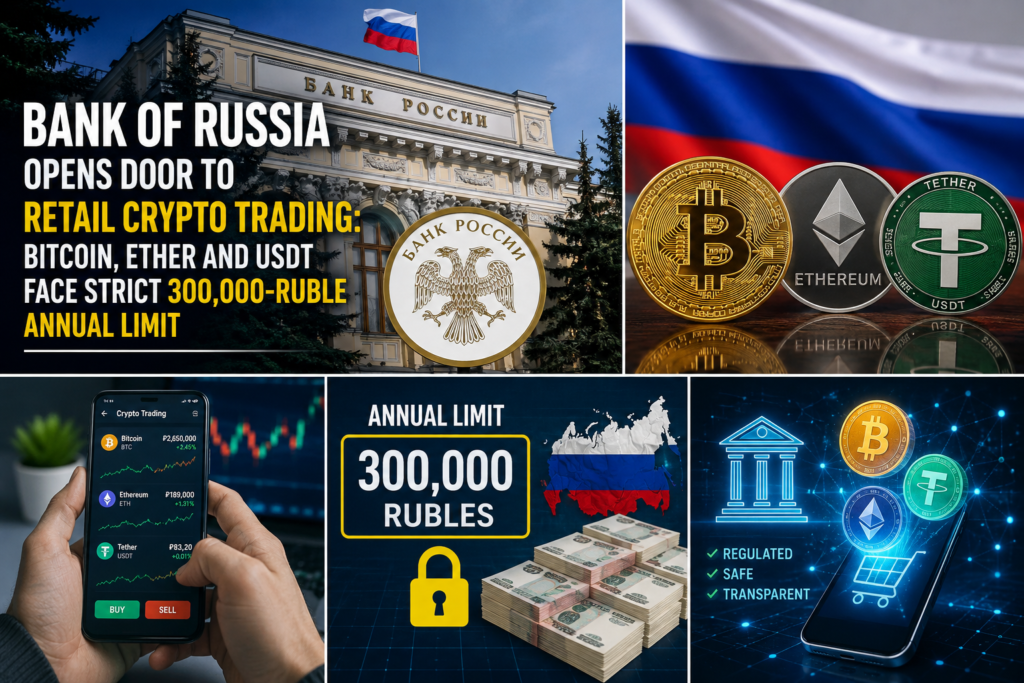
Moscow, August 13, 2026 — In a significant step toward regulated cryptocurrency markets, the Bank of Russia published a draft directive this week that would allow non-qualified retail investors to purchase Bitcoin, Ethereum, and Tether’s USDT through licensed brokers, crypto exchanges, and asset managers. The framework imposes a firm annual purchase limit of 300,000 rubles per intermediary, roughly equivalent to several thousand U.S. dollars depending on exchange rates, while requiring all investors to pass risk-awareness tests before trading.
The draft, released on August 11, fills in critical details left open by federal legislation signed into law by President Vladimir Putin earlier this month. That law, which largely takes effect on September 1, 2026, establishes a formal regime for organised trading of digital currencies while maintaining a domestic ban on using crypto as a means of payment. Public comments on the Bank of Russia’s draft are being accepted through August 24, after which the central bank may refine the rules before final implementation.
This move marks a cautious but deliberate shift for Russia, which has long approached cryptocurrencies with a mix of scepticism toward speculative retail activity and pragmatic interest in their potential for cross-border settlements amid geopolitical pressures. For years, ordinary Russians faced heavy restrictions or outright uncertainty around crypto access. The new rules create a controlled on-ramp for retail participation limited to the most established and liquid assets, while giving greater freedom to qualified investors.
Background: From Restriction to Regulated Access
Russia’s relationship with cryptocurrency has evolved in stages. Early official commentary often framed digital assets as high-risk instruments that could threaten financial stability and facilitate illicit activity. At the same time, the country’s substantial energy resources and cold climate made it an attractive location for mining operations, and authorities explored crypto’s utility for international trade settlements, particularly after the imposition of Western sanctions.
Legislative groundwork accelerated in 2025 and early 2026. Draft concepts circulated that would allow both qualified and non-qualified investors to trade crypto under differentiated rules. Non-qualified investors—essentially the bulk of the retail population—would face purchase limits and restrictions to the most liquid tokens. Qualified investors would enjoy broader access without volume caps. Privacy-focused coins were expected to remain off-limits.
By July 2026, the State Duma had advanced a comprehensive bill. On July 21, lawmakers passed key readings of legislation that legalises regulated trading infrastructure while preserving the ban on domestic crypto payments. President Putin signed the measure in early August. The law requires intermediaries—exchanges, brokers, custodians, and related entities—to register and meet capital and operational standards. A transition period runs until mid-2027 for full licensing compliance in some areas.
The statute itself left important operational details to the Bank of Russia. Which assets would qualify as sufficiently liquid for retail public trading? How exactly would the 300,000-ruble annual ceiling be calculated and enforced? What testing requirements would apply? The draft directive published this week answers those questions with precision.
The Core Provisions of the Draft Directive
According to the Bank of Russia’s materials and contemporaneous reporting from major outlets, the draft sets out several interlocking rules.
First, it names an explicit list of digital currencies eligible for public organised trading: Bitcoin (Bitcoin), Ethereum (Ethereum), and Tether USDT (Tether USDT). These three alone meet the regulator’s criteria of substantial market capitalisation, high average daily trading volume, and at least five years of continuous pricing history on licensed foreign exchanges. The central bank emphasised that this shortlist is designed to shield non-qualified investors from “drastic and unpredictable fluctuations” in less established tokens.
Second, non-qualified retail investors may acquire these assets only through licensed intermediaries—brokers, crypto exchanges (or exchange services), or managers—and only up to a maximum total value of 300,000 rubles per calendar year per intermediary. The limit is calculated on the cumulative ruble cost of purchases made through that intermediary during the year. Because the cap applies separately to each intermediary, an investor theoretically could achieve higher aggregate exposure by using multiple licensed platforms, though each remains independently limited.
Third, qualified investors face no such monetary ceiling. They may acquire any cryptocurrencies admitted to exchange or over-the-counter trading, subject only to the general market infrastructure rules. Obtaining qualified status can draw on prior crypto transaction history in some cases, alongside traditional financial criteria.
Fourth, every investor—regardless of qualification status—must complete a risk test and review disclosures about the risks of investing in crypto assets before executing transactions. This knowledge requirement is intended to ensure a baseline of understanding of volatility, custody issues, technological risks, and the absence of traditional investor protections that accompany many securities.
The draft also clarifies that the list of eligible assets and related parameters remain subject to adjustment. The Bank of Russia has invited comments until August 24, leaving open the possibility of modifications to the three-asset roster, the numerical limit, or implementation timing before the broader legal framework activates on September 1.
Why These Three Assets?
The selection of Bitcoin, Ethereum, and USDT reflects a deliberate emphasis on liquidity, track record, and relative maturity. Bitcoin, the original and largest cryptocurrency by market capitalisation, has operated continuously for more than a decade and a half and remains the benchmark for the sector. Ethereum underpins a vast ecosystem of decentralised applications and smart contracts; its multi-year price history and substantial trading volumes place it in a similar category of established assets. USDT, the leading dollar-pegged stablecoin issued by Tether, offers a different profile: it aims for price stability relative to the U.S. dollar rather than speculative appreciation, and it has become a primary medium of exchange and liquidity vehicle across global crypto markets.
By restricting retail public trading to these three, the regulator seeks to minimise the risk that less liquid or newer tokens—whose prices can move dramatically on thin order books—would expose ordinary investors to outsized losses. The five-year pricing history requirement further filters out assets that have not yet demonstrated resilience across multiple market cycles.
Notably absent from the initial list are other large-capitalisation cryptocurrencies and alternative stablecoins. Reporting has highlighted that tokens such as XRP were not included at this stage. The Bank of Russia retains authority to expand the list later if additional assets meet the statutory and regulatory thresholds.
Investor Protection and the 300,000-Ruble Ceiling
The annual purchase limit of 300,000 rubles has been a consistent feature of the legislative discussion for months. Officials have defended the figure as exceeding the average balances held in many ordinary brokerage and trust management accounts, while still constraining potential losses for retail participants. Because crypto markets remain highly volatile, a hard ceiling on new purchases each year functions as a circuit breaker against rapid escalation of exposure.
The per-intermediary structure is consequential. An investor who spreads activity across several licensed brokers or exchanges could, in principle, multiply the effective annual capacity. Whether the Bank of Russia will monitor aggregate exposure across platforms, or whether the design intentionally permits such stacking, remains an area that market participants will watch closely during the comment period and early implementation.
Testing requirements apply universally. The precise content of the risk test has not been fully detailed in the public draft summaries, but it is expected to cover fundamental concepts: the nature of digital assets, sources of volatility, operational and cyber risks, the absence of deposit insurance or similar safety nets, and the fact that past performance offers no guarantee of future results. Successful completion of the test, together with acknowledgement of risk disclosures, becomes a precondition for trading.
Qualified investors, while free of the volume cap, remain subject to the same testing obligation. This creates a two-tier market: broader product access and unlimited size for those who meet qualification criteria, versus a tightly constrained, highly liquid subset of assets for everyone else.
Market Infrastructure and Licensing
The broader legal framework requires intermediaries to operate under Bank of Russia oversight. Exchanges, brokers, custodians, and related service providers must join relevant registries, meet capital thresholds (reports have cited figures in the range of 15 million rubles for certain exchange operators), and adhere to operational, reporting, and anti-money-laundering standards. Licensed platforms may also assume tax-agent responsibilities, facilitating collection of taxes on crypto gains.
A phased approach is built in. Core provisions of the enabling law take effect on September 1, 2026. Requirements that all crypto deals occur exclusively through licensed entities become fully operative later, with some reports pointing to July 1, 2027. This transition window gives existing market participants time to adapt systems, obtain necessary authorisations, and build compliant custody and trading infrastructure.
Domestic use of cryptocurrency as payment for goods and services remains prohibited. The regulated market is therefore oriented toward investment and trading rather than transactional use inside Russia. Cross-border settlements involving crypto, particularly for foreign trade, receive more favourable treatment under the overall policy direction, reflecting strategic interest in alternative payment channels.
Implications for Retail Investors
For ordinary Russians, the new regime represents the first formal, regulated pathway to acquire Bitcoin, Ethereum, and USDT through domestic licensed intermediaries. Previously, many interested individuals relied on peer-to-peer platforms, foreign exchanges accessed via workarounds, or informal channels—arrangements that carried legal, operational, and counterparty risks and offered limited consumer protections.
The 300,000-ruble annual ceiling per intermediary will constrain the scale of retail participation. For many households, the sum is meaningful but not transformative; it allows modest exposure without permitting large concentrations of wealth in highly volatile assets. Investors seeking larger positions will need either to qualify for unrestricted status or to spread purchases carefully across multiple platforms while remaining within each platform’s limit.
The mandatory testing requirement may also shape participation. Those who lack basic familiarity with digital assets will need to educate themselves sufficiently to pass the assessment. In practice, this could encourage the growth of educational materials, broker-provided guidance (carefully bounded to avoid advice that crosses regulatory lines), and third-party resources aimed at retail audiences.
Tax treatment will become more straightforward once licensed intermediaries act as tax agents. Capital gains and other taxable events related to crypto holdings should enter the formal reporting system more systematically, reducing ambiguity that previously surrounded informal holdings.
Broader Economic and Policy Context
The timing of the draft coincides with ongoing efforts to modernise Russia’s financial infrastructure and expand options for capital allocation. Traditional equity and bond markets coexist with newer instruments such as digital financial assets (DFAs). Cryptocurrencies now receive a parallel but carefully ring-fenced treatment: investable under strict conditions, yet barred from everyday payments.
Geopolitically, the framework sits against the backdrop of sanctions and the search for resilient cross-border payment mechanisms. While the retail rules focus on domestic investor protection, the enabling legislation facilitates crypto use in foreign-trade settlements. This dual approach—tight control at home, pragmatic openness for international commercial flows—has characterised much of Russia’s recent crypto policy.
Volatility remains a central concern for the Bank of Russia. Officials have repeatedly characterised cryptocurrencies as high-risk instruments unsuitable as primary savings vehicles for the general population. The three-asset list, the purchase cap, and the testing mandate all serve that protective philosophy. At the same time, by creating a legal channel rather than attempting comprehensive prohibition, authorities acknowledge the persistent demand among citizens and the practical difficulty of suppressing activity entirely.
Reactions and Outstanding Questions
Market observers have noted both the significance of the opening and the conservatism of its design. Allowing any form of regulated retail access to Bitcoin and Ethereum is a notable development after years of more restrictive signals. The inclusion of USDT provides a stable-value option within the permitted set. Yet the short list and the numerical ceiling ensure that the initial market will remain limited in scale and product diversity relative to more open jurisdictions.
Several practical questions will be clarified in the coming weeks and months. How will intermediaries track and enforce the 300,000-ruble cumulative purchase limit in real time? What technical standards will govern custody, settlement, and reporting? How readily will existing platforms secure the necessary licenses? Will the Bank of Russia expand the eligible-asset list relatively soon, or will the initial three remain the retail universe for an extended period? How will the testing regime be administered and updated as market conditions evolve?
The public comment period ending August 24 offers an opportunity for industry participants, legal experts, and other stakeholders to submit proposals. The final form of the directive may incorporate adjustments based on that feedback.
Looking Ahead
As September 1 approaches, attention will turn to the readiness of licensed intermediaries and the practical rollout of trading access. Early volume is likely to be modest given the purchase limits and the novelty of the regulated channel. Over time, the combination of legal clarity, tax integration, and supervised infrastructure could draw a portion of previously informal activity into the formal system.
For non-qualified retail investors, the message is clear: limited, supervised exposure to the three most established digital assets is now contemplated within the Russian regulatory perimeter, provided the investor passes the required test and stays within the annual monetary bound at each intermediary. Qualified investors gain substantially wider latitude. The domestic payment ban continues to distinguish the investment market from any vision of crypto as everyday money.
The Bank of Russia’s draft directive thus represents a calibrated experiment in controlled market opening. It prioritises investor protection through product restriction, size limits, and education requirements, while establishing the institutional foundations for organised trading. Whether the framework expands in subsequent years—through additional eligible assets, adjusted ceilings, or refined qualification pathways—will depend on observed market behaviour, technological developments, and the evolution of the broader economic environment.
In the immediate term, the publication of the draft provides the most concrete guidance yet on how ordinary Russians will be able to buy Bitcoin, Ethereum, and USDT under the new legal regime. The details remain subject to finalisation, but the direction of policy is now firmly on the public record: regulated access, tightly bounded for retail participants, and oriented toward the most liquid and historically established digital currencies.
This development will be closely monitored by market participants inside Russia and by international observers tracking the global evolution of crypto regulation. As the comment period concludes and the September effective date nears, further refinements and operational announcements from the Bank of Russia and market infrastructure providers can be expected. For now, the draft stands as the clearest statement to date of the rules that will govern retail crypto purchases in the country’s emerging regulated marketplace.