

In the vast tapestry of Spanish football, few matchups capture the romance of the underdog quite like Deportivo de La Coruña against Real Madrid. It is not a traditional derby fueled by geography or politics in the same way as El Clásico or the Madrid derby. Instead, it is a story of ambition colliding with established power, of a rainy Galician port city briefly rewriting the hierarchy of La Liga, and of one of the most enduring curses in modern Spanish football: Real Madrid’s nearly two-decade inability to win a league match at the Riazor.
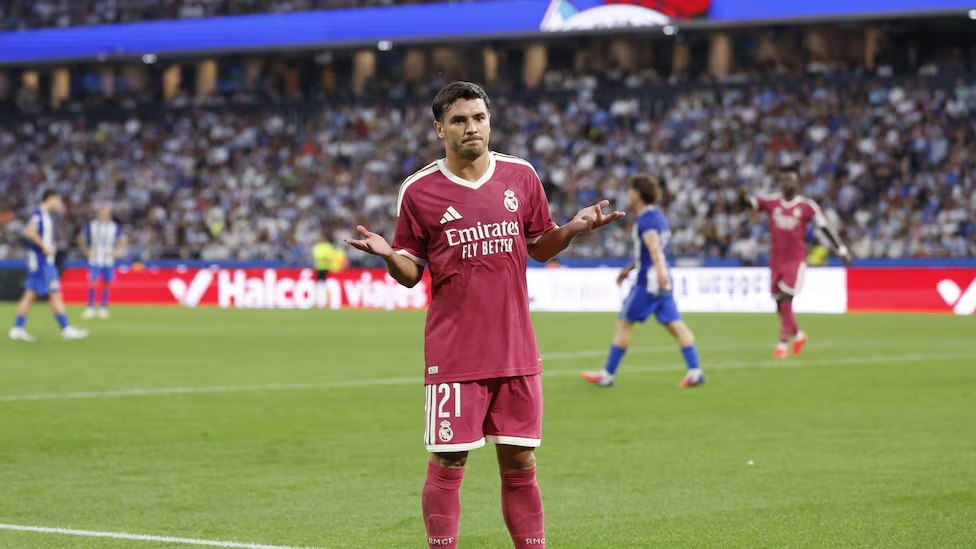
As Deportivo returns to La Liga for the 2026-27 season after years in the wilderness and the two sides recently met in a pre-season Trofeo Teresa Herrera (won 1-0 by Real Madrid through Brahim Díaz), the fixture once again stirs memories of an extraordinary era. This is the story of Super Depor, the Centenariazo, the Riazor curse, and a rivalry that punched far above its expected weight.
The Rise of Super Depor
Real Club Deportivo de La Coruña spent much of its history as a solid but unspectacular club, oscillating between the top flight and the second division. That changed dramatically in the early 1990s under president Augusto César Lendoiro. Ambitious investment, smart recruitment of Brazilian talent, and the shrewd management of Arsenio Iglesias transformed the side.
The symbolic birth of “Super Depor” is widely dated to 3 October 1992. Deportivo sat top of La Liga after a blistering start. Real Madrid, still carrying the aura of the Quinta del Buitre era and managed by Benito Floro, arrived at the Riazor as heavy favourites. Within 25 minutes, they led 2-0 through Fernando Hierro and Iván Zamorano. What followed became folklore. Bebeto scored twice, and an own goal from Rocha completed a 3-2 comeback. The stadium erupted. A club from a city of roughly a quarter of a million people had just stared down one of the giants of world football and refused to blink.
That night crystallised something larger. Deportivo finished third that season, qualified for Europe for the first time, and established Riazor as a fortress. Bebeto claimed the Pichichi. The following campaigns brought near-misses: a last-gasp Djukic penalty miss that cost the 1993-94 title, consecutive runners-up finishes, and growing national affection for the stylish, attacking side built around players such as Fran, Mauro Silva, Donato, and later Juan Carlos Valerón, Diego Tristán, and Djalminha.
In 1995, Deportivo claimed their first major silverware, the Copa del Rey. They followed it by thrashing Real Madrid 5-1 on aggregate in the Supercopa de España (3-0 at home, 1-2 away). The message was clear: the traditional order had been disrupted.
The Riazor Curse
Between 1992 and January 2010, Real Madrid failed to win a single league match at the Riazor. Across roughly 18 seasons, the record was stark: Deportivo victories in the majority of encounters, a handful of draws, and zero Madrid wins. The goal difference was heavily skewed in Depor’s favour. Famous thrashings included a 4-0 in 1993-94 and a 5-2 in February 2000.
Madrid players of successive generations spoke of the psychological weight. Zinedine Zidane, Raúl, Luis Figo, and others arrived knowing the history. The pitch, the weather, the partisan crowd, and Deportivo’s organisation combined into something close to a complex. Only on 30 January 2010, under Manuel Pellegrini, did the spell break. Esteban Granero scored, Guti produced a trademark back-heeled assist for Karim Benzema, and Benzema added a late second in a 3-1 victory. By then, Super Depor’s peak had long passed, and Deportivo would be relegated the following season. The curse’s end felt like the closing of an era.
The Centenariazo
If one match defines the rivalry above all others, it is the 2002 Copa del Rey final. Real Madrid were celebrating their centenary. Florentino Pérez’s Galácticos—featuring Zidane, Figo, Raúl, Roberto Carlos, and company—were the clear favourites. The Spanish Football Federation agreed to stage the final at the Santiago Bernabéu on 6 March, the exact anniversary of the club’s founding. The occasion was meant to be a perfect party.
Deportivo, managed by Javier Irureta, refused to play the role of guests. Within six minutes, Sergio González scored. Before half-time, Diego Tristán made it 2-0. Raúl pulled one back after the interval, but Deportivo held firm. Final score: Real Madrid 1-2 Deportivo. The Galician contingent inside the Bernabéu sang “Happy Birthday” with delicious irony. The Spanish press immediately christened it the “Centenariazo,” a deliberate echo of Uruguay’s Maracanazo against Brazil in 1950.
It remains one of the most romantic upsets in modern Spanish football history. Deportivo’s second Copa del Rey was lifted in the home of their most glamorous rivals on the most symbolic date possible. For Depor fans, it is sacred; for Madrid, it is a scar that still smarts.
Later Years and Madrid’s Domination
After the early 2000s, Deportivo’s financial model became unsustainable. The club slipped down the table, suffered relegation, and eventually fell as far as the third tier amid severe economic difficulties. Real Madrid, by contrast, continued to accumulate Champions League titles and domestic dominance.
In the 2010s, the encounters became one-sided. Notable results included an 8-2 Madrid win at the Riazor in September 2014 (still one of Real Madrid’s biggest away league victories) and a 7-1 thrashing at the Bernabéu in January 2018. Head-to-head statistics across all competitions reflect the overall imbalance: Real Madrid hold a clear majority of wins (roughly 55-60 per cent in comprehensive counts of more than 100 meetings), with Deportivo claiming around 23 percent and the rest draws. Goal tallies heavily favour Madrid.
Yet the historical memory of Super Depor ensures the fixture retains emotional charge whenever the sides meet. Even in friendlies or lower-stakes games, Galician pride and Madrid’s lingering awareness of past humiliations surface.
Statistical Snapshot and Cultural Weight
Across more than a century of intermittent meetings, Real Madrid have generally held the upper hand. In La Liga alone, the record is heavily skewed toward the capital club. Deportivo’s best results cluster in that golden window of the 1990s and early 2000s. Biggest wins for Depor include the 4-0 of 1999 and the various Riazor masterclasses. Madrid’s heaviest victories came later, once the competitive balance shifted.
Culturally, the rivalry matters because it represents something larger than points. Deportivo embodied the possibility that a well-run, ambitious club from outside the traditional power centres could challenge the status quo. Galicia’s football identity found its purest expression in those Super Depor sides. For Madrid supporters, the Riazor curse and the Centenariazo serve as reminders that even the biggest institutions are vulnerable on certain nights.
The Present and Future
In 2026, Deportivo completed a remarkable recovery, earning promotion back to La Liga alongside Racing Santander and Málaga. The club that once sat at the summit of Spanish football returns after an eight-year absence from the top flight. A new generation of players, including standout talents such as Yeremay Hernández, carries the hopes of a passionate fanbase that never stopped believing.
The recent Trofeo Teresa Herrera meeting, won by Real Madrid, offered a low-stakes reunion. More meaningful chapters await when the sides meet in competitive fixtures during the 2026-27 season and beyond. Whether Deportivo can recreate even a fraction of Super Depor’s magic remains to be seen. The financial and competitive landscape of modern football is far less forgiving to smaller clubs than it was in the 1990s.
What endures is the memory. The 1992 comeback that announced Super Depor to the world. The years when Madrid players approached the Riazor with visible apprehension. The night the Galácticos lost a cup final on their own centenary. These moments form a distinctive strand in Spanish football history—one in which a club from the Atlantic edge of the peninsula forced the giants to take notice.
Deportivo versus Real Madrid is ultimately a story about possibility. It reminds us that football’s greatest narratives are not always written by the richest or most decorated sides. Sometimes they are written by a team that, for one glorious decade, refused to accept its supposed place in the hierarchy. The Riazor may no longer be an impregnable fortress, and Super Depor exists primarily in the realm of nostalgia. Yet every time the two clubs meet, that history walks onto the pitch with them.
In an era of state-backed super clubs and ever-widening financial gaps, the tale of Deportivo’s rise and its repeated ability to wound Real Madrid retains a special resonance. It is a reminder of a time when Spanish football felt a little more open, a little more romantic, and a lot more surprising. For that reason alone, the fixture will always matter.