
Reykjavik / Madrid / London — August 13, 2026
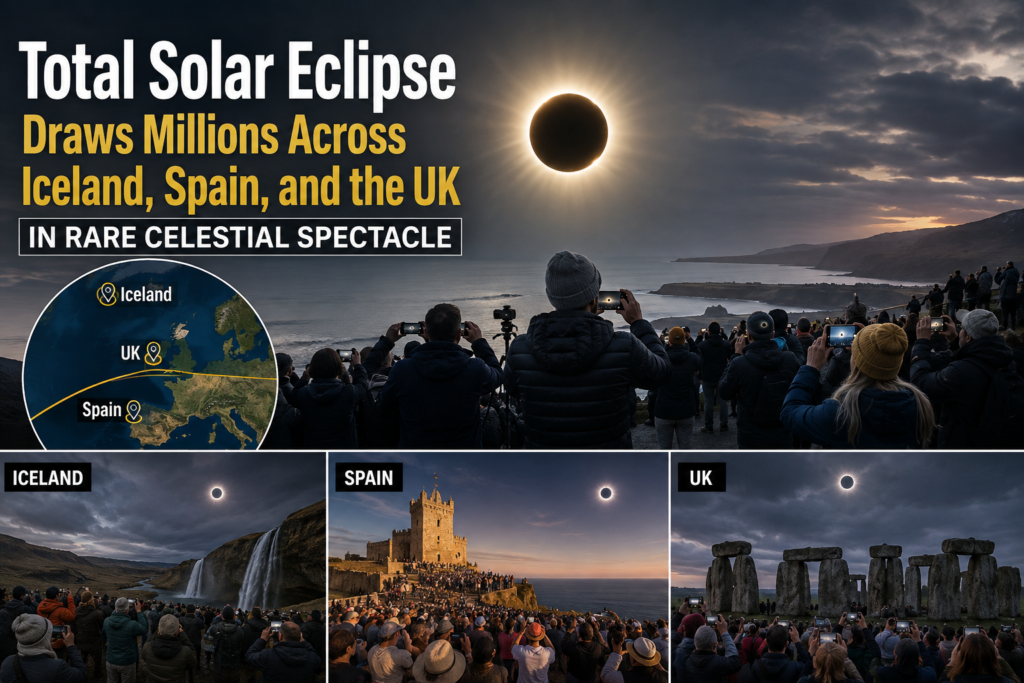
Millions gathered across Iceland, Spain, and the United Kingdom on Wednesday, August 12, 2026, to witness a total solar eclipse that swept from the Arctic through the North Atlantic and across northern Spain near sunset. A total solar eclipse occurs when the Moon passes directly between the Earth and the Sun, completely covering the Sun and plunging parts of the world into temporary darkness along a narrow path called the path of totality. For the United Kingdom, it marked the deepest partial solar eclipse in 27 years, since the total eclipse that crossed Cornwall and parts of Devon on August 11, 1999. While the path of totality missed the British Isles entirely, more than 90 per cent of the Sun was obscured across much of the country, creating an eerie twilight in the early evening and drawing crowds to parks, beaches, hillsides, and city squares from Cornwall to Scotland.
The eclipse began far to the north, with the Moon’s umbral shadow first touching remote regions of northern Russia and the Arctic before racing southeast across eastern Greenland, western Iceland, the open Atlantic, and then northern Spain, clipping a tiny corner of Portugal and ending over the western Mediterranean and the Balearic Islands as the Sun set. At the point of greatest eclipse, just off Iceland’s western coast, totality lasted a maximum of 2 minutes and 18 seconds. In Spain, the duration was shorter, typically between one and two minutes depending on location, with the Sun low on the horizon and a striking “sunset eclipse” effect.
Spanish authorities had prepared for an extraordinary influx. Officials estimated that as many as six million people could move into or already be within the roughly 200-kilometre-wide path of totality that stretched from A Coruña in Galicia across northern and central regions to Valencia and the island of Mallorca. More than 450,000 international visitors had already arrived in the days leading up to the event, many from Japan, Australia, the United States, and Canada. Hotels in towns along the centre line reported near-total occupancy months in advance; some smaller villages saw prices double or triple. Rural roads became congested with caravans, camper vans, and private cars as families and eclipse chasers sought clear sightlines on hillsides, riverbanks, and open fields.
In northern Spain, the skies largely cooperated. Clear or only partly cloudy conditions prevailed across much of the path, allowing vast crowds to experience the full drama of totality. As the Moon’s disc slid across the Sun, temperatures dropped noticeably, birds fell silent or began evening calls, and the landscape took on an otherworldly quality. At the moment of second contact—when the last bright bead of sunlight vanished—cheers, gasps, and spontaneous applause rose from hilltops and town squares. The solar corona, the Sun’s outer atmosphere normally invisible to the naked eye, flared into view as a pearly white halo around the black disc of the Moon. Planets and brighter stars appeared in the darkened sky. In places such as Bilbao, Zaragoza, León, Valladolid, and Valencia, the brief period of totality transformed ordinary evening into a collective moment of wonder. One observer in La Rioja described the corona as “a living crown of light,” while another in a village near Burgos said the sudden darkness felt “like the world holding its breath.”
Security and safety measures were extensive. Spain’s Interior Ministry deployed approximately 25,000 police officers and nearly 100 aircraft, including helicopters and planes, to manage crowds, traffic, and the elevated risk of wildfires amid a heatwave that had left parts of the countryside tinder-dry. Officials repeatedly urged visitors to avoid lighting fires or discarding cigarettes and to use only certified eclipse glasses for the partial phases. Hospitals and emergency services were placed on heightened alert. Despite the scale of the gathering, reports indicated that the event proceeded largely without major incidents. However, some rural roads experienced temporary gridlock as people left viewing sites after the eclipse.
Iceland presented a more mixed picture. The island nation of roughly 400,000 residents expected up to 80,000 visitors, a significant temporary boost. Reykjavik and the western regions—particularly the Westfjords and the Snæfellsnes Peninsula—lay within or near the path of totality. In the far west, totality lasted up to about 2 minutes and 13 seconds; in Reykjavik itself, the duration was closer to one minute. Cruise ships, numbering a record 31 vessels carrying tens of thousands of passengers and crew, positioned themselves off the western coast in hopes of clearer skies over the ocean. On land, hotels and campsites filled rapidly. In some remote Westfjords locations, campgrounds that normally held a few hundred people swelled to thousands.
Weather proved less cooperative than in Spain. Forecasts had warned of cloudy conditions and showers across much of Iceland, and many locations experienced overcast skies that obscured the total phase. In Reykjavik, crowds gathered in front of landmarks such as Hallgrímskirkja church nevertheless erupted in cheers when the light dimmed dramatically, even if the corona itself remained hidden behind cloud. Some observers farther west reported brief clearings that allowed glimpses of totality. The temperature drop and the sudden deepening of twilight were still widely felt, and the event retained a powerful emotional impact for those who had travelled long distances. For Iceland it was the first total solar eclipse since 1954, and the only one expected this century; the next is not due until 2196.
Across the United Kingdom the experience was partial but still profound. From roughly 6:00 p.m. to just after 8:00 p.m. British Summer Time, the Moon progressively covered the Sun. Maximum obscuration ranged from about 91 per cent in London, Manchester, Glasgow, and Edinburgh to 93 per cent in Cardiff and Belfast and as high as 95–96 percent in parts of southwest England and southern Ireland. In the southwest the sky took on a deep, unnatural twilight; streetlights flickered on in some places, and the air cooled. Crowds filled parks and open spaces: Primrose Hill and other London vantage points, beaches in Cornwall and Devon, hillsides in Wales and northern England. Protective eclipse glasses sold out in many shops in the preceding days. People watched through cardboard viewers, projected the crescent Sun through pinholes, or simply stood together as the light faded.
Many British observers noted the historical parallel with 1999. That earlier total eclipse had been largely clouded out in Cornwall, leaving many disappointed. This time the weather across much of the UK was more favourable for the partial phases, and the depth of coverage created a memorable shared experience even without the corona. Social media was filled with images of crescent Suns, darkened cityscapes, and groups of people in parks wearing paper glasses. Comments ranged from scientific fascination to simple expressions of awe—“Well done, Moon,” one Londoner was overheard saying.
The scientific community made the most of the opportunity. Teams from NASA, the European Space Agency, and various universities set up instruments along the path in Spain and, where possible, in Iceland. Observations of the corona, solar magnetic fields, and atmospheric changes during the brief period of totality will feed into ongoing research on the Sun’s outer atmosphere and its influence on space weather. Citizen scientists also contributed, sharing photographs and timing data. The eclipse coincided with the peak of the Perseid meteor shower later that night, giving dedicated skywatchers a full day and night of celestial activity, though moonlight and residual twilight limited meteor visibility in some areas.
Beyond the immediate spectacle, the event highlighted both the enduring human fascination with eclipses and the logistical challenges of hosting millions of temporary visitors in relatively remote or rural zones. Small Spanish villages that normally see modest tourism suddenly hosted thousands. Local economies benefited from hotel bookings, food sales, and guided viewing events, yet infrastructure strained under the sudden demand. In Iceland, the combination of limited accommodation and uncertain weather underscored the risks of travelling for a weather-dependent phenomenon. Environmental concerns, particularly wildfire risk in Spain, prompted careful official messaging and enforcement.
Historically, total solar eclipses have carried cultural weight far beyond their scientific value. Ancient records from many civilisations treated them as omens or divine messages. In the modern era, they have become destinations for “eclipse chasers”—people who travel the globe to stand in the Moon’s shadow. The 2024 North American total eclipse had drawn enormous crowds; the 2026 event, though shorter in duration and more limited in land path, proved equally magnetic for Europeans and international travellers. Spain’s next total eclipse arrives as soon as August 2, 2027, part of a rare “Iberian eclipse trio” that also includes an annular eclipse in 2028. For the United Kingdom, another deep partial eclipse of similar magnitude is not expected until 2081, and the next total eclipse on British soil is not due until 2090.
As the Moon’s shadow raced across the Atlantic and then across Spain on August 12, ordinary life paused for a few minutes. In Icelandic fjords, Spanish hill towns, and British city parks, people stood together looking upward. Some cried; others laughed or simply fell silent. The corona, when visible, appeared as a delicate, structured glow rather than a uniform ring—streamers and loops shaped by the Sun’s magnetic field. The sudden return of light after third contact felt abrupt, almost jarring, as the world returned to ordinary evening.
In the aftermath, social media and news outlets were filled with photographs and videos: the diamond-ring effect at the edge of totality, the darkened silhouette of Spanish churches against a glowing horizon, crowds on London hills, cruise ships under partial cloud off Iceland. Scientists began analysing data. Tourism officials tallied visitor numbers. Ordinary participants returned home carrying a shared memory of the day the Sun disappeared.
The August 12, 2026, total solar eclipse will be remembered as a moment when millions paused to watch the geometry of the solar system play out in real time. For those in the path of totality in Iceland and Spain, it delivered the full, rare experience of daytime darkness and the solar corona. For the millions more across the United Kingdom and the rest of western Europe who saw a deep partial eclipse, it offered a powerful reminder of the same celestial mechanics and a connection to the last major British eclipse a generation earlier. In an age of constant digital distraction, the simple act of standing outside and looking at the sky—protected by a pair of cardboard glasses—proved once again capable of uniting strangers in collective wonder.
The Moon has moved on. The Sun shines again. But for a brief interval on a Wednesday in August 2026, the alignment of three bodies—Earth, Moon, and Sun—turned ordinary landscapes into stages for one of nature’s most precise and moving performances. Millions who gathered in Iceland, Spain, and the United Kingdom will carry that performance with them for years to come.