
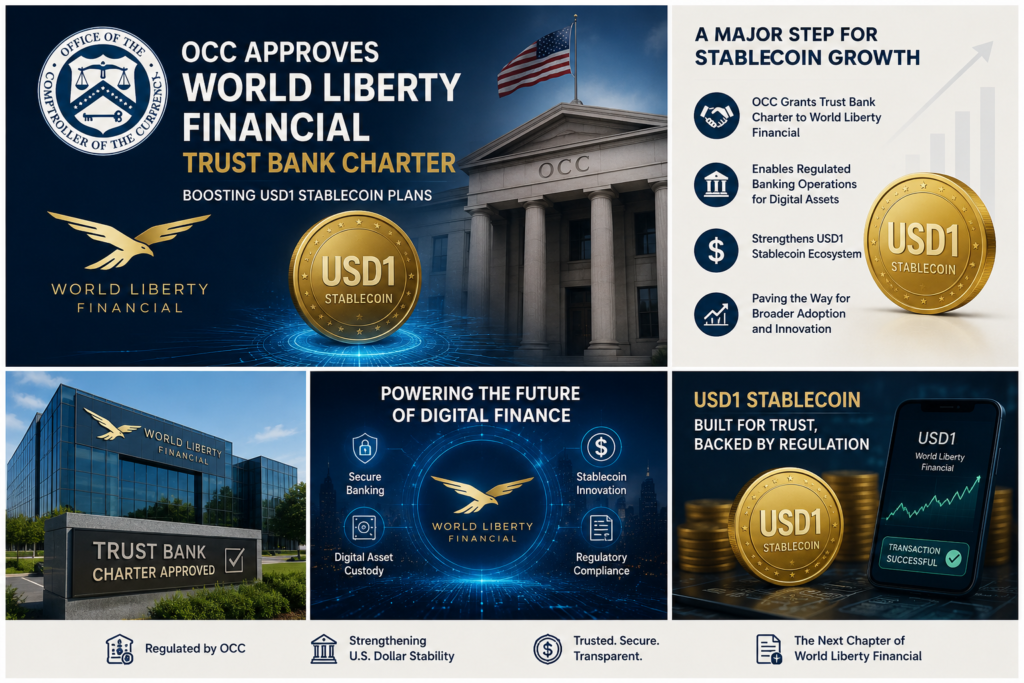
WASHINGTON — On August 14, 2026, the Office of the Comptroller of the Currency (OCC) granted conditional preliminary approval to World Liberty Trust Company’s application for a national trust bank charter, advancing World Liberty Financial’s ability to directly issue, redeem, and custody its USD1 dollar-backed stablecoin under federal banking supervision. The decision carries significant implications for cryptocurrency, traditional banking, and presidential family business interests, and was detailed in a letter published on the OCC’s website.
The move effectively greenlights an expansion of the firm’s stablecoin activities, which until now have relied on a third-party partner, BitGo Bank & Trust. Upon final approval and satisfaction of pre-opening conditions, World Liberty Trust Company, National Association, planned to be based in Bay Harbour Islands, Florida, would assume primary responsibility for managing USD1. In turn, the stablecoin has grown to a market value of approximately $4 billion, ranking among the larger dollar-pegged tokens in circulation.
This development marks another chapter in the rapid integration of digital assets into the U.S. regulated financial system under the second Trump administration. It also intensifies longstanding debates about potential conflicts of interest, the appropriate boundaries of limited-purpose trust banks, and the evolving regulatory framework for stablecoins following the enactment of the GENIUS Act.
The Approval and Its Conditions
The OCC’s letter stated that the preliminary conditional approval followed a thorough evaluation of the application, including representations and commitments made by the organisers. World Liberty Trust Company applied for the de novo national trust charter in January 2026. The review process lasted 221 days — longer than the roughly 120-day timeline that Comptroller of the Currency Jonathan Gould, a Trump appointee, had previously indicated for many such applications.
As a national trust bank, the institution would be limited in scope. It would not accept federally insured deposits, make commercial loans in the traditional sense, or operate as a full-service commercial bank. Instead, its primary activities would centre on fiduciary and trust-related services tied to digital assets. Specifically, it plans to issue and redeem USD1 on a nationwide basis for institutional clients, maintain the reserves backing the stablecoin, provide digital asset custody, and offer conversion services between U.S. dollars and USD1 (initially without fees, according to earlier company statements).
The OCC imposed standard and specific conditions. These include maintaining a minimum of $20 million in Tier 1 capital, with at least half held in eligible liquid assets such as cash or short-term government obligations; notifying the regulator of any material changes to the business plan; hiring a qualified internal audit manager; and complying with applicable requirements under the GENIUS Act, the federal stablecoin legislation signed into law by President Trump. Final approval remains contingent on the company meeting pre-opening requirements, and the OCC retains the ability to rescind the preliminary approval if conditions are not satisfied.
In addressing public comments received during the application process, the OCC noted concerns about non-U.S. investors in World Liberty Financial, potential conflicts involving the Trump family and the Witkoff family, and questions related to the Emoluments Clause. The regulator determined that certain foreign investors were not principal shareholders of the proposed bank and that it had obtained passivity agreements — formal commitments not to exercise control or influence over the bank’s operations — from key parties. These included entities linked to Eric Trump (through the majority stakeholder DT Marks), a UAE-based entrepreneur associated with StringZ Holdings, and other co-founders. The OCC largely treated broader conflict-of-interest arguments as outside the narrow statutory and policy criteria governing charter approvals, emphasising that career staff reviewed the application under established procedures.
Zach Witkoff, CEO of World Liberty Financial and the designated president and chairman of the trust company, described the decision as a milestone. “USD1 grew because institutions trust how it operates, and confidence at enterprise scale deserves the backing of federal supervision,” he said in a statement. He added that the firm welcomes ongoing federal scrutiny. Witkoff is the son of Steve Witkoff, President Trump’s special diplomatic envoy. Other proposed directors have included members of the Witkoff family business circle.
Background on World Liberty Financial and USD1
World Liberty Financial emerged in late 2024 as a flagship crypto project associated with Donald Trump and his sons — Donald Trump Jr., Eric Trump, and Barron Trump — alongside the Witkoffs and other partners. The company has positioned itself around a suite of digital asset products, with USD1 as its primary stablecoin. USD1 is designed to maintain a one-to-one peg with the U.S. dollar, backed by reserves of cash and cash equivalents such as short-term U.S. Treasuries.
According to the company’s website and financial disclosures, an entity affiliated with Donald Trump and certain family members — DT Marks DEFI LLC — owns approximately 38 per cent of the holding company that controls World Liberty Financial. Trump has disclosed substantial income from the venture, including nearly $600 million in 2025 from token and equity-related sales as part of broader crypto-related earnings reported in the hundreds of millions to over a billion dollars across related activities. The family has maintained that the president does not manage day-to-day operations of these interests, which are overseen by his children, and that the trust company structure includes non-voting interests and passivity commitments intended to mitigate direct control concerns.
Prior to the charter application, issuance and custody of USD1 were handled exclusively by BitGo. Bringing these functions in-house is expected to reduce reliance on intermediaries, potentially improve operational efficiency and margins, and allow the firm to offer more seamless services to institutional clients such as market makers, exchanges, and investment firms. Company representatives have argued that the trust bank structure was intentionally designed to comply with the GENIUS Act and to operate under continuous federal oversight, thereby addressing earlier criticisms about conflicts.
The growth of USD1 has been notable. Its market capitalisation expanded significantly in its first year and beyond, aided in part by large transactions, including reports of tokens used in connection with investments related to major crypto platforms. As of its approval, it stood as one of the larger stablecoins after industry leaders such as Tether’s USDT and Circle’s USDC.
Regulatory Context: Trust Banks, the OCC, and the Crypto Shift
National trust banks occupy a specialised niche in the U.S. banking system. They are chartered and supervised by the OCC, an independent bureau of the Treasury Department, and traditionally focus on fiduciary activities such as asset custody, trust administration, and related services rather than deposit-taking or lending. The OCC currently supervises dozens of such institutions. Crypto-native firms have increasingly sought these charters as a pathway into the regulated banking perimeter without the full suite of requirements and restrictions that apply to commercial banks or bank holding companies.
Under Comptroller Jonathan Gould, appointed by President Trump, the OCC has approved or preliminarily approved a series of applications from digital asset companies. Firms including Circle (issuer of USDC), Ripple, Crypto.com, and others have received similar green lights for trust bank charters focused on stablecoin issuance, custody, and related activities. Anchorage Digital previously held a pioneering national trust bank charter in the digital asset space. Proponents argue that federal charters provide clearer regulatory status, enhance consumer and institutional confidence, facilitate banking relationships, and support the competitiveness of U.S. dollar stablecoins globally.
The GENIUS Act, signed by President Trump, established a federal framework for payment stablecoins, addressing reserve requirements, redemption rights, issuers’ obligations, and supervisory oversight. World Liberty has repeatedly stated that its trust bank plans are structured to align with this legislation. Industry observers note that the law has accelerated interest in bank charters among stablecoin issuers seeking to operate under a single federal regulator rather than a patchwork of state money transmitter licenses or third-party banking partners.
Banking trade groups and some traditional financial institutions have raised concerns that expanding trust charters to crypto firms could introduce new risks, dilute the meaning of a national bank charter, or create competitive imbalances. Critics of the World Liberty approval specifically have pointed to the combination of presidential family ownership stakes, the appointment of the deciding regulator by the president, and the financial benefits that could flow to the Trump family as the stablecoin scales under federal imprimatur.
Political Reactions and Conflict-of-Interest Debate
Democratic lawmakers reacted sharply. Senator Elizabeth Warren of Massachusetts described the approval in stark terms, stating that “President Trump is now the first President in history to approve, operate, and supervise his own bank” and calling it “the most brazen act of self-dealing our financial system has ever seen.” She and other Democrats had previously pressed Comptroller Gould during congressional hearings for details on the application and warned that granting the charter would create an unprecedented conflict. Gould had declined to discuss specifics of pending applications and asserted that the only political pressure he felt came from members of Congress themselves.
Supporters of the decision counter that the OCC applied the same standards used for other crypto applicants, that passivity commitments and structural separations limit direct presidential influence over the bank’s operations, and that the president’s financial interests are managed through blind or passive arrangements consistent with past practices for officeholders. The White House has stated that the president has no involvement in business deals implicating his official responsibilities. World Liberty organisers have emphasised that Trump family members hold nonvoting interests in the trust company and will not serve as executives or exercise day-to-day control.
The debate reflects broader tensions. On one side is the view that bringing major stablecoin issuers under federal banking supervision strengthens financial stability, anti-money-laundering compliance, and the global role of the dollar. On the other is the concern that the proximity of presidential family financial interests to a regulated banking entity — supervised by an appointee of the same president — undermines public confidence in the impartiality of regulation, regardless of formal legal separations.
Broader Implications for Crypto, Banking, and Markets
The conditional approval arrives amid a period of significant policy support for digital assets at the federal level. The Trump administration has pursued a more permissive approach to crypto innovation compared with the prior administration, including executive actions, regulatory appointments, and legislation such as the GENIUS Act. Stablecoins in particular have been framed by proponents as tools for extending the reach of the U.S. dollar in digital form, facilitating faster payments, and competing with foreign alternatives.
For World Liberty, successful final approval and launch of the trust bank could reduce operational costs associated with third-party custody and issuance, enable tighter integration of services, and potentially attract additional institutional volume to USD1. Market participants will watch closely for the size and composition of reserves, the transparency of attestations, redemption performance under stress, and any expansion into related products such as yield-bearing or more sophisticated conversion services.
For the broader industry, the decision reinforces a pathway that other firms are already travelling. Circle has progressed further in some respects, obtaining final OCC approval in certain reports, while others remain at the conditional stage. The cumulative effect is a growing cohort of federally chartered digital asset trust banks operating under OCC supervision. This could accelerate the migration of stablecoin activity from less regulated or offshore venues into the U.S. banking system, with corresponding implications for reserve management, liquidity in short-term Treasury markets, and the competitive position of U.S.-based issuers relative to offshore giants.
Risks remain. Stablecoins have faced historical episodes of de-pegging, reserve opacity concerns, and runs during market stress. Federal oversight is intended to mitigate these through capital, liquidity, examination, and disclosure requirements, but the limited-purpose nature of trust banks means they operate without the full safety net of deposit insurance or traditional bank resolution tools. The OCC and other regulators will need to calibrate supervisory intensity accordingly as volumes grow.
Politically, the approval is likely to remain a flashpoint. Oversight hearings, potential legislative responses, or further public comment processes could follow. Legal challenges, while not immediately apparent from the public record surrounding this decision, remain a theoretical possibility if parties argue that the approval process or ownership structure violated specific statutory or constitutional provisions.
Looking Ahead
World Liberty Trust Company must still satisfy the remaining pre-opening conditions before receiving final approval and commencing operations. Timeline estimates vary, but the company has signalled readiness to move forward under federal supervision. Meanwhile, the USD1 stablecoin continues to circulate under existing arrangements with BitGo pending any transition.
The decision illustrates the speed with which crypto businesses are seeking — and in many cases obtaining — formal entry into the regulated banking system. It also underscores the unique dynamics that arise when a major presidential family business interest intersects with that system under an administration actively promoting digital asset innovation. Whether the structural safeguards and regulatory scrutiny prove sufficient to maintain confidence will be tested as the trust bank, if finally approved, begins operations and as USD1’s role in institutional and potentially broader markets evolves.
For now, the OCC’s conditional approval stands as a concrete step: a Trump family-linked crypto venture has cleared a major federal regulatory hurdle toward becoming a national trust bank focused on stablecoin issuance and related digital asset services. The full implications for markets, regulation, and political accountability will unfold in the months ahead as the conditions are met — or not — and as the broader experiment of integrating large-scale stablecoins into the U.S. banking perimeter continues.
This episode is part of a larger realignment in which digital assets are moving from the regulatory periphery toward the core of American finance, with all the opportunities, risks, and political complexities that entails. The conditional charter for World Liberty Trust Company is both a product of that realignment and a test of its durability.