

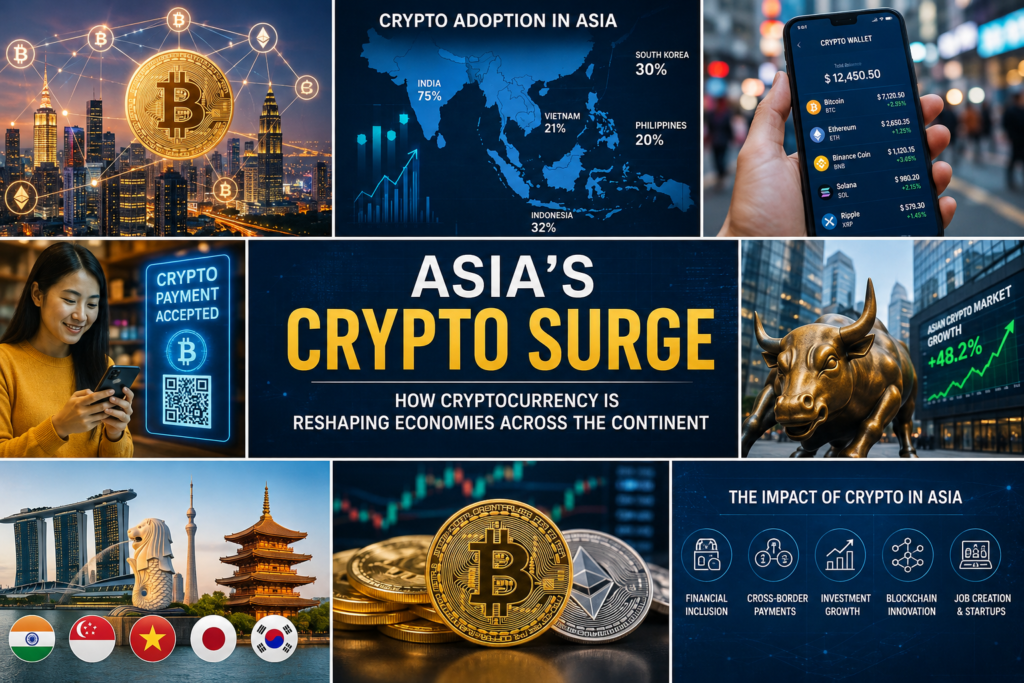
Asia has emerged as the epicentre of global cryptocurrency activity, transforming from a region of fragmented experiments into a powerhouse of adoption, innovation, and regulatory maturation. In the twelve months ending June 2025, Asia-Pacific on-chain crypto transaction value surged 69 per cent year-over-year to $2.36 trillion, making it the fastest-growing region worldwide according to Chainalysis data. This growth was driven by retail enthusiasm in emerging markets, institutional infrastructure in financial hubs, and practical use cases ranging from remittances to business settlements.
India topped the Chainalysis 2025 Global Crypto Adoption Index for the second consecutive year, ranking first across retail, centralised finance, decentralised finance, and institutional metrics. Pakistan, Vietnam, Indonesia, and the Philippines also featured prominently in global rankings, underscoring how grassroots demand in South and Southeast Asia is propelling the region forward. Meanwhile, more mature markets such as Singapore, Hong Kong, Japan, and South Korea are building regulated onshore ecosystems that attract licensed players and traditional finance institutions.
Stablecoins have become a defining feature of Asia’s crypto landscape. The region accounted for roughly $12.5 trillion in stablecoin transaction volume in 2025, a 67 per cent increase from the prior year and the highest of any region. Business-to-business payments, cross-border trade settlement, remittances, and savings in inflation-prone or capital-controlled environments have driven much of this activity rather than pure speculation.
This report examines cryptocurrency’s role across Asian economies: the scale of adoption, country-specific dynamics, regulatory evolution, real-world applications, institutional participation, risks, and the outlook for the remainder of 2026 and beyond.
Explosive Growth and Regional Leadership
The numbers paint a clear picture of Asia’s ascent. Total crypto transaction volume in Asia-Pacific jumped from $1.4 trillion to $2.36 trillion in the year to June 2025. Monthly on-chain value received climbed from about $81 billion in mid-2022 to a peak of $244 billion in December 2024 before stabilising above $185 billion per month through mid-2025.
India’s dominance is particularly striking. With an estimated 119 million crypto users (and projections approaching or exceeding 127 million by some 2026 estimates), the country leads not only in absolute numbers but also in the breadth of activity. On-chain value received by India grew approximately 99 per cent year-over-year in the period through June 2025. Remittances play a major role: India receives over $100 billion in annual remittances, and stablecoins and crypto rails have become increasingly important channels for diaspora transfers. Despite a 30 per cent tax on virtual digital asset gains and a 1 per cent tax deducted at source on certain transfers, adoption has continued to accelerate, illustrating the resilience of demand rooted in economic utility rather than pure speculation. Market research firm IMARC projects India’s crypto market could expand from roughly $3.04 billion in 2025 to $14.21 billion by 2034.
Southeast Asia has shown equally impressive momentum. Vietnam ranks among the top global adopters, with strong growth in on-chain value (around 55 per cent year-over-year in some measurements) fueled by remittances, gaming, and savings. Ownership rates in Vietnam have been reported as high as 20 per cent or more of the population in various surveys. Indonesia hosts around 19 million active crypto users and saw total crypto transaction value reach $26.55 billion by September 2025. Regulatory reclassification of crypto as financial instruments under the Financial Services Authority (OJK) in 2025 helped stabilise the market and open pathways for institutional participation and regulated derivatives. Tax revenues from crypto activity also rose, reaching the equivalent of about $128 million by September 2025. The Philippines and Pakistan similarly rank high in global adoption indices, with crypto serving as a tool for remittances, inflation hedging, and access to dollar-denominated value.
East Asia presents a more varied picture. South Korea stands out for intense retail participation. Roughly 30 to 33 per cent of Korean adults hold crypto assets—among the highest rates in the developed world—and trading volumes on domestic exchanges have been enormous. Upbit and other platforms have processed massive volumes, with Korean won-denominated trading historically representing a significant share of global spot activity. Japan has moved toward greater integration, with discussions and progress on reducing the capital gains tax rate (previously as high as 55 per cent) toward a flatter 20 per cent treatment aligned with other financial products, alongside stablecoin pilots involving major banks. Singapore consistently ranks near the top of adoption and regulatory maturity indices, with high user penetration among finance-forward residents and a dense ecosystem of fintech and Web3 firms.
Hong Kong has positioned itself as a key institutional and regulatory hub. Its Stablecoins Ordinance took effect on August 1, 2025, creating a licensing regime for fiat-referenced stablecoin issuers under the Hong Kong Monetary Authority. By early 2026, licenses began to be issued, including to groups linked to major banks such as HSBC and Standard Chartered. Tokenisation pilots and real-world asset (RWA) initiatives have also advanced, with participants including traditional financial institutions and asset managers.
China remains a unique case. Domestic cryptocurrency trading and related activities have been heavily restricted or banned for years, with further clarifications and expansions of the prohibition in 2026 notices that also addressed RWA tokenisation and offshore activities by Chinese entities. Yet underground and offshore activity persists at significant scale. Chinese-language money laundering networks alone moved an estimated $16.1 billion in illicit crypto funds in 2025, according to Chainalysis, representing about one-fifth of the global illicit crypto market. USDT and other stablecoins continue to play a large role in grey-market cross-border trade and capital flows. Hong Kong serves in part as a regulated sandbox adjacent to the mainland.
Regulatory Maturation Across the Region
One of the most significant developments of 2025 and 2026 has been the shift from policy announcements to workable regulatory frameworks in several key jurisdictions. Asia’s regulators have focused particularly on stablecoins and asset tokenisation as anchors for broader digital asset rules.
Hong Kong’s stablecoin regime, effective August 2025, requires licensing, reserve asset standards, redemption rights, and governance controls. Unlicensed public marketing of stablecoins is prohibited. Singapore has long maintained a progressive licensing regime under the Monetary Authority of Singapore and has refined its stablecoin framework for single-currency instruments. Japan has advanced reclassification of certain crypto assets as financial products, opened pathways for institutional products, and pursued tax reform. South Korea enacted its Digital Asset Basic Act and continues refining travel-rule requirements, registration screening, and taxation timelines. Taiwan passed its Virtual Asset Service Act in mid-2026, establishing licensing for exchanges and stablecoin issuers with cybersecurity, client asset segregation, and penalty provisions. Indonesia transferred oversight of crypto to the OJK and strengthened compliance standards.
These frameworks are deliberately designed to bring activity onshore. Industry executives note that licensed ecosystems in Hong Kong, Singapore, and Japan are gradually pulling business that previously operated offshore back into regulated environments. Real-world asset tokenisation is widely expected to be a defining theme of 2026, with pilots and infrastructure already underway in several markets.
Not all jurisdictions have moved at the same pace. India maintains a relatively high tax burden and continues to rely more on enforcement and existing financial rules than a comprehensive licensing regime for crypto intermediaries. China maintains its strict prohibition. Fragmentation remains a challenge: differing approaches to travel rules, custody, taxation, and stablecoin reserves create complexity for cross-border platforms and users.
Practical Use Cases Driving Adoption
Beyond trading, cryptocurrency and blockchain technology are embedding themselves in everyday and commercial financial activity across Asia.
Remittances form a core use case. In India, Vietnam, the Philippines, Pakistan, and Indonesia, diaspora workers and families use stablecoins and crypto rails to move value faster and often more cheaply than traditional corridors. Stablecoins provide dollar exposure in economies facing currency volatility or capital controls.
Business payments and trade settlement have grown rapidly. Aggregate B2B stablecoin volumes in sampled data rose from under $100 million per month in early 2023 to several billion dollars per month by 2025, with Asia as a major contributor. Cross-border QR payment experiments, such as systems linking China and Vietnam, illustrate efforts to integrate digital rails into regional commerce while promoting local currency use.
Savings and inflation protection drive retail holdings in high-inflation or currency-depreciating environments. Gaming and play-to-earn models, particularly in Southeast Asia, have introduced millions of younger users to digital assets. In more developed markets, crypto trading has become mainstream financial behaviour, as evidenced by ownership rates in South Korea and Singapore.
Tokenisation of real-world assets—bonds, funds, real estate interests, and other instruments—is moving from pilot to early production in regulated hubs. Hong Kong’s Project Ensemble and similar initiatives involving banks and asset managers signal institutional interest in using blockchain for efficiency, transparency, and new product design.
Institutional and Banking Involvement
Traditional finance is no longer merely observing. In Hong Kong, major banks have obtained or applied for stablecoin-related licenses and participate in tokenisation pilots. Japan’s large banks have engaged in stablecoin experiments, and firms such as SBI Holdings have pursued Bitcoin and other crypto ETF applications. South Korean financial groups have taken stakes in exchange operators. Singapore’s dense fintech cluster includes both pure crypto firms and traditional institutions offering digital asset services under license.
Corporate treasuries have also entered the picture. Japanese firm Metaplanet has accumulated significant Bitcoin holdings, at one point deploying substantial credit lines to build its position, reflecting a broader trend of Asian companies treating Bitcoin as a treasury reserve asset. Government and quasi-government holdings exist in a few Asian jurisdictions, though at modest scale compared with some other regions.
These developments mark a transition toward a more institutional digital-asset era in Asia’s leading financial centres, even as retail and utility-driven activity continues to dominate in emerging markets.
Challenges and Risks
The rapid growth has not been without problems. Illicit activity remains a concern. Chinese-language crypto networks moved billions in potentially criminal proceeds in 2025, often coordinating via messaging platforms. Scams, investment fraud, and money-laundering risks persist across the region, prompting tighter know-your-customer, travel-rule, and seizure rules in markets such as South Korea.
Regulatory inconsistency creates arbitrage and compliance burdens. High taxes in India dampen formal market development even as adoption continues. China’s ban pushes activity underground or offshore, complicating transparency and enforcement. Volatility continues to affect retail investors, and the collapse of poorly regulated platforms in earlier cycles left lasting caution among some users and policymakers.
Energy consumption of proof-of-work mining, environmental concerns, and the concentration of activity on a few large exchanges or stablecoins also feature in policy debates. Cybersecurity threats against exchanges and individual wallets remain elevated.
Outlook for 2026 and Beyond
Industry observers expect 2026 to be defined by the operationalisation of the stablecoin and tokenisation infrastructure built in 2025. Licensed onshore markets in Hong Kong, Singapore, and Japan are projected to capture a larger share of activity previously conducted offshore. Real-world asset tokenisation is anticipated to expand significantly as legal clarity improves and institutional participation deepens.
Retail adoption in South and Southeast Asia is likely to remain robust, supported by remittances, mobile-first financial services, and the search for alternatives to traditional banking in underbanked segments. Cross-border payment experiments and regional stablecoin initiatives may further integrate crypto rails into Asia’s trade and tourism economies.
Challenges will persist. Harmonisation of rules across jurisdictions will be slow. Geopolitical tensions, capital controls, and differing monetary policy priorities will continue to shape national approaches. The balance between innovation and consumer protection, financial stability, and anti-money-laundering objectives will remain delicate.
Nevertheless, the trajectory is clear. Cryptocurrency is no longer a peripheral or purely speculative phenomenon in Asian economies. It has become an active component of remittances, trade settlement, savings strategies, institutional product development, and regulatory reform agendas. From the high streets of Seoul and the fintech corridors of Singapore to the remittance corridors linking India and the Gulf, and the grey markets operating in the shadow of China’s restrictions, digital assets are embedding themselves in the financial fabric of the world’s most dynamic economic region.
As Asia continues to drive the majority of global population and a rising share of economic growth, its approach to cryptocurrency—pragmatic, diverse, and increasingly regulated—will influence the future of digital money far beyond its borders. The coming years will test whether the region can convert its current momentum into sustainable, inclusive, and resilient digital financial infrastructure. For now, the evidence of active and expanding involvement is unmistakable.