
China and the United States remain the two most influential equity markets in the global financial system, but their stock markets are currently being driven by very different forces. U.S. equities are facing pressure from rising long-term Treasury yields, elevated oil prices, geopolitical uncertainty and a sharp correction in technology and semiconductor shares. Chinese equities, meanwhile, are experiencing a combination of strong enthusiasm for artificial intelligence, semiconductors and robotics and growing concerns about valuations, corporate earnings and the wider Chinese economy.
The latest session highlights the contrast particularly well. On August 18, 2026, the U.S. market closed lower, with the S&P 500 falling 0.69% to 7,691.76, the Nasdaq Composite declining 1.33% to 26,289.71 and the Dow Jones Industrial Average losing 0.22% to 53,343.40.
In China, trading on August 19 has been much more volatile. Reports indicated that the CSI 300 was down about 2.4% and the Shanghai Composite about 2% during Wednesday’s session, while Hong Kong equities were comparatively resilient. At the same time, robotics company Unitree produced one of the year’s most spectacular IPO debuts, demonstrating the enormous investor appetite for China’s strategic technology sectors.
1. U.S. Stock Market: Latest Situation
The U.S. stock market entered the latest trading period after a strong 2026 rally, but investors have recently become more cautious.
Major U.S. indexes
| Dow Jones Industrial Average | 53,343.40 | -0.22% |
| S&P 500 | 7,691.76 | -0.69% |
| Nasdaq Composite | 26,289.71 | -1.33% |
| Russell 2000 | 3,017.89 | -1.3% |
The August 18 decline represented the third consecutive modest decline for the S&P 500 after the index recently reached a record high. Nevertheless, the broader 2026 performance remains strong, with the S&P 500 still up approximately 12.4% year-to-date, the Dow up around 11% and the Nasdaq up approximately 13.1% according to AP’s market summary.
Technology stocks under pressure
Technology and semiconductor shares were the biggest source of weakness.
The Philadelphia Semiconductor Index fell approximately 5%, while individual companies including Nvidia, Micron, SanDisk and Western Digital suffered significant declines. Reuters reported that Micron fell about 7%, Nvidia 2.3%, SanDisk 9% and Western Digital 7.4%.
The immediate concern is not necessarily that investors have abandoned artificial intelligence. Instead, investors are questioning whether some AI-related stocks have risen too quickly and whether the enormous capital expenditure required for AI infrastructure will generate sufficiently large profits.
This has created a particularly difficult environment for highly valued semiconductor and AI companies.
2. U.S. Treasury Yields Become a Major Market Risk
One of the most important developments for Wall Street is the increase in long-term Treasury yields.
The 30-year U.S. Treasury yield recently reached approximately 5.34%, its highest level since 2007, before easing somewhat. The 10-year Treasury yield was around 4.7%.
Higher bond yields can pressure stocks for several reasons:
- Bonds become more attractive compared with equities.
- Higher borrowing costs can reduce corporate investment.
- Expensive growth stocks become harder to justify using discounted-cash-flow valuations.
- Consumers face higher financing costs.
- Government debt servicing becomes more expensive.
- Companies planning large capital expenditures may face higher funding costs.
This is particularly significant for technology companies because many AI businesses are investing heavily in data centres, computing infrastructure and semiconductor capacity.
3. Oil Prices and Geopolitical Risk
Oil has become another major influence on the U.S. market.
Brent crude was recently around $91 per barrel, while U.S. WTI was around $85 per barrel. The increase has been linked to geopolitical tensions and concerns surrounding energy supplies and the Strait of Hormuz.
Higher oil prices can create a difficult combination for investors:
Higher oil prices → higher inflation pressure → higher bond yields → greater pressure on interest-rate-sensitive equities.
Energy companies can benefit from higher crude prices, but transportation, manufacturing, consumer and other oil-sensitive industries may experience increased costs.
The August 18 session reflected this rotation. Defensive sectors such as healthcare and consumer staples performed better, while energy stocks also benefited from higher crude prices.
4. Federal Reserve Remains Central to U.S. Market Direction
Investors are closely monitoring the Federal Reserve for clues about future interest-rate policy.
The market is particularly interested in the Federal Reserve’s July meeting minutes and the upcoming Jackson Hole economic discussions. Investors want to know whether policymakers believe inflation is sufficiently controlled to allow monetary easing or whether persistent inflation risks require interest rates to remain restrictive.
The combination of elevated oil prices, high Treasury yields and geopolitical uncertainty means that even positive corporate earnings may not be sufficient to push U.S. stocks steadily higher.
The market’s next major question is therefore:
Will earnings growth remain strong enough to justify current equity valuations if interest rates and bond yields stay elevated?
5. China Stock Market: Current Situation
China’s equity market is entering a considerably different phase.
The major mainland markets include:
- Shanghai Stock Exchange
- Shenzhen Stock Exchange
- Beijing Stock Exchange
Hong Kong’s stock market is also critically important because many major Chinese technology and internet companies trade there.
Chinese equities have benefited from renewed investor interest in artificial intelligence, robotics, semiconductors and other strategic industries.
However, the latest session has shown that this enthusiasm is not uniform.
Reports on August 19 indicated that the CSI 300 was down approximately 2.4% and the Shanghai Composite was down around 2% during Wednesday trading, while Hong Kong’s Hang Seng Index was slightly higher.
The weakness was concentrated in semiconductor and robotics shares, with concerns about corporate earnings and the broader economic outlook weighing on sentiment.
6. Unitree Robotics IPO Becomes a Major China Market Story
One of the biggest developments in China’s market is the spectacular debut of Unitree Robotics on the Shanghai Stock Exchange’s STAR Market.
Unitree shares were priced at 150.80 yuan in the IPO but surged to as high as 1,100 yuan, representing an increase of roughly 629% from the IPO price. The stock later traded below its peak but remained dramatically above the offering price.
The IPO raised approximately 6.1 billion yuan, or about $900 million, giving Chinese investors direct exposure to one of the country’s most prominent robotics companies.
The extraordinary debut illustrates two important features of China’s current stock market:
First: Strong demand for strategic technology
Investors are showing enormous enthusiasm for companies involved in:
- Artificial intelligence
- Humanoid robots
- Semiconductors
- Advanced manufacturing
- Automation
- Domestic technology
Second: Valuation risk
The extraordinary price increase also raises questions about whether investors are paying excessive prices for companies associated with strategic technology themes.
Reuters described the Unitree debut as an example of major valuation challenges within China’s IPO market, with enormous retail demand concentrating capital in a limited number of highly sought-after companies.
7. China’s AI and Semiconductor Investment Theme
Artificial intelligence has become one of the strongest investment themes in China.
Chinese authorities and investors are increasingly focused on developing domestic technological capabilities, particularly in areas where China faces restrictions on access to advanced Western technology.
This has helped create strong demand for domestic semiconductor, AI and robotics companies.
The Shanghai STAR Market has been a major beneficiary of this trend. Recent analysis has shown exceptionally high valuations in some Chinese technology segments, reflecting expectations that AI and advanced manufacturing will become major engines of future economic growth.
However, high valuations create a major risk.
A company can have excellent technology and still be an expensive investment if its stock price already assumes years of extraordinary growth.
8. China Faces Important Economic Challenges
Despite the technology boom, China’s broader economy continues to present challenges for investors.
The market is dealing with concerns involving:
- Weak consumer demand
- Property-sector difficulties
- Uneven corporate earnings
- Deflationary pressures
- Excess industrial capacity in some industries
- Geopolitical tensions
- U.S. technology restrictions
- Uncertainty surrounding global trade
These issues help explain why China’s market can simultaneously experience a technology investment boom and weakness in traditional sectors.
Investors are increasingly separating China’s economy into two stories:
Traditional China: property, construction, conventional manufacturing and weaker consumer demand.
New China: AI, robotics, electric vehicles, batteries, advanced manufacturing and semiconductors.
The second group is attracting significantly greater investor enthusiasm.
9. China-U.S. Technology Competition
The relationship between China and the United States remains one of the most important long-term factors affecting both stock markets.
Technology is at the centre of this competition.
The U.S. has imposed restrictions affecting China’s access to certain advanced technologies, while China is attempting to strengthen domestic alternatives.
This competition is influencing investment decisions in:
- Semiconductors
- AI processors
- Data centers
- Robotics
- Cloud computing
- Telecommunications
- Electric vehicles
- Advanced manufacturing
Unitree’s extraordinary IPO is therefore more than a single-company market event. It reflects China’s broader ambition to build globally competitive technology companies.
At the same time, U.S. restrictions can limit Chinese companies’ access to some overseas markets, technologies and supply chains. Reuters reported that Unitree has faced U.S. restrictions concerning future robot imports, illustrating the geopolitical risks facing Chinese technology companies.
10. Hong Kong Provides a Bridge Between China and Global Capital
Hong Kong remains an important connection between mainland Chinese companies and international investors.
The Hong Kong Exchange has experienced exceptionally strong activity in 2026. Hong Kong Exchanges & Clearing reported a record second quarter, with net profit increasing 21% year over year to HK$5.38 billion and average daily turnover reaching a record HK$289.5 billion.
IPO activity has also been strong, with 87 IPOs in the first half of 2026 raising HK$212.4 billion, according to the same report.
This is important because Chinese companies increasingly view Hong Kong as an alternative source of international capital when geopolitical or regulatory restrictions make U.S. listings more difficult.
11. China vs. U.S. Stock Markets
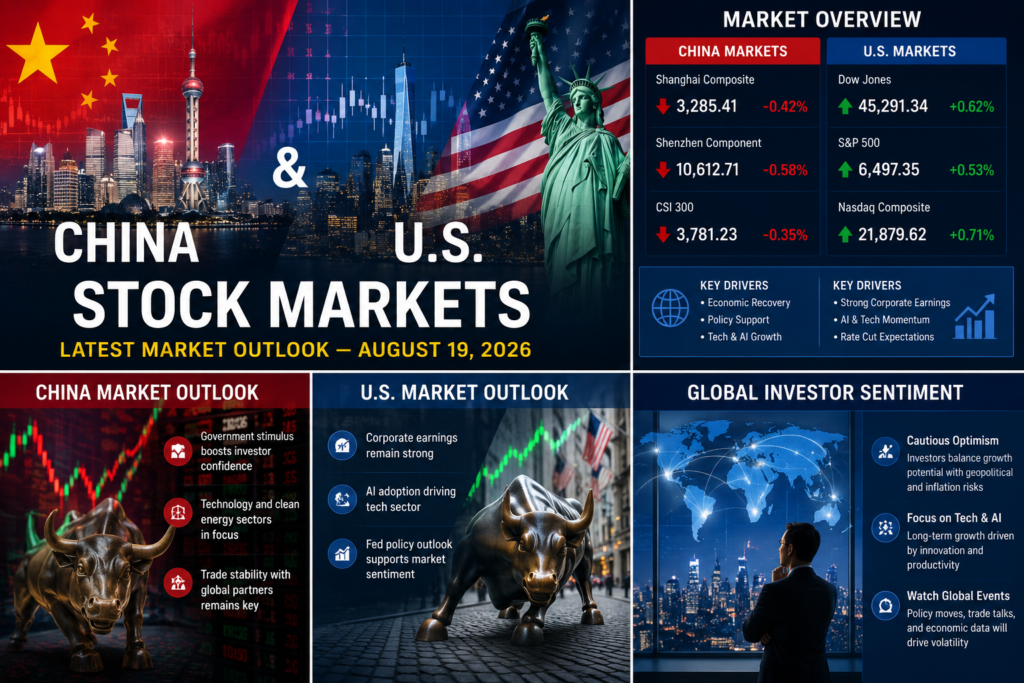
| Factor | United States | China |
| Main market drivers | AI, earnings, rates, bonds | AI, robotics, policy, domestic technology |
| Current sentiment | Cautious after recent highs | Highly selective and volatile |
| Major risk | Bond yields and valuations | Economic weakness and valuations |
| Technology outlook | Strong but expensive | Strong government support |
| Semiconductor outlook | Major global leaders but volatile | Strategic domestic development |
| Geopolitical risk | Middle East and China relations | U.S. restrictions and trade tensions |
| Investor profile | Large institutional participation | Significant retail participation |
| IPO environment | Mature | Rapidly expanding strategic-tech IPO market |
| Major opportunity | AI, productivity, earnings | AI, robotics, semiconductors |
| Key concern | High valuations and rates | Economic weakness and speculative valuations |
12. Key Differences Between the Two Markets
The most important distinction is that the U.S. market is currently dealing primarily with valuation, interest-rate and macroeconomic risks, whereas the Chinese market is balancing structural economic weakness against enormous enthusiasm for strategic technology sectors.
The U.S. market has a much deeper and more globally diversified corporate earnings base.
China, however, has significant potential in manufacturing, robotics, electric vehicles, batteries and AI.
This means the investment cases are fundamentally different.
United States
The U.S. market continues to benefit from:
- Strong corporate profitability
- Global technology leadership
- Deep capital markets
- AI investment
- Strong institutional participation
- Highly developed financial infrastructure
But valuations and interest rates remain important risks.
China
China offers:
- Lower valuations in many traditional sectors
- Government support for strategic industries
- Rapid development in robotics and AI
- Strong manufacturing capabilities
- Growing domestic technology champions
- Large domestic consumer and industrial markets
But investors must also consider economic weakness, policy uncertainty, geopolitical restrictions and extreme valuation movements in some technology stocks.
13. What Investors Should Watch Next
Several developments could determine the direction of both markets during the coming weeks.
United States
Investors should closely monitor:
- Federal Reserve policy signals
- Treasury yields
- Inflation data
- Crude oil prices
- Nvidia and other semiconductor earnings
- Consumer spending
- Retail-company earnings
- U.S.-Iran geopolitical developments
- AI capital expenditure
- Corporate bond issuance
China
Key indicators include:
- Shanghai Composite performance
- CSI 300 movement
- Shenzhen technology shares
- Hong Kong’s Hang Seng Index
- STAR Market activity
- Robotics IPOs
- Semiconductor earnings
- Property-sector data
- Consumer spending
- Beijing’s economic policy measures
14. Global Market Implications
Movements in China and U.S. equities have consequences well beyond their domestic markets.
The U.S. market influences global technology stocks, institutional capital flows, currencies and bond markets.
China influences commodities, manufacturing supply chains, emerging markets and global industrial demand.
A prolonged U.S. technology correction could therefore affect technology markets worldwide.
Similarly, a major Chinese technology rally could encourage investment into Asian technology, robotics and semiconductor companies.
The two markets are increasingly interconnected even as their governments compete strategically.
15. Current Market Outlook
Short-term U.S. outlook: Cautious
The immediate U.S. environment appears relatively challenging.
The combination of:
high Treasury yields + elevated oil prices + geopolitical risk + AI valuation concerns
could keep volatility elevated.
However, the broader U.S. earnings environment remains an important source of support. The market’s strong year-to-date gains also indicate that the recent decline should not automatically be interpreted as the beginning of a prolonged bear market.
Short-term China outlook: Highly volatile
China’s market has significant upside potential in strategic technology sectors, but recent weakness in the CSI 300 and Shanghai Composite shows that investors remain sensitive to earnings and economic concerns.
The extraordinary Unitree IPO demonstrates strong appetite for robotics and AI, but it also highlights the possibility of speculative excess.
Medium-term outlook
Over the medium term, the competition between the U.S. and China could become increasingly centred on AI, semiconductors, robotics, energy technology and advanced manufacturing.
The winners may not simply be the companies with the highest sales today. Investors are increasingly attempting to identify companies that can dominate the next generation of technology.
Conclusion
The U.S. and Chinese stock markets are entering an important period in August 2026.
Wall Street remains fundamentally strong but is confronting higher bond yields, expensive technology valuations, geopolitical uncertainty and concerns about the cost and profitability of the AI investment boom. On August 18, the S&P 500, Nasdaq and Dow all declined, with technology stocks leading the sell-off.
China’s stock market presents a different picture. Mainland indexes have recently come under pressure, but investor enthusiasm for AI, semiconductors and robotics remains exceptionally strong. The dramatic Unitree Robotics debut is a powerful example: shares jumped more than six-fold at their peak on the Shanghai STAR Market, highlighting the enormous appetite for China’s strategic technology companies.
For global investors, the central story is therefore no longer simply China versus the United States. It is increasingly a competition over AI, semiconductors, robotics, capital, manufacturing and technological leadership.
The coming months will show whether U.S. companies can continue to justify their high valuations through earnings growth and whether Chinese technology companies can convert investor enthusiasm into sustainable commercial profits.
Market note: This report is an informational market overview, not personalised investment advice. Stock prices and market conditions can change rapidly, and investors should conduct independent research before making investment decisions.