

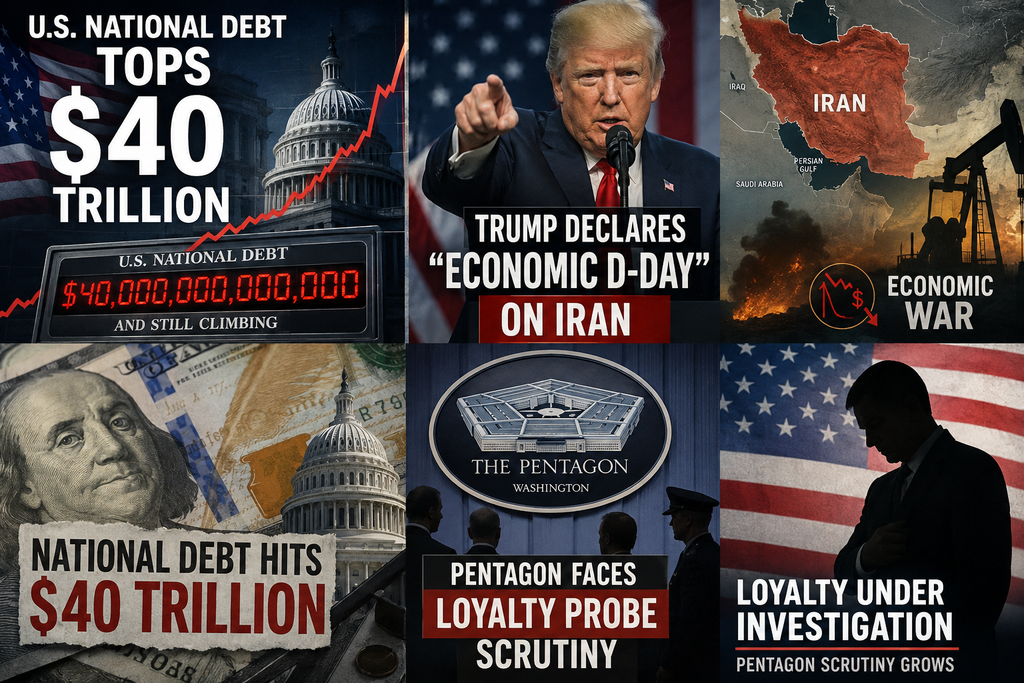
WASHINGTON — The United States crossed a stark fiscal threshold this week when the national debt officially exceeded $40 trillion for the first time, according to Treasury Department data released Wednesday. The milestone arrived amid concurrent developments that underscore the overlapping pressures of domestic fiscal strain, foreign policy escalation, and internal institutional tensions within the military establishment. President Donald Trump announced a sweeping new economic campaign aimed at isolating Iran, threatening severe penalties on any country that continues trading with Tehran, while the Pentagon came under fresh scrutiny for circulating political loyalty questionnaires to NATO allies and for leadership upheaval at the storied military newspaper Stars and Stripes.
The confluence of these events on successive days in mid-August 2026 has sharpened debates over the sustainability of American fiscal policy, the trajectory of the nearly six-month conflict with Iran, and the boundaries of political influence inside the Department of Defence.
The Debt Milestone: A Threshold Reached Sooner Than Expected
Treasury figures showed total public debt outstanding stood at approximately $40.047 trillion as of the close of business on Tuesday, August 18. The precise reported figure in some accounts reached $40,047,425,768,420.22. Of that total, roughly $32.266 trillion was debt held by the public and about $7.78 trillion consisted of intragovernmental holdings, including Social Security trust funds.
The crossing of the $40 trillion mark occurred less than five months after the debt hit $39 trillion in March and followed the $38 trillion threshold reached in October 2025. A decade earlier, the figure stood near $19.4 trillion. Analysts noted that the debt has more than doubled in under ten years and quadrupled in less than two decades. The first $1 trillion in U.S. debt was not reached until 1981.
Economists and budget watchdogs emphasise that the gross figure includes intragovernmental debt, while many prefer focusing on debt held by the public, which stood near $32.3 trillion. That measure has already exceeded the size of the U.S. economy in recent assessments, marking the first such occurrence in roughly 80 years when adjusted against GDP. The Congressional Budget Office has projected the gross national debt could climb toward $63 trillion by 2036, with annual deficits widening from about $2.1 trillion in the current fiscal year toward $3.1 trillion a decade from now.
Several factors accelerated the climb. Persistent budget deficits, elevated interest costs on existing debt, spending on social safety-net programs such as Social Security and Medicare, defence outlays, and the ongoing costs associated with the Iran conflict all contributed. Interest payments alone have become a major line item; year-to-date figures for fiscal 2026 showed net interest costs exceeding $1 trillion in some tallies and rising 15 per cent year-over-year in certain periods. Tax cuts enacted in recent years constrained revenue growth even as spending continued. Lost revenue linked to invalidated tariffs under earlier policy experiments also factored into faster-than-expected accumulation, according to multiple reports.
The Bipartisan Policy Centre estimates the statutory debt limit of $41.1 trillion could be reached sometime between late winter and mid-summer 2027, potentially sooner given recent borrowing rates. Fiscal year 2026, which began in October 2025, has already seen roughly $1.8 trillion added to the debt in its first months. A July deficit of $432.3 billion marked one of the highest monthly shortfalls in more than five years.
Reactions from budget advocacy groups were swift. Maya MacGuineas, president of the Committee for a Responsible Federal Budget, noted that the $40 trillion figure arrived less than five months after $39 trillion and that the debt had quadrupled in under 20 years. “The more we borrow, the more we exacerbate inflation, squeeze out other priorities in the budget, and leave ourselves vulnerable to emergencies at home and turmoil abroad,” she said. Michael A. Peterson of the Peter G. Peterson Foundation urged attention to the milestone for those concerned about affordability, observing that the debt had doubled in under a decade and calling for a change of course.
Market response mixed concern with technical adjustments. Long-term Treasury yields had been elevated, reflecting investor wariness about fiscal trajectory. On Wednesday, the Treasury announced plans to expand buybacks of longer-dated securities, prompting a temporary decline in yields. Analysts described a potential “doom loop” risk in which higher interest costs add to the debt, which in turn can push yields higher and further increase borrowing costs. Yet some economists framed the $40 trillion figure as more optical than immediately catastrophic, given the dollar’s reserve status and the depth of U.S. capital markets. Matthew Luzzetti, chief U.S. economist at Deutsche Bank, observed that such thresholds tend to focus attention in the near term even if structural deficits remain largely unaddressed.
The debt accumulation spans administrations. Roughly $11.6 trillion was added across Trump’s two terms to date, and $8.4 trillion during the Biden years, according to one compilation. Pandemic-era stimulus accounted for a substantial portion of the earlier surge. In the current environment, competing priorities—sustaining defence operations in the Iran conflict while pursuing tax and spending policies aimed at growth—have kept deficits elevated. Whether the scale of indebtedness represents an urgent crisis requiring entitlement reform and revenue measures, or a manageable feature of a high-income economy with strong institutional credibility, remains a central point of partisan and analytical disagreement.
Trump’s “Economic D-Day”: Isolating Iran and Its Trading Partners
As the debt news circulated, President Trump escalated the economic dimension of the conflict with Iran. In a Truth Social post late Wednesday, he declared the launch of “the most crushing economic operation ever taken against any country.” He framed the move as “Economic Warfare and Isolation on an unprecedented scale” and labelled it an “ECONOMIC D-DAY.” The announcement followed the expiration of a 60-day ceasefire window without a broader diplomatic settlement.
Trump wrote that any country allowing its financial institutions, businesses, airports, or government entities to provide “any type of lifeline to Iran” would itself face “TREMENDOUS Economic Consequences.” He specifically called out oil smuggling, currency swap lines, cash transfers, exchange houses, ship registries, and front companies, stating they “all need to stop NOW. You know who you are.” He urged allies to stand with the United States to isolate and defeat what he termed the Iran threat, asserting that the Islamic Republic had been given every opportunity to reach a deal and had failed to take it.
The campaign builds on earlier measures under the banner of Operation Economic Fury, launched in April, which targeted foreign banks and firms doing business with Tehran. Treasury Secretary Scott Bessent had previewed intensified isolation measures days earlier, describing economic pressure “like the world has never seen before.” The United Arab Emirates, a key regional commercial partner for Iran, announced it was severing all financial and economic ties with Tehran after reports of Iranian missiles entering its waters—an allegation Iran denied. The UAE move followed direct engagement from the White House.
The conflict itself began with U.S. and Israeli strikes at the end of February 2026. It has since evolved through phases of intense military exchange, a brief memorandum of understanding and ceasefire in June that temporarily reopened aspects of the Strait of Hormuz, and a subsequent breakdown. By mid-August, the “hot” phase of large-scale strikes had largely subsided, with no publicly reported U.S. strikes on Iranian targets since late July in some accounts. The contest has shifted toward economic attrition, naval blockade elements, and pressure on oil revenues. Iran has used its position along the Strait of Hormuz to disrupt shipping, contributing to elevated global energy prices at points in the conflict, while the United States has sought to constrain Iranian oil exports.
China remains the largest purchaser of Iranian oil, absorbing the majority of shipments according to 2025 tracking data. Secondary sanctions or penalties aimed at third-country facilitators therefore raise the prospect of friction with Beijing and other partners. Analysts noted that previous maximum-pressure campaigns demonstrated Iran’s resilience and the difficulty of fully sealing off revenue channels through front companies, barter arrangements, and non-dollar settlements. Iranian officials dismissed the latest threat as a diversion from America’s own fiscal problems, and a doubling down on failed policies, asserting it would only deepen hostility.
The economic campaign arrives as domestic political calendars tighten. Midterm elections approach, and the costs of the Iran operation—both direct military outlays and indirect effects through energy markets and debt service—have become subjects of public discussion. Trump has maintained that the regime in Tehran is “hanging by a thread,” its currency weakened, military production facilities degraded, and leadership under pressure. Critics counter that the strategic objectives of fully curtailing Iran’s nuclear program and ending regional proxy activity remain incomplete, and that prolonged economic warfare carries its own risks of escalation or allied divergence.
Pentagon Scrutiny: Loyalty Questionnaires to Allies and Upheaval at Stars and Stripes
Parallel to the fiscal and foreign-policy developments, the Department of Defence faced criticism over two distinct but related matters involving political alignment and institutional independence.
Documents obtained by journalists revealed a three-page questionnaire circulated to NATO allies and other key stakeholders as part of an ongoing six-month Pentagon review of American forces in Europe. Titled “Questions for NATO Allies & Other Key Stakeholders,” the document probes whether countries have been “publicly supportive of US foreign policy priorities,” whether they have shown alignment with a “strong, clear, and quiet” approach referenced by Defense Secretary Pete Hegseth, and whether they have endorsed concepts such as “NATO 3.0” that envision greater European responsibility with more limited U.S. support.
Additional questions address restrictions on U.S. access to bases and military overflights—an issue that arose when some allies limited use of their territory for operations related to the Iran conflict—progress on defence spending targets, willingness to purchase American defence equipment rather than favour European procurement rules, and readiness to reduce or eliminate any existing restrictions. Bloomberg News first reported elements of the questionnaire; Al Jazeera later published additional details and imagery of the document.
Allied officials and analysts described the exercise as injecting political loyalty considerations into decisions about force posture. Some characterised it as an attempt to link security guarantees to public alignment with specific administration priorities rather than collective defence commitments. The review is expected to inform potential adjustments to the U.S. military footprint in Europe. Supporters of the approach argue that after decades of American subsidisation of European security, it is reasonable to assess partner contributions and political reliability before allocating scarce resources. Critics contend the questionnaire risks fracturing alliance cohesion and substituting personal or partisan fealty for institutional continuity.
Separately, leadership changes at Stars and Stripes, the independent newspaper serving the military community, drew attention. Longtime publisher Max D. Lederer Jr. announced his retirement effective at the end of September, citing fundamental differences between his philosophy of leadership and the value of the publication’s mission and the direction set by Department of Defence leadership. Lederer had served as publisher since 2007 and had been associated with the organisation since the early 1990s.
The announcement followed months of friction. In January, Pentagon spokesman Sean Parnell stated that the department was returning Stars and Stripes to its “original mission” of reporting for warfighters, modernising operations, and refocusing content away from what he termed “woke distractions.” Subsequent guidance limited use of commercial wire services, barred comics and certain syndicated features, required content consistency with “good order and discipline,” and expanded oversight roles for Pentagon public affairs. The department also withdrew a federal regulation that had underpinned independent operation under First Amendment principles. In April, the newspaper’s ombudsman, Jacqueline Smith, whose role included safeguarding editorial independence, was removed after criticising the restrictions.
Stars and Stripes has historically operated with editorial independence despite partial Pentagon funding and the status of its staff as Department of Defence employees. Congress has long affirmed that independence. Advisory board members and First Amendment advocates expressed concern that the cumulative changes risk converting the publication into a more tightly controlled internal communications vehicle. Pentagon officials maintained the steps restore focus on service members’ needs and eliminate inefficiencies. Job applicants for positions associated with the newspaper and broader federal hiring processes have also encountered questions about advancing administration policy priorities, prompting further debate about the line between political accountability and institutional neutrality.
Interlocking Pressures and Broader Implications
The three storylines intersect in practical ways. Debt service and defence spending compete for budgetary space even as the Iran conflict continues to generate both direct costs and secondary economic effects through energy markets. The shift from kinetic operations toward intensified economic isolation of Iran occurs against a backdrop of already elevated U.S. borrowing. Questions of allied reliability and the political character of military institutions arise precisely when the United States seeks coordinated pressure on third countries that maintain commercial links with Tehran.
Fiscal hawks argue the $40 trillion figure should force a reckoning with mandatory spending growth and interest costs that crowd out discretionary priorities, including national security. Administration officials and some market participants emphasise that the United States retains unique advantages in financing deficits and that growth-oriented policies can improve the debt-to-GDP trajectory over time. On Iran, the administration presents economic isolation as a lower-cost alternative to renewed large-scale military action, while sceptics question enforceability against major buyers and the potential for retaliatory measures that could further strain global trade and energy flows.
Within the alliance system and the domestic military establishment, the loyalty questionnaires and Stars and Stripes changes highlight long-running debates over civil-military relations, the politicisation of institutions, and the proper balance between civilian direction and professional autonomy. Supporters of tighter alignment view them as necessary correctives after years of perceived drift; opponents see risks to the nonpartisan ethos that has underpinned American military effectiveness and alliance credibility.
As of Thursday, August 20, 2026, the Treasury continued to report daily debt figures above the new threshold, markets digested the buyback announcement and the broader fiscal news, the Iran economic campaign awaited detailed implementing measures, and both NATO capitals and Stars and Stripes staff assessed the practical consequences of the latest Pentagon initiatives. The simultaneous arrival of a historic debt milestone, an expanded sanctions strategy, and institutional controversies inside the defence establishment ensures that questions of American solvency, strategic reach, and internal cohesion will remain at the centre of policy discussion in the months ahead.
The scale of the debt, the intensity of the economic campaign against Iran, and the explicit political framing of alliance and internal military relationships together illustrate the interlocking challenges facing U.S. governance at this moment. Whether these pressures produce fiscal restraint, diplomatic breakthrough, or further institutional adaptation will shape the remainder of the current administration and the strategic environment beyond it. The $40 trillion figure is no longer a projection; it is a recorded fact. The economic isolation of Iran is no longer a secondary tool; it has been elevated to the primary announced instrument. And the expectations placed on allies and on military media have been stated with unusual clarity. How each of these realities evolves will determine much of the next chapter in American economic and security policy.