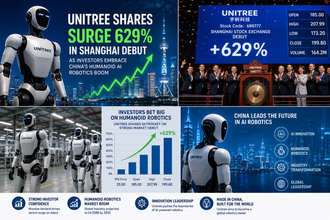


SHANGHAI, August 19, 2026 — Shares of Chinese humanoid robot maker Unitree Robotics rocketed higher in its trading debut on the Shanghai Stock Exchange’s STAR Market on Wednesday, underscoring intense investor appetite for domestic artificial intelligence hardware and embodied intelligence technologies. The Hangzhou-based company, officially known as Yushu Technology Co., saw its stock open at 1,100 yuan per share — a surge of approximately 629% from the initial public offering price of 150.80 yuan — before paring gains to close at 845 yuan, still up roughly 460% on the day. Some market reports highlighted peaks and intermediate moves around the 542% level cited in early coverage, reflecting a volatile, euphoric trading session.
The blockbuster debut valued Unitree at as much as about 445 billion yuan (roughly $66 billion) at the open and around 342 billion yuan (approximately $50–51 billion) at the close. Trading volume reached about 23.2 billion yuan, and the performance stood in sharp contrast to a broader market selloff, with China’s CSI 300 index declining around 3% and the STAR Composite Index falling more than 7% amid global technology weakness and concerns over higher U.S. Treasury yields.
Unitree raised approximately 6.1 billion yuan ($904–905 million) by selling 40.45 million new shares, representing 10% of its enlarged post-IPO share capital. The offering price implied a pre-debut valuation of about 61 billion yuan ($9 billion). Net proceeds after costs were roughly 5.9 billion yuan. The company plans to deploy the capital primarily toward intelligent robot model research and development, hardware R&D, new-generation smart product development, and construction of an intelligent robot manufacturing base.
Retail investor demand reached historic levels. Valid subscription accounts numbered about 9.78 million — the highest participation for any STAR Market IPO since the board’s launch. The retail tranche was oversubscribed thousands of times (reports ranging from more than 5,500 times to over 8,000 times in some measures), resulting in an allotment rate of just 0.018%, a record low for the market. A single successful allocation of 500 shares generated paper profits exceeding 470,000 yuan at the opening price. Institutional and strategic interest was also strong, with participants including Chinese AI firm DeepSeek and investment arms linked to major state-owned enterprises.
Founder and largest individual shareholder Wang Xingxing, aged 36, holds approximately 121.4 million shares through direct and indirect holdings, representing a substantial stake of around one-fifth of the company. At the closing price, his paper wealth exceeded 100 billion yuan (more than $11–15 billion in various estimates), catapulting him into the ranks of China’s wealthiest tech entrepreneurs. Early institutional backers such as Meituan (reported as the largest external shareholder with a stake near 8–9.7% in some filings), Tencent, Alibaba, Ant Group, ByteDance, and others also saw massive paper gains.
Company Origins and Product Portfolio
Unitree was founded in 2016 by Wang Xingxing, an engineer who has become one of the most visible faces of China’s robotics push. The company initially built a reputation for agile quadruped “robot dogs” that demonstrated remarkable mobility, balance, and adaptability across terrain. These platforms found applications in research, inspection, entertainment, and limited commercial settings. Over time, Unitree expanded aggressively into bipedal humanoid robots capable of walking, running, climbing, performing martial arts routines, dancing, and executing dynamic manoeuvres such as backflips.
Its humanoid models, including the G1 series, have featured prominently in high-visibility demonstrations. Videos of Unitree robots performing coordinated dances, martial arts sequences, and athletic feats have circulated widely online and on Chinese television, including appearances associated with major cultural events. In 2025, the company shipped more than 5,500 humanoid robots, claiming the global lead with a reported market share of around 32%. Cumulative quadruped shipments exceeded 33,000 units, commanding a dominant share near 60% in that segment according to company disclosures. Overall shipments across its product range reached higher figures by mid-2026.
Unitree’s robots incorporate advanced sensors, actuators, and AI-driven control systems. The company emphasises reinforcement learning and imitation learning algorithms that allow machines to improve performance through experience. Products range from research and education platforms to models aimed at industrial, service, and eventually broader commercial environments. Overseas sales accounted for roughly 44% of main-business revenue in 2025, with customers including research institutions and technology companies in various markets. The firm has stated that existing models have received necessary U.S. approvals for civilian use, though it has flagged potential geopolitical risks that could restrict future models from the American market.
On the eve of the listing, Unitree unveiled a new humanoid model marketed as “Superman,” claimed to jump two meters from a standing position and reach running speeds of up to 12.66 meters per second. Such demonstrations reinforce the company’s positioning at the cutting edge of dynamic locomotion.
Financial Trajectory and Path to Profitability
Unlike many peers in the capital-intensive humanoid robotics sector that remain deeply unprofitable, Unitree has achieved positive net income. Revenue grew dramatically to 1.70 billion yuan in 2025 from 392.77 million yuan the prior year. Net profit reached 278.21 million yuan. Humanoid robots overtook quadrupeds as the largest revenue contributor, generating 867.8 million yuan in sales. Growth has moderated in 2026 relative to the prior surge, a point noted by analysts as a key monitoring item for justifying elevated valuations.
The IPO was priced at a rich multiple of approximately 219 times 2025 earnings and around 36 times sales. Post-debut trading pushed valuations far higher — in the range of hundreds of times earnings and more than 200 times sales based on closing figures. Analysts have cautioned that the company must sustain rapid growth in shipments, improve unit economics, and expand commercial deployments beyond research and demonstration use cases to support such multiples over the longer term.
China’s Strategic Push for Embodied AI and Domestic Hardware
The listing arrives against the backdrop of Beijing’s intensified focus on hard technology, self-reliance in critical supply chains, and leadership in artificial intelligence and robotics. Humanoid robots and embodied AI have been elevated as strategic priorities. Policymakers view the sector as a potential driver of productivity gains in manufacturing, logistics, eldercare, and services amid demographic pressures and the need to move up the value chain.
Unitree’s STAR Market debut — the first by a pure-play humanoid robot maker on the mainland A-share market — is widely interpreted as validation of this industrial policy direction. The STAR Market itself was designed to channel capital toward innovative technology companies that might not fit traditional listing criteria. Unitree’s rapid progression through the review process (reportedly completing key stages in a compressed timeframe under preferential hard-tech mechanisms) and the extraordinary retail demand signal strong domestic capital market support for the theme.
Experts have described the event as a transition point for the Chinese humanoid robotics industry from technology accumulation and prototype validation toward scaled commercialisation and capital-market recognition. The simultaneous opening of the World Robot Conference in Beijing, where hundreds of mostly Chinese firms showcased developments, amplified the celebratory atmosphere around domestic capabilities.
Government-linked investment vehicles and major technology platforms have provided both capital and strategic partnerships. Collaboration with AI leaders such as DeepSeek is expected to accelerate progress on the software and foundation-model side of embodied intelligence — the challenge of enabling robots not merely to move dynamically but to perceive, reason, and act usefully in unstructured real-world environments.
Global Competitive Landscape
Unitree competes in a field that includes U.S. players such as Tesla (with its Optimus program) and Boston Dynamics (owned by Hyundai), as well as Chinese rivals including AgiBot (still private) and Hong Kong-listed UBTech. The latter saw its shares decline nearly 10% on the day of Unitree’s debut, illustrating both competitive pressure and the capital-market spotlight now focused on the sector.
Industry forecasts project substantial growth. One estimate from JPMorgan anticipates global humanoid robot shipments rising from about 18,000 units in the prior year to 60,000 in 2026 and potentially 1.75 million by 2030, with China expected to capture more than half the market. Longer-term projections from other analysts suggest the overall humanoid robotics market could expand from roughly $2 billion in 2025 toward hundreds of billions of dollars by the mid-2030s if technical and commercial hurdles are cleared.
China’s advantages include a deep manufacturing ecosystem for components such as motors, sensors, and batteries; large-scale production capacity; a sizable domestic market for testing and deployment; and coordinated policy support. Unitree’s demonstrated ability to ship thousands of units and achieve profitability differentiates it from many Western counterparts that remain in earlier stages of commercialisation.
Challenges persist on both sides of the competition. Achieving reliable, cost-effective performance in real-world commercial settings — factories, warehouses, homes, or public spaces — remains difficult. Safety, battery life, dexterity for fine manipulation, general-purpose intelligence, and total cost of ownership must improve substantially. Geopolitical tensions add further complexity: export controls, investment screening, and market access restrictions could limit technology flows and sales opportunities in either direction.
Market Reaction, Risks, and Investor Sentiment
The extraordinary first-day pop occurred even as broader Chinese equities and global technology stocks faced pressure. This divergence highlights the thematic power of domestic AI hardware and robotics narratives among Chinese retail and institutional investors. The scarcity of pure-play listed vehicles in the humanoid space amplified demand for Unitree shares.
Yet the valuation leaves little room for execution shortfalls. Prospectus disclosures and analyst commentary have flagged uncertainties around the pace of large-scale commercial adoption. Many current deployments remain concentrated in research, education, demonstration, and limited pilot environments rather than high-volume industrial use. Sustaining triple-digit percentage growth in revenue and shipments while expanding margins will be critical.
The conversion of proceeds into productive capacity and R&D must be monitored. Competition is intensifying rapidly both inside China and internationally. Any material delays in next-generation models, supply-chain disruptions, or adverse regulatory developments could pressure the share price after the initial euphoria.
For U.S. and international investors, access to the A-share listing is limited, though some may explore channels such as certain ETFs or secondary market opportunities where available. The debut has already prompted comparisons with private Western peers, with some observers arguing that Unitree’s public valuation makes certain overseas competitors appear relatively inexpensive on a relative basis — though differences in technology focus, target markets, and capital structures complicate direct comparisons.
Broader Implications for the Sector
Unitree’s successful listing is expected to encourage other Chinese robotics and embodied-AI companies to pursue public markets. Firms in related areas — component suppliers, software platforms, specialised humanoids, and service robots — may find it easier to raise capital or attract strategic partners. The event also provides a valuation benchmark that could influence private-market funding rounds and M&A activity across the ecosystem.
At a national level, the debut reinforces the narrative of Chinese technological progress in areas previously dominated by Western firms. High-profile demonstrations of agile, capable humanoids serve both commercial marketing and soft-power purposes. Policymakers are likely to continue supporting the sector through subsidies, procurement preferences, research funding, and favourable regulatory treatment for qualified “hard-tech” enterprises.
For the global robotics community, the capital influx into Chinese players accelerates the overall pace of innovation and cost reduction. Lower-cost, high-performance hardware from China could expand the addressable market for applications that were previously economically unviable. At the same time, it intensifies the competitive and geopolitical dimensions of the race toward practical general-purpose robots.
Looking Ahead
In the near term, attention will focus on Unitree’s quarterly results, shipment data, progress on commercial contracts, and updates on its manufacturing base and new product pipeline. Analysts will scrutinise whether revenue growth reaccelerates and whether the mix shifts further toward higher-value humanoid platforms and software or services revenue streams.
Longer-term success will hinge on solving the hard problems of embodied AI: robust perception in cluttered environments, reliable long-horizon task planning, safe human-robot interaction, energy efficiency, and affordability at scale. Unitree’s combination of hardware expertise, demonstrated mobility, early profitability, strong domestic capital market support, and strategic partnerships positions it as a leading contender. Yet the history of robotics is littered with promising prototypes that struggled to achieve widespread commercial impact.
The 542%–629% range of gains cited across reports on debut day captures more than a single stock’s performance. It reflects a broader wave of investor conviction that humanoid robots and domestic AI hardware represent one of the defining technological and industrial opportunities of the coming decade — and that Chinese companies are determined to claim a leading share of that future. Whether the valuation proves justified will depend on execution measured not in viral videos of backflips and dances, but in reliable, cost-effective machines deployed by the thousands and eventually the millions in the real economy.
As trading continues in the days and weeks ahead, volatility is likely. The first-day surge has already created substantial wealth for early shareholders and a powerful demonstration effect for the sector. For Unitree, the harder work of converting capital-market enthusiasm into sustained industrial leadership now begins in earnest. For China’s robotics ecosystem and the global contest in embodied intelligence, Wednesday’s debut marked a visible milestone on a much longer journey.