
Kathmandu / Beijing – August 27, 2026
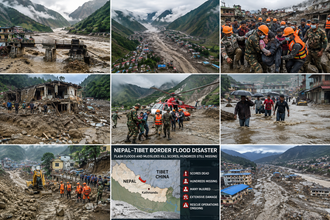
Severe flooding and mudslides along the Nepal–Tibet border caused major casualties and widespread destruction after a sudden wall of water, mud, rock and debris tore through Himalayan river valleys on Wednesday morning, August 26. Officials in Nepal reported that 95 bodies had been recovered, with hundreds still missing. Indian media and Nepalese tourism authorities confirmed significant numbers of Indian nationals among those unaccounted for, many of them pilgrims headed toward the sacred Mount Kailash region in Tibet. Chinese state media reported three confirmed deaths and 265 people missing on the Tibetan side of the border. Rescue teams continue to battle difficult terrain, high river levels and disrupted communications as the scale of the tragedy unfolds.
The disaster struck shortly after 8:30 a.m. local time in the Rasuwa district of northern Nepal and the adjacent Gyirong (Kerung) area of China’s Tibet Autonomous Region. Preliminary accounts from Nepalese officials, including Foreign Minister Shisir Khanal, indicated that a magnitude-4.4 earthquake or intense shaking near the border may have triggered an ice-and-rock avalanche or glacial-rock landslide high in the mountains. Debris and meltwater then surged into the Lhende Khola, a tributary feeding the Bhote Koshi and Trishuli river systems, sending a destructive flash flood downstream. Satellite imagery analysis by Nepal’s National Disaster Risk Reduction and Management Authority pointed to a debris-laden flood originating roughly 20 kilometres northeast of the Rasuwagadhi border point. Security camera footage from the Chinese side of the Gyirong Port captured the terrifying speed of the event: a roaring torrent of mud, rocks and water that overwhelmed buildings, vehicles and people within seconds.
In Nepal, the floodwaters raced through the steep, narrow valleys of Rasuwa, then into neighbouring districts including Nuwakot, Dhading and parts of Chitwan and Gorkha. Entire sections of riverside settlements were swept away. Houses, shops, hotels and temporary shelters used by travellers vanished under the muddy surge. At least 19 vehicle bridges and approximately 40 kilometres of roads were destroyed or severely damaged, according to a statement from the office of Nepal’s Prime Minister Balendra Shah. Critical infrastructure suffered heavy blows: hydropower projects lost around 430 megawatts of generation capacity—more than 12 per cent of the country’s total installed hydropower output of roughly 3.2 gigawatts. Power lines, communications networks and the newly rebuilt Friendship Bridge at Rasuwagadhi were among the casualties. Three Nepal Police facilities were damaged, and multiple Armed Police Force and army personnel deployed in the area remain missing.
Casualty figures on the Nepalese side rose steadily throughout the day. Early reports spoke of nine or fewer confirmed deaths; by evening the prime minister’s office and police confirmed 95 bodies recovered, many still unidentified. Some later tallies from provincial police and media outlets climbed higher as recovery continued, but official statements centred on the 95 figure as of late August 26. Hundreds more people are missing. Nepal’s Tourism Board and related agencies reported between 384 and more than 480 travellers unaccounted for in the affected zone. Of these, roughly 291 to 391 were foreign nationals and the remainder Nepalese. The largest identified group among the foreigners consists of Indian citizens—figures ranging from more than 100 to 133, plus dozens of non-resident Indians—many travelling as pilgrims toward Mount Kailash and Lake Manasarovar, sites of deep religious significance for Hindus, Buddhists and others. Other nationalities listed include citizens of the United States (dozens in some tallies), the United Kingdom (around 12–33), Malaysia, South Africa, Australia, Canada, the Netherlands and South Korea. Eight South Korean workers at a hydropower site were among those missing. Residents, trekkers near Gosainkunda lake (timed with the Janai Purnima festival), security personnel (including scores of army and police members) and hydropower project staff add to the grim totals. Chinese authorities reported three deaths and 265 missing in Gyirong County, where the mudslide struck the border port, severing roads, power and communications. Combined, nearly 900 people remained unaccounted for across both sides of the frontier as night fell on the first day.
Rescue and recovery operations began immediately but faced severe obstacles. River levels remained dangerously high, preventing helicopters from landing in key locations such as Syabrubesi and Timure in Rasuwa. Nepal’s army mobilised troops and aircraft, reporting the rescue of at least 88 survivors in the initial hours and efforts to reach more than 100 others stranded in villages such as Mailung. Chinese authorities deployed hundreds of rescuers to the Gyirong area; President Xi Jinping ordered “all-out” search efforts and called for stronger monitoring and early-warning systems to prevent secondary disasters. India coordinated closely with Kathmandu on relief and information-sharing, given the large number of Indian citizens involved. Other governments offered assistance as the list of missing foreign nationals grew. Hospitals in the affected districts and in Kathmandu treated dozens of injured survivors, many suffering trauma, hypothermia or injuries from debris. Local media described survivors caked in mud, some unable to speak, recounting how family members were swept away before their eyes. One woman told reporters she and her son survived by climbing onto a rooftop while others disappeared in the torrent.
The human cost extends beyond the immediate death and missing tallies. Families of pilgrims and tourists from across India and other countries waited anxiously for news, many having last heard from loved ones near the border immigration point or on buses and jeeps heading toward Tibet. Travel agencies and tour operators, including those specialising in the Kailash Mansarovar Yatra, scrambled to account for clients. Alpine Eco Trek confirmed that a group of British nationals on a border-crossing tour was among the missing. Similar reports emerged from Malaysian, South African and other operators. On the Chinese side, the sudden isolation of the port area left residents and workers cut off. Downstream communities in Nepal received urgent warnings to stay away from the banks of the Bhote Koshi, Trishuli and Narayani rivers, as authorities feared further surges if upstream blockages of debris and ice gave way.
Geologists and disaster specialists are still piecing together the precise sequence of events. Early statements from Nepalese officials pointed to seismic activity triggering an avalanche of ice and rock. The German Research Centre for Geosciences noted a magnitude-4.4 event roughly seven minutes before security footage timestamps. However, subsequent analysis by the United States Geological Survey suggested that the recorded seismic energy may itself have been generated by the massive landslide rather than a conventional tectonic earthquake, raising questions about the primary trigger. Climate and mountain researchers at the International Centre for Integrated Mountain Development and elsewhere have long warned that the Himalayas are increasingly vulnerable to glacial lake outburst floods, rock-ice avalanches and debris flows as glaciers retreat and permafrost thaws under a warming climate. The region’s steep topography, heavy monsoon rains (though this event occurred outside peak monsoon intensity in some assessments), and active tectonics combine to create high risk. Similar disasters in recent years—in Uttarakhand, India, and elsewhere in the Hindu Kush-Himalaya—have underscored the growing frequency and intensity of such events.
Infrastructure losses will have lasting economic consequences. Nepal relies heavily on hydropower for domestic electricity and potential exports. The sudden loss of more than 400 megawatts strains the national grid and affects industrial and household users. Road and bridge destruction isolates mountain communities that depend on the Rasuwa corridor for trade with Tibet and access to markets, healthcare and education. The Gyirong Port is a major land crossing; its temporary closure disrupts bilateral commerce and the movement of goods and people. Tourism, a vital source of foreign exchange for Nepal, has been hit hard. The Kailash pilgrimage route and the Langtang/Rasuwa trekking areas attract thousands of visitors annually; the loss of life and the damage to facilities will dampen arrivals for months or longer. Reconstruction of bridges, roads and power facilities will require substantial investment and international support.
Government responses have been swift on both sides of the border. Nepal’s prime minister ordered evacuations to safer ground and directed the army, police and disaster management agencies to intensify search-and-rescue work. The National Disaster Risk Reduction and Management Authority continues to analyse satellite imagery and coordinate with provincial authorities. China allocated emergency funds, relief supplies (tents, clothing, stoves and other essentials) and additional personnel. International organisations and neighbouring countries have signalled readiness to provide technical assistance, search equipment and humanitarian aid once access improves. Diplomatic channels between Kathmandu, Beijing and New Delhi remain active to share information on missing persons and facilitate consular support.
Survivors and relatives describe scenes of sudden terror. In villages along the Trishuli, residents spoke of a roaring sound like thunder followed by a wall of brown water and debris that arrived with almost no warning. Some managed to climb higher ground or cling to sturdy structures; others were carried downstream. In Timure and Syabrubesi, hotels and guesthouses that catered to border travellers were heavily damaged or destroyed. Security personnel on duty at checkpoints and posts were among those caught in the surge. On the Tibetan side, the footage of people fleeing moments before the mudslide engulfed the port area has circulated widely, illustrating the split-second nature of the catastrophe.
As recovery operations continue into a second day, the priority remains locating the missing and identifying the recovered bodies. Identification is complicated by the force of the flood, the remoteness of many sites and the multinational composition of the travellers. DNA testing and coordination with foreign embassies will be required in many cases. Authorities have also warned of secondary hazards: unstable slopes, residual debris dams that could release further floods, and the onset of further rainfall. Communities downstream remain on alert.
The disaster highlights the shared vulnerability of the Nepal–Tibet border region and the broader Himalayan arc. Cross-border cooperation in early-warning systems, glacial monitoring, seismic networks and joint disaster response will be essential in the years ahead. For now, the focus is on the immediate human tragedy: the 95 confirmed dead in Nepal, the three in Tibet, the hundreds still missing—including a large contingent of Indian pilgrims—and the families waiting for news. Rescue teams press on through mud-choked valleys and severed roads, hoping to find more survivors and bring closure to those who have lost loved ones in one of the most devastating natural disasters to strike the Nepal–Tibet frontier in recent memory.
The full extent of the destruction will become clearer only as waters recede and access is restored. In the meantime, governments, aid agencies and ordinary citizens on both sides of the border, as well as in India and other countries with missing nationals, continue the difficult work of response, recovery and mourning. The mountains that draw pilgrims, trekkers and traders have once again demonstrated their capacity for sudden, overwhelming force. The coming days and weeks will test the resilience of the communities and the systems designed to protect them.
(This report is compiled from official statements, contemporaneous news accounts from major international and regional outlets, and publicly available details as of late August 26–early August 27, 2026. Figures remain subject to revision as search and recovery operations continue.)