

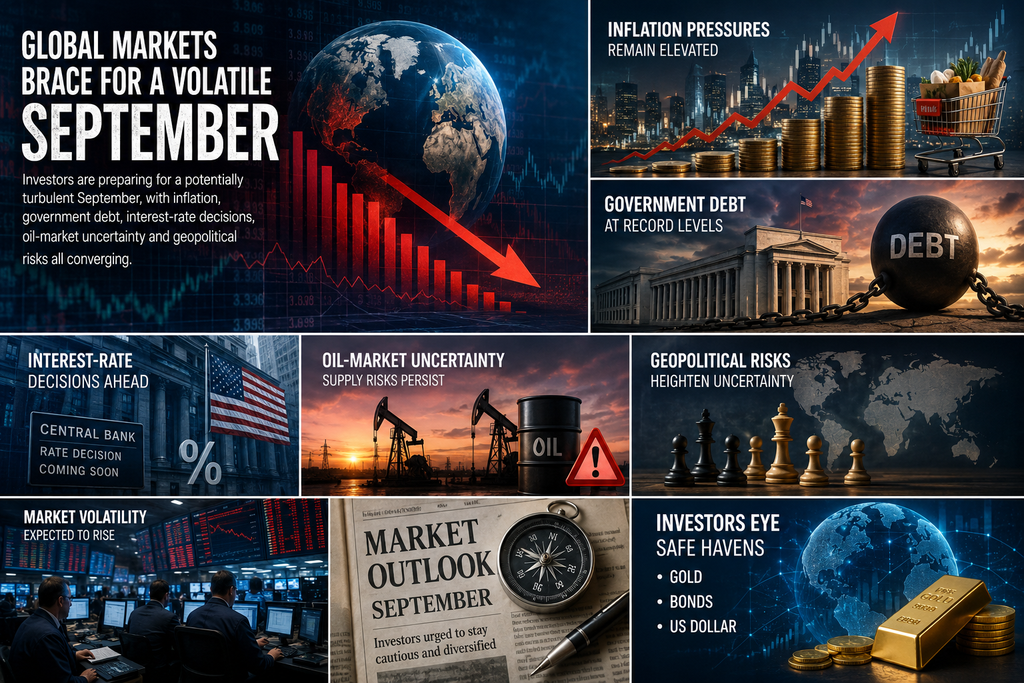
Investors are preparing for a potentially turbulent September, with inflation, government debt, interest-rate decisions, oil-market uncertainty and geopolitical risks all converging.
As August draws to a close and traders return from summer holidays, global financial markets are girding for what many strategists describe as one of the most uncertain Septembers in recent years. The confluence of sticky inflation, record government indebtedness, pivotal central-bank decisions, lingering disruptions in energy markets, and unresolved geopolitical flashpoints has created a combustible mix. Equity indices have shown resilience through much of 2026, supported by artificial-intelligence investment and productivity gains, yet the underlying currents of risk are growing stronger. Volatility gauges remain relatively subdued in late August, but history and current macro conditions suggest that calm can give way quickly once September trading intensifies.
The month has long carried a reputation for weakness in equities. Data stretching back nearly a century show September as the only calendar month with a negative average return for the S&P 500. That seasonal pattern intersects this year with a uniquely charged set of fundamental drivers. Market participants are watching the Federal Reserve’s mid-September policy meeting with particular intensity, while simultaneously tracking oil flows through the Strait of Hormuz, the trajectory of U.S. Treasury yields under the weight of a $40 trillion national debt, and the durability of any de-escalation in Middle Eastern tensions.
What follows is a detailed examination of the forces shaping investor positioning as the third quarter ends and the fourth begins.
The Inflation Backdrop: Energy Shocks and Sticky Core Pressures
Inflation remains the central preoccupation of policymakers and portfolio managers alike. Global headline inflation is projected to rise in 2026 before moderating, according to the International Monetary Fund’s July World Economic Outlook Update. The Fund sees global headline inflation increasing from 4.1 per cent in 2025 to 4.7 per cent in 2026, then declining to 3.9 per cent in 2027. The disinflation trend that had been underway since early 2024 has stalled, largely because of energy-price volatility linked to Middle Eastern conflict.
In the United States, the picture is similarly mixed. Headline measures accelerated earlier in the year before showing some cooling in midsummer data. Core inflation, however, has proven more persistent. Supply shocks in energy and related goods have fed into broader price pressures, while strong demand in certain sectors and capacity constraints in technology supply chains have kept goods inflation elevated. Central bankers have repeatedly emphasised that they will not look through these pressures indefinitely.
Across developed markets, the response has been uneven. Some institutions that had been expected to ease policy have instead paused or even contemplated further tightening. The European Central Bank has already delivered interest rate hikes, and faces debate over additional moves. The Bank of Japan continues gradual normalisation after lifting rates to levels not seen in decades. In the United Kingdom and elsewhere, precautionary increases remain on the table if inflation fails to retreat cleanly toward targets.
For investors, the practical implication is that real interest rates are likely to stay higher for longer than many had hoped at the start of the year. Bond markets have already reflected this shift: longer-term yields have remained elevated even as short-term policy rates have been held steady in several jurisdictions. Equity valuations, particularly in rate-sensitive sectors, face ongoing pressure whenever inflation data surprise to the upside or when central-bank rhetoric turns more hawkish.
Energy prices sit at the heart of the inflation story. Oil has experienced extreme swings since the escalation of U.S.-Iran tensions earlier in 2026. Brent crude surged past $120 per barrel at points in the spring before retreating sharply after diplomatic developments, only to remain volatile as shipping constraints through the Strait of Hormuz have waxed and waned. Forecasts for the remainder of 2026 vary widely depending on assumptions about the durability of any ceasefire or memorandum of understanding. Some houses see average prices in the mid-to-high $70s or low $80s by year-end if flows normalise; others keep higher numbers in place for longer if disruptions persist. Natural-gas prices in Europe have also been revised upward in several outlooks to account for lingering risk.
The pass-through from energy into broader inflation is already visible in producer-price data and in certain consumer categories. Plastics, fertilisers, and transportation costs have shown sharp increases at various points. While base effects and demand destruction in some regions may eventually help, the near-term risk remains that inflation expectations could re-anchor higher if energy prices stay elevated through the autumn.
Government Debt: The $40 Trillion Milestone and Its Market Consequences
Perhaps no single statistic captures the fiscal strain more starkly than the U.S. national debt crossing the $40 trillion threshold in August 2026. The milestone, reached after the debt more than doubled in a decade, has sharpened focus on the sustainability of public finances at a time of higher interest rates. Debt held by the public is approaching or has already surpassed 100 per cent of GDP in many projections, with the Congressional Budget Office forecasting continued rises in the debt-to-GDP ratio over the coming decade.
Net interest outlays have become one of the fastest-growing components of the federal budget. For fiscal year 2026, interest costs are projected to exceed $1 trillion in some estimates, representing a rising share of total spending and, in certain comparisons, approaching or surpassing discretionary defence outlays. The mechanics are straightforward and self-reinforcing: large deficits require more Treasury issuance; higher issuance at elevated yields increases the interest bill; the larger interest bill widens the deficit further.
Treasury markets have already shown sensitivity. The 10-year yield has traded near levels that some strategists describe as fair value given growth, inflation, and fiscal dynamics—around the mid-to-high 4 per cent area in recent commentary—yet those same levels impose a heavier carrying cost on the government. Efforts by the Treasury to manage the maturity profile of issuance and to conduct buybacks of longer-dated securities reflect awareness of the challenge. Still, the scale of refinancing needs in the years ahead is substantial.
Other advanced economies face analogous pressures. Elevated public debt ratios, combined with higher servicing costs after years of ultra-low rates, constrain fiscal space just as geopolitical and demographic demands are rising. Germany’s fiscal impulse provides some offset in Europe, but overall European growth remains subdued relative to the United States in many forecasts. Emerging markets, particularly energy importers in Asia, confront additional strains from higher oil bills and potential capital-flow volatility if developed-market rates stay elevated.
For global investors, the debt overhang raises the risk of higher term premia in bond markets. Any perception that fiscal policy is on an unsustainable path can lead to abrupt repricing of government paper, with spillover effects into equities, credit, and currencies. September, with its usual seasonal issuance patterns and the approach of fiscal-year transitions in several countries, offers a natural focal point for these concerns to surface more forcefully in price action.
Interest-Rate Decisions: The September FOMC and Divergent Central-Bank Paths
The Federal Open Market Committee meeting scheduled for September 15-16 stands as the most closely watched event on the near-term calendar. Under new Chair Kevin Warsh, the Fed held the federal funds rate target range at 3.50 to 3.75 per cent at its July meeting. The decision was not unanimous: three regional Fed presidents dissented in favour of a quarter-point increase. Markets initially trimmed, then adjusted, the probability of a September hike, with pricing fluctuating according to incoming data and geopolitical headlines.
The July statement acknowledged solid economic expansion despite elevated uncertainty linked in part to the Middle East conflict. Productivity growth and capital investment were described as strong, job gains were keeping pace with the workforce, and the unemployment rate had changed little. Inflation, however, remained elevated relative to the 2 per cent goal, reflecting supply shocks in energy and other sectors. Chair Warsh emphasised the commitment to deliver price stability and indicated the Committee would not hesitate to act if necessary.
Subsequent data and commentary have kept the debate alive. Some private forecasters still expect the Fed to remain on hold through the rest of 2026, citing the eventual fade of energy-driven inflation and the supportive role of AI-related productivity. Others see a higher probability of at least one hike this year if core measures remain sticky and the labour market stays resilient. The September meeting will incorporate two additional months of employment and inflation readings, making it a potential inflexion point for the policy path into year-end and 2027.
Elsewhere, the picture is one of divergence. The European Central Bank faces pressure from inflation that has been revised higher in staff projections, with some market participants and economists looking for a further move in September before a prolonged hold. The Bank of Japan is expected to continue gradual tightening. Several Asian central banks may raise rates where inflation, currency pressures, or external balances are most stressed. The overall result is a less synchronised global monetary cycle than in previous years, increasing the potential for cross-border capital flows and exchange-rate volatility.
Higher-for-longer policy rates, or even modest additional tightening, would reinforce the headwinds already visible in interest-rate-sensitive sectors of the equity market and would keep pressure on corporate borrowing costs. Credit spreads have generally remained orderly, but any sharp rise in government yields could test the resilience of private credit and leveraged borrowers.
Oil-Market Uncertainty: Hormuz Flows and the Geopolitical Premium
Oil markets remain the most direct transmission channel for geopolitical risk into the global economy. The conflict involving Iran has produced the largest oil-supply disruption in modern history according to some energy agencies, with production shut-ins in the region at times exceeding several million barrels per day. The Strait of Hormuz, through which a substantial share of seaborne oil trade passes, has seen constrained transit at various points. A memorandum of understanding reached in mid-June initially eased pressures and allowed prices to fall sharply from their spring peaks, yet subsequent developments have kept uncertainty elevated.
Forecasts for Brent and WTI in the second half of 2026 and into 2027 diverge according to assumptions about the speed and completeness of normalisation. Base-case scenarios in many houses now assume gradual recovery of Gulf production and shipping, with prices moderating into the $70–$85 range by year-end or early 2027. Adverse scenarios keep higher averages if constraints persist or escalate. Inventories have drawn significantly in periods of disruption, leaving OECD commercial stocks at multi-year lows at points during the year. Demand has shown some destruction, particularly in China and parts of Europe, which has limited the upside in prices relative to the scale of the supply shock.
For financial markets, the implications are twofold. First, energy-price volatility feeds directly into inflation expectations and therefore into rate pricing. Second, the equity and credit markets of energy producers and consumers react in opposite directions to price swings, creating dispersion across sectors and regions. Equity volatility has at times been contained relative to the magnitude of oil moves, reflecting confidence in eventual resolution and in underlying growth resilience. That confidence could be tested if September brings renewed escalation or if inventory draws continue without clear signs of supply recovery.
Beyond crude, natural-gas markets in Europe and liquefied-natural-gas pricing globally retain elevated risk premia. Fertiliser and petrochemical feedstock costs remain sensitive to the same dynamics. The broader commodity complex has shown mixed performance, with some agricultural and industrial metals responding more to demand and inventory signals than to pure geopolitical risk.
Geopolitical Risks: Multiple Flashpoints and Policy Uncertainty
The Middle East conflict is the most immediate geopolitical driver, but it is not the only one. Risks surrounding a potential Russia-Ukraine settlement, or the absence of one, continue to influence energy and grain markets. Defence-spending increases across Europe and elsewhere provide a fiscal impulse in some economies while adding to public-debt burdens. Trade policy remains a source of uncertainty, with the possibility of renewed tariff actions or other protectionist measures capable of disrupting supply chains and raising input costs.
In Asia, energy-importing economies have faced stress tests from higher oil prices, with varying degrees of resilience depending on fiscal buffers, currency strength, and domestic demand. Capital-flow volatility remains a concern if U.S. rates stay elevated or if risk appetite deteriorates. Political calendars in several countries, including state elections in Germany and policy transitions elsewhere, add layers of domestic uncertainty that can interact with global market sentiment.
Financial markets have so far absorbed these risks with notable resilience. Equity drawdowns associated with the spring escalation of Middle Eastern tensions were contained relative to historical geopolitical episodes. Risk appetite recovered as diplomatic channels reopened. Yet measures of implied volatility and tail-risk pricing have at times retreated close to pre-conflict levels, leading some observers to question whether downside scenarios are fully incorporated. A renewed flare-up, or a breakdown in existing understandings, could reverse that complacency rapidly.
Market Positioning and Historical September Patterns
Investors enter September with mixed positioning. Equity indices in the United States have been supported by the AI and technology complex, with productivity optimism offsetting some of the macro headwinds. European and Japanese markets have shown more muted performance in many periods. Credit markets remain relatively tight by historical standards, though private credit has attracted increasing scrutiny. Currency markets have reflected the shifting interest-rate differentials, with the dollar experiencing periods of strength followed by partial retracement.
The historical September effect provides an additional cautionary note. Long-run data show the month as the weakest for the S&P 500 on average, with a higher frequency of negative returns than any other month. Volatility indices typically rise on average in September even if the median day remains calm; the tails become fatter. Whether that pattern asserts itself in 2026 will depend on the interaction of the fundamental drivers outlined above with seasonal liquidity conditions and positioning.
Portfolio managers are adjusting accordingly. Many are emphasising diversification across regions and asset classes, maintaining dry powder for potential dislocations, and scrutinising duration exposure in fixed-income portfolios. Hedging costs have fluctuated with oil and equity volatility, but the overall level of implied equity volatility has remained moderate relative to the scale of the risks. That moderation itself is a source of debate: some see it as evidence of underlying economic strength; others view it as a vulnerability if a catalyst emerges.
Outlook: Scenarios for the Months Ahead
Base-case projections from major institutions generally assume that growth remains resilient, supported by AI-related investment and eventual easing of energy constraints, while inflation moderates gradually toward targets over 2027. In this scenario, central banks can remain patient or resume limited easing later, bond yields stabilise, and risk assets grind higher, albeit with elevated volatility. Global growth is expected in the low-to-mid 3 per cent range for 2026 in several forecasts, with the United States outperforming Europe.
Downside scenarios centre on prolonged or renewed Middle Eastern disruption that keeps oil prices elevated, pushes inflation higher, forces additional monetary tightening, and weighs on growth. Fiscal concerns could amplify bond-market volatility. An adverse combination could produce sharper equity corrections and wider credit spreads.
Upside scenarios involve faster-than-expected resolution of geopolitical tensions, a cleaner disinflation path, and stronger productivity gains that allow growth to accelerate without reigniting price pressures. In that environment, risk assets could extend gains and volatility could compress further.
September is unlikely to resolve these uncertainties fully. The Fed decision, successive inflation and employment prints, oil-inventory and shipping data, and any diplomatic developments will all shape the path. Investors who have enjoyed relatively orderly markets through parts of 2026 are being reminded that multiple risk factors are now aligned. Preparation for turbulence is not the same as prediction of collapse; it is simply recognition that the margin for error has narrowed.
The coming weeks will test the resilience that markets have demonstrated so far. Whether September proves merely seasonally weak or becomes the stage for a more significant repricing will depend on the interplay of data, policy, and geopolitics. For now, the consensus among many market participants is clear: brace for volatility. The forces of inflation, debt, rates, oil, and geopolitics are not moving in isolation. Their convergence makes the autumn of 2026 a period that demands careful navigation.