
In the vast tapestry of human civilisation, few regions of the world display such intricate interwoven threads of history, belief, art, and daily life as Southeast Asia and India. Stretching from the Himalayan foothills and the fertile plains of the Indian subcontinent across the Bay of Bengal and into the archipelagos, river deltas, and highlands of Southeast Asia, this cultural continuum has shaped societies for millennia. Despite the realities of modern political borders, occasional economic frictions, and territorial disagreements that inevitably arise among sovereign nations, the deeper currents of shared heritage and cultural affinity continue to flow with remarkable resilience. These affinities offer a powerful foundation upon which a stronger, more cohesive regional block can emerge in the decades ahead—one rooted not in uniformity, but in mutual respect, complementary strengths, and a collective civilizational memory.
This article explores the rich heritage and cultural similarities that bind India with the nations of Southeast Asia—Indonesia, Malaysia, Singapore, Thailand, Vietnam, Cambodia, Laos, Myanmar, the Philippines, and Brunei. It celebrates the enduring legacies of ancient trade routes, religious transmission, artistic exchange, and social practices, while looking forward with optimism to a future in which these connections help the region navigate challenges and claim a more prominent place on the global stage.
Ancient Pathways of Exchange
Long before the drawing of modern maps, the Indian Ocean and the overland routes of mainland Southeast Asia served as highways of ideas, goods, and people. From at least the early centuries of the Common Era, Indian merchants, scholars, and religious teachers sailed eastward, carrying with them Sanskrit learning, Buddhist and Hindu philosophies, architectural knowledge, and literary traditions. Southeast Asian societies, already sophisticated in their own right, absorbed, adapted, and transformed these influences into distinctive local expressions that remain vibrant today.
The great maritime empires of Southeast Asia—Srivijaya centred in Sumatra, Majapahit in Java, the Khmer Empire at Angkor, the kingdoms of Champa, and the Thai and Burmese polities—flourished in dialogue with the Indian subcontinent. Inscriptions in Sanskrit and later in local languages written in scripts derived from Brahmi appear across the region. Temples rose in forms inspired by Indian models yet uniquely Southeast Asian in scale, ornament, and spiritual emphasis. The Ramayana and Mahabharata travelled eastward and took root in new soils, becoming the Kakawin Ramayana of Java, the Ramakien of Thailand, the Reamker of Cambodia, and countless local shadow-puppet and dance-drama traditions.
Buddhism, which had developed profound schools of thought in India, found fertile ground in Sri Lanka and then across Southeast Asia. Theravada Buddhism remains the predominant faith in Thailand, Myanmar, Laos, and Cambodia, while Mahayana traditions influenced Vietnam and aspects of Indonesian and Malaysian history. Hinduism left lasting imprints in Bali, where temple rituals, caste-influenced social structures adapted to local conditions, and the continuous performance of sacred dances keep ancient practices alive. Even in predominantly Muslim Indonesia and Malaysia, traces of earlier Hindu-Buddhist civilisation endure in place names, classical literature, performing arts, and the syncretic elements of popular culture.
These were not one-way transmissions. Southeast Asian spices, forest products, gold, and later fine textiles and ceramics flowed westward, enriching Indian markets and courtly life. The monsoon winds that made regular voyages possible also encouraged the settlement of Indian communities in port cities and the intermarriage that produced hybrid cultural forms. Over centuries, this exchange created a civilizational zone in which differences in language and political organisation never fully erased a sense of shared aesthetic and spiritual vocabulary.
Living Traditions of Faith and Ritual
Religion and ritual continue to offer some of the most visible similarities. In temples and monasteries from Bodh Gaya to Borobudur, from Varanasi to Wat Phra Kaew, the same stories of the Buddha’s life are told, the same principles of compassion and impermanence are contemplated, and similar offerings of flowers, incense, and light are made. The annual cycle of Buddhist festivals—Vesak or Buddha Purnima, the rains retreat, and various local merit-making ceremonies—creates parallel rhythms of communal life across India and much of mainland Southeast Asia.
In Hindu communities, particularly in Bali and among the Indian diaspora in Singapore, Malaysia, and elsewhere, the same deities are honoured, the same epics recited, and many of the same life-cycle rituals observed, albeit with local adaptations of music, costume, and language. The festival of Diwali finds echoes in the light celebrations of Southeast Asia, while the spirit of Holi resonates with various spring and water festivals that mark renewal and joy.
Even where Islam predominates, as in Indonesia (the world’s largest Muslim-majority nation) and Malaysia, earlier cultural layers remain visible. The wayang kulit shadow theatre of Java and Bali continues to perform stories drawn from the Indian epics. Classical dance forms in Indonesia and Thailand retain gestures and narrative structures with clear Indian ancestry. In the Philippines, Spanish colonial influence is strong, yet indigenous and earlier maritime Asian connections persist in folklore, boat-building traditions, and certain social customs that parallel those of neighbouring archipelagic societies.
Cuisine provides another everyday expression of connection. Rice as the staple, the sophisticated use of spices, the balance of sweet, sour, salty, and spicy flavours, and the importance of communal eating are shared across the region. Indian spices and cooking techniques contributed to the development of curry traditions that appear in countless local variations—from Thai gaeng to Indonesian gulai and Malaysian kari. Coconut milk, tamarind, lemongrass, galangal, and turmeric appear in kitchens from Kerala to Cambodia. Street food cultures in Bangkok, Jakarta, Singapore, and Indian cities share a similar energy and inventiveness. Vegetarian traditions rooted in Indian religious practice find parallel expressions in Buddhist societies that emphasise non-violence and seasonal fasting or abstinence.
Arts, Architecture, and Aesthetic Sensibilities
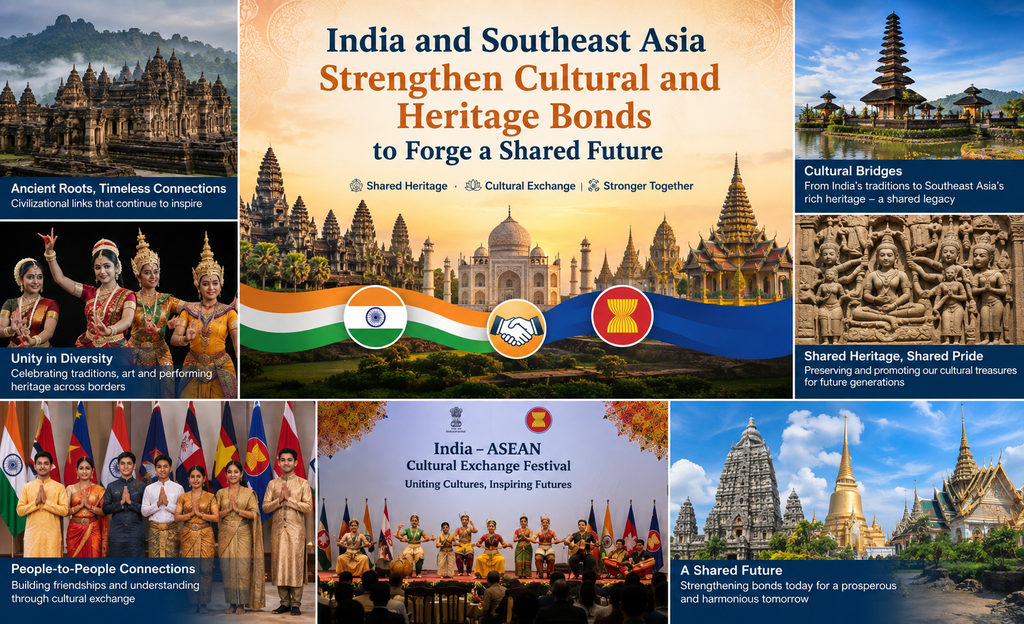
The visual and performing arts reveal deep structural similarities. Temple architecture across the region demonstrates a shared vocabulary of form—garbhagriha sanctums, towering shikharas or prangs, intricate bas-reliefs depicting mythological scenes, and the integration of water features and processional paths. Angkor Wat stands as one of the most magnificent expressions of this tradition, its scale and artistic ambition rivalling the greatest monuments of India. Borobudur’s monumental stupa complex and the rock-cut temples of Ellora and Ajanta speak to a common impulse to give permanent form to spiritual aspiration. In later periods, Islamic architecture in Indonesia and Malaysia incorporated local motifs alongside influences that had earlier travelled through Indian Ocean networks.
Classical dance and music traditions display related principles of gesture, rhythm, and narrative. The mudras of Indian classical dance find cousins in the hand movements of Thai, Cambodian, and Balinese dancers. Epic storytelling through dance-drama remains central to cultural identity in many Southeast Asian courts and villages, just as it does in Indian classical and folk forms. Music systems, while distinct, share an emphasis on modal structures, improvisation within rules, and the integration of percussion, strings, and wind instruments in ensemble performance.
Textile traditions offer another parallel. The production of fine silks, the use of natural dyes, and techniques of weaving and resist dyeing (including batik in Indonesia and related practices elsewhere) connect to broader Asian textile histories in which Indian cottons and silks long played a central role. Motifs drawn from nature, mythology, and geometric abstraction appear across borders, adapted to local tastes and materials.
Literature and oral traditions further bind the region. Beyond the epics, collections of moral tales, animal fables, and courtly poetry circulated and were localised. The Jataka stories of the Buddha’s previous lives remain popular teaching tools. Classical languages—Sanskrit, Pali, and later local literary languages—created a shared elite culture that transcended political boundaries for centuries.
Social Values and Everyday Practices
Beneath the surface of religious and artistic forms lie shared social values that continue to shape daily life. Respect for elders, the importance of family and community, the value placed on hospitality, and a preference for harmony and indirect communication in social relations appear across much of the region. Hierarchical yet reciprocal relationships between teacher and student, ruler and subject, and host and guest have deep historical roots. Concepts of duty, merit, and cosmic order that developed in Indian philosophical traditions found ready reception and local reinterpretation in Southeast Asia.
Agricultural calendars tied to monsoon rhythms, the centrality of rice cultivation, and associated rituals of planting and harvest create parallel seasonal experiences. Village organisation, markets as social as well as economic spaces, and the role of traditional healers and knowledge-keepers of herbal medicine further illustrate common patterns. Even as urbanisation and globalisation transform societies, these deeper cultural orientations provide continuity and a sense of recognisable kinship when people from different countries of the region meet.
Modern Expressions of Cultural Continuity
In the contemporary era, these historical connections find new life through education, tourism, diaspora communities, popular culture, and deliberate cultural diplomacy. Indian films, music, and television have long enjoyed audiences across Southeast Asia; Southeast Asian cinema, cuisine, and design increasingly reach Indian viewers and consumers. Yoga, Ayurveda, and mindfulness practices originating in India have found enthusiastic reception throughout the region, while Southeast Asian wellness traditions and spa cultures attract visitors from India and beyond.
Universities and research institutions collaborate on the study of shared history, language, and archaeology. Festivals of Indian classical arts are held in Singapore, Kuala Lumpur, Jakarta, and Bangkok; Southeast Asian performing groups tour Indian cities. The Indian diaspora in Southeast Asia—long-established communities in Singapore, Malaysia, Indonesia, and Myanmar, as well as more recent professionals and students—serves as a living bridge, maintaining temples, cultural associations, and business networks while contributing to the societies in which they live.
Tourism flows in both directions. Indian visitors explore the temples of Angkor, Borobudur, and Bagan, as well as the beaches and cities of Thailand, Indonesia, and Singapore. Southeast Asian travellers visit the holy sites of Buddhism and Hinduism in India, the cultural centres of Rajasthan and Kerala, and the growing modern cities. These encounters reinforce awareness of shared heritage while generating economic benefits and personal relationships that transcend official diplomacy.
Navigating Disputes with Perspective
It would be incomplete to celebrate cultural affinities without acknowledging the existence of political, border, and economic disputes. Territorial questions in the South China Sea involve several Southeast Asian nations and external powers. Bilateral border issues have occasionally strained relations between neighbours. Economic competition, differing development priorities, and occasional trade frictions arise, as they do in every region of the world. India’s own relationships with individual Southeast Asian countries have experienced periods of closeness and distance shaped by Cold War alignments, domestic politics, and shifting strategic calculations.
Yet these disputes, while real and sometimes serious, do not erase the deeper civilizational connections. History demonstrates that cultural affinity can coexist with political difference. The same societies that once fought wars over trade routes or succession also exchanged artists, monks, and scholars. Modern nation-states, defined by sovereignty and interests, still operate within a broader cultural ecology that softens antagonisms and creates space for dialogue. ASEAN itself was founded in part on the recognition that regional cooperation could manage differences and promote shared prosperity. India’s Look East and later Act East policies reflect a strategic understanding that engagement with Southeast Asia serves both economic and civilizational interests.
The existence of disputes should therefore be viewed not as evidence of fundamental incompatibility, but as the ordinary challenges of neighbouring and near-neighbouring states in a complex world. What distinguishes this region is the availability of cultural resources—shared stories, aesthetic sensibilities, religious philosophies emphasising harmony and interdependence—that can be drawn upon to build trust and long-term cooperation.
The Promise of a Stronger Regional Block
Looking ahead, the combination of cultural affinity, demographic dynamism, economic potential, and geographic centrality positions Southeast Asia and India to emerge as a stronger and more influential collective presence. Several factors support this optimistic trajectory.
First, economic complementarity is substantial. India’s large and growing market, technological capabilities in information technology, pharmaceuticals, and space, and its manufacturing ambitions align with Southeast Asia’s strengths in electronics, commodities, tourism, and increasingly sophisticated manufacturing and services. Supply-chain diversification, infrastructure connectivity through initiatives such as the India-Myanmar-Thailand Trilateral Highway and broader maritime linkages, and growing investment flows create practical foundations for deeper integration. Digital connectivity, fintech innovation, and educational exchange further multiply opportunities.
Second, the soft power of culture provides unique leverage. In an era when geopolitical competition often emphasises hard power, the ability to draw on centuries of mutual influence offers a distinctive form of attraction and legitimacy. Cultural festivals, educational scholarships, heritage conservation projects, and people-to-people exchanges build constituencies for cooperation that outlast particular governments or policy cycles. The shared vocabulary of Buddhism, the continuing popularity of the epics, and the everyday familiarity of certain aesthetic and culinary forms create an emotional and intellectual basis for partnership that pure realpolitik cannot supply.
Third, the region’s collective weight in global institutions and forums is increasing. ASEAN’s role as a central actor in the Indo-Pacific architecture, India’s growing engagement with the Quad and other frameworks, and joint advocacy on issues of climate change, sustainable development, maritime security, and equitable global governance can amplify the voices of countries that share historical and cultural linkages. A more coordinated approach need not require formal political union; it can take the form of denser networks of cooperation, aligned positions on key issues, and mutual support in international arenas.
Fourth, demographic and social trends favour continued engagement. Young populations across much of the region are digitally connected, curious about neighbouring cultures, and open to educational and professional mobility. The rise of middle classes expands markets for cultural products, tourism, and lifestyle goods that carry regional signatures. Urbanisation and the growth of creative industries create new platforms for collaboration in design, media, cuisine, and the arts.
Challenges remain. Infrastructure gaps, regulatory differences, occasional protectionist impulses, and the need to manage great-power competition carefully will require sustained diplomatic effort and political will. Climate change, pandemics, and economic shocks will test resilience. Yet the cultural and historical foundations provide a reservoir of goodwill and mutual understanding that can help the region weather difficulties and pursue opportunities.
Toward a Civilizational Partnership
The future strength of Southeast Asia as a block—broadly understood to include deeper partnership with India—will not rest solely on treaties or trade statistics. It will draw power from the recognition that these societies have long been part of a connected civilizational space. The temples that still stand, the epics that are still performed, the festivals that still mark the calendar, the cuisines that still delight the palate, and the values of respect, harmony, and hospitality that still guide social relations all testify to this deeper unity.
By investing in cultural diplomacy, educational exchange, heritage conservation, and people-to-people ties alongside economic and strategic cooperation, the countries of the region can convert historical affinity into contemporary advantage. A stronger bloc need not erase national identities or resolve every dispute overnight. It can instead create a denser web of relationships in which differences are managed more easily because commonalities are better understood and more widely celebrated.
In the coming decades, as the centre of global economic and demographic gravity continues to shift toward Asia, the societies that share the heritage of the Indian Ocean world and the mainland and maritime realms of Southeast Asia have an opportunity to shape that shift on their own terms. Their rich cultural inheritance is not a museum piece; it is a living resource for creativity, resilience, and cooperation. By drawing upon it with confidence and generosity, India and the nations of Southeast Asia can move beyond the constraints of past disputes and emerge as a more cohesive, prosperous, and influential presence—united not by uniformity, but by the enduring strength of shared civilisation.
The story of this region has always been one of adaptation, synthesis, and renewal. From the ancient ports where merchants and monks first met, through the great kingdoms that built monuments still admired today, to the modern cities where young people exchange ideas across digital networks, the capacity for creative connection has defined the area. That capacity remains intact. With deliberate cultivation, it can support the emergence of a stronger regional block capable of contributing more fully to regional peace, prosperity, and the broader human story. The heritage is rich, the cultural similarities profound, and the future open to those willing to build upon both.