

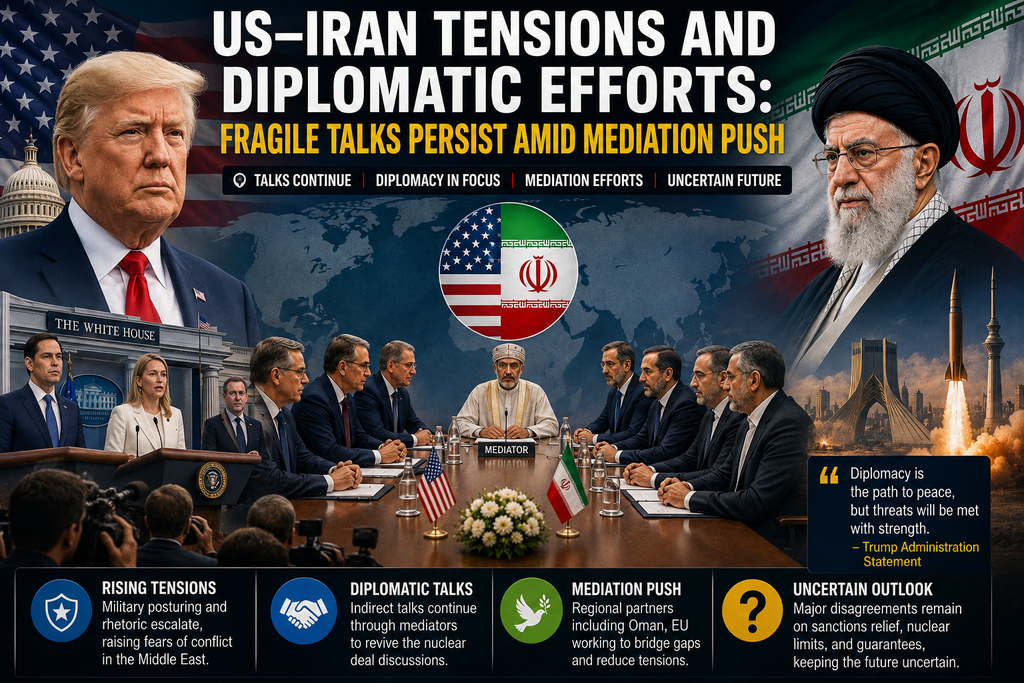
Regional diplomacy involving the United States and Iran remained a major international story in late August 2026, with Pakistan continuing to play a reported mediating role as the conflict that began in late February entered its sixth month without a lasting settlement. Despite a high-profile memorandum of understanding signed in mid-June and repeated rounds of technical and high-level discussions, core disputes over the Strait of Hormuz, Iran’s nuclear program, sanctions relief, and linked regional fighting have prevented a final agreement. Both sides have left the door open to further talks while escalating economic and rhetorical pressure, keeping global energy markets, shipping routes, and Middle East stability under strain.
The confrontation erupted on February 28, 2026, when the United States and Israel launched airstrikes targeting Iranian nuclear and ballistic missile facilities, along with elements of the Islamic Revolutionary Guard Corps. Washington and its ally framed the operation as necessary to prevent Iran from obtaining a nuclear weapon and to degrade Tehran’s regional proxy network. Iran responded with missile and drone attacks on U.S. and allied positions in the Gulf, effectively closed the Strait of Hormuz to commercial traffic, and intensified support for Hezbollah in Lebanon. The resulting war disrupted roughly one-fifth of the world’s oil and liquefied natural gas trade, drove energy prices higher, and produced thousands of casualties, primarily in Iran and Lebanon.
By early June, after months of intermittent fighting and failed earlier mediation attempts involving Oman and others, Pakistani and Qatari diplomats had emerged as the central facilitators. Pakistan, which maintains working relations with both Washington and Tehran and shares a long border with Iran, leveraged its military and civilian channels. Field Marshal Asim Munir, Pakistan’s army chief, maintained direct contacts with U.S. President Donald Trump and Iranian security officials. Prime Minister Shehbaz Sharif, Deputy Prime Minister and Foreign Minister Ishaq Dar, and other officials coordinated messaging and hosted key sessions. Qatar provided additional venues and logistical support, drawing on its established role as a Gulf intermediary.
These efforts produced a 14-point memorandum of understanding, electronically signed on or around June 17, 2026, by representatives of the Trump administration and Iranian President Masoud Pezeshkian’s government. The document was not a final peace treaty but a transitional framework. It called for an immediate halt to hostilities, the temporary reopening of the Strait of Hormuz to commercial shipping (toll-free for at least 60 days), the lifting of the U.S. naval blockade of Iranian ports, limited sanctions waivers, and the start of negotiations toward a permanent settlement. The talks were to address Iran’s nuclear program—including the disposition of its stockpile of highly enriched uranium under International Atomic Energy Agency supervision—sanctions relief, a reported $300 billion reconstruction and development plan for Iran, and broader regional security arrangements. The memorandum set a 60-day window, extendable by mutual consent, for converting the interim understanding into a lasting accord that would ultimately be endorsed by the United Nations Security Council.
Initial optimism was tempered almost immediately. Fighting between Israel and Hezbollah in Lebanon continued in apparent violation of the MOU’s call for a complete cessation of operations on all fronts. Iranian officials insisted that progress on Lebanon was a prerequisite for deeper nuclear discussions. Technical talks opened in Switzerland (including sessions in Lucerne and Bürgenstock) in late June, led on the U.S. side at times by Vice President JD Vance and on the Iranian side by Parliament Speaker Mohammad Bagher Ghalibaf. Mediators from Pakistan and Qatar participated. Working groups were established on nuclear issues, sanctions termination, reconstruction, and monitoring and dispute resolution. A “de-confliction cell” for Lebanon and a communications hotline for the Strait of Hormuz were announced as guardrails to prevent incidents from derailing the process.
Public statements quickly diverged. U.S. officials, including President Trump and Vice President Vance, claimed progress on nuclear inspections, asserting that Iran had agreed to high-level IAEA access and the dilution or disposition of highly enriched uranium. Iranian spokespeople, including Foreign Ministry official Esmail Baghaei, denied that detailed nuclear talks had even begun and rejected claims of new inspection commitments for war-damaged sites. Disputes also arose over the Strait of Hormuz. Iran maintained that sovereignty and traffic arrangements rested with Tehran and Oman and signalled intentions to impose tolls after the initial period. The United States demanded unrestricted passage. Limited sanctions waivers were implemented, allowing some Iranian oil and petrochemical exports, and discussions of unfreezing assets (with mechanisms involving Qatar) advanced in parallel. Yet mutual accusations of violations mounted. Iranian projectiles struck commercial vessels; U.S. and Iranian forces exchanged strikes on bases and facilities in the Gulf; and both sides threatened further escalation.
By late June and into July, the process had become a cycle of de-escalation efforts followed by renewed friction. Trump publicly warned that Iran would “cease to exist” if it failed to honour the agreement. Iranian leaders vowed “all-out defence” and refused to meet certain U.S. envoys, including Jared Kushner and Steve Witkoff, during a planned Doha visit, preferring to engage only through mediators. Pakistan’s foreign ministry announced technical talks would resume, while Iranian officials insisted no direct meetings with the American side were scheduled. Qatari and Pakistani intermediaries continued shuttle diplomacy, including phone calls between Iranian President Pezeshkian and Pakistani Prime Minister Sharif.
The 60-day deadline expired in mid-August without a final deal. The Strait of Hormuz remained effectively closed or tightly controlled by Iran, which conditioned full reopening on U.S. fulfilment of its MOU commitments, including lifting the counter-blockade and broader sanctions relief. Washington declared a shift toward “economic warfare,” imposing additional pressure measures while stating that no active negotiations were underway. White House officials emphasised that preventing Iran from obtaining a nuclear weapon remained the top priority and that military options were not ruled out. Iranian Foreign Minister Abbas Araghchi stated that diplomacy remained possible only if the United States abandoned its pressure campaign, built trust, spoke respectfully, and upheld existing commitments. “Pressure doesn’t work,” he posted. Iranian lawmakers warned of offensive actions if the memorandum continued to be ignored.
In this context, Pakistan intensified its mediation in the final days of August. Field Marshal Asim Munir visited Tehran around August 24, meeting senior Iranian leaders after speaking with President Trump. Pakistani Interior Minister Mohsin Naqvi accompanied or followed aspects of the engagement. Officials on both the Pakistani and Iranian sides described the discussions as productive, focusing on reviving stalled talks, reopening the Strait of Hormuz, and returning to the framework of the Islamabad-mediated MOU. Pakistani sources indicated proposals for a fresh 60-day period with immediate resumption of direct talks on Hormuz and sanctions. Iran’s presidential office called the visit highly productive, with results expected to become apparent soon. Concurrently, Iranian officials held talks with Oman on maritime arrangements in the strait and met Qatari counterparts in Tehran. These parallel tracks underscored that regional actors continued to treat diplomacy as viable even as the principal parties hardened their public positions.
The persistence of mediation reflects deeper strategic calculations. For Pakistan, successful facilitation enhances its standing as a middle-power broker with unique dual-track access to Washington and Tehran. It also serves Islamabad’s interest in preventing further regional destabilisation that could affect its own security and economy. Qatar benefits from maintaining relevance as a diplomatic hub and protecting its energy interests. For the United States under the Trump administration, keeping channels open through intermediaries allows pressure to continue while avoiding the appearance of negotiating from weakness. Iran, economically strained by sanctions, wartime damage, and the Hormuz closure’s double-edged impact, gains breathing space and leverage by insisting on sequential implementation of the June framework.
Yet the obstacles remain formidable. Trust is minimal. The nuclear file is especially contentious: the United States has long demanded severe limits or zero enrichment, while Iran has insisted on its right to a civilian program and has continued enrichment activities. The disposition of existing highly enriched uranium stockpiles, the return and authority of IAEA inspectors, and verification mechanisms after the 2025 and 2026 strikes are unresolved. The Strait of Hormuz involves questions of sovereignty, tolls, security arrangements with Oman, and the status of any U.S. naval presence. Lebanon’s conflict, though not a direct party to the U.S.-Iran MOU, has repeatedly spilt over and tested the de-escalation mechanisms. Reconstruction financing, the sequencing of sanctions relief, and guarantees against future military action add further layers of complexity. Historical precedent from the 2015 Joint Comprehensive Plan of Action, which took years to negotiate and later collapsed, illustrates how difficult sustained compliance can be.
As of the end of August 2026, the situation is one of managed tension rather than active large-scale combat. Major military operations have largely paused, but the absence of a comprehensive agreement leaves the region vulnerable to miscalculation. Global shipping continues to adapt with longer routes and higher insurance costs. Energy markets remain sensitive to every statement from Washington, Tehran, or the mediators. Diplomatic efforts, though stalled at the principal level, have not collapsed. Pakistan’s latest push, alongside Qatar’s ongoing engagement and Oman’s technical discussions on the strait, keeps a pathway open.
Whether these efforts can produce a renewed interim understanding or progress toward a final settlement depends on political will in Washington and Tehran. Both sides have incentives to avoid full-scale renewed warfare—the economic costs for Iran and the strategic and political costs for the United States are high—yet neither appears ready to concede on core red lines. The coming weeks will test whether the dual-track diplomacy pioneered by Pakistan and supported by other regional actors can once again bridge the gap, or whether the pattern of partial agreements followed by breakdown will continue. For now, regional diplomacy involving the United States and Iran remains an active and closely watched international story, with Pakistan’s mediation role underscoring the continued search for an off-ramp from a conflict that has already reshaped the Middle East’s security and economic landscape.