

August 31, 2026
Oil markets jolted higher on Monday as the United States and Iran exchanged military strikes for the first time in roughly a month, pushing the global benchmark Brent crude above $90 a barrel and reigniting fears that the prolonged disruption of the Strait of Hormuz could deepen into a more sustained shock for energy supplies and the world economy. The latest flare-up, centred on Iranian efforts to seed the strategic waterway with sea mines and a swift American response, underscored how fragile the partial calm of recent weeks had been and how quickly geopolitical risk can reassert itself over the world’s most critical oil chokepoint.
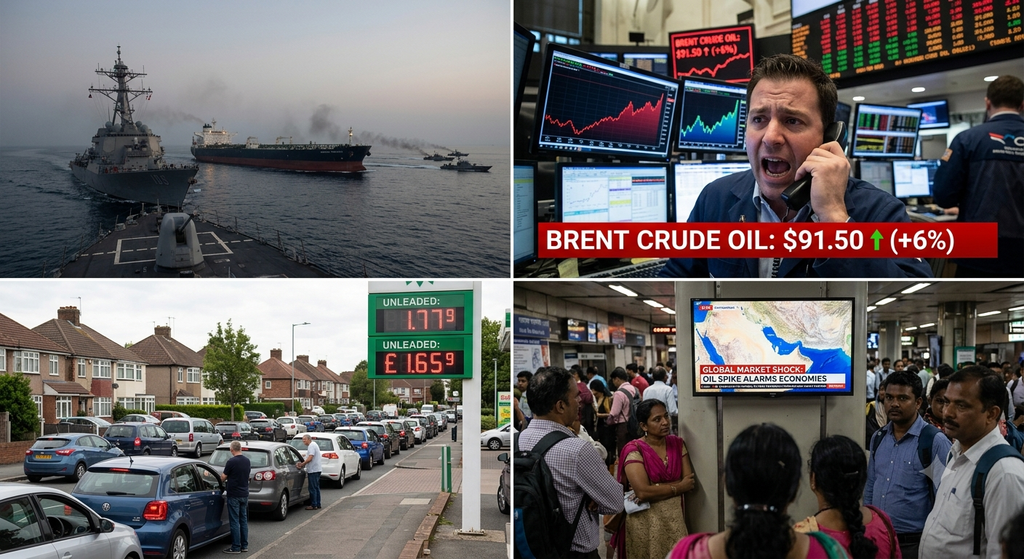
Brent crude futures climbed more than 3 per cent in early trading, briefly topping $91 a barrel before settling in a range around that level, according to market data from multiple exchanges and reporting outlets. West Texas Intermediate, the U.S. benchmark, rose by a similar magnitude to trade above $86 a barrel. The gains reversed a sharp decline the previous week that had been fueled by tentative diplomatic signals between Iran and Oman aimed at restoring more orderly shipping through the strait. Analysts attributed the rebound not only to the immediate military exchanges but to the broader reality that tanker traffic remains a fraction of pre-conflict levels and that inventories continue to draw down under sustained risk.
The sequence of events began late Sunday when U.S. forces struck two Iranian rocket launchers on Larak Island, a small but strategically positioned landmass inside the Strait of Hormuz. U.S. Central Command stated that Islamic Revolutionary Guard Corps personnel had been observed preparing to launch rockets carrying sea mines into the waterway. The strike marked the first known American military action against Iranian targets since late July, ending a pause that President Donald Trump had announced on August 1. Iranian forces responded by firing missiles and drones at American air bases in Jordan. Jordanian authorities reported intercepting the incoming projectiles. Iranian media, citing the Revolutionary Guards, also claimed that a bulk carrier had been seized near Bandar Abbas and that a supertanker had struck mines while attempting transit, though U.S. officials maintained that demining operations had kept the main passage viable.
President Trump amplified market nerves with a social media post asserting that Iran’s Kharg Island, the country’s primary oil export terminal, was being “blown to smithereens.” Iranian officials swiftly denied any such attack and insisted that oil operations continued uninterrupted. No independent confirmation of damage to Kharg emerged from military or commercial sources on Monday. Nevertheless, the combination of kinetic action, rhetorical escalation, and lingering uncertainty over the strait’s navigability was enough to send energy traders scrambling to reassess supply risk premiums.
The Strait of Hormuz has been the central pressure point of the conflict since it intensified at the end of February 2026. Before hostilities, more than 130 ships a day typically transited the narrow waterway between Iran and Oman, carrying roughly one-fifth of the world’s seaborne oil and significant volumes of liquefied natural gas. In recent weeks, visible commodity vessel traffic has collapsed. Maritime data providers reported averages as low as five ships a day over the most recent weekend and roughly 15 ships per day across the prior week. Independent trackers estimated that only about 5.2 million barrels of crude per day had passed through the strait on average over the past 28 days—far below the pre-war flow and also below some official U.S. estimates. Energy Secretary Chris Wright has publicly cited figures closer to 8 million barrels a day leaving the Persian Gulf, while other analysts and satellite-based tracking firms place the number lower. Goldman Sachs has estimated total Gulf oil exports in the range of 15–16 million barrels per day, still 7–8 million barrels below pre-war levels even after accounting for possible night-time sailings with transponders switched off to avoid detection.
The reduction in traffic reflects a mix of Iranian threats and attacks, elevated insurance costs, cautious shipowners, and periodic U.S. naval operations aimed at keeping a corridor open. Iran has repeatedly declared the strait closed or threatened vessels that do not comply with its instructions. The United States has conducted demining efforts, escorted some commercial traffic, and imposed a blockade on Iranian ports that has redirected dozens of vessels, disabled others, and involved boardings. The practical effect has been a prolonged constriction of one of the global economy’s most vital arteries. Six months into the conflict—far longer than the four-to-five-week duration initially suggested by the White House—the market has absorbed the disruption more resiliently than many early doomsday forecasts predicted, yet the risk premium has never fully dissipated.
Monday’s price spike occurred against a backdrop of already tight inventories and stretched refining capacity. The U.S. Strategic Petroleum Reserve has fallen to its lowest level since 1982. President Trump announced over the weekend that oil secured through a recent agreement involving Venezuela would be used to replenish the stockpile. Analysts cautioned that meaningful additional production from those reserves could take years, limiting any near-term buffer. Simultaneously, strikes on refining infrastructure in the Middle East and elsewhere have constrained global processing capacity, pushing refined-product margins to elevated levels and supporting crude prices even when absolute supply shortfalls have been partially offset by other producers.
Equity markets felt the pressure as higher energy costs fed into inflation expectations and raised the spectre of tighter monetary policy in some jurisdictions. Thin trading volumes linked to a public holiday in the United Kingdom amplified the moves. Pump prices in the United States remained relatively stable in the immediate aftermath, with the national average for regular unleaded hovering near $4.08 a gallon and diesel near $5.60, according to industry data. Over longer horizons, however, sustained crude above $90 would be expected to filter through to consumers and industrial users, particularly in import-dependent economies in Asia and Europe.
The conflict’s trajectory has been marked by intermittent pauses and renewed hostilities. A period of relative quiet after the August 1 pause had allowed some optimism that diplomatic channels—particularly involving Oman—might produce a workable arrangement for shared or supervised transit. Those efforts appear to have stalled amid the latest exchange. Iran has continued to probe the limits of American and coalition resolve by attempting to reintroduce mines and by targeting U.S. assets in third countries. The United States has responded with precision strikes intended to degrade those capabilities without necessarily expanding the geographic scope of the war. The pattern suggests a grinding contest of attrition rather than a decisive conventional campaign, one in which control of the strait remains the decisive economic lever.
For oil-importing nations, the consequences extend beyond headline prices. Asian refiners have reported depressed crude import volumes in August relative to seasonal norms. European gas markets, already sensitive to any interruption in LNG flows that once moved through the Gulf, have experienced elevated volatility even when U.S. natural gas prices remained more subdued. Developing economies face the dual burden of higher energy import bills and potential currency pressure if capital markets reassess risk. Exporters outside the immediate conflict zone have captured some market share, yet the absolute shortfall in Gulf volumes has kept the global balance tighter than it would otherwise have been.
Military and intelligence assessments continue to emphasise the difficulty of permanently securing the strait against determined asymmetric tactics. Iran’s ability to launch rockets or small craft from multiple points along its coastline means that clearance operations must be repeated. Commercial operators, facing multimillion-dollar hull values and crew safety considerations, have shown a preference for waiting out periods of heightened tension or seeking longer alternative routes when possible—routes that add time, cost, and capacity constraints of their own. Insurers have adjusted war-risk premiums accordingly, further raising the effective cost of transit even when physical passage remains open.
Diplomatic activity has not ceased. Mediators continue to explore formulas that would allow a supervised shipping lane or confidence-building measures that reduce the incentive for either side to escalate. Yet the fundamental positions remain far apart. Iran seeks guarantees against further military pressure and relief from related economic constraints. The United States and its partners insist on freedom of navigation and an end to attacks on commercial shipping and regional bases. Bridging that gap has proven elusive across six months of fighting.
Market participants are now pricing a scenario in which supply risk persists into the autumn and potentially beyond. Inventories are expected to continue drawing if Hormuz volumes do not recover meaningfully. Any further kinetic action—whether additional U.S. strikes, Iranian retaliatory attacks on infrastructure or shipping, or miscalculation involving third parties—could produce sharper price spikes. Conversely, a durable agreement on transit protocols could reverse the recent gains and ease the geopolitical premium that has been embedded in crude prices since late February.
The broader macroeconomic backdrop complicates the outlook. Higher oil prices arrive at a moment when several major economies are still calibrating interest-rate paths after earlier inflationary episodes. Central banks will watch closely for second-round effects on consumer prices and wage demands. Energy-intensive industries, from chemicals to transportation, face renewed cost pressure. For households, the impact will depend on the duration of elevated prices and on any fiscal or strategic-reserve responses governments choose to deploy.
In the United States, the administration has pointed to domestic production capacity and the potential long-term contribution of the Venezuela arrangement as mitigating factors. Critics note that SPR levels are already historically low and that bringing new heavy crude online at scale is neither quick nor inexpensive. Allied nations in Europe and Asia are examining their own contingency stocks and diversification strategies, including accelerated investment in non-Gulf sources and alternative energy pathways, though those longer-term shifts offer little relief in the near term.
Shipping data will be watched intently in the coming days. If visible transits remain in the single digits or low teens, the market will continue to treat the strait as effectively constrained. Any sustained uptick toward pre-war norms, even if achieved under escort or at night, would likely moderate the risk premium. Satellite imagery, AIS tracking, and commercial intelligence will provide the earliest signals of whether the latest military exchange has further deterred operators or whether the corridor retains enough functionality to keep physical supplies moving.
The human and strategic dimensions of the conflict remain stark. Regional states have absorbed missile and drone attacks, hosted U.S. forces under heightened alert, and navigated the economic fallout of disrupted trade. Iranian officials portray their actions as defensive responses to foreign military presence and pressure. American officials describe their operations as necessary to uphold freedom of navigation and to prevent the strait from becoming a permanent lever of coercion. The gap between those narratives has shown little sign of narrowing.
As trading desks closed on Monday, the dominant sentiment was one of renewed caution. Oil above $90 is not unprecedented in this conflict—prices have previously tested and exceeded the $100 mark during earlier phases—but the return to that threshold after a period of relative optimism serves as a reminder that the underlying disruption has not been resolved. Six months on, the Strait of Hormuz remains both a physical waterway and a symbol of unresolved great-power and regional tensions. Until traffic normalises or a durable political settlement emerges, markets will continue to assign a meaningful probability to further escalation and further supply interruption.
The coming weeks will test whether the latest exchange remains a contained incident or becomes the opening of a new, more intense phase. For now, the price of oil has delivered its verdict: the risk is real, the constraint is binding, and the global economy continues to operate under the shadow of a chokepoint that once seemed almost unthinkable to close for any sustained period. That shadow lengthened again on August 31, and the markets reflected it in dollars and cents that will eventually register in factories, fuel tanks, and household budgets around the world.
(The report synthesises publicly reported developments from August 31, 2026, market data, maritime tracking estimates, and official statements regarding the ongoing conflict and its impact on oil flows through the Strait of Hormuz.)