

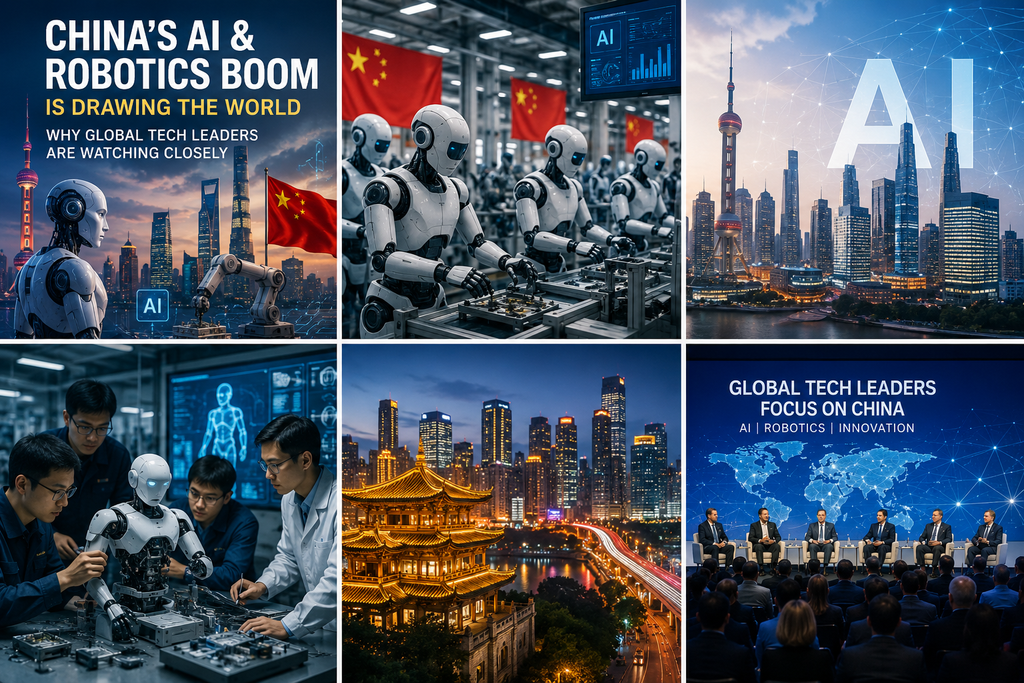
In the sprawling industrial corridors of Shenzhen, Hangzhou, Beijing, Shanghai and Hefei, a new kind of pilgrimage is underway. Foreign executives, investors, policymakers and engineers are arriving in growing numbers to walk the floors of highly automated electric-vehicle plants, watch humanoid robots perform tasks once limited to research labs, and study the rapid deployment of artificial intelligence systems across factories and supply chains. What was once occasional corporate fact-finding has evolved into a sustained wave of technology tourism, reflecting a broader recognition that China’s advances in AI, robotics, advanced manufacturing and new-energy vehicles are reshaping global competitive dynamics.
As of early September 2026, the phenomenon has become impossible to ignore. Humanoid robots operating on factory floors, large language models and embodied AI systems challenging international benchmarks, and electric-vehicle plants producing cars at remarkable speed and scale are drawing visitors who pay substantial sums for access that was once tightly controlled. Industrial tourism in China generated approximately $17.8 billion in the previous year and is projected to exceed 300 billion yuan, or roughly $44.6 billion, by 2029. Tour operators report sharp increases in demand, particularly from European and Singaporean clients, with some agencies now running more than 100 single-day company visits each month. The circuit typically covers the country’s key innovation hubs, where the electric-vehicle, battery, AI and robotics industries concentrate.
Xiaomi’s Beijing electric-vehicle factory has become one of the most visible symbols of this interest. Since opening structured public and professional tours in 2024, the facility has welcomed more than 250,000 visitors. Demand is so intense that lottery-allocated slots are resold online for hundreds of dollars. Visitors describe lines of robots performing casting, stamping, welding and assembly with minimal human intervention, achieving automation rates above 90 per cent on key processes and producing a vehicle roughly every 76 seconds. Similar interest surrounds Nio’s Hefei operations and other new-energy vehicle plants. World leaders have joined the flow: Germany’s Chancellor Friedrich Merz was filmed watching Unitree’s humanoid robots dance and perform martial arts in Hangzhou, an image that circulated widely as a marker of China’s technological visibility.
Shenzhen, preparing to host the Asia-Pacific Economic Cooperation forum later in 2026, has seen foreign visitor numbers rise sharply—up 70 per cent in the prior year and more than 30 per cent in the first quarter of 2026, with millions of entries recorded through August. The city’s dense ecosystem of hardware innovators, robotics startups and electronics manufacturers makes it a natural focal point. Across these sites, the common thread is not merely spectacle but the physical reality of scale, speed and integration that digital reports cannot fully convey. As one participant in a multi-city robotics and emerging-tech tour put it, grasping the true dimensions of Chinese innovation requires standing on the factory floor.
The Scale of China’s Robotics Ascent
China’s position in industrial robotics is already dominant by conventional metrics. In 2024, the country installed 295,000 industrial robots—more than half the global total—and its operational stock surpassed two million units. Robot density reached approximately 470 units per 10,000 manufacturing workers, overtaking levels in Germany and Japan. Domestic brands captured a majority of the home market for the first time. Revenue from major robotics companies continued to climb into 2026, with reports of double-digit growth in the first half of the year. The broader robotics market, valued around $47 billion in 2024, is forecast by analysts to more than double by 2028.
The newer frontier—humanoid and embodied robots—has accelerated even more dramatically. Chinese manufacturers accounted for the overwhelming majority of global humanoid robot shipments in 2025 and the first half of 2026, with estimates ranging from 86 per cent to 97 per cent depending on the research firm. Leading players including AgiBot, Unitree, Galbot, UBTech and Leju have shipped tens of thousands of units. Unitree’s initial public offering on the Shanghai STAR Market was heavily oversubscribed and produced a dramatic share-price surge, underscoring investor enthusiasm. In the first quarter of 2026 alone, the domestic embodied-AI sector recorded more than 50 financing deals worth around 20 billion yuan. More than 100,000 new companies registered in the humanoid robotics space in the first half of the year, according to state media.
These machines are moving beyond demonstration. Humanoids are appearing in logistics, manufacturing training centres, inspection roles and limited commercial service settings. At the 2026 World Robot Conference in Beijing, exhibitors showcased robots capable of autonomous navigation, collaborative assembly, tennis-playing and high-speed running. Industrial collaborative robots achieving micron-level precision and service robots for elderly care, education and public spaces were equally prominent. Policy support has been decisive. Embodied intelligence features prominently in the 15th Five-Year Plan (2026–2030). National standards covering the full lifecycle of humanoid robots have been issued. Local governments in Shenzhen, Beijing, Shanghai and Guangdong have launched dedicated funds, training centres and industrial zones. A whole-of-nation approach—combining central directives, provincial competition, subsidies, land grants and procurement—has compressed development timelines.
Yet challenges remain. Many humanoids still operate at roughly half the efficiency of human workers in complex factory tasks. Commercialisation lags the pace of hardware production, raising concerns about potential overcapacity or a bubble. Dependence on advanced chips, high-precision components and software ecosystems—some still linked to foreign suppliers—persists even as localisation accelerates. Analysts note that while China leads in volume and cost, the most sophisticated AI “brains” for general-purpose robots remain an area of intense global competition.
Artificial Intelligence as the Enabling Layer
Robotics advances rest on concurrent progress in artificial intelligence. China’s core AI industry surpassed 1.2 trillion yuan (approximately $177 billion) in value in 2025, with more than 6,200 AI enterprises operating nationwide. Enterprise AI spending is rising rapidly as applications move from pilot projects to large-scale deployment. Embodied intelligence—AI systems that perceive and act in the physical world—is forecast to grow at a compound annual rate exceeding 90 per cent over the next several years, expanding from a relatively small base into a multi-tens-of-billions market. Open-source large language models originating in China rank among the most downloaded globally, and domestic AI accelerator shipments have risen substantially, reducing reliance on restricted foreign chips in certain segments.
The integration of AI with manufacturing and mobility is particularly visible. Smart factories employ vision systems, predictive maintenance algorithms and multi-agent coordination. Intelligent connected vehicles incorporate advanced driver-assistance and autonomous features developed and tested at scale on Chinese roads. The “AI Plus” initiative pushes artificial intelligence into batteries, drones, agriculture and logistics, treating it as a general-purpose capability rather than a standalone product category. International visitors to AI briefing centres and research facilities report sharp increases in attendance, reflecting demand for firsthand observation of both software capabilities and their physical embodiment.
Policy frameworks emphasise standards, ethics governance and international cooperation. China has proposed structures for global AI dialogue and released action plans on ethics, seeking influence over the emerging rules of the technology. At the same time, domestic priorities focus on vertical applications that deliver measurable productivity gains inside the country’s vast manufacturing base—an advantage of scale that few other economies can match.
Electric Vehicles and Advanced Manufacturing as the Foundation
The electric-vehicle industry provides the clearest demonstration of how policy, capital, supply-chain density and automation converge. China produces the majority of the world’s electric cars and an even larger share of the batteries that power them. Companies such as BYD, CATL, Nio, XPeng and Xiaomi have built highly automated plants that attract both commercial partners and curious observers. Automation rates in body shops and certain assembly lines approach or reach 100 per cent. Die-casting machines of unprecedented size collapse dozens of parts into single structural components. Battery and component suppliers operate at volumes that drive continuous cost reduction and process refinement.
Foreign automakers have responded by deepening their own footprints. Volkswagen has established major technology and testing centres in China with full product-development authority outside Germany for the first time. Other global brands are localising electronic architectures, shortening development cycles and exploring exports of China-developed models. The logic has shifted from “in China, for China” toward treating the country as a global innovation and manufacturing hub. Supply-chain resilience, cost competitiveness and the density of specialised suppliers—lidar, actuators, harmonic reducers, power electronics—create an environment difficult to replicate elsewhere.
Visitors repeatedly cite the same observations: the speed of iteration, the willingness to automate aggressively, the coordination between local governments and industry, and the sheer physical scale of production. Dark-factory concepts—facilities so automated that lighting becomes optional—are no longer purely theoretical. Logistics ports, electronics assembly lines and battery plants exhibit similar levels of robotic density. This manufacturing base supplies both the robots themselves and the environments in which they are trained and deployed, creating a reinforcing loop.
Why Global Tech Leaders Are Paying Attention
Several interlocking reasons explain the intensity of international scrutiny. First is the fear of falling behind. European executives in particular, confronting slower productivity growth and ageing industrial bases, view China’s integrated progress in AI, robotics and electrification as a competitive threat that must be understood firsthand. Learning tours allow companies to benchmark their own automation strategies, identify potential partners or suppliers, and assess the feasibility of similar deployments at home.
Second is commercial opportunity. Chinese robots and components are entering export markets. Industrial robot exports have grown sharply, and Chinese firms already supply significant shares of certain hardware categories. As humanoid and service robots mature, demand is expected in logistics, eldercare, hospitality and manufacturing outside China. Partnerships, joint ventures and technology licensing discussions accompany many factory visits.
Third is geopolitical and strategic calculation. Policymakers and national security analysts monitor the dual-use potential of advanced robotics and AI, the implications for labour markets and military applications, and the shifting balance of technological influence. High-profile visits by political leaders serve both signalling and information-gathering functions. The density of state support, the speed of standards-setting and the ability to mobilise capital at scale are studied as models—or as challenges—depending on the observer’s perspective.
Fourth is the soft-power dimension. Viral videos of dancing or athletic humanoids, combined with accessible factory tours, generate public curiosity that feeds further professional interest. Content creators, investors and engineers share experiences online, amplifying the cycle. China has actively encouraged industrial tourism as a national strategy, designating demonstration sites and easing access in selected sectors.
The convergence of these factors produces a self-reinforcing dynamic. Visible success attracts visitors; visitors produce reports, partnerships and investment; the resulting capital and knowledge further accelerate domestic progress. Companies that once treated China primarily as a low-cost manufacturing location now confront it as a source of process innovation and product leadership in critical emerging technologies.
Challenges, Risks and the Road Ahead
The boom is not without friction. Geopolitical tensions, particularly export controls on advanced semiconductors, constrain access to the highest-performance AI chips. Humanoid robots remain expensive relative to their current productivity and face reliability hurdles in unstructured environments. Overcapacity risks in both EVs and robotics have prompted official cautionary notes. Labour-market effects of rapid automation require careful management, even as demographic pressures create demand for robotic assistance.
International cooperation remains selective. While some foreign firms deepen R&D and manufacturing ties, others face restrictions or political pressure at home. Standards competition—China’s early moves to define humanoid-robot specifications versus parallel efforts elsewhere—will shape interoperability and market access. Ethical questions around data, safety and displacement cut across borders.
Nevertheless, the trajectory through the remainder of the decade appears set by the 15th Five-Year Plan’s emphasis on future industries: embodied intelligence, intelligent robotics, new energy storage, low-altitude economy and related domains. Provincial and municipal competition will continue to amplify central targets. Capital markets, having rewarded early movers such as Unitree, are likely to fund further rounds of capacity expansion and technological iteration. Global humanoid shipments are projected to rise from tens of thousands today toward hundreds of thousands and eventually millions as costs fall and capabilities improve. Industrial robot density will keep climbing. AI systems will embed more deeply into physical processes.
For global tech leaders, the practical implication is clear. Observation is no longer optional. Understanding China’s AI and robotics ecosystem requires more than reading white papers or watching demonstration videos. It demands presence on the factory floor, conversations with engineers and founders, and direct assessment of the speed at which ideas move from prototype to production. The technology tourism now underway is both symptom and accelerator of a larger realignment in the geography of innovation.
As humanoid robots continue their transition from viral performers to industrial tools, as electric-vehicle plants set new benchmarks for automation, and as AI models find ever more physical expression, the world’s attention will remain fixed on the cities and companies driving that change. China’s combination of manufacturing scale, policy coordination, capital intensity and application density has produced a momentum that competitors and partners alike cannot afford to ignore. The visitors arriving each week are not merely tourists. They are participants in an ongoing global recalibration of technological power—one measured not only in algorithms and patents but in the tangible, humming reality of robots, batteries and assembly lines operating at unprecedented pace.