

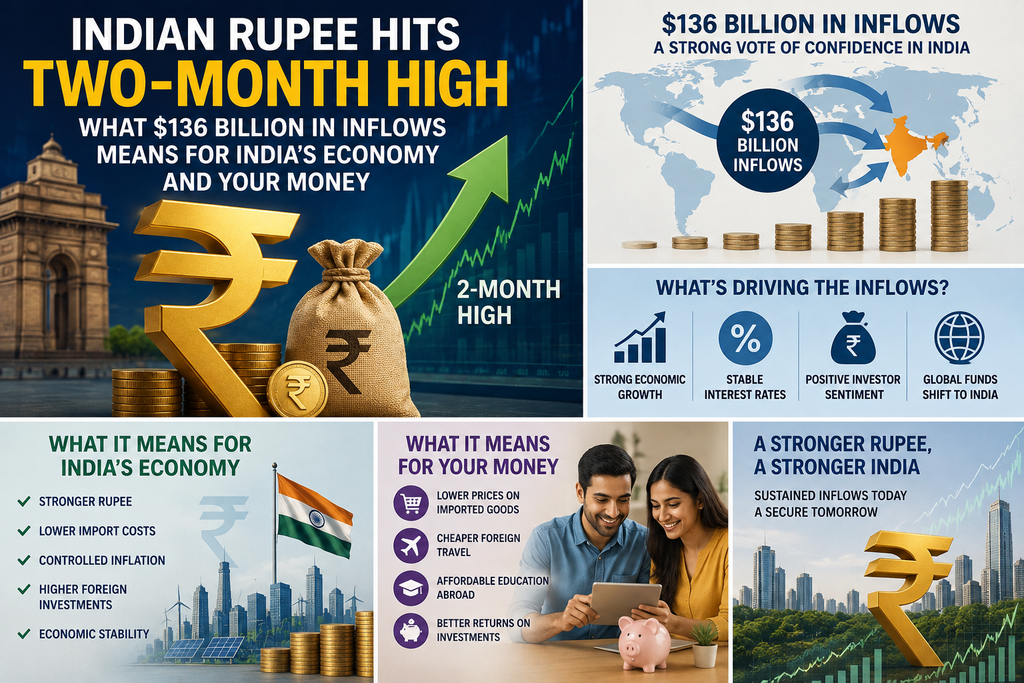
Mumbai/New Delhi, September 3, 2026 — The Indian rupee surged to a two-month high against the US dollar on Thursday, opening near 94.30 per dollar after settling around 94.95–94.97 in the previous session. The sharp move was powered by the Reserve Bank of India’s disclosure that special foreign-currency mobilisation schemes had attracted a far larger-than-expected $136.38 billion by the end of August. The overwhelming bulk — roughly $127.2 billion — came through Foreign Currency Non-Resident (Bank) or FCNR(B) deposits from non-resident Indians, with smaller contributions from external commercial borrowings and overseas foreign-currency borrowings by banks.
The scale of the inflows has swollen India’s foreign-exchange reserves, already at a record around $729 billion, and given the central bank greater firepower to manage currency volatility at a time of elevated global risks, including higher crude oil prices linked to tensions in West Asia and a broader sell-off in global bonds. Traders described the figure as a significant positive surprise; market expectations had clustered closer to $80–100 billion. The rupee’s gains this week have made it one of the stronger performers among Asian currencies.
This is not ordinary portfolio or direct investment. The RBI’s special dollar-rupee swap facility, launched in early June, allowed banks to mobilise foreign-currency deposits and borrowings under preferential terms and then swap the dollars with the central bank. In effect, the RBI has absorbed a large volume of dollars onto its balance sheet while providing rupee liquidity to the banking system. The arrangement strengthens external buffers but also creates future repayment and liquidity-management obligations.
Background: Why the Schemes Were Needed
The rupee had come under sustained pressure earlier in 2026. It touched record lows near 97 per dollar in May amid a spike in global crude prices following renewed conflict risks in West Asia, persistent foreign institutional investor (FII) selling, and broader risk-off sentiment. Foreign investors had sold significant volumes of Indian equities through 2025 and into early 2026, with some months marking among the heaviest outflows on record. Net FDI had also remained subdued in recent years even as gross inflows stayed healthy, reflecting higher repatriation and outward investment by Indian firms.
In response, the RBI introduced the special facilities covering FCNR(B) deposits, external commercial borrowings, and overseas foreign-currency borrowings. Banks were able to offer more attractive dollar interest rates to NRIs because the currency risk was effectively transferred via the swap. Deposit rates in some cases climbed to around 6–7 per cent in dollars — competitive against US savings rates near 4.8 per cent — and the deposits were tax-free in India for the depositors. The response exceeded almost all forecasts. The FCNR(B) window alone pulled in more than $127 billion before being closed ahead of its original end-September schedule. Additional schemes remain open until the end of December.
The episode has historical echoes. In 2013, during the “taper tantrum,” a similar FCNR(B) window had mobilised around $34 billion. This time the haul is roughly four times larger, reflecting both the deeper NRI savings pool and the more aggressive incentives on offer.
Immediate Market Reaction and RBI’s Stance
The announcement triggered an immediate positive reaction in the currency market. The rupee climbed more than 60 paise in early trade on September 3, hitting levels last seen in late June. Analysts noted that the RBI had already been intervening by selling dollars in recent sessions to support the currency; the large inflows amplify that capacity. India’s forward book — the stock of future dollar delivery obligations — has also risen sharply and now stands near all-time highs around $137 billion. While this means a portion of the newly mobilised dollars is effectively earmarked, the net addition to usable reserves remains substantial.
Currency traders and strategists at major banks have described the risk of a sharp further depreciation as significantly reduced in the near term. The combination of higher reserves, demonstrated willingness to intervene, and the sheer size of the dollar supply has shifted market psychology. At the same time, underlying dollar demand from oil importers and the eventual unwinding of swap-related flows remain factors to watch once the immediate settlement phase concludes.
What the Inflows Mean for India’s Economy
Stronger external buffers and resilience
The most direct benefit is an enhanced ability to withstand external shocks. India runs a structural current-account deficit driven largely by energy imports. Elevated oil prices raise the import bill and increase demand for dollars. A larger reserve stockpile gives the RBI more room to smooth volatility without allowing disorderly moves in the exchange rate. It also improves India’s credit metrics and reduces the probability of a sudden stop in capital flows. In an environment of geopolitical uncertainty and higher global yields, this buffer is valuable.
Liquidity and monetary policy implications
When banks swap dollars with the RBI, they receive rupees. This injects liquidity into the domestic banking system. Excess liquidity can put downward pressure on short-term interest rates and complicate the RBI’s liquidity management. The central bank has tools — reverse repos, open-market operations, and cash-reserve ratio adjustments — to absorb surplus funds if needed. Over time, the inflows could support credit growth, but they also raise questions about the durability of the funds. FCNR(B) deposits have fixed tenors; when they mature, the dollars will need to be repaid unless rolled over. The RBI has effectively taken on a large volume of future foreign-currency liabilities in exchange for present reserves.
Impact on the balance of payments and capital account
These inflows are recorded as capital inflows and improve the overall balance of payments. They are more stable than hot-money portfolio flows because they are deposits rather than equity or debt securities that can be sold instantly. However, they are not permanent equity capital. Unlike foreign direct investment that builds factories or creates long-term stakes, these are liabilities that must eventually be repaid with interest. The distinction matters for assessing the quality of India’s external financing.
Trade competitiveness and the exchange-rate channel
A stronger rupee makes imports cheaper in local-currency terms and exports more expensive. For an oil-importing economy, cheaper imports of crude, fertilisers, electronic components, and gold are a clear near-term positive for the trade balance and for inflation. Importers of capital goods and intermediate inputs also benefit. On the export side, sectors with high domestic value addition — certain IT services, pharmaceuticals with limited imported content, and some agricultural products — face a relative loss of price competitiveness. Sectors that are heavily import-dependent (electronics assembly, gems and jewellery, some engineering goods) see a mixed effect: higher rupee realisation on exports is partly offset by costlier imported inputs.
Empirical studies of India’s export elasticities suggest that exchange-rate movements do affect volumes, but the pass-through is incomplete and often delayed. Global demand conditions, trade policy (including tariffs in key markets), and non-price factors such as quality and supply-chain reliability frequently dominate pure currency effects. A moderate, orderly appreciation is unlikely to derail India’s export momentum if external demand remains supportive; a sharp or prolonged overvaluation would be more problematic.
Inflation and monetary policy space
Imported inflation is a perennial concern in India. A stronger rupee reduces the domestic-currency cost of oil and other commodities, helping contain fuel and transportation costs that feed into the broader price index. This provides the RBI with greater flexibility on interest rates. If inflation remains within the target band, the central bank can keep policy supportive of growth. Conversely, if global commodity prices rise sharply again, the stronger currency acts as a partial shock absorber.
Banking sector effects
Indian banks have gained substantial foreign-currency deposits. This expands their balance sheets and provides a stable funding source in dollars. However, it also increases their foreign-currency liabilities and requires careful asset-liability management. The swaps with the RBI mitigate immediate currency risk for the banks, but the system as a whole still faces maturity and rollover considerations. Higher deposit rates offered to attract the funds raise the cost of liabilities; banks will need to deploy the corresponding rupee funds productively to maintain margins.
What It Means for Ordinary Indians and Household Finances
Imported goods, travel, and education
A stronger rupee makes foreign travel, overseas education, and imported consumer goods relatively cheaper. Students paying tuition in dollars or euros will find the rupee cost lower than it would have been at weaker exchange rates. Families planning international holidays benefit similarly. Importers of smartphones, electronics, automobiles, and luxury goods can pass on some of the currency gain in the form of stable or lower prices, though domestic taxes, logistics, and brand pricing strategies also matter.
Fuel and everyday inflation
Because India imports the bulk of its crude oil, a stronger rupee reduces the landed cost of petroleum products. This can moderate petrol and diesel prices or limit the extent of increases when global oil prices rise. Lower fuel costs ease transportation expenses that feed into food and manufactured-goods prices. For households, the net effect is supportive of purchasing power, particularly for lower- and middle-income groups for whom fuel and food form a large share of the consumption basket.
Remittances
NRIs sending money home will convert fewer dollars into the same rupee amount when the rupee is stronger. In pure rupee terms, the purchasing power of a given dollar remittance declines. However, the same NRIs who placed large FCNR(B) deposits have locked in attractive dollar returns; the overall impact on the diaspora’s contribution to the Indian economy remains positive because of the scale of capital attracted.
Savers, borrowers, and financial markets
Domestic interest rates are influenced by liquidity conditions and the RBI’s policy stance. Excess liquidity from the inflows could keep short-term rates softer than they otherwise would be, benefiting borrowers. Equity markets may view the stronger external position and reduced currency risk as positives, supporting valuations. Bond markets will watch for any impact on the RBI’s liquidity operations and the trajectory of inflation. For retail investors, a more stable currency reduces one source of uncertainty in portfolio returns, especially for those with exposure to international assets or companies with significant import or export linkages.
Exporters and import-competing industries
Exporters in competitive global markets may feel margin pressure if they cannot raise dollar prices. Companies with large foreign-currency debt benefit from a stronger rupee because the rupee cost of servicing that debt declines. Import-competing domestic manufacturers gain from cheaper imported inputs but may face stiffer competition from finished goods imports if the rupee appreciates significantly.
Risks and Caveats
The $136 billion is not free money. It represents liabilities that will mature. If global interest rates remain high or risk appetite shifts, rollover of FCNR(B) deposits could become more expensive or less complete. The RBI’s expanded forward book means a portion of the reserves is already committed. Persistent FII outflows or a sharp rise in the current-account deficit could still test the currency. Geopolitical shocks that drive oil prices substantially higher would renew pressure regardless of the current buffer.
There is also a question of opportunity cost and intergenerational equity. By offering elevated dollar rates and absorbing the currency risk, the RBI and the banking system have transferred value to depositors. The long-term cost will depend on how productively the corresponding domestic liquidity is used and on the path of interest rates and the exchange rate over the life of the deposits.
Finally, a strong currency is not an unalloyed good for a developing economy seeking to expand manufacturing and exports. Policymakers have historically preferred a competitive real effective exchange rate that supports tradable sectors. Managing the appreciation so that it remains orderly and does not lead to lasting overvaluation will be an important task.
Broader Context and Outlook
India’s growth story remains intact. Domestic demand, public capital expenditure, and a gradual recovery in private investment continue to support activity. The external sector has been the more vulnerable flank. The successful mobilisation of $136 billion demonstrates that India retains the ability to attract stable foreign-currency funding when incentives are aligned, and the policy framework is credible. It also underscores the importance of the NRI community as a source of patient capital.
Looking ahead, markets will monitor several variables: the trajectory of crude oil prices, the pace of any residual FII flows, the RBI’s liquidity operations in the coming weeks, and the eventual maturity profile of the new deposits. Most analysts expect the rupee to remain better supported in the near term than it was in the spring. A return to the 95–96 range is possible once the immediate impact of the announcement and swap settlements fades, but the probability of a disorderly slide toward previous lows has diminished.
For households, the practical message is relatively straightforward. Imported inflation risks have eased, overseas spending has become less expensive in rupee terms, and the overall external stability of the economy has improved. For businesses, the environment is more nuanced: importers and those with foreign-currency liabilities gain, pure exporters face a modest headwind, and everyone benefits from reduced macroeconomic uncertainty.
The episode also highlights a larger truth about modern Indian economic management. In an interconnected world of volatile capital flows and commodity shocks, the ability to mobilise and warehouse foreign exchange on a large scale has become a central tool of macroeconomic stabilisation. The $136 billion inflow is both a technical success and a reminder that external resilience is continually earned rather than permanently secured. How effectively the additional buffers are used — to support growth, contain inflation, and maintain a competitive yet stable currency — will determine whether this episode is remembered as a temporary relief or as a durable strengthening of India’s external position.
In the end, a two-month high for the rupee is welcome news. The $136 billion that helped produce it is even more significant. Together they offer breathing room at a moment when global conditions remain unsettled. For the Indian economy and for the finances of ordinary citizens, that breathing room is valuable.