
September 3, 2026
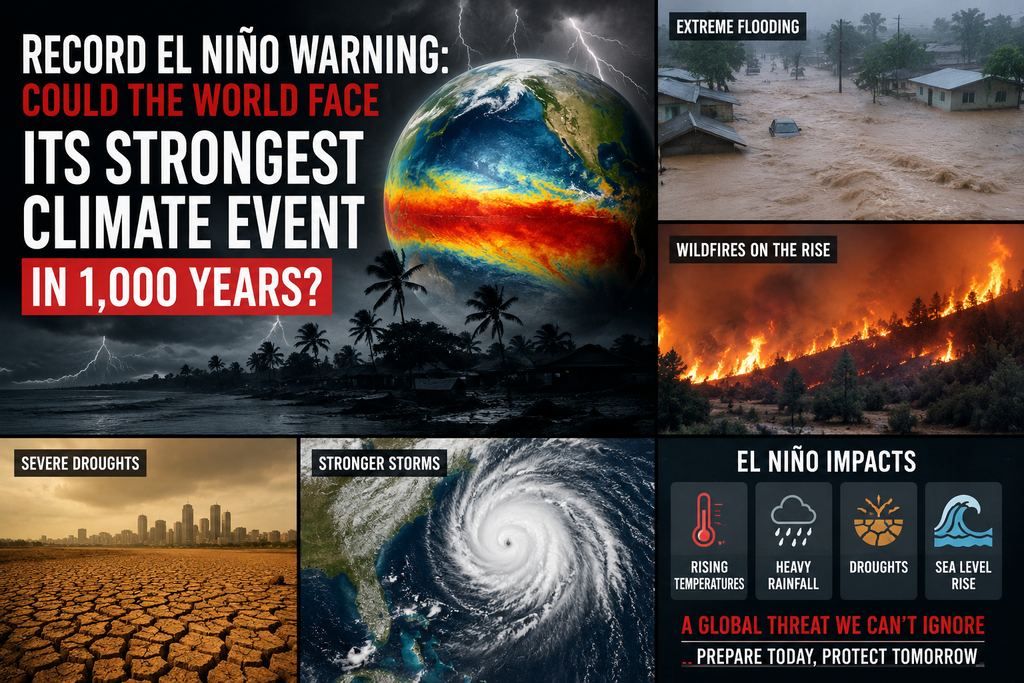
A powerful climate force is gathering strength over the tropical Pacific. What began as a rapid transition from La Niña earlier this year has evolved into what scientists are increasingly describing as a potential “super” or even “Godzilla” El Niño — an event that models suggest could rank as the strongest in the modern instrumental record and, according to emerging paleoclimate research, among the most intense in the past millennium.
As of early September 2026, sea surface temperatures in the key Niño 3.4 region of the central equatorial Pacific are running approximately +2.6°C above the 1991–2020 average, according to weekly data tracked by the U.S. National Oceanic and Atmospheric Administration (NOAA). The eastern Pacific is even warmer in places, with anomalies exceeding +3°C to +4°C near the South American coast. Official forecasts from NOAA’s Climate Prediction Centre place the odds of a “very strong” event (peak of at least +2.0°C) at greater than 90 per cent for the Northern Hemisphere fall and winter of 2026–27.
Multi-model ensembles paint an even more dramatic picture. Analyses of hundreds of ensemble members from systems including the North American Multi-Model Ensemble, European models, and others show a multi-model median peak near +3.6°C in the Niño 3.4 region (detrended). That would smash the previous observational high of about +2.75°C set during the 2015–16 event by roughly 0.8°C — a margin larger than the gap separating the strongest and fifth-strongest events of the past 150 years. Roughly 90 per cent of model runs project a record-setting peak.
The rapidity of development has stunned forecasters. After a relatively quiet early 2026, conditions flipped from La Niña to El Niño by April–June, with the ocean–atmosphere system coupling tightly. Subsurface heat content — a massive reservoir of warm water hundreds of meters deep — has rivalled or exceeded that of the legendary 1982–83, 1997–98, and 2015–16 events. Westerly wind anomalies and a strongly negative Southern Oscillation Index confirm that the atmosphere is responding in classic El Niño fashion. The World Meteorological Organisation and multiple national agencies have issued alerts urging preparedness.
A 1,000-Year Context
The claim that this could be among the strongest events in a millennium is not mere hyperbole. A major study published in Science in late August 2026, led by researchers including Julia Cole of the University of Michigan, used geochemical analysis of Galápagos coral skeletons to reconstruct eastern Pacific sea surface temperature variability over the past 1,000 years. The findings are stark: temperature variability since the mid-1980s has been approximately 36.5 per cent higher than during the pre-industrial period from 1000 to 1850 CE, and still about 16 per cent higher than the 1851–1982 interval. The intensification is driven primarily by stronger warm (El Niño) events, and the pattern parallels the rise in global temperatures since the Industrial Revolution.
“We don’t see a time in the past where El Niños have been as strong as today,” Cole noted in related commentary. The coral record shows that the extreme intensity of the past four decades has no clear parallel in the preceding millennium. Climate models struggle to fully reproduce this recent amplification through natural variability alone, pointing toward a human influence via greenhouse-gas warming. While the 2026–27 event is still unfolding and its final peak remains uncertain, the broader trend of stronger eastern Pacific El Niños adds weight to concerns that humanity is entering an era of more extreme climate oscillations.
Some meteorologists have gone further in public commentary, suggesting the current developing event could rank among the most extreme global climate disruptions since the invention of the printing press, with only major volcanic winters as potential rivals in impact. Official agencies remain more measured, but the combination of record model guidance and the paleoclimate context has elevated the 2026–27 El Niño into a category of genuine historical significance.
Global Temperature and Extreme Weather Implications
El Niño does not create new weather; it tilts the odds. By releasing vast quantities of heat from the tropical Pacific into the atmosphere and rearranging atmospheric circulation (notably weakening the Walker Circulation), a strong event typically elevates global average temperatures. The lag means that while 2026 is already on track for extreme warmth — with rising odds of becoming a record or near-record year — 2027 is widely expected to feel the full thermal punch. Some analyses suggest a substantial chance that one or both years will temporarily push global temperatures more than 1.5°C above pre-industrial levels.
Regional impacts follow well-established patterns, though intensity and exact location vary. Drought risk rises sharply across parts of Australia, Indonesia, the Philippines, Central America, northern South America, and southern Africa. Flooding and heavy rainfall become more likely along the west coast of South America (Peru and Ecuador), parts of the southern United States, and East Africa. Heatwaves intensify in many regions, including South Asia, the Middle East, and parts of North America and Europe. Tropical cyclone activity shifts: the Atlantic hurricane season often sees reduced activity due to increased wind shear, while the eastern Pacific can become more active.
The human and economic stakes are enormous. Past strong El Niños have been linked to trillions of dollars in cumulative global income losses. One analysis of the 1982–83 and 1997–98 events estimated multi-trillion-dollar impacts over subsequent years through disrupted agriculture, infrastructure damage, and cascading effects. Early assessments for 2026–27 suggest potential contemporaneous losses in the hundreds of billions under a very strong scenario, with longer-term costs potentially far higher if extreme weather compounds existing vulnerabilities. Food security is a particular flashpoint: the World Food Programme has warned that a strong event could push tens of millions more people into acute hunger by amplifying droughts, floods, and heat stress in already food-insecure regions of Africa, Latin America, and Asia.
Coral reefs face bleaching risks on a scale not seen since 2015–16. Fisheries, especially in the eastern Pacific, can collapse as warm water displaces nutrient-rich upwelling. Wildfire seasons lengthen in drought-prone areas. The interaction with ongoing human-caused warming means extremes are arriving on a hotter baseline, raising the potential for compound disasters.
India’s Monsoon Under Pressure
For India, the stakes are immediate and existential. The southwest monsoon, which delivers 70–90 per cent of the country’s annual rainfall between June and September and sustains the livelihoods of hundreds of millions, has a well-documented (if imperfect) inverse relationship with El Niño. Historically, a majority of moderate-to-strong El Niño years have brought below-normal or deficient monsoon rainfall. The India Meteorological Department has already forecast the 2026 season at around 90 per cent of the long-period average — a below-normal outlook, with elevated probabilities of deficiency in the monsoon core zone that covers much of the country’s rain-fed farmland.
Early-season deficits in northwest and central India raised alarms. Reservoir levels, groundwater, and soil moisture face pressure heading into the critical grain-filling stages for kharif crops — rice, maize, soybean, pulses, and cotton. A weak or poorly distributed monsoon does not merely reduce yields; it cascades through rural incomes, demand for non-farm goods, and the broader economy. India’s buffer stocks of rice and wheat provide an important cushion against outright shortages, but vegetable, pulse, and oilseed prices are far more volatile. Heat stress compounds the problem: El Niño years often feature elevated temperatures that further stress crops and livestock.
Historical precedent is mixed but cautionary. The 2015–16 super El Niño coincided with consecutive deficient monsoons and contributed to food-price pressures. The 1997–98 event, by contrast, produced near-normal rainfall in India despite its extreme Pacific strength, illustrating that Indian Ocean conditions (including the Indian Ocean Dipole) and sub-seasonal variability can modulate the outcome. Still, the combination of a potentially record El Niño, already elevated fertiliser costs in some markets, and a warming climate raises the risk of another bout of elevated food inflation. Analysts have flagged possible firming of consumer food inflation later in 2026 and into 2027, particularly for perishables such as tomatoes, onions, and potatoes, as well as pulses and edible oils.
Rural households, which depend heavily on monsoon performance for income and employment, stand to be hit hardest. Migration pressures can increase. Power demand for irrigation and cooling rises even as hydropower generation may suffer from lower reservoir inflows. The government has tools — open-market sales from buffer stocks, import facilitation, and targeted support — but the scale of a severe monsoon shortfall would test them.
Food Prices, Heatwaves, Floods, and Droughts: A Global Cascade
Beyond India, the food-price channel is global. Rice production in South and Southeast Asia is vulnerable; India is the world’s largest rice exporter in normal years, and any significant cut in output or export restrictions (as seen in previous stress periods) can send international prices higher. Palm oil, sugar, coffee, and cocoa also face regional risks. Southern Africa, still recovering from recent droughts, faces another potentially dry rainy season. Central America and parts of East Africa confront similar threats to rain-fed agriculture.
Simultaneously, the heatwave threat is acute. El Niño amplifies the odds of prolonged extreme heat across large swaths of the tropics and subtropics. Cities in South Asia, the Middle East, and Africa already struggle with deadly heat; an intensified event raises mortality and morbidity risks, strains power grids, and reduces labour productivity. Floods, while less widespread under classic El Niño patterns than under La Niña in some regions, can still devastate coastal Peru and Ecuador, parts of East Africa, and sections of the southern United States. Infrastructure damage, displacement, and disease outbreaks (cholera, dengue) often follow.
Droughts tend to linger after the peak of the event. Agricultural drought can persist into 2027 even as Pacific temperatures begin to cool, prolonging pressure on water resources, pastures, and food production. The Amazon and parts of Indonesia face heightened fire risk under drier conditions.
Economic analyses underscore the uneven nature of the shock. Commodity prices for some crops may rise sharply while others decline depending on regional rainfall. Inflationary pressure is most pronounced for food, with secondary effects on transport and energy if extreme weather disrupts supply chains. Developing countries with high food-import dependence and limited fiscal space are most exposed. Humanitarian agencies are already calling for pre-positioning of aid and strengthened early-warning systems.
Preparation and the Longer View
Governments, farmers, and businesses have months to act. Improved seasonal forecasts allow targeted water management, adjusted planting decisions, and strategic grain releases. International coordination on food trade can prevent panic-driven export bans that amplify price spikes. Investment in resilient agriculture — drought-tolerant varieties, improved irrigation, index-based insurance — reduces long-term vulnerability, though such measures take years to scale.
Scientists stress that while El Niño is a natural oscillation, its recent intensification and the hotter baseline on which it operates are influenced by human-caused climate change. The 2026–27 event is therefore both a test of short-term preparedness and a preview of a future in which extreme phases of the El Niño–Southern Oscillation may become more disruptive.
As the Pacific continues to warm and the atmosphere responds, the world is watching closely. Whether this El Niño ultimately sets an all-time instrumental record or merely ranks among the top few, its potential to reshape weather, food systems, and economies for the next 18–24 months is already clear. For a planet already contending with record heat and strained resources, the message from the tropical Pacific is unambiguous: prepare for extremes.
The coming months will reveal the precise intensity of this event. What is no longer in doubt is that the climate system is delivering a powerful reminder of its capacity for rapid, far-reaching change — and of the urgent need to build resilience in the face of it.