

Breaking Geopolitics Report | September 2026
In the early hours of a tense September week, the waters of the Strait of Hormuz once again became the epicentre of a conflict that has already rewritten the global energy map. United States forces launched fresh airstrikes on Islamic Revolutionary Guard Corps (IRGC) targets along Iran’s southern coast and islands near the narrow waterway, while Tehran responded with missiles and drones aimed at American positions in Jordan, Bahrain, Kuwait, and Iraq. The exchange marked the most significant direct military confrontation between Washington and Tehran since July, shattering a fragile month-long lull and reigniting fears that the six-to-seven-month-old war could spiral into broader regional instability.
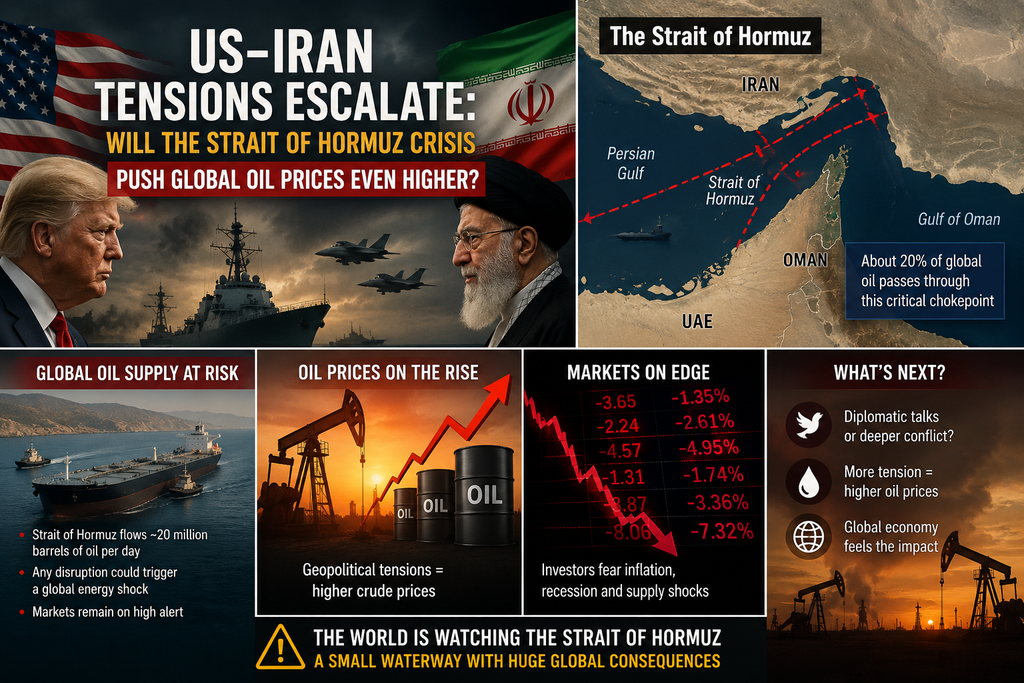
At the heart of the renewed fighting lies the Strait of Hormuz, the 21-mile-wide chokepoint through which roughly one-fifth of the world’s seaborne oil and significant volumes of liquefied natural gas once flowed daily. Before the conflict erupted in late February 2026 following coordinated U.S. and Israeli strikes on Iranian targets, more than 20 million barrels of oil per day typically transited the strait. Today, that figure remains deeply disrupted. Shipping traffic has fluctuated wildly—recovering partially after a June memorandum of understanding (MOU) only to collapse again amid repeated attacks on commercial vessels, mine-laying threats, and competing claims over shipping lanes.
President Donald Trump has framed the latest U.S. actions as limited and defensive, aimed at preventing Iran from reasserting control over the waterway and targeting commercial shipping. “We’re going to hit them hard,” he stated, while insisting the campaign would not drag on indefinitely and that the United States already held a decisive position. Iranian officials, for their part, have accused Washington of violating earlier understandings and warned that continued strikes would only “tighten the lock” on the strait. The IRGC has claimed responsibility for strikes on vessels using routes outside those it designates, and civilian casualties—including reports of deaths at a wedding gathering—have added a grim human dimension to the military calculus.
The June 17 MOU between Trump and Iranian President Masoud Pezeshkian had briefly raised hopes of de-escalation. It lifted a U.S. naval blockade on Iranian ports, committed Iran to safe passage of commercial vessels without charges for 60 days, and opened a window for further negotiations involving Oman and other Gulf states on the long-term administration of the strait. For a short period, traffic rebounded from near-standstill levels. Yet the arrangement proved fragile. Iran continued efforts to route ships through its territorial waters and enforce compliance, while the United States responded to attacks on vessels and regional targets with retaliatory strikes. By early July, the MOU was effectively dead; by late August and early September, tit-for-tat attacks on radar sites, missile launchers, coastal facilities, and shipping had returned in force.
Analysts describe the current phase as a hybrid contest: low-intensity kinetic exchanges combined with an economic and maritime standoff. Iran views its geographic leverage over Hormuz as a core deterrent against regime-threatening operations. The United States and its partners seek to keep the waterway open to international commerce while degrading Iran’s ability to mine, drone-strike, or otherwise interdict traffic. The result is a volatile equilibrium in which oil continues to move—sometimes at two-thirds of pre-war volumes according to some estimates—but under elevated risk premiums, higher insurance costs, and the constant threat of sudden closure.
Oil Prices Under Pressure
The market has responded with predictable volatility. As of early September 2026, Brent crude has traded near $95 a barrel, with West Texas Intermediate (WTI) hovering around $90–$91. These levels represent a substantial premium over the roughly $70–$72 range that prevailed in February before the conflict began—an increase of roughly 30 per cent or more. Prices surged more than $4 a barrel on days of acute escalation, reaching five-week highs, before steadying somewhat on signals that the latest exchange might remain contained.
The “Hormuz premium” is now a permanent feature of price formation. Beyond the absolute level of crude, refined products such as diesel have often risen even faster, reflecting both feedstock costs and refining bottlenecks. Global inventories have been drawn down significantly over the past six months. Strategic petroleum reserves in major consuming nations have been tapped, while commercial stocks have absorbed successive waves of disruption. Saudi Arabia and the United Arab Emirates have maximised use of pipelines that bypass the strait—Saudi’s East-West pipeline to the Red Sea and the UAE’s Habshan-Fujairah line—yet these routes cannot fully replace the volumes that historically moved through Hormuz.
The International Energy Agency earlier characterised the initial closure as the largest supply disruption in the history of the modern oil market, with Middle Eastern output effectively constrained by more than 14 million barrels per day at the peak of the crisis. Even with partial recovery, the market remains tight. Demand destruction in some regions, inventory drawdowns, and increased U.S. exports provided a temporary buffer, preventing prices from remaining in the extreme triple-digit territory seen in the earliest weeks of fighting. Yet any sustained intensification—full re-closure of the strait, successful mining campaigns, or attacks that idle key Gulf export terminals—could quickly push Brent well above $100 again and potentially toward levels last seen in previous major supply shocks.
Market participants watch daily transit data closely. On some recent days, only a handful of commodity vessels have cleared the strait, far below the pre-war average of more than 100–130 ships. “Dark” shipping—vessels operating with Automatic Identification System transponders switched off—has risen, increasing collision and environmental risks. Insurance rates for war-risk coverage have soared, adding several dollars per barrel to the delivered cost of crude. Freight markets for very large crude carriers have reflected the same uncertainty, with owners reluctant to commit vessels without clear security guarantees.
Petrol, Diesel, and the Consumer Impact
The crude price surge has transmitted unevenly into retail fuel markets around the world. In many consuming nations, governments have used subsidies, tax adjustments, or strategic releases to cushion the blow to motorists and businesses. In others, pump prices have risen sharply, contributing to broader inflationary pressures.
Diesel, critical for freight, agriculture, and industry, has often borne a heavier burden than gasoline. Refining margins for middle distillates widened as feedstock costs climbed and some Gulf refining capacity faced operational or logistical constraints. Heating oil and jet fuel have followed similar trajectories. The cumulative effect has been a higher cost of living and doing business across energy-importing economies.
In the United States, gasoline prices have reflected both WTI movements and domestic refining dynamics, though the country’s position as a net exporter of petroleum products has provided a degree of insulation compared with Asia or Europe. European consumers have faced the dual impact of higher crude and elevated natural-gas prices, given the region’s reliance on Qatari LNG that also transits Hormuz. Asian markets, particularly those with limited domestic production, have felt the full force of both higher absolute prices and elevated freight and insurance costs.
Global Markets Feel the Ripple Effects
Equity, currency, and bond markets have priced in the geopolitical risk premium with varying degrees of intensity. Energy-exporting nations and companies have generally seen gains, while energy-intensive manufacturers, airlines, and transport firms have faced margin pressure. Emerging-market currencies dependent on oil imports have come under strain, while safe-haven assets such as gold have strengthened.
Broader macroeconomic effects are already visible. Higher energy costs feed into inflation readings, complicating central-bank efforts to normalise policy after earlier tightening cycles. Growth forecasts for 2026 and 2027 have been revised downward in several major economies, with the largest revisions in heavily import-dependent Asian and European nations. The International Monetary Fund and other institutions have repeatedly flagged the Hormuz disruption as a key downside risk to the global outlook.
Supply-chain disruptions extend beyond oil. Fertiliser prices, which depend on natural gas and phosphate logistics from the Gulf, have risen. Petrochemical feedstocks have become more expensive. Even non-energy commodities have felt secondary effects through higher transport costs and risk aversion among shippers.
Equity markets in the Gulf Cooperation Council states have shown mixed performance: higher oil revenues support fiscal positions, yet the physical threat to infrastructure and the broader security environment weigh on investor sentiment. In contrast, equity indices in major oil-importing economies have experienced periods of sharp volatility whenever headlines of tanker attacks or new U.S.–Iran exchanges dominate news cycles.
India’s Economy in the Crosshairs
Few major economies are as exposed to Hormuz risk as India. The country imports roughly 85–90 per cent of its crude oil requirements, with a substantial share historically originating in the Persian Gulf and therefore transiting the strait. More than half of India’s LNG and a large proportion of its LPG supplies also move through the same corridor.
During the acute phase of the crisis, India’s crude basket soared, at one point approaching or exceeding $150 a barrel in extreme moments before settling into a persistently elevated range. The additional cost of fossil-fuel imports between March and August 2026 has been estimated in the tens of billions of dollars. One analysis put the gross additional import bill at approximately $22 billion, with a net economic cost equivalent to a meaningful fraction of a percentage point of GDP.
Domestic fuel retailers initially absorbed part of the shock by holding retail petrol and diesel prices steady for an extended period, drawing on earlier accumulated margins and government support. Eventually, however, successive revisions became unavoidable. Petrol in major cities crossed psychological thresholds, and diesel prices rose in tandem, raising costs for trucking, agriculture, and industry. Wholesale price inflation spiked, driven heavily by the fuel and power component, even as consumer price inflation remained more contained due to policy buffers and base effects.
India responded with a multi-pronged strategy. Refiners diversified crude sourcing toward Russia (already a major supplier under discounted arrangements), the United States, Latin America, and Africa. Strategic petroleum reserves were drawn upon. Spot LNG purchases were rationalised, and domestic gas allocation was adjusted. Pipeline and port infrastructure that could handle non-Hormuz cargoes was maximised. These measures, combined with global demand destruction and inventory draws elsewhere, helped India avoid the most catastrophic scenarios projected in the earliest weeks of the conflict.
Nonetheless, the cumulative burden remains significant. Higher energy costs have contributed to upward pressure on the current-account deficit, weighed on the rupee at times of peak stress, and complicated the Reserve Bank of India’s inflation-management task. Corporate margins in energy-intensive sectors have been squeezed. Growth forecasts for the fiscal year have been tempered. Analysts continue to warn that a renewed full closure of the strait lasting several months would force further retail price increases, deeper inventory draws, and potentially more aggressive monetary or fiscal responses.
At the same time, the crisis has accelerated longer-term policy discussions in New Delhi about energy security: accelerating domestic exploration and production, expanding strategic reserves, investing in overseas upstream assets, promoting electric mobility and alternative fuels, and deepening partnerships with non-Gulf suppliers. The Hormuz shock has underscored that India’s growth trajectory remains vulnerable to distant maritime chokepoints.
Strait of Hormuz Shipping: A Waterway Under Siege
The physical reality of the strait itself tells the story most vividly. At its narrowest, the shipping lanes are only a few miles wide. Iran controls the northern shore and several islands; Oman the southern. For decades, the international community treated the waterway as an open artery of global commerce. The 2026 conflict shattered that assumption.
Iran has repeatedly declared the strait closed or subject to its control, demanding that vessels use designated routes and, at times, seeking to impose fees or inspections. The United States has insisted on freedom of navigation and has used naval presence, mine-clearance operations, and airstrikes against Iranian coastal and island assets to enforce that principle. Commercial operators have faced an impossible choice: risk transit under elevated threat levels, pay higher insurance and security costs, divert to longer and more expensive routes where possible, or simply wait at anchor.
Transit statistics illustrate the severity. Pre-war daily ship movements often exceeded 100–130. During the worst periods, the number fell to single digits. Even during partial recoveries, volumes of crude and products moving outbound remained well below historical norms. Attacks on specific tankers—Saudi, Qatari, and others—have served as stark reminders of the risks. Crew safety, environmental danger from potential spills, and the sheer uncertainty of schedules have kept many owners on the sidelines.
Alternative routes provide only partial relief. Saudi Arabia’s East-West pipeline can move several million barrels per day to Red Sea terminals. The UAE’s Fujairah pipeline offers another bypass. Yet these capacities are finite, and the Red Sea itself has faced its own security challenges from other regional actors. The net result is a structural reduction in the flexibility and volume of Gulf energy exports available to the world market.
Looking ahead, the central question remains whether the latest escalation will settle into another uneasy stalemate or escalate further. A sustained re-closure of the strait, successful mining of the main channels, or attacks that disable major export terminals would almost certainly drive oil prices significantly higher—potentially into triple digits on a sustained basis. Conversely, a durable de-escalation that restores predictable, high-volume transit could allow prices to ease toward the mid-80s or lower, provided global demand does not rebound aggressively.
For now, the market is pricing a persistent risk premium. Shipowners, refiners, importers, and governments are adjusting to a new normal in which the world’s most important energy chokepoint can no longer be taken for granted. India and other major Asian importers are accelerating diversification. Producers are maximising non-Hormuz outlets. And military planners on both sides continue to calibrate the next move in a contest whose economic consequences already stretch far beyond the waters of the Persian Gulf.
The Strait of Hormuz crisis is no longer a hypothetical scenario discussed in energy security seminars. It is the defining geopolitical and economic reality of 2026. Whether oil prices climb still higher will depend on decisions made in Washington, Tehran, and the waters between them in the days and weeks ahead. The world is watching—and paying the price.