

New Delhi, September 7, 2026 — A five-storey building operating as a boys’ paying guest (PG) accommodation known as “Hostel Daze” collapsed in the densely populated Satya Niketan neighbourhood of southwest Delhi on Sunday afternoon, September 6, leaving five people dead and several others injured or feared trapped under the rubble. The tragedy, which unfolded around 1:30 pm near Delhi University’s South Campus, has triggered a massive multi-agency rescue operation, an FIR against the alleged building owner, a magisterial inquiry ordered by the Chief Minister, and widespread questions about illegal constructions, unsafe student housing, and civic oversight in one of the capital’s major student hubs.
As of late Sunday night and into the early hours of Monday, the death toll stood at five, according to statements from the JPN Apex Trauma Centre at AIIMS. Ten patients were received at the centre: four were brought dead, one critically injured patient later succumbed, three remained admitted under treatment (one of whom underwent limb surgery), and one with minor injuries was discharged after observation. Reports indicated around 10 to 11 people had been rescued overall by evening, with estimates of those still trapped or missing ranging from 15-20 to as high as 40-50 according to local residents and early eyewitness accounts, though official confirmation of exact numbers remaining under the debris was not available as operations continued.
What Happened: The Sudden Collapse
The incident occurred in a congested bylane near Shiv Mandir in Satya Niketan, a resettlement colony that has transformed over the decades into a major hub for outstation students attending Delhi University’s South Campus colleges such as Atma Ram Sanatan Dharma (ARSD) College, Motilal Nehru College, and Sri Venkateswara College. The building, estimated to be 40 to 50 years old (some reports described it as around 30 years old in certain contexts), consisted of a basement and five upper floors. It was being used as a boys’ PG with a reported capacity of around 75 beds, housing students primarily from states including Bihar, Kerala, Haryana, Uttar Pradesh, and Rajasthan. Students typically paid around ₹12,000 to ₹13,000 per bed.
According to police and preliminary assessments, renovation or repair work was underway on the ground floor or in the basement at the time of the collapse. Delhi Chief Minister Rekha Gupta stated that preliminary information suggested excavation in the basement had caused a pillar to shift, leading to the entire structure coming down. Local residents pointed to water accumulation in the basement following recent rains, which may have further weakened an already compromised foundation. Eyewitnesses described a sudden tremor that felt like a small earthquake, followed by the building crumbling into a pile of concrete, slabs, and debris within moments. An adjacent building also reportedly suffered damage or partial collapse, prompting precautionary evacuations.
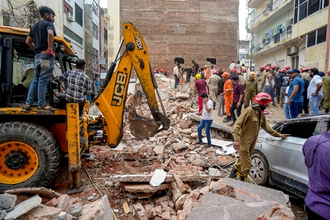
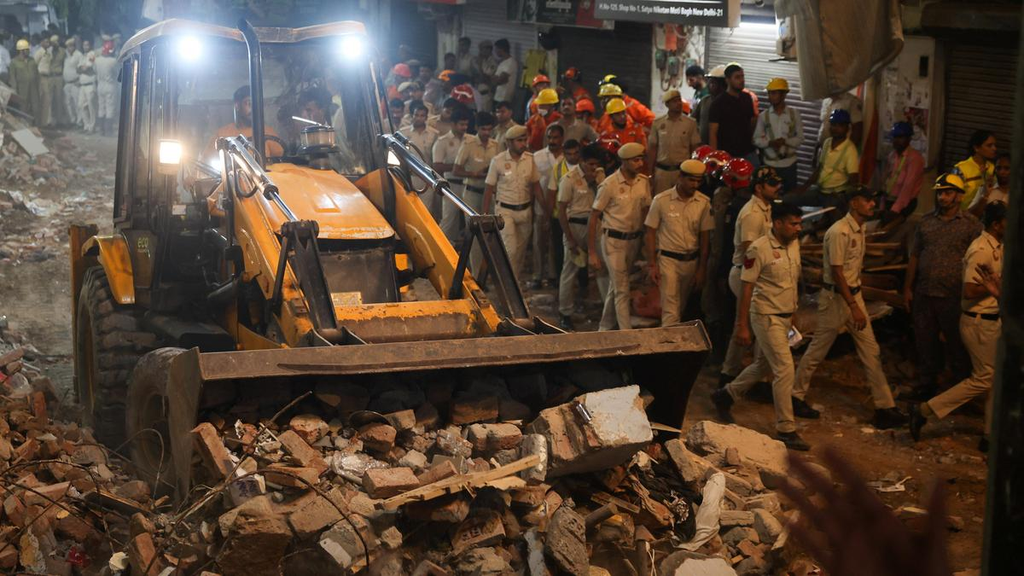
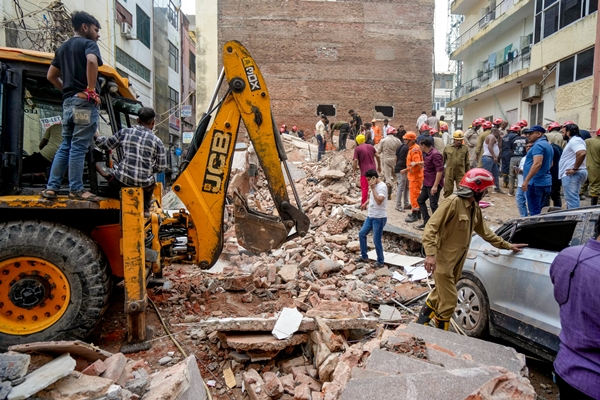
A PCR call was received at the South Campus police station at approximately 1:34 pm. Delhi Fire Service, National Disaster Response Force (NDRF), Delhi Police, Delhi Disaster Management Authority (DDMA), and other agencies rushed to the scene with fire tenders, JCB machines, and specialised equipment. Locals and students formed human chains and joined the initial frantic efforts to dig through the rubble with bare hands before professional teams took over. Screams and pleas for help were reported from under the debris in the immediate aftermath.
One particularly harrowing account involved a bloodied student named Aditya, a first-year BCom student from Bihar studying at ARSD College, who recorded a video from a pocket beneath the rubble while trapped. The video, circulating among students and reported by the media, showed him dust-covered and injured as he called for help. Other survivors and rescuers recounted cries of “Brother, save me” from those trapped.
Latest Death Toll and Condition of the Injured

The death toll climbed steadily through the day. Initial reports spoke of one or two dead and several rescued. By evening, it had risen to three, and later official hospital figures confirmed five fatalities. Among those identified in early reports were students and at least one labourer. Names circulating in media and among students included Yuvraj (a student brought dead) and others still being confirmed by families. Many of the victims were young students who were inside their rooms on a Sunday when classes were not held.
At AIIMS Trauma Centre, the three admitted patients were under treatment, with one having undergone surgery for limb injuries. Another patient with minor injuries was discharged. Additional injured individuals were reported at Safdarjung Hospital and other facilities. Union Health Minister J.P. Nadda spoke to the Chief Minister and directed AIIMS and central government hospitals to provide full medical support.
Families of students from distant states arrived or contacted authorities in desperation, with groups of Delhi University students gathering at AIIMS Trauma Centre holding photographs of missing friends, checking lists, and seeking information. Some colleges, including Sri Venkateswara and Motilal Nehru, opened their campuses overnight for students whose PGs were in the affected area or who felt unsafe returning to nearby accommodations.
Rescue Operation: A Race Against Time
Rescue operations were described as being conducted “on a war footing.” Teams from NDRF, Delhi Fire Service, Delhi Police, DDMA, Municipal Corporation of Delhi (MCD), CATS ambulances, and Civil Defence were deployed. Heavy machinery was used carefully to avoid further harming anyone still trapped. Officials reported receiving calls from people believed to be under the debris in the early stages, and teams maintained contact where possible.
Chief Minister Rekha Gupta visited the site in the evening, reviewed the operations from a nearby temple structure, and directed close coordination among agencies. She later visited AIIMS Trauma Centre to meet the injured. Lieutenant Governor, senior police officials, and the local MP were also involved in the response. Home Minister Amit Shah spoke to the Chief Minister, Police Commissioner, and NDMA officials, expressing distress and assuring support. Prime Minister Narendra Modi issued a statement expressing condolences and praying for the recovery of the injured.
An adjoining girls’ PG building was evacuated and sealed by the MCD as a precaution after it was found to be in a dilapidated condition. The exact number of people still unaccounted for remained unclear late into the night, with estimates varying widely between official caution and local claims of dozens potentially affected given the Sunday timing and the PG’s occupancy.
Survivors and Eyewitness Accounts
Survivors described chaos and terror. One student pulled from the debris spoke of the sudden shaking and the rapid collapse. Locals who rushed to help recounted pulling out injured individuals, some with bleeding injuries, and the overwhelming dust and screams. A resident who had lived in the area for decades noted the lack of proper maintenance over the years. Another pointed to ongoing construction despite visible tilting of the structure.
Students living in nearby PGs described the tremor felt in their own buildings and the subsequent panic. Many expressed long-standing fears about the safety of the densely packed, often poorly maintained PG accommodations that have proliferated in Satya Niketan to meet the demand from outstation students. The area, originally a resettlement colony with permissions typically limited to lower heights (G+1 in some descriptions), has seen extensive vertical expansion and conversion of residential spaces into commercial student housing, often without full adherence to building norms, fire NOCs, or structural safety standards.
Investigation and Accountability
Delhi Police registered FIR No. 153/26 at South Campus Police Station against the alleged owner identified as Hariram (also referred to in some reports in connection with Anand Bansal or related names in ownership details) and others under sections of the Bharatiya Nyaya Sanhita including 105 (culpable homicide not amounting to murder), 290 (negligent conduct regarding construction or repair of buildings), and 125(a) (act endangering life or personal safety). Multiple teams were formed to trace the accused. The owner was reportedly based in Gurugram.
Chief Minister Rekha Gupta ordered a magisterial inquiry and directed the FIR. She stated repeatedly that those responsible—whether the owner or any officials—would not be spared and would be held fully accountable under the strictest provisions of law. Preliminary focus centred on the renovation/excavation work that allegedly compromised structural pillars in the old building. MCD officials indicated the structure may have violated height limits, and the broader issue of unauthorised constructions in the area came under scrutiny.
This is not the first such incident in Delhi or even in Satya Niketan and surrounding areas. Building collapses linked to illegal additions, weak foundations, and inadequate maintenance have claimed lives in previous years, including a notable incident near Saket earlier in 2026. Experts and planners have long highlighted the risks of unengineered vertical expansion in older colonies and the pressures of student housing demand that incentivise packing more beds into unsafe structures.
Broader Context: Student Housing Crisis and Civic Challenges
Satya Niketan and similar neighbourhoods near DU campuses have become synonymous with the student housing crunch. With limited official hostel seats in many colleges, thousands of outstation students rely on private PGs. High demand allows operators to charge premium rates while often providing cramped conditions with minimal oversight. Residents and student activists have pointed to waterlogging, seepage, lack of regular MCD inspections, and the conversion of older low-rise homes into multi-storey PGs without corresponding structural upgrades.
The collapse has renewed calls for comprehensive safety audits of PG accommodations, stricter enforcement against unauthorised construction, and better regulation of the private student housing sector. Opposition voices and student groups demanded accountability from civic authorities and a systemic review of how such high-risk buildings continue to operate. Colleges responded in the immediate term by offering temporary shelter, but longer-term questions about safe, affordable housing for students remain unresolved.
Ongoing Situation and Next Steps
As of the latest available information early on September 7, rescue teams continued working through the night under lights, carefully removing debris in the hope of finding more survivors. Families waited anxiously for news. Hospitals treated the injured. Police pursued the accused. The magisterial inquiry and technical assessments of the cause were expected to provide clearer answers on structural failure, the role of the renovation work, and any negligence by owners or officials.
The tragedy has left a community of students and residents in shock. Backpacks, notebooks, and personal belongings scattered in the rubble served as poignant reminders of the young lives disrupted or lost in a matter of moments. Authorities have vowed thorough action, but for the families of the deceased and the injured recovering in hospital beds, the immediate focus remains on recovery, identification, and support.
Further updates on the death toll, additional rescues, and investigation findings were expected as operations progressed and official statements emerged. The incident underscores the persistent challenges of urban safety, housing pressures, and regulatory enforcement in India’s capital, particularly in areas catering to the large floating population of university students.
This report is based on official statements from Delhi Police, AIIMS Trauma Centre, the Chief Minister’s Office, and contemporaneous media reporting from the scene as of September 6-7, 2026. Details such as exact numbers of those still trapped and full identification of all victims were subject to ongoing verification during active rescue efforts.