
WASHINGTON — As the United States enters a pivotal stretch less than seven weeks before the November 3, 2026, midterm elections, voter registration activity has intensified across the country this week. National Voter Registration Day observances, community drives, online campaigns, and partisan mobilisation efforts have combined to push hundreds of thousands of eligible citizens onto the rolls or update existing records. Election officials, nonprofits, political parties, and civic groups are emphasising a simple message: check your status now, and if you are not registered, do so before state deadlines close.
With roughly 204.6 million Americans registered to vote according to state election office data compiled earlier in 2026, the electorate remains large by historical standards. California leads with about 23.1 million registered voters, followed by Texas at 17.4 million and Florida at 13.4 million. Registration rates vary widely by state, with Minnesota among the highest at roughly 83.6 per cent of the eligible population and some other states lagging notably lower. North Dakota remains the sole state without a traditional registration requirement; residents there vote by presenting identification and proof of residency.
This week’s focus has been sharpened by National Voter Registration Day activities. One coordinated nonpartisan effort involving more than 4,000 community partners — libraries, colleges, local election offices, veteran groups, and national organisations — reported an estimated 400,000 first-time registrations or updates, more than triple previous off-year records. Events have included campus drives, library tables, church gatherings, grocery-store outreach, and digital campaigns on major platforms. Party organisations have also been active. Democratic groups highlighted efforts aimed at younger voters, college campuses, and community meetings, framing registration as a continuation of earlier investments. In competitive states such as Nevada, where the party registration gap has narrowed to a few hundred voters among more than two million active registrants, local officials have used the moment to urge residents to confirm addresses and party affiliations.
Federal and state election calendars leave limited time. Under the National Voter Registration Act, states generally cannot set federal-election registration deadlines earlier than 30 days before Election Day. In practice, the earliest common cutoffs fall around October 4–5, 2026, for several states. Many others set deadlines in mid-to-late October, while roughly two dozen states and the District of Columbia permit same-day registration on Election Day itself or during early voting. Online registration, available in about 42 states plus the District of Columbia as of early 2026, typically follows similar timelines. Mail registration often requires postmark or receipt by a specific date; election officials advise mailing well in advance because postal delivery is not guaranteed on the postmark day.
How to Register to Vote
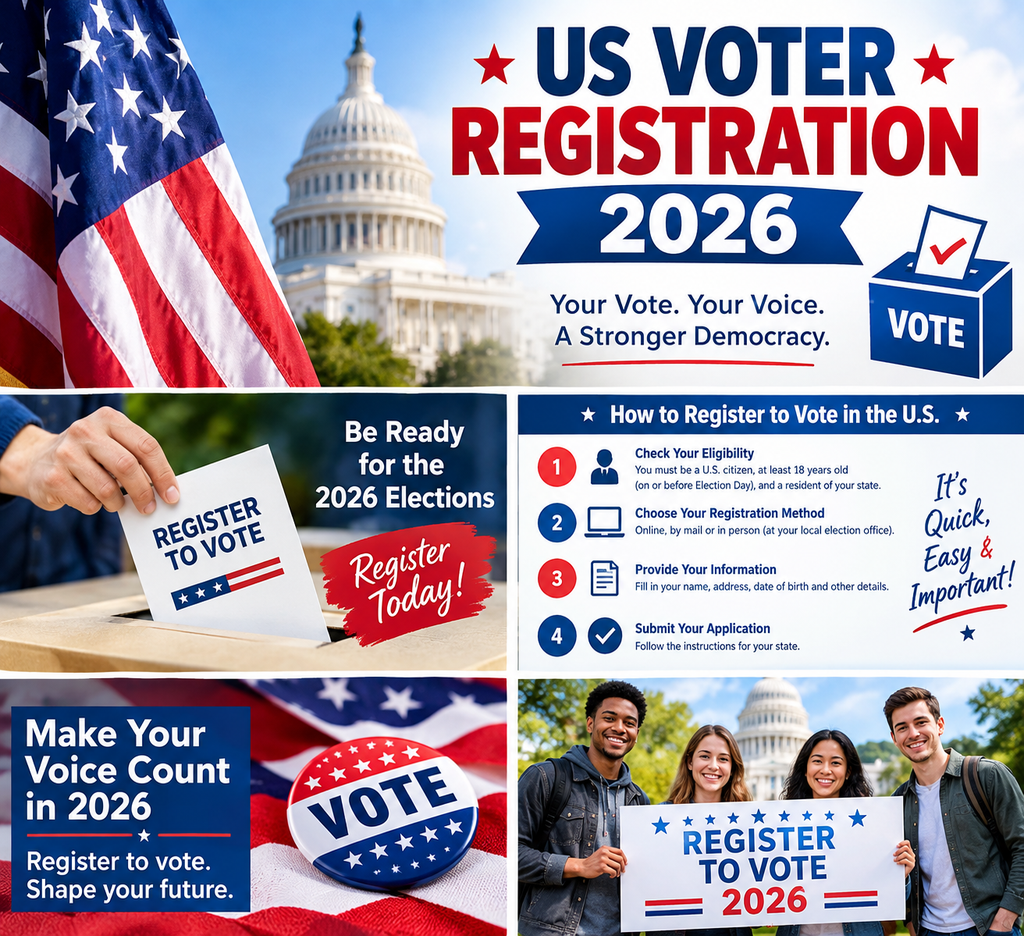
The process is administered by the states, but the federal government provides a clear starting point. The official portal is vote.gov. Visitors select their state or territory and are directed to the appropriate online system, mail instructions, or in-person options. The site also allows users to check existing registration status, update name or address information, and, in many places, change party affiliation.
Eligibility is straightforward under federal baselines: a person must be a U.S. citizen, at least 18 years old by Election Day (many states allow 16- or 17-year-olds to pre-register), and a resident of the jurisdiction where they seek to vote. States may impose additional residency-duration requirements or rules concerning felony convictions and restoration of voting rights. Individuals adjudicated mentally incompetent by a court may face restrictions in some places. Homeless individuals are not required to have a traditional street address; states provide alternative methods for establishing residency.
Three primary methods exist in most jurisdictions:
Online registration. Available in the large majority of states, this is usually the fastest route. Applicants typically need a current driver’s license or state-issued identification number, and sometimes the last four digits of a Social Security number. The system often auto-fills or verifies information against motor-vehicle records. Once submitted, confirmation is usually emailed or mailed. Deadlines for online applications are frequently the same as or a few days earlier than mail deadlines.
Registration by mail. The National Mail Voter Registration Form, available from the U.S. Election Assistance Commission and through vote.gov, is accepted in nearly every state (exceptions include New Hampshire, North Dakota, Wisconsin, and Wyoming for the federal form). Applicants download the PDF, complete it according to the state-specific instructions that begin on page 3 of the form, sign it, and mail it to the address listed for their state or local election office. Postage must be affixed. Many states also accept their own state forms. Because mail deadlines are often postmark- or receipt-based, early submission is strongly recommended.
In-person registration. This can be completed at local election offices, many departments of motor vehicles (under the “motor-voter” provisions of the National Voter Registration Act), public-assistance agencies, and designated community sites. Some states allow registration at libraries, colleges, or naturalisation ceremonies. Same-day registration states permit eligible citizens to register and vote in one visit during early voting or on Election Day, usually upon presentation of proof of identity and residency.
Military and overseas citizens use the Federal Voting Assistance Program (FVAP.gov). They can register, request absentee ballots, and update information through specialised federal forms that states must accept. New citizens can often register at naturalisation ceremonies or immediately afterwards through state channels.
After registration, most states mail a voter registration card or confirmation. The card is useful for reference but is rarely required at the polls; identification rules vary by state. Voters who move within a state should update their address promptly; those who move to a new state must register there. Failure to vote in consecutive federal elections can result in an “inactive” status in some jurisdictions, though reactivation is usually simple upon contact or appearance at the polls.
Deadlines and Practical Considerations for 2026
Election Day is Tuesday, November 3, 2026. Until approximately October 4, every eligible citizen can still register by whatever method their state offers. After that date, options narrow. States with 30-day deadlines will close advance registration first. Others remain open longer. Same-day registration states continue to accept new voters through early voting and Election Day. Prospective voters should consult their state election website or vote.gov for exact dates, which can differ for online, mail, and in-person methods, and which sometimes distinguish between postmark and receipt.
Common pitfalls include outdated addresses after a move, name changes after marriage or court order, and party-affiliation rules that affect primary voting. Checking status online takes only a few minutes and can prevent problems later. Voters who believe they were incorrectly removed from the rolls have rights under the National Voter Registration Act and can contact their local election office or seek assistance from nonpartisan organisations.
Broader Context This Week
Beyond pure registration numbers, the week has featured parallel developments in election administration. The Justice Department has continued efforts related to statewide voter lists and citizenship verification, issuing preservation directives to numerous states concerning 2024 records and pursuing litigation over access to detailed registration data. Courts have dismissed or constrained several of these actions, and privacy and voting-rights groups have challenged the use of certain federal databases for list maintenance. Separately, some states and federal agencies have publicised investigations into potential noncitizen registrations, though documented instances of noncitizen voting remain rare relative to the size of the electorate. These disputes occur against the backdrop of the 90-day “quiet period” under the National Voter Registration Act that limits systematic list purges close to an election.
Political parties are treating registration as a core organising activity. With all 435 House seats, approximately one-third of the Senate, 36 governorships, and numerous state legislative seats on the ballot, both major parties and independent groups are investing in list-building and turnout infrastructure. College campuses, naturalisation centres, and high-mobility communities have been particular focuses.
For individual citizens, the practical steps remain accessible. Visit vote.gov, select your state, and follow the prompts. If online registration is unavailable or inconvenient, download the national mail form or visit a local election office or DMV. Confirm your information is current. Note your state’s deadline and, if necessary, plan for same-day registration. Once registered, voters can typically request absentee or mail ballots according to state rules, or vote early or in person on Election Day.
Election officials emphasise that registration is the foundational step of electoral participation. With midterms approaching and deadlines drawing nearer, this week’s heightened activity reflects both organised civic campaigns and the individual decisions of citizens determining whether and how they will take part in the democratic process on November 3. Those who have not yet registered still have time in most places — but that window is closing.
( Sources include state election data compilations, vote.gov, the U.S. Election Assistance Commission, Ballotpedia, National Conference of State Legislatures summaries, and contemporaneous reporting on National Voter Registration Day activities and federal election-administration developments as of mid-September 2026. Deadlines and procedures can change; always verify with official state election authorities.)