

Riyadh, September 19, 2026 — In the early hours of Saturday, Saudi Arabia’s capital experienced a rare and unsettling series of air-raid alerts. Residents across the city and nearby areas received urgent mobile notifications from the National Early Warning Platform warning of a “hostile aerial threat.” Explosions were heard in parts of the capital, smoke was later observed near King Khalid International Airport, and flight operations faced significant disruption. Saudi Civil Defence subsequently issued all-clear messages, stating the immediate danger had passed. The episode sharpened longstanding security concerns in the kingdom and underscored the deeper regional conflict that continues to reshape the Middle East. The first alerts were issued for Riyadh since the height of the US-Iran conflict earlier this year, and the first linked to the renewed escalation with Yemen’s Iran-backed Houthi movement since fighting intensified in July.
The first alert reached Riyadh residents shortly before 3 a.m. local time. Messages instructed people to remain indoors, stay away from windows and open areas, and follow official safety guidance. A Reuters journalist reported hearing two distinct booms in the Olaya district. AFP correspondents similarly noted explosions. A second alert followed at 5:19 a.m. for Riyadh and the city of Al-Kharj to the east. In both cases, Civil Defence declared the threat over within a short time—minutes after the first and more than ten minutes after the second. Similar warnings had also sounded overnight in other parts of the kingdom, including Jeddah, Yanbu, Taif, Khamis Mushait, AlUla, Farasan Islands, Jazan and Abha.
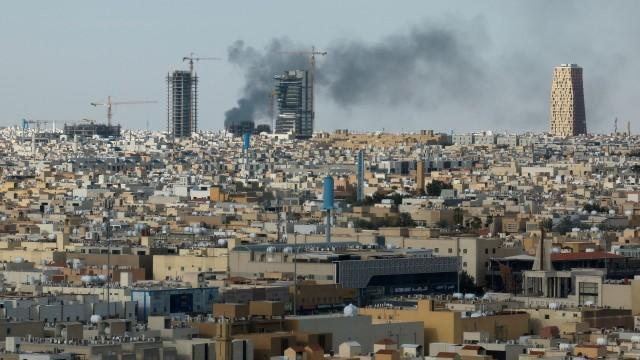
Later on Saturday, a large plume of black smoke was visible near the fuel storage area of King Khalid International Airport. Flight-tracking data from Flightradar24 placed the airport at the highest disruption level, signalling major delays and cancellations. Saudi authorities did not immediately provide detailed public confirmation of any strike, interception, or damage at the airport or elsewhere in the capital. No official casualty figures were released for the overnight events in Riyadh, and Civil Defence urged residents to avoid gathering in crowds or filming emergency operations.
The alerts marked a notable shift. While southern and western Saudi cities have faced repeated Houthi drone and missile attacks in recent weeks, the capital had largely been spared direct alerts tied to the Yemen front until Saturday. Previous capital warnings earlier in 2026 were associated with the broader US-Iran war. The appearance of the threat so close to the political and economic heart of the kingdom has unsettled residents and raised questions about the reach of Houthi capabilities and the effectiveness of Saudi air defences.
Context of the Escalation with the Houthis
The overnight alerts occurred against a backdrop of rapidly intensifying hostilities between Saudi Arabia and the Houthis. The Iran-aligned group, which controls the most populous parts of Yemen and large areas of the north, declared a maritime “embargo” or blockade against Saudi Arabia in July. Since then, it has targeted Saudi vessels in the Red Sea and conducted nearly daily strikes on Saudi territory, focusing especially on western towns and energy infrastructure.
In recent days, the Houthis have made significant territorial gains along Yemen’s Red Sea coast. They seized the strategic port city of Mokha and Perim (Mayyun) Island, a gateway controlling access to the Bab al-Mandab Strait—one of the world’s most critical shipping chokepoints. Claims of further seizures of islands in the area have also circulated. These advances give the group greater ability to pressure Saudi oil exports that had increasingly shifted to Red Sea routes after Iran effectively closed the Strait of Hormuz earlier in the US-Iran war. Maritime data indicated a drop in Saudi exports via Bab al-Mandab since July, although some loaded tankers continued to transit.
Houthi military spokesman Yahya Sarea has repeatedly framed the group’s actions as retaliation. He stated that the Houthis launched drones and missiles at Saudi targets in response to more than 450 Saudi airstrikes on Houthi-held territory over a recent period. On Friday, Sarea claimed the group had foiled unspecified “criminal attempts” in Sanaa that he attributed to Saudi Arabia and vowed a response. Saudi officials have not publicly detailed their own air campaign numbers but have acknowledged operations in support of the internationally recognised Yemeni government.
Civilian impact inside Saudi Arabia has been reported in earlier attacks. On Thursday, debris from an intercepted Houthi drone killed one person and injured others in Taif. Previous waves of strikes injured dozens, including women and children, in southern cities such as Abha, Khamis Mushait, Jizan and Najran, and caused temporary disruptions at energy facilities. The United Nations Security Council issued a statement on Friday condemning “in the strongest terms” continued Houthi attacks against Saudi Arabia that have impacted civilian and energy infrastructure and resulted in injuries. The Council warned that the escalation risks expanding the conflict, threatening maritime security and international trade, and undermining efforts toward peace in Yemen. It also stressed enforcement of the UN arms embargo on the Houthis.
Broader Security Pressures on Riyadh
Saudi Arabia faces simultaneous pressure on multiple fronts. Beyond the southern Yemen border, a drone attack last week that Saudi authorities said originated from Iraq forced the shutdown of the vital East-West oil pipeline. Iraq hosts several pro-Iran militias, and the incident added to concerns about coordinated or opportunistic strikes from different directions. Combined with the Hormuz closure and Red Sea disruptions, Saudi oil exports have faced severe constraints, contributing to higher global prices and complicating the kingdom’s fiscal position.
These developments present particular challenges for Crown Prince Mohammed bin Salman, the kingdom’s de facto ruler. Vision 2030, the ambitious program to diversify the economy away from oil dependence, attract foreign investment, and develop tourism and other sectors, relies on perceptions of stability and security. Repeated alerts, infrastructure attacks, and the psychological impact of threats reaching the capital risk deterring the very investors and visitors the plan seeks to attract. The upcoming Future Investment Initiative in Riyadh, scheduled for October, now takes place under heightened security scrutiny.
Saudi air defences have intercepted numerous incoming drones and missiles, including one near Mecca that authorities described as crossing a red line by approaching the holy city. The Houthis denied targeting Mecca and accused Riyadh of propaganda. Interceptions themselves can produce the booms and debris that residents experience, and it remains unclear whether the Saturday explosions in Riyadh resulted from successful intercepts, impacts, or other activity. Official silence on the precise nature of the overnight threat has left room for speculation.
Regional Conflict Dynamics and the US-Iran Backdrop
The Saudi-Houthi confrontation cannot be separated from the wider Middle East war that has gripped the region for months. The US-Iran conflict, which escalated dramatically earlier in 2026, has closed or severely restricted key waterways, disrupted energy markets, and empowered proxies on multiple fronts. Iran’s support for the Houthis has long been a feature of the Yemen war; the current phase appears to leverage that relationship more aggressively as Tehran seeks leverage against US partners.
Saudi Arabia has sought to manage its exposure carefully, maintaining channels where possible while defending its territory and supporting its Yemeni allies. Requests for more robust US assistance against the Houthis have not produced the large-scale intervention some in Riyadh hoped for. US officials have engaged in diplomacy, including contacts involving the Houthis via Oman, while prioritising other aspects of the Iran confrontation. The limits of that partnership have become more visible as Saudi infrastructure, and now the capital itself, come under pressure.
Other regional actors are watching closely. The internationally recognised Yemeni government has called for stronger international action. Egypt and other Red Sea littoral states have interests in keeping the Bab al-Mandab open. Gulf partners share Saudi concerns about Iranian proxy activity. At the same time, any further expansion of the fighting risks drawing in additional parties or triggering wider retaliation cycles.
Impact on Civilians, Economy and Daily Life

For ordinary Saudis, the overnight alerts translated into fear and disrupted routines. Residents described the experience as “scary” and “terrifying,” noting that the all-clear did not always arrive as quickly as hoped. Instructions to stay indoors, avoid windows, and refrain from public gatherings interrupted normal life even after the formal danger passed. In a city that has invested heavily in becoming a modern, open destination, the return of air-raid messaging carries psychological weight.
Economically, the cumulative effect of pipeline shutdowns, Red Sea threats, and airport disruptions compounds existing pressures from the broader war. Oil prices have already responded to earlier incidents. Airlines and logistics operators face higher risk premiums and operational challenges. Tourism and entertainment projects central to Vision 2030 become harder to market when security alerts reach the capital.
In Yemen, the human cost continues to mount on both sides of the front lines. Airstrikes and ground fighting have produced civilian casualties, displacement, and damage to infrastructure. The Houthi advance along the coast has altered the military map, while Saudi and government operations aim to reverse those gains. Humanitarian conditions in Yemen, already among the world’s most severe, risk further deterioration if the fighting intensifies.
International Response and Diplomatic Outlook
The UN Security Council’s condemnation of Houthi attacks reflects growing international concern about the threat to shipping and regional stability. Calls for enforcement of the arms embargo highlight the persistent challenge of cutting supply lines to the group. Diplomatic efforts to revive a broader Yemen settlement remain stalled amid the current escalation.
Saudi Arabia continues to emphasise its preference for diplomatic solutions while insisting on its right to self-defence. Official statements have avoided detailed operational disclosures about the latest alerts, consistent with a pattern of measured public communication. The kingdom has also pursued new security partnerships, including a defence agreement involving Türkiye and Pakistan that includes mutual defence elements, as one avenue to bolster its position.
Looking ahead, several variables will determine whether the current phase remains contained or expands further. The ability of Saudi air defences to continue intercepting threats before they reach major population centres is critical. The Houthis’ willingness or capacity to sustain high-tempo operations, and Iran’s calculations about the costs and benefits of proxy escalation, will shape the trajectory. External actors, particularly the United States, face choices about the degree of support they are prepared to offer an important partner under pressure.
Latest Developments and Unresolved Questions
As of Saturday evening, Saudi Civil Defence had lifted the alerts across affected cities. Smoke near the Riyadh airport continued to draw attention, and flight disruptions persisted. No comprehensive official account of the overnight incidents—whether they involved successful intercepts, impacts, or other causes—had been released. Houthi statements focused on their broader retaliatory campaign rather than claiming specific responsibility for any Riyadh events.
Separate regional news included reports from Iran of the execution of a man convicted of spying for Israel’s Mossad, adding another layer of tension to an already volatile landscape. The UN continued to urge restraint and adherence to international obligations.
The events of September 19 illustrate how quickly security conditions can shift. What began as a series of early-morning mobile alerts in Riyadh has highlighted the interconnected nature of the Yemen conflict, Iranian proxy activity, energy security, and the broader Middle East war. For residents of the Saudi capital, the night brought a direct reminder that the regional conflict is no longer confined to distant borders or southern provinces. For policymakers, it underscores the difficulty of insulating core economic and political centres from the cascading effects of prolonged regional hostilities.
Saudi authorities continue to monitor the situation closely. Civil Defence has reminded the public to remain attentive to official channels and to follow safety instructions should further alerts be necessary. The coming days will reveal whether Saturday’s episode was an isolated reach by the Houthis or a signal of a more sustained campaign against the heart of the kingdom. In either case, the security concerns in Riyadh, the ongoing regional conflict, and the evolving Middle East landscape remain tightly linked, with consequences that extend well beyond the Arabian Peninsula.
The situation remains fluid. Further updates from official Saudi sources, Houthi statements, and international diplomatic channels will clarify the precise nature of the overnight threat and the next steps by all parties involved. For now, the capital has returned to a wary calm after a night that brought the distant war visibly closer to home.