
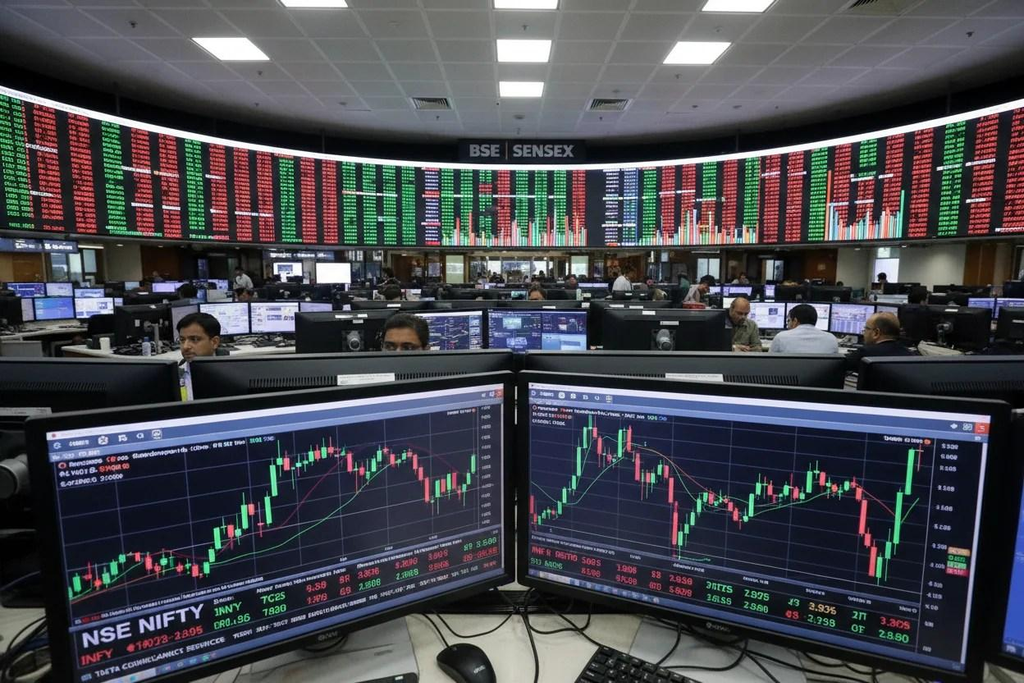
Mumbai, September 23, 2026: Indian equity benchmarks snapped a four-day winning streak on Tuesday, September 22, as selling pressure in information technology and financial stocks erased early gains, even as crude oil prices eased and global cues turned supportive. The BSE Sensex closed 329.91 points, or 0.44 per cent, lower at 74,529.08, while the NSE Nifty 50 declined 85.30 points, or 0.36 per cent, to settle at 23,329.
The session reflected the market’s ongoing tug-of-war between domestic institutional support and foreign selling, relief from softer energy prices, and lingering geopolitical uncertainty surrounding US-Iran developments. Investors remain focused on the trajectory of crude oil, the rupee’s stability, Federal Reserve policy signals, and the sustainability of domestic liquidity support.
Market Performance: Early Gains Fade Amid IT Drag
Equity markets opened on a positive note, with the Sensex rising to an intraday high near 75,039 and the Nifty touching around 23,489. Positive global cues and a decline in crude oil prices initially boosted sentiment. However, selling intensified as the day progressed, particularly in IT heavyweights. The Sensex slipped to a low of 74,423.71 before closing at 74,529.08. The Nifty ended at 23,329 after testing a low near 23,286.
Sectoral performance was largely negative. The Nifty IT index fell about 0.86–0.9 per cent, with TCS, Infosys, HCL Technologies, and Tech Mahindra among the major laggards. Brokerage notes from CLSA and Goldman Sachs highlighting subdued demand and a cautious medium-term earnings outlook for the sector weighed on sentiment. Banking and financial services also faced pressure, with the Nifty Bank and Nifty Financial Services indices declining. Pharma and FMCG stocks contributed to the downside.
On the positive side, media, realty, and metal indices ended higher. Among individual stocks, Coal India, InterGlobe Aviation (IndiGo), Eternal, Titan, and Tata Steel featured among the top gainers on the Nifty and Sensex. Bajaj Finserv, Trent, Bajaj Finance, Sun Pharma, TCS, and UltraTech Cement were among the notable losers.
Broader markets mirrored the weakness in benchmarks, though declines were relatively contained. The Nifty Midcap 100 fell about 0.08–0.14 per cent, while the Nifty Smallcap 100 declined around 0.23–0.26 per cent. Market breadth remained negative, with more stocks declining than advancing on the NSE.
India VIX, the volatility index, eased further, closing down nearly 2.9 per cent to around 10.92–11.00. The decline in the “fear gauge” suggested that while prices corrected, near-term anxiety among options traders remained relatively contained.
Crude Oil: Easing Below Key Psychological Level Provides Temporary Relief
Crude oil prices provided one of the few bright spots for the market. Brent crude, the global benchmark, declined around 1.5–1.67 per cent to settle near $98.44–$98.66 per barrel, slipping below the psychologically important $100 mark after earlier intraday strength. WTI crude also softened, trading in the high-$80s to low-$90s range depending on the contract.
The pullback was driven by hopes of diplomatic progress. Reports, including one from Japan’s Kyodo News, indicated that Iran had offered to reopen the Strait of Hormuz within seven days if the United States eased military pressure. With the UN General Assembly underway and potential high-level contacts between US and Iranian officials in focus, traders reduced some geopolitical risk premium. Additional support for the downside came from expectations of improved Saudi shipments and partial recovery in regional flows.
For India, a major oil importer, lower crude prices offer multiple benefits. They ease the current account deficit pressure, reduce imported inflation, support the rupee, and improve margins for downstream companies in sectors such as paints, chemicals, airlines, and consumer goods that have high energy input costs. Sustained prices below $100 would be viewed positively for the broader equity market and the RBI’s inflation management. However, any sharp reversal on escalation risks or supply disruptions could quickly reintroduce headwinds.
Rupee Outlook: Gains Ground on Softer Oil
The Indian rupee appreciated against the US dollar, closing around 95.58–95.60 after gaining roughly 15–20 paise during the session. Intraday levels saw the currency firm toward 95.58–95.65 levels. The move was supported by the sharp decline in crude oil prices, which reduced the urgency of dollar demand from oil importers, and improved risk sentiment.
Despite the daily gain, the rupee remains under broader pressure. It has traded in a relatively elevated range through much of 2026 amid persistent foreign portfolio outflows, a firm dollar, and earlier spikes in energy prices. Analysts note that the currency is likely to stay range-bound in the near term, with support expected near 95.50 and resistance or intervention thresholds watched around 96.30–96.50. The RBI’s active management of liquidity and foreign exchange reserves continues to act as a stabilising force.
Key drivers for the rupee in the coming sessions will include crude oil trajectory, FII flows, US dollar strength (influenced by Fed policy), and any further RBI measures to attract foreign currency deposits or external commercial borrowings.
Institutional Flows: FIIs Sell Aggressively, DIIs Step In
Provisional data showed foreign institutional investors (FIIs) as net sellers of approximately ₹3,810 crore in the cash market on September 22. Domestic institutional investors (DIIs) provided a strong counterbalance, buying a net ₹4,120 crore. The combined net flow remained marginally positive.
FII selling has been a consistent feature in recent sessions and through much of 2026, with cumulative outflows remaining substantial on a year-to-date basis. DIIs, including mutual funds and insurance companies, have absorbed a large portion of the selling, supported by steady domestic SIP inflows and liquidity. This divergence has limited the downside in equities but also highlights the market’s dependence on domestic capital for stability.
Key Factors Investors Should Watch Closely
Several interconnected factors will shape market direction in the near to medium term:
1. Geopolitical Developments and Crude Oil Trajectory
The US-Iran situation remains the single largest swing factor. Any credible de-escalation or progress toward reopening shipping lanes through the Strait of Hormuz would support lower oil prices, benefit the rupee, ease inflation concerns, and improve risk appetite for emerging-market equities. Conversely, renewed escalation or threats to energy infrastructure could push Brent back above $100–$105 and trigger fresh volatility. Investors should track developments around the UN General Assembly and any official statements carefully.
2. Federal Reserve Policy Path
Markets are closely watching US inflation data and Fed communications. Expectations of further rate hikes or a more hawkish stance could strengthen the dollar, pressure the rupee, raise global bond yields, and intensify FII outflows from India. A more neutral or dovish tone would provide relief. Higher US yields narrow the interest-rate differential that has historically attracted capital to Indian markets.
3. RBI Stance and Domestic Inflation
With oil prices volatile and food prices sensitive to monsoon outcomes, inflation remains a key monitorable. The RBI has flagged upside risks. Any shift toward rate hikes in the coming quarters would impact rate-sensitive sectors such as banking, autos, real estate, and consumption. Liquidity measures and forex intervention will also influence short-term market conditions.
4. Corporate Earnings Trajectory
Brokerages note that the earnings downgrade cycle may be nearing its end. Consensus expectations point to moderate growth in FY27 followed by stronger expansion in FY28. IT sector commentary on demand, BFSI asset quality and credit growth, and margin trends in energy-sensitive industries will be critical in the upcoming results season. Large-cap earnings resilience is particularly important given the shift in preference toward quality names.
5. FII vs DII Flows and Domestic Liquidity
Continued strong SIP and domestic institutional buying have been a major cushion. Any sustained acceleration in FII selling or a slowdown in domestic inflows would increase vulnerability. Conversely, a return of foreign buying on improved macros could fuel a sharper rebound.
6. Technical Levels and Market Structure
For the Nifty, the 23,200–23,230 zone is viewed as crucial near-term support, while 23,450–23,500 acts as resistance. A sustained move above 23,500 could open the path toward higher levels. For the Sensex, the 74,400–74,500 area provides support, with resistance near 75,000–75,200. Low VIX readings suggest that any breakout or breakdown could gain momentum quickly.
7. Global Equity and Commodity Cues
Performance of US and Asian markets, movements in the dollar index, and prices of gold and industrial metals will continue to influence sentiment. Gold’s resilience as a safe-haven asset remains relevant amid geopolitical uncertainty.
Longer-Term Outlook: Cautious Optimism Amid Crosscurrents
Several brokerages have turned more constructive on Indian equities for the medium term. Bank of America, for instance, has raised its December 2026 Nifty target to 26,200, implying meaningful upside from current levels, citing peaking earnings cuts, resilient domestic growth, and valuations that have moderated. Other houses emphasise India’s structural growth story, corporate capital expenditure, manufacturing push, and demographic advantages.
However, risks remain elevated. Persistent elevated oil prices, a more aggressive Fed, delayed monsoon recovery, or sharper-than-expected earnings disappointment could keep markets range-bound or extend the consolidation. Valuations, while more reasonable than peaks seen earlier, still demand earnings delivery.
Investor Strategy Considerations
In the current environment, a disciplined approach is advisable. Long-term investors may continue systematic investments through SIPs, focusing on quality large-caps and sectors with domestic demand resilience or structural growth (financials, select manufacturing, infrastructure, and consumption themes). Volatility can create opportunities for staggered accumulation in fundamentally strong names.
Traders should respect key support and resistance levels, monitor crude and currency closely, and avoid aggressive leverage given the potential for sharp moves on geopolitical headlines. Diversification across asset classes, including a measured allocation to gold and high-quality debt, can help manage overall portfolio risk.
The Indian market continues to demonstrate resilience through domestic liquidity support even as external headwinds persist. The coming weeks will test whether softer oil prices and diplomatic hopes can translate into sustained risk-on sentiment, or whether global rate dynamics and geopolitics will keep volatility elevated. Investors who focus on the evolving macro dashboard—oil, the rupee, Fed-RBI policy interplay, and earnings—will be better positioned to navigate the path ahead.
As always, past performance is not indicative of future results, and investors should align decisions with their risk tolerance, time horizon, and financial goals, preferably in consultation with qualified advisors.