
New Delhi / Jakarta / Kuala Lumpur — October 2026
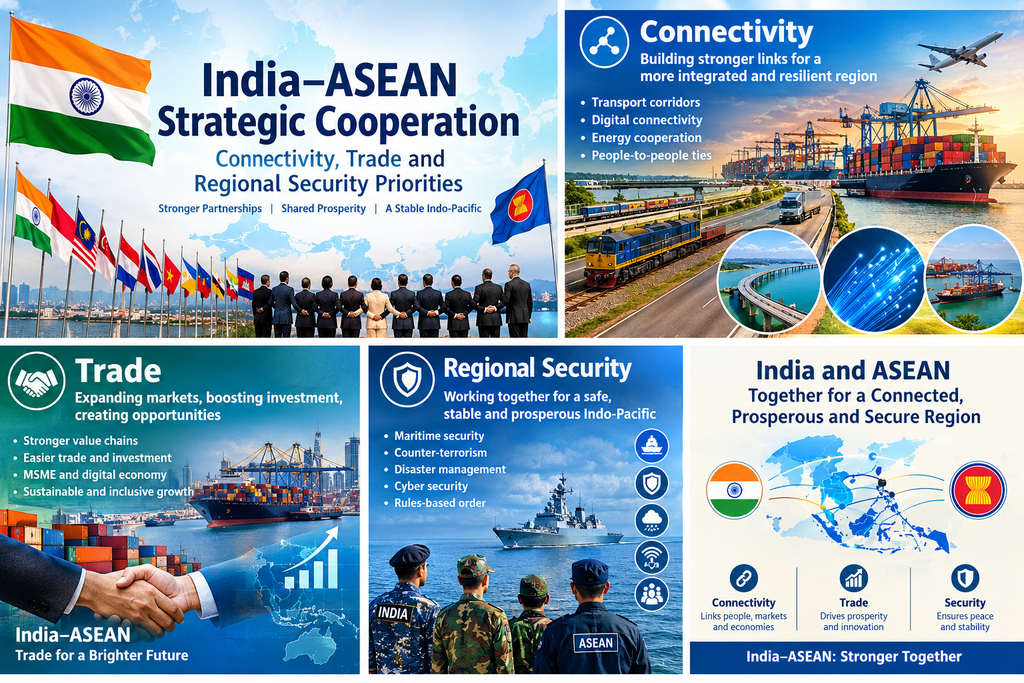
In the shifting geopolitics of the Indo-Pacific, the partnership between India and the Association of Southeast Asian Nations (ASEAN) has emerged as one of the region’s most consequential strategic relationships. What began as an economic dialogue three decades ago has matured into a Comprehensive Strategic Partnership that prioritises physical and digital connectivity, balanced and expanded trade, and collective approaches to regional security. As 2026 unfolds as the ASEAN–India Year of Maritime Cooperation, leaders on both sides are translating shared principles into practical cooperation amid rising strategic competition, supply-chain vulnerabilities, and non-traditional threats.
Defence Minister Rajnath Singh’s address at the inaugural ASEAN–India Defence Think Tank Forum in New Delhi on 14 October 2026 captured the current mood. He underscored that India and ASEAN share a clear interest in an open, inclusive and stable Indo-Pacific, and that ASEAN centrality remains the organising principle of India’s approach. Linking India’s Act East Policy with its SAGAR (Security and Growth for All in the Region) and MAHASAGAR (Mutual and Holistic Advancement for Security and Growth Across Regions) visions, Singh called for deeper maritime domain awareness, naval and coast-guard interoperability, underwater awareness, joint emergency response, and defence-industrial collaboration. The message was unambiguous: the Indian Ocean and Southeast Asian waters form a single connected maritime space whose security underpins trade, energy flows and regional prosperity.
Historical Foundations and Institutional Architecture
India’s engagement with Southeast Asia predates modern ASEAN. Civilisational, cultural and commercial links stretch back centuries through the Indian Ocean and the Bay of Bengal. Contemporary institutional ties took shape after the Cold War. India became a Sectoral Dialogue Partner of ASEAN in 1992, a Full Dialogue Partner in 1995, and joined the ASEAN Regional Forum in 1996. It was a founding member of the East Asia Summit in 2005 and participates actively in the ASEAN Defence Ministers’ Meeting-Plus (ADMM-Plus).
The relationship was elevated to a Strategic Partnership in 2012 and further to a Comprehensive Strategic Partnership in 2022, coinciding with the 30th anniversary of dialogue relations. The Act East Policy, announced by Prime Minister Narendra Modi in 2014, shifted the emphasis from primarily economic “Look East” engagement to a multi-dimensional strategy encompassing commerce, connectivity, culture, capacity-building and security. ASEAN centrality is repeatedly affirmed in joint statements and aligns with the ASEAN Outlook on the Indo-Pacific (AOIP).
The Plan of Action to Implement the ASEAN–India Comprehensive Strategic Partnership (2026–2030), adopted in 2025, provides the current operational roadmap. It supports ASEAN’s longer-term Community Vision 2045 and prioritises peace and security, economic integration, sustainable development, digital transformation, maritime cooperation, connectivity, and people-to-people exchanges. Regular mechanisms— the ASEAN–India Summit, Foreign Ministers’ Meeting, Joint Cooperation Committee, Senior Officials’ Meeting, and specialised dialogues on trade, defence and energy—keep the relationship institutionalised and forward-looking.
Connectivity: Bridging South and Southeast Asia
Physical and digital connectivity remains the most tangible expression of India’s Act East Policy and a shared priority with ASEAN. Two flagship land-and-sea projects illustrate the ambition and the persistent challenges.
The India–Myanmar–Thailand Trilateral Highway aims to link Moreh in Manipur with Mae Sot in Thailand via Myanmar, creating a continuous road corridor that can eventually extend to Laos, Cambodia and Vietnam. Progress has been uneven due to political instability in Myanmar and infrastructure bottlenecks, yet both sides continue to treat completion and operationalisation as strategic imperatives. Parallel to this, the Kaladan Multi-Modal Transit Transport Project connects Kolkata by sea to Sittwe port in Myanmar, then by inland waterway and road to Mizoram, offering an alternative route to India’s Northeast that bypasses the narrow Siliguri Corridor.
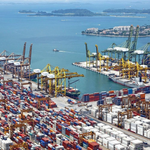
Maritime connectivity is equally critical. Indian ports and ASEAN hubs form part of overlapping sea lines of communication that carry a large share of global trade and energy. India has supported port development and logistics cooperation, while ASEAN’s Master Plan on ASEAN Connectivity and India’s own infrastructure push under the National Logistics Policy create opportunities for “connecting the connectivities.”
Energy connectivity has gained fresh momentum. At the 20th East Asia Summit Energy Ministers’ Meeting in Manila in October 2026, India welcomed the ASEAN Plan of Action for Energy Cooperation 2026–2030 and reaffirmed cooperation under the ASEAN–India Plan of Action. Minister of State for Power Shripad Yesso Naik highlighted exploration of a proposed 2,000 MW cross-border power interconnection between India and Singapore. One option under study is a roughly 3,000 km land-based transmission corridor from Imphal through Myanmar, Thailand and Malaysia to Singapore. Such a link would facilitate electricity trade, integrate renewable energy, and strengthen regional energy security. India has offered to share experience in large-scale renewable deployment, grid integration, energy storage, green hydrogen and related technologies, and to deepen institutional links between the ASEAN Centre for Energy and Indian agencies.
Digital connectivity and financial integration are advancing in parallel. Cross-border linkages between India’s Unified Payments Interface and ASEAN payment systems, fintech collaboration, and discussions on secure digital public infrastructure reflect a shared interest in inclusive digital transformation. People-to-people connectivity—direct flights to multiple ASEAN capitals, tourism flows, scholarships at Nalanda University and agricultural institutions, and cultural heritage restoration projects—further softens the geography between the two regions.
Despite these advances, connectivity projects face well-known obstacles: financing gaps, regulatory differences, political risk in transit countries, and the need for coordinated standards. Both sides recognise that without sustained political will and private-sector participation, physical corridors risk remaining incomplete.
Trade and Economic Integration
Trade forms the economic backbone of the partnership. Bilateral merchandise trade reached approximately USD 128.38 billion in financial year 2025–26, with ASEAN accounting for roughly 10.5 per cent of India’s global trade. Exports from India stood at about USD 38.4 billion and imports from ASEAN at nearly USD 90 billion, reflecting a persistent and widening trade deficit that has grown from under USD 5 billion in the early years of the ASEAN–India Trade in Goods Agreement (AITIGA) to more than USD 50 billion.
AITIGA, which entered into force in 2010, liberalised tariffs on a large share of goods but has long been criticised for imbalances, restrictive rules of origin, non-tariff barriers, and limited utilisation by Indian exporters. Negotiations to review and upgrade the agreement have been underway for several years. The 15th meeting of the AITIGA Joint Committee, held in Jakarta from 6 to 9 October 2026, marked a renewed push. Co-chaired by senior officials from India and Malaysia (as ASEAN coordinator), the meeting directed all eight sub-committees—covering customs procedures and trade facilitation, legal and institutional issues, national treatment and market access, sanitary and phytosanitary measures, rules of origin, and others—to accelerate work with time-bound deliverables. The next Joint Committee meeting is scheduled for January 2027 in India. Both sides aim for a modernised, more balanced and business-friendly agreement that addresses market access asymmetries and supports contemporary supply-chain realities.
Beyond the FTA review, economic cooperation spans investment, services, digital economy, green technologies and resilient supply chains. ASEAN remains an important source of foreign direct investment into India and a destination for Indian outward investment, particularly in manufacturing, pharmaceuticals, information technology, renewable energy and infrastructure. Sectoral dialogues and business councils work to reduce non-tariff frictions and expand opportunities for small and medium enterprises. Cooperation on critical minerals, semiconductors, artificial intelligence and clean energy technologies is increasingly visible in bilateral agreements with individual ASEAN members, notably Indonesia, Malaysia, Singapore, Vietnam and the Philippines.
The economic relationship is not without friction. Indian industry has voiced concerns about import surges in certain sectors and the need for greater reciprocity. ASEAN partners emphasise the importance of timely conclusion of the AITIGA review and further liberalisation. Both sides nevertheless treat expanded, more balanced trade as essential for regional prosperity and for reducing over-dependence on any single external market.
Regional Security Priorities
Security cooperation has deepened markedly over the past decade and now occupies a central place in the strategic partnership. Maritime security is the most prominent domain. The designation of 2026 as the ASEAN–India Year of Maritime Cooperation provides a focused platform for information-sharing, joint exercises, capacity-building, blue-economy initiatives and sustainable ocean governance.
The ASEAN–India Maritime Exercise (AIME) series, including the 2026 edition that involved Indian Navy ships such as INS Sahyadri and INS Kulish alongside ASEAN partners, demonstrates growing operational familiarity. India has also transferred or agreed to supply advanced systems, most notably the BrahMos supersonic cruise missile to the Philippines and, more recently, arrangements involving Indonesia. These transfers are framed as contributions to the defensive capabilities of partner nations and to a rules-based maritime order grounded in the United Nations Convention on the Law of the Sea.
At the Defence Think Tank Forum, Rajnath Singh proposed concrete next steps: a joint research agenda covering maritime security, disaster response, cyber threats and emerging technologies; pilot projects such as tabletop exercises on maritime disaster response and studies on counter-drone solutions; and greater participation of start-ups, universities and smaller firms in defence innovation. He invited ASEAN countries to explore co-development and co-production under India’s self-reliance initiatives in areas including patrol vessels, radars, air-defence systems, helicopters and unmanned systems. Humanitarian assistance and disaster relief (HADR) is to be regularised as part of the defence dialogue, building on existing MoUs such as that between India’s National Disaster Management Authority and the ASEAN Coordinating Centre for Humanitarian Assistance.
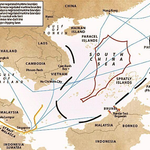
Beyond the maritime domain, cooperation extends to counter-terrorism, transnational crime, cybersecurity, and space. India participates actively in ADMM-Plus and ASEAN Regional Forum activities. Both sides emphasise that security challenges—terrorism, piracy, illegal fishing, trafficking, cyber threats and climate-related disasters—cross borders and require collective, practical responses rather than unilateral action. India’s consistent support for ASEAN centrality and for dialogue-based approaches to disputes, including in the South China Sea, is presented as complementary to ASEAN’s own preference for inclusivity and non-alignment.
Strategic competition in the Indo-Pacific, grey-zone activities at sea, and vulnerabilities in critical supply chains form the broader backdrop. India positions itself as a reliable and equal partner that does not seek to force countries into exclusive alignments. The emphasis on multipolarity, respect for sovereignty, and adherence to international law is intended to reassure ASEAN members navigating complex great-power dynamics.
Challenges and the Road Ahead
Several structural and operational challenges temper optimism. Connectivity projects continue to encounter implementation delays linked to financing, technical standards and political conditions in transit states. The trade relationship remains unbalanced, and the AITIGA review, while accelerated, still faces complex negotiations on rules of origin, market access and non-tariff measures. On the security front, ASEAN’s consensus-based decision-making and preference for neutrality sometimes limit the pace and depth of collective responses, while India’s own resource constraints and competing priorities across multiple theatres require careful prioritisation.
Perception gaps also exist. Some ASEAN voices have called for clearer articulation of India’s strategic expectations and more consistent follow-through on infrastructure and economic commitments. Indian stakeholders occasionally express frustration at the slow pace of institutional processes and at residual protectionism. Bridging these gaps requires sustained high-level political attention, greater private-sector involvement, and more granular, results-oriented working groups.
Looking ahead, the 2026–2030 Plan of Action, the Year of Maritime Cooperation, and the ongoing AITIGA negotiations offer concrete near-term opportunities. Successful completion of key connectivity segments, a modernised trade agreement, expanded defence-industrial collaboration, and institutionalised maritime information-sharing would materially strengthen the partnership. Energy interconnections, digital public infrastructure linkages, and joint work on resilient supply chains in critical technologies can further diversify the economic relationship. People-to-people exchanges—education, tourism, cultural projects and professional training—will continue to underwrite long-term affinity.
In a region marked by intensifying strategic competition and transnational risks, India and ASEAN have chosen a path of open, inclusive and multipolar cooperation. The partnership is neither a formal alliance nor a purely transactional arrangement. It rests on overlapping interests in economic growth, maritime security, and a rules-based order that allows countries of all sizes to pursue development without coercion. Realising its full potential will depend on converting shared principles into measurable outcomes—finished highways and power lines, balanced trade flows, interoperable navies and coast guards, and trusted mechanisms for crisis response. As both sides implement the current Plan of Action and navigate the Year of Maritime Cooperation, the India–ASEAN relationship stands as a significant pillar of stability and prosperity in the Indo-Pacific.