

[courtesy -source]
Manila / Beijing / Singapore — October 2026
Tensions in the South China Sea have intensified sharply in recent months, with a surge in confrontations between Chinese and Philippine forces, renewed island-building activity by Beijing, and growing international concern over the erosion of the rules-based maritime order. What was once framed primarily as a territorial dispute has evolved into a complex contest involving maritime security, the practical application of international law, and the broader stability of one of the world’s most vital sea lanes. As of mid-October 2026, Philippine authorities report a near-doubling of Chinese naval and coast guard vessels in contested waters claimed by Manila, while aerial intercepts, water-cannon incidents, and blocked resupply missions have become almost routine. These developments underscore the persistent gap between legal rulings and on-the-water realities a full decade after a landmark arbitral award rejected China’s expansive claims.
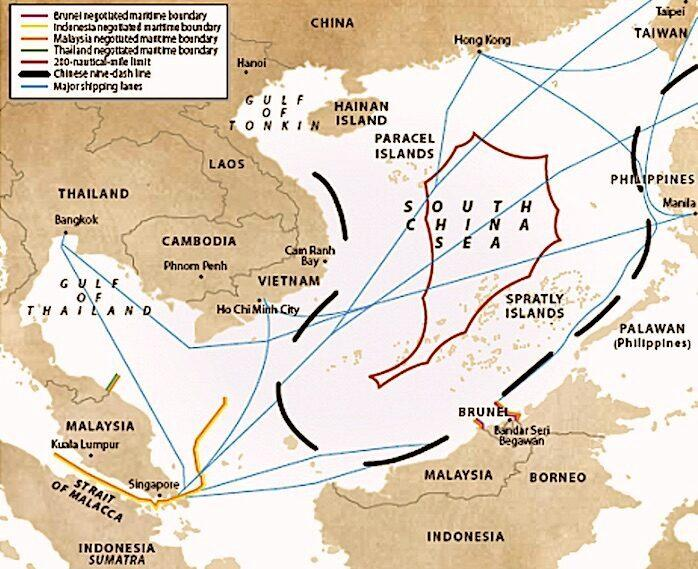
The South China Sea, spanning approximately 3.5 million square kilometres, carries an estimated one-third of global shipping trade and holds significant fisheries and potential hydrocarbon resources. Overlapping claims involve China, the Philippines, Vietnam, Malaysia, Brunei, and Taiwan. China’s assertion of “historic rights” within its nine-dash line (sometimes depicted with ten dashes) encompasses the vast majority of the waterway, including the Spratly and Paracel Islands and features such as Scarborough Shoal. Other claimants base their positions primarily on the United Nations Convention on the Law of the Sea (UNCLOS), which grants coastal states rights to exclusive economic zones (EEZs) extending 200 nautical miles from their baselines and continental shelves.
Recent Flashpoints and the Pattern of Coercion
Incidents have spiked since early October 2026. Philippine and Chinese forces engaged each other dangerously at least six times across Scarborough Shoal, Second Thomas Shoal (Ayungin Shoal), and the Spratly Islands. On 1–2 October, the Philippine Coast Guard pressured a Chinese civilian maritime survey vessel near the Batanes islands in the Luzon Strait; a large China Coast Guard cutter, derived from a Type 052D destroyer hull, provided protection. On 3 October, a People’s Liberation Army Air Force J-16 fighter intercepted a Philippine Air Force C-208 Cessna over Scarborough Shoal, manoeuvring in close proximity in what Manila described as an unsafe encounter. Beijing countered that the Philippine aircraft had illegally entered airspace over “Huangyan Dao.”
Later that week, a medical evacuation of a sick sailor from the BRP Sierra Madre—the grounded Philippine vessel that serves as an outpost at Second Thomas Shoal—was delayed for nearly ten hours by China Coast Guard water-cannon harassment. Philippine officials also reported Chinese maritime militia vessels and small boats operating near Loaita (Kota) Island and engaging in unauthorised fishing. Manila tracked 101 Chinese navy and coast guard vessels around Thitu (Pag-asa) Island, Second Thomas Shoal, Sabina Shoal, and Scarborough Shoal during September—nearly double the 56 recorded in August and well above July’s 48.
These events form part of a longer pattern of grey-zone tactics. China has employed coast guard cutters, maritime militia vessels (often disguised as fishing boats), water cannons, ramming, laser dazzling, and dangerous manoeuvres to assert control without triggering open conflict. Philippine resupply missions to the Sierra Madre have faced repeated interference. In September 2025, Beijing declared a national nature reserve at Scarborough Shoal, a move Manila and Washington rejected as unlawful. By April 2026, Chinese authorities had installed a floating barrier across the shoal’s entrance. Satellite imagery and vessel-tracking data have shown persistent Chinese presence, including floating structures and buoys, despite Philippine protests.
Similar pressure has been applied against Vietnamese and other claimants, though the most publicised confrontations in 2025–2026 have centred on the Philippines under President Ferdinand Marcos Jr., whose administration has taken a firmer stance than its predecessor. Manila has publicised incidents extensively, strengthened defence ties with the United States, Japan, Australia, and others, and sought to uphold the 2016 arbitral award as a cornerstone of policy.
International Law: The 2016 Award and Its Limits
At the heart of the legal dimension stands the 12 July 2016 award by an arbitral tribunal constituted under Annex VII of UNCLOS in the case brought by the Philippines against China. The tribunal unanimously ruled that China’s claims to historic rights within the nine-dash line had no lawful effect insofar as they exceeded the maritime entitlements provided by UNCLOS. It determined that none of the Spratly features generated an EEZ or continental shelf of their own, that Scarborough Shoal was a rock entitled only to a 12-nautical-mile territorial sea, and that China had violated Philippine sovereign rights by interfering with fishing and hydrocarbon activities and by constructing artificial islands that caused severe environmental harm.
China rejected the proceedings from the outset, refused to participate, and has consistently declared the award “null and void.” Beijing maintains that the tribunal lacked jurisdiction, that the Philippines violated a prior bilateral agreement to resolve disputes through negotiation, and that its claims rest on historical discovery, naming, and continuous administration. Chinese officials argue that UNCLOS does not settle questions of territorial sovereignty and that the award cannot bind China.
A decade later, the practical impact of the ruling remains limited. While the legal status of the award is intact—it is final and binding on the parties under UNCLOS—enforcement mechanisms are weak. There is no international police force to compel compliance. China’s island-building campaign, begun in earnest around 2013–2015, created large artificial features equipped with airstrips, ports, radar, and, according to U.S. and other assessments, anti-ship and anti-aircraft missile systems, fighter aircraft capabilities, and electronic warfare equipment on Mischief Reef, Subi Reef, and Fiery Cross Reef. These outposts enable persistent presence, surveillance, and the ability to challenge activities by other claimants or third parties.
In 2025–2026, China resumed significant reclamation activity. Satellite imagery shows large-scale dredging and construction at Antelope Reef in the Paracel Islands, including work toward a runway estimated at around 3,000 metres—potentially one of the longest in the region. Analysts assess this could become operational by mid-2027, extending China’s military reach closer to the Vietnamese coast. New structures on nearby features suggest supporting infrastructure, possibly early-warning radar. These developments occur despite earlier Chinese statements that the islands would not be militarised.
Other states and the European Union have repeatedly reaffirmed the 2016 award. In July 2026, on the tenth anniversary, 14 nations including the United States, Japan, Australia, the United Kingdom, and the Philippines issued joint statements underscoring that the ruling is final and binding and opposing China’s use of coast guard and other forces to harass lawful operations. At the United Nations, the Philippines has defended the award as one of the “twin anchors” of its policy alongside UNCLOS itself. Yet ASEAN as a whole has remained cautious; only the Philippines among member states prominently marked the anniversary in some joint statements, reflecting divergent interests and sensitivities toward Beijing among members such as Cambodia, Laos, and others with closer economic ties to China.
The long-sought Code of Conduct (COC) between ASEAN and China remains elusive. Negotiations continue, with the Philippines having pushed for more frequent meetings and a substantive text during its ASEAN chairmanship periods, but progress has been incremental. Critics argue that any COC risks being watered down or non-binding, and that it cannot substitute for compliance with existing international law.
Maritime Security Dynamics
Maritime security in the South China Sea is shaped by asymmetry. China’s coast guard is the world’s largest by tonnage, and its maritime militia provides a scalable, deniable presence. The People’s Liberation Army Navy has expanded rapidly, enabling sustained operations far from the Chinese mainland. Rival claimants maintain far smaller forces. The Philippines has invested in coast guard modernisation, new vessels, and enhanced domain awareness, but capacity gaps remain. Vietnam has similarly strengthened its maritime forces and island presence.
The United States maintains that it takes no position on the underlying sovereignty disputes but insists on freedom of navigation and overflight consistent with international law. U.S. Navy freedom of navigation operations (FONOPs), alongside those by allies including Japan, Australia, the United Kingdom, Canada, and others, challenge excessive maritime claims. Washington has clarified that its Mutual Defence Treaty with the Philippines covers armed attacks on Philippine armed forces, coast guard, and public vessels anywhere in the South China Sea. Bilateral Defence Guidelines and expanded Enhanced Defence Cooperation Agreement sites have deepened practical cooperation. Japan’s Reciprocal Access Agreement with the Philippines and participation in exercises such as Balikatan (which in 2026 included Japanese combat troops for the first time in decades) signal a growing minilateral security architecture.
Risks of miscalculation are real. Close encounters between aircraft and vessels, water-cannon use against resupply or medical missions, and the presence of large numbers of vessels in confined waters raise the possibility of an incident escalating. Philippine officials have warned that a simple misstep could trigger an out-of-control clash. Chinese statements often frame Philippine and allied activities as provocations engineered by external powers.
Environmental degradation adds another layer. Extensive reclamation has damaged coral reefs. Overfishing, illegal, unreported, and unregulated fishing, and waste dumping by some vessels have strained fish stocks that support coastal communities across the region. Declaring nature reserves while restricting access by traditional fishers from other countries has been criticised as a pretext for control rather than genuine conservation.
Regional Stability and Broader Implications
The South China Sea is not merely a local dispute; it is a barometer of the health of the post-World War II maritime order. Safe passage through the sea and the adjacent Malacca, Sunda, and Lombok straits underpins global trade, energy supplies to Northeast Asia, and supply-chain resilience. Any sustained disruption—whether from conflict, heightened insurance costs, or coercive control—would carry worldwide economic consequences.
For ASEAN, the dispute tests centrality and cohesion. The organisation has long preferred consensus and non-interference. While the Declaration on the Conduct of Parties in the South China Sea (DOC) of 2002 remains a reference point, its implementation has been uneven. Individual members pursue varied strategies: some emphasise dialogue and economic engagement with China; others, particularly the Philippines and, to a degree, Vietnam, prioritise legal rights and external partnerships. The risk is that unresolved maritime tensions divert attention and resources from other regional priorities, including climate adaptation, economic integration, and non-traditional security threats.
China’s approach reflects a preference for bilateral negotiations, rejection of “internationalisation” of the disputes, and the creation of facts on the water that alter the status quo. Beijing argues that U.S. military presence and allied operations themselves undermine stability. From the perspective of many other states, China’s rejection of the arbitral award, militarisation of features, and grey-zone pressure challenge the principle that disputes should be settled peacefully in accordance with international law rather than by superior force.
Prospects for near-term stabilisation appear limited. Joint development of resources faces legal and constitutional obstacles in the Philippines and mutual distrust elsewhere. Confidence-building measures, hotlines, and operational agreements exist but have not prevented confrontations. Transparency initiatives by Manila have raised domestic and international awareness but have not deterred Chinese presence; some analysts argue that publicising incidents alone is insufficient without stronger deterrence and coalition messaging.
Looking ahead, several factors will shape the trajectory. Continued Chinese construction and presence will further entrench physical control. Strengthening of U.S. alliance and partnership networks, including with Japan, Australia, and increasingly European partners, provides a counterbalance but also raises the stakes. The evolution of unmanned systems, undersea infrastructure (including cables), and domain awareness technologies will influence operational dynamics. Domestic politics in claimant states and the broader U.S.–China relationship will continue to cast long shadows.
For now, the South China Sea remains a zone of managed tension rather than open conflict. Fishermen from multiple countries still operate, commercial shipping continues largely unimpeded, and diplomatic channels remain open. Yet the accumulation of incidents, the divergence between legal norms and operational realities, and the militarisation of the maritime domain erode the margin for error. Regional stability depends on whether claimants and external stakeholders can reaffirm the primacy of international law, particularly UNCLOS, while developing practical mechanisms to reduce the risk of escalation and manage competing interests in one of the planet’s most strategically consequential waterways.
The disputes illustrate a deeper challenge for the international system: how to uphold agreed legal frameworks when a major power declines to accept outcomes that constrain its preferred narrative of rights and interests. Maritime security, the integrity of international law, and regional stability are inextricably linked. As activities intensify in 2026, the South China Sea continues to test the resilience of the order that has underpinned decades of relative peace and prosperity in the Indo-Pacific.