

London, 20 October 2026 – The United Kingdom has announced a significant expansion of its defensive military support to Saudi Arabia, deploying Royal Air Force Typhoon fighter jets to help protect Saudi cities and critical national infrastructure from escalating aerial attacks by Yemen’s Iran-backed Houthi movement. The decision, authorised by Prime Minister Andy Burnham and approved by Defence Secretary Wes Streeting, marks the UK’s most substantial combat aircraft commitment in the Gulf crisis to date and builds on earlier assistance, including air defence systems, personnel, and aerial refuelling support.
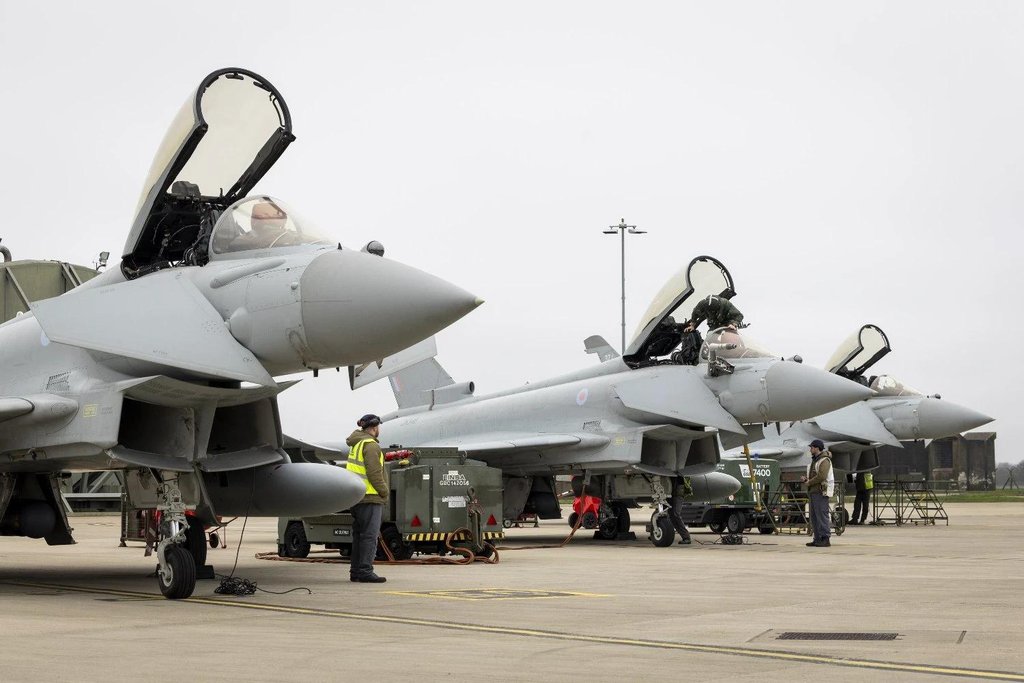
In an official operational update published by the Ministry of Defence, the government stated that RAF Typhoons will fly “defensive counter air missions” over Saudi airspace. Officials stressed repeatedly that the aircraft will operate strictly in a defensive role and “will not conduct offensive strikes against the Houthis.” Alongside the fighters, Britain is providing an RAF A400M Atlas transport aircraft to move defence materiel within the kingdom and deploying additional UK military advisers to support Saudi staff officers.
Defence Secretary Wes Streeting described the Houthi campaign as “absolutely despicable,” highlighting the targeting of Riyadh’s King Khalid International Airport as evidence of the group’s determination to escalate regional tensions. “That’s why today I have approved further UK military support. RAF Typhoons will fly defensive air missions to help protect Saudi airspace from drones and missiles. This builds on the UK equipment and personnel we already have in the country to defend against Houthi air attacks,” Streeting said in a written statement.
The announcement comes against a backdrop of intensified Houthi missile and drone strikes that have struck deep into Saudi territory in recent weeks. On 10 October, a ballistic missile attack on King Khalid International Airport killed at least 13 people and wounded more than 300, according to Saudi authorities. The dead included Saudi nationals as well as citizens of Bangladesh, the United States, Egypt, Jordan, Palestine, Syria and Sudan. It was widely reported as the deadliest attack on Saudi soil in more than a decade. Subsequent strikes on the same airport and other facilities, including energy infrastructure and ports, raised the overall death toll from recent airport attacks to around 19 or 20.
Saudi Arabia’s civil aviation authority ordered the temporary closure of the Riyadh airport following the 10 October strike, with schools in the capital shifting to remote learning and international airlines suspending or diverting flights. The Houthis claimed responsibility and issued warnings to commercial airlines to avoid Saudi airspace, designating it a military operations zone. Parallel attacks targeted oil facilities linked to Saudi Aramco and other critical sites along the kingdom’s coast and southern border regions.
These strikes form part of a broader escalation in Yemen’s long-running conflict. The Houthis, also known as Ansar Allah, have been locked in a civil war with Yemen’s internationally recognised government, which receives military and political backing from a Saudi-led coalition. Fighting intensified in September and October, with Houthi forces advancing in some areas while launching cross-border attacks into Saudi Arabia. Analysts note that the group’s improved ballistic missile and drone capabilities, widely attributed to Iranian technical and material support, have enabled strikes of greater range and accuracy than in previous phases of the war.
Britain has framed its response as carefully defensive and limited. The Typhoon deployment expands an existing package announced in September 2026, when the UK agreed to a Saudi request for an RAF Voyager air-to-air refuelling aircraft. That tanker has already completed at least 14 operational missions, enabling Saudi jets—many of them British-built Typhoons supplied by BAE Systems—to remain airborne longer for defensive patrols and, according to the Ministry of Defence, operations to degrade Houthi military targets inside Yemen that threaten Saudi and Yemeni civilians. The refuelling support has now been extended by 90 days. Britain had also previously deployed ground-based air defence equipment and personnel to help Saudi forces intercept incoming missiles and drones.
Officials in London have linked the support to both alliance obligations and direct British interests. The Ministry of Defence noted that Houthi efforts to destabilise the region undermine Middle East security and deepen Yemen’s humanitarian crisis. Escalating violence in the Gulf, the government argued, risks driving up the cost of living in the UK through higher energy prices, disrupting trade routes and imposing additional costs on British businesses. “It is in the UK’s national economic and security interest that they do not succeed,” the official statement declared. Saudi Arabia and Yemen were described as long-standing partners that play a vital role in regional stability.
The decision reflects the depth of the UK-Saudi defence relationship. Over the past two decades, Britain has sold Saudi Arabia a substantial fleet of Typhoon aircraft under contracts originally valued in the billions of pounds. Saudi pilots train with RAF counterparts, and the two air forces share operational concepts and technical standards. In earlier regional crises, including defensive missions against Iranian and proxy missile and drone attacks, RAF Typhoons operating from bases such as Akrotiri in Cyprus and facilities in the Gulf have already demonstrated the ability to intercept aerial threats. The current deployment continues that pattern while remaining under strict rules of engagement that prohibit strikes into Yemeni territory.
Political reaction in Britain has so far been measured. The government has emphasised that the mission does not represent an open-ended combat commitment or a slide into deeper involvement in Yemen’s civil war. Downing Street has insisted the support is proportionate, focused on defending an ally and protecting British economic and security interests, while continuing to encourage a diplomatic resolution. Opposition voices and some analysts have nevertheless raised questions about the risk of mission creep, the legal and political thresholds for any future expansion of the rules of engagement, and the humanitarian consequences of the wider conflict for Yemeni civilians.
Regionally, the UK move adds to a pattern of Western support for Saudi defensive capabilities. The United States and other partners have also provided intelligence, logistics and air defence assistance at various points. The Houthis’ ability to strike civilian infrastructure far from the Yemeni border has underscored the limits of purely passive defences and the value of active fighter patrols capable of intercepting threats before they reach populated areas or energy facilities. At the same time, the group’s control of territory along the Red Sea and its past interference with commercial shipping through the Bab al-Mandab strait continue to raise concerns about global trade and energy flows.
The precise number of Typhoons being deployed has not been disclosed, nor have details of their operating bases or rotation schedule. Military sources indicate that the aircraft will integrate with Saudi command-and-control systems and existing UK air defence assets already in theatre. The A400M Atlas will facilitate the rapid movement of interceptors, spare parts and other equipment across Saudi territory, reducing logistical bottlenecks. Advisers will work with Saudi staff officers on planning, coordination and the application of international humanitarian law.
For Saudi Arabia, the British reinforcement arrives at a moment of heightened vulnerability. The kingdom has invested heavily in layered air defences, including US-made Patriot and other systems, yet the volume and sophistication of recent Houthi salvos have tested those defences. Successful hits on a major international airport in the capital have carried both practical and symbolic weight, disrupting travel, commerce and the sense of security that underpins Vision 2030 economic ambitions. Riyadh has vowed firm responses and continues air operations against Houthi launch sites and military infrastructure inside Yemen.
The conflict’s humanitarian dimension remains acute. Yemen has endured years of war, economic collapse and aid shortfalls. Houthi advances and the Saudi-led coalition’s counter-operations have displaced additional populations and complicated the delivery of food, medicine and fuel. International organisations continue to call for de-escalation, unrestricted humanitarian access and a return to political negotiations. Britain has reiterated its support for a diplomatic path while arguing that Saudi Arabia and the Republic of Yemen retain the right to self-defence against attacks on their territory and people.
Looking ahead, the durability of the UK deployment will depend on the trajectory of Houthi attacks and the broader regional security environment. If the volume of missile and drone launches declines, the need for continuous Typhoon patrols may diminish. Conversely, further successful strikes on Saudi cities or energy infrastructure could prompt requests for expanded assistance. Officials in London have signalled that any such requests would be considered carefully against the criteria of necessity, proportionality and national interest.
The Typhoon itself is a highly capable multi-role fighter, equipped with advanced sensors, air-to-air missiles and the ability to operate in contested airspace. In the defensive counter-air role, its primary task will be the rapid interception of inbound threats—ballistic missiles in their terminal phase, cruise missiles and one-way attack drones. Coordination with ground-based radars, early-warning aircraft and Saudi fighters will be essential to maximise the defensive bubble over key population centres and infrastructure.
Britain’s decision also carries longer-term implications for its defence posture and industrial relationships. Sustained operational use of Typhoons in the Gulf reinforces the aircraft’s relevance and the value of the UK-Saudi partnership for BAE Systems and the wider aerospace supply chain. It further demonstrates the RAF’s ability to project power and provide reassurance to allies at relatively short notice, even while balancing other commitments in Europe and elsewhere.
As the jets prepare for deployment, attention will focus on whether the enhanced defensive posture deters further Houthi attacks or merely shifts the pattern of confrontation. For now, the British government has drawn a clear line: support for Saudi self-defence is firm, but offensive operations against Houthi targets remain outside the mandate of the RAF aircraft. The coming weeks will test whether that carefully calibrated approach can help stabilise a volatile front in an already complex regional conflict.
The Ministry of Defence has confirmed that all UK activity will continue to comply with international law and that the safety of British personnel remains a priority. Further operational updates are expected as the Typhoons begin their defensive missions over Saudi skies. In the meantime, the message from London is unambiguous: attacks on civilian airports and critical infrastructure will not go unanswered by Britain’s closest Gulf partner, and the United Kingdom is prepared to stand with its ally in the defence of its cities and people.
This latest chapter in UK-Saudi defence cooperation underscores the enduring strategic alignment between the two countries at a time of heightened threat. Whether it proves sufficient to restore a measure of calm to the skies over Riyadh and the Saudi coastline will depend on developments on the ground in Yemen and the calculations of the Houthi leadership in the weeks ahead.