



Mumbai/New Delhi, October 21, 2026 — In a decisive shift after nearly four years of accommodative policy, the Reserve Bank of India’s Monetary Policy Committee (MPC) has raised the benchmark repo rate by 25 basis points to 5.50 per cent and moved its stance to “calibrated tightening.” The decision, taken at the October 5-7 meeting and detailed in minutes released on Wednesday, marks the first rate hike since February 2023 and signals that further rate cuts are firmly off the table in the near term.
For millions of Indian households, the practical question is immediate: will home loan EMIs rise, and will fixed deposit (FD) returns improve? The short answer is yes on both counts, though the transmission will not be uniform or instantaneous. Borrowers with floating-rate loans linked to the external benchmark (primarily the repo rate) are already seeing higher costs, while savers stand to benefit from better returns on fresh deposits as banks reprice their liability side.
The Policy Pivot: Why the RBI Raised Rates
Governor Sanjay Malhotra, who chairs the six-member MPC, explained the rationale clearly in the minutes. Headline CPI inflation had risen to 4.8 per cent in August from 4.5 per cent in July, with core inflation climbing to 4.2 per cent. More worrying was the broadening of price pressures: the share of items in the CPI basket with inflation above 4 per cent jumped from 20 per cent in March to 37 per cent in August. The MPC revised its FY27 inflation projection upward to 5.2 per cent from 5.0 per cent earlier, with the third quarter expected to touch the upper tolerance limit of 6 per cent.
Supply-side shocks — a deficient monsoon, weather-related disruptions to food supplies, rising crude oil prices linked to geopolitical tensions, and a weaker rupee — were cited as key drivers. The central bank also raised its real GDP growth forecast for 2026-27 to 7.1 per cent from 6.7 per cent, reflecting continued economic resilience even as inflation risks mounted.
All six members voted for the 25-basis-point hike. However, two external members, Dr Nagesh Kumar and Prof. Ram Singh, opposed the change in stance from neutral to calibrated tightening. They argued that the new stance risked being interpreted as the start of an extended hiking cycle that could dampen demand and private investment. The majority view, articulated by the Governor and others including Deputy Governor Poonam Gupta and Saugata Bhattacharya, held that pre-emptive action was necessary to prevent inflation expectations from becoming unanchored.
“Rate cuts are off the table in the near term and policy action ahead can only be a rate hike or a pause, depending on the evolving circumstances and the outlook,” Malhotra stated. The duration and extent of any further tightening, he emphasised, would depend on underlying inflation, the spread of price pressures, second-round effects of supply shocks, and the impact on demand.
The next MPC meeting is scheduled for December 2-4, 2026. Markets will watch closely whether inflation data in the intervening weeks justify another hike or allow a pause.
Transmission to Home Loan EMIs: What Borrowers Should Expect
Most new home loans and a large share of outstanding floating-rate loans in India are now linked to external benchmarks, predominantly the RBI’s repo rate (known as External Benchmark Linked Rate or EBLR / RLLR). Under RBI guidelines, banks must reset these rates at least once every three months. Consequently, the October 7 hike has already begun feeding through.
Several major public sector banks — including State Bank of India, Punjab National Bank, Bank of Baroda, Bank of India, Canara Bank and Indian Bank — raised their repo-linked lending rates by 25 basis points within days of the policy announcement. SBI, for instance, moved its EBLR from 7.90 per cent to 8.15 per cent (plus credit risk premium and spread) effective mid-October.
The impact on monthly EMIs is measurable but not catastrophic for most borrowers. Industry calculations illustrate the arithmetic:
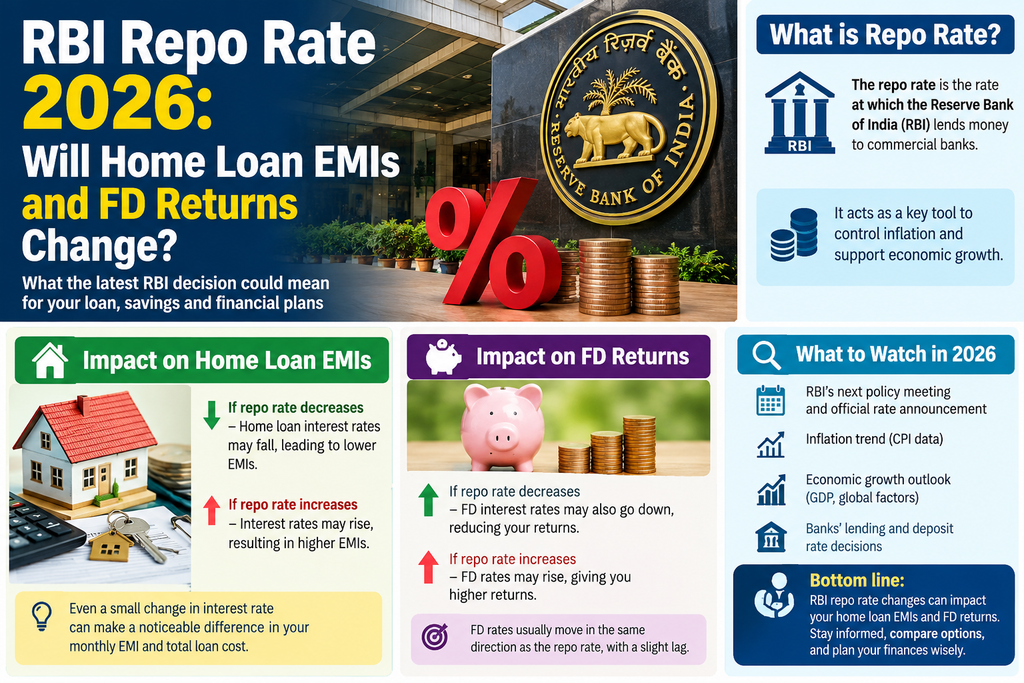
- On a ₹30 lakh loan at around 7.5-8 per cent for 25 years, a 25-bps hike typically adds roughly ₹490 to the EMI.
- On a ₹40 lakh loan, the increase is about ₹650-655.
- On a ₹50 lakh loan over 25 years, the EMI can rise by approximately ₹817. Over the full tenure, this translates into an extra interest outgo of around ₹2.45 lakh.
- For a ₹50 lakh loan over 20 years at an illustrative 8 per cent rising to 8.25 per cent, the EMI climbs by about ₹780-795, with lifetime interest rising by nearly ₹1.9 lakh.
Banks have two main ways to absorb the higher rate for existing borrowers: increase the EMI while keeping the tenure fixed, or keep the EMI unchanged and extend the loan tenure. Extending the tenure is often the default because it avoids an immediate cash-flow shock, but it significantly increases the total interest paid over the life of the loan. Financial advisors uniformly recommend that borrowers with surplus funds consider raising the EMI or making partial prepayments to limit the long-term cost.
Fixed-rate home loans remain unaffected during their fixed period. However, pure fixed-rate products are relatively rare for longer tenures in the Indian market; most “fixed” loans eventually convert to floating.
New borrowers will face higher rates from day one. With the festive season under way and demand for housing still firm, lenders have little incentive to absorb the cost. Housing finance companies that rely more on market borrowings may also raise rates, though the lag can be slightly longer than for banks.
Looking ahead, the calibrated-tightening stance raises the possibility of further 25-bps moves if inflation remains sticky near 6 per cent in the current quarter. Analysts have flagged scenarios in which the repo rate could climb toward 6-6.25 per cent by early 2027 if second-round effects materialise. Each additional hike would compound the EMI burden.
Impact on Fixed Deposit Returns: A Silver Lining for Savers
While borrowers feel the pinch, depositors stand to gain — at least on new money. Banks’ cost of funds rises when the policy rate increases, and competition for deposits typically intensifies as credit demand holds up. Term deposit rates for tenures above one year currently range between roughly 6.00 and 6.75 per cent across major banks; senior-citizen rates are 25-50 basis points higher.
A 25-bps repo hike does not automatically translate into an identical rise in FD rates. Banks adjust deposit rates based on their individual liquidity positions, credit growth, and competitive dynamics. Historically, transmission on the deposit side has been partial and lagged. Still, most market observers expect banks to raise rates on fresh FDs and renewals by 10-25 basis points in the coming weeks, especially if further policy tightening is anticipated.
Existing FDs are completely insulated. The contracted rate remains locked until maturity. This creates an opportunity for laddering: investors can place funds in shorter-tenure deposits so that maturities coincide with potential further rate increases, allowing reinvestment at higher yields.
Senior citizens and retirees who rely on interest income may find the environment more favourable after years of low rates during the easing cycle (the repo rate had been cut from 6.50 per cent to 5.25 per cent between 2023 and late 2025). Tax implications remain important: interest is taxable as per the slab, and TDS applies above the prescribed threshold.
Debt mutual funds, particularly those with longer duration, may experience near-term mark-to-market pressure as yields rise, but new investments in shorter-duration or floating-rate funds could benefit from higher accrual.
Broader Context and Household Strategy
The October decision ends a long pause that followed the aggressive 125-basis-point easing cycle of 2025. Between February 2023 and the recent hike, the repo rate had stayed at elevated levels for an extended period before being lowered in steps to support growth amid global uncertainty. The current pivot reflects the RBI’s dual mandate: price stability while supporting growth. With growth projected at a robust 7.1 per cent, the central bank has room to prioritise inflation control.
For households, the message is clear. Borrowers should:
- Check their loan’s reset date and the exact benchmark (repo-linked versus MCLR).
- Calculate the impact of both higher EMI and longer tenure options.
- Explore prepayment or switching to a lower-spread lender if the spread is uncompetitive.
- Avoid stretching tenure indefinitely; the interest cost compounds significantly.
Savers should:
- Compare rates across banks and small finance banks before renewing or placing new FDs.
- Consider laddering to retain flexibility.
- Weigh the post-tax returns against alternatives such as debt funds or government schemes, factoring in liquidity needs and risk tolerance.
The December MPC meeting will be the next major checkpoint. If food and fuel inflation ease and core pressures remain contained, a pause is possible. If inflation broadens further or the rupee remains under pressure, another hike cannot be ruled out. Either way, the era of easy money that characterised much of 2025 has ended.
In the meantime, the 25-basis-point move of October 2026 has already begun reshaping the cost of borrowing and the return on savings. Home loan EMIs are rising for floating-rate borrowers, and FD rates on new deposits are poised to improve. Indian households would do well to reassess both sides of their balance sheets — the loans they service and the deposits they hold — in light of a monetary policy regime that has shifted decisively toward calibrated vigilance against inflation.