

Christchurch, October 22, 2026 – In a thrilling, high-scoring contest under the lights at Hagley Oval, India launched their five-match T20I series against New Zealand with a hard-fought four-wicket victory, chasing down a formidable 226 with two balls to spare. The visitors finished on 230 for 6 in 19.4 overs after New Zealand had posted 225 for 4. Sanju Samson’s explosive 67 off 33 balls set the platform, Shreyas Iyer contributed a vital 42, and Naman Dhir’s blistering unbeaten 42 off just 15 balls sealed India’s highest successful chase in T20I history.
The result gave India a 1-0 lead in the series, which forms the opening leg of their full tour of New Zealand that also includes ODIs and Tests. Played just days after India completed a high-scoring home T20I series against West Indies, the match was another run-fest, though dew and New Zealand’s fielding lapses played a part in the dramatic finish.
New Zealand set a stiff target with Phillips’ fireworks
India captain Shreyas Iyer won the toss and elected to field, a decision influenced by the expected dew later in the evening. New Zealand’s openers Tim Seifert and Finn Allen provided a solid start. Seifert made 24 off 17 before falling to Mayank Yadav’s pace – a sharp edge through to Samson – with the score on 49 in the fifth over.
Allen continued the aggression, striking 45 off 24 balls with five fours and two sixes. His powerful hitting in the V was a highlight until Axar Patel dismissed him, caught by Tilak Varma at long-off as Allen miscued a shot that stuck in the surface. At 80 for 2, New Zealand were well placed. Daryl Mitchell added 28 off 19 before Arshdeep Singh had him caught by Bhuvneshwar Kumar, reducing the hosts to 122 for 3.
The innings truly ignited through a 73-run partnership for the fourth wicket between Glenn Phillips and Bevon Jacobs. Jacobs, making an impact with his long levers, scored 31 off 16 including three sixes before being run out by Arshdeep Singh while attempting a risky single. Phillips remained the star, finishing unbeaten on 82 off 40 deliveries with eight fours and three sixes. His resourceful innings featured decisive footwork against spin and clinical pulling of anything short. Michael Bracewell was not out on 7 as New Zealand closed on 225 for 4 – their highest T20I total against India and a joint sixth-highest overall.
India’s bowlers kept things relatively contained for long periods. Mayank Yadav returned 1 for 40, Arshdeep 1 for 45, and Axar 1 for 51. Bhuvneshwar Kumar, returning to the side, went wicketless for 49, while Nitish Kumar Reddy also conceded 40 without a breakthrough. New Zealand’s total looked imposing, especially given the venue’s history – no team had previously chased more than 180 successfully at Hagley Oval in T20Is.
India’s powerplay blitz and middle-order wobble
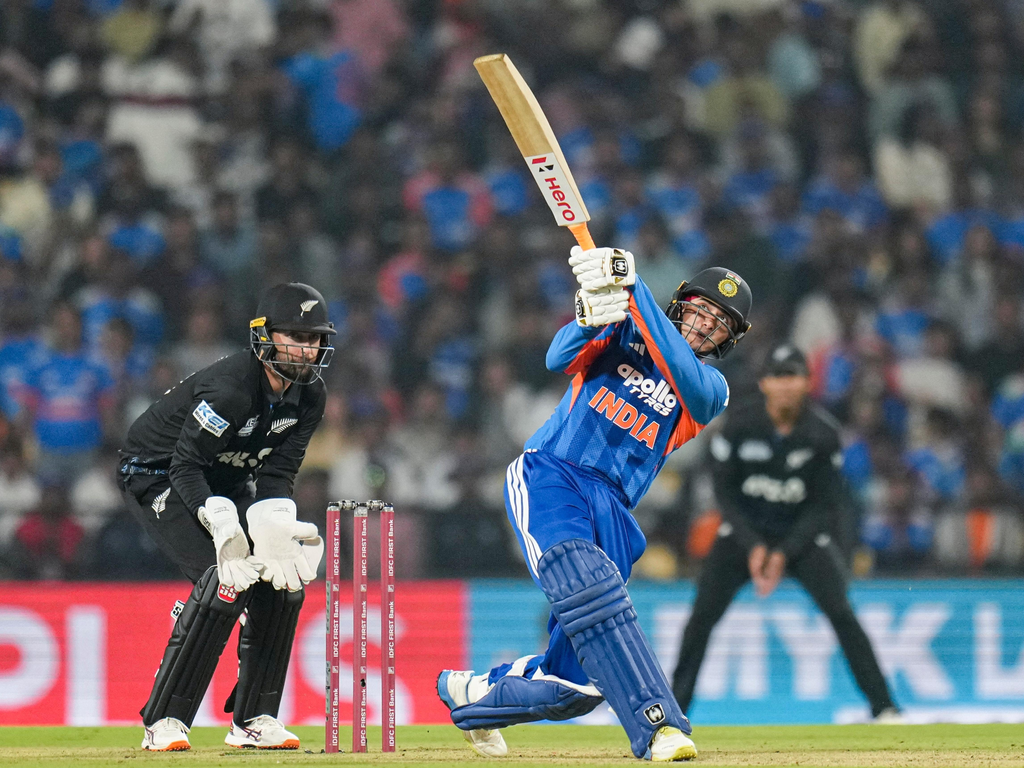
India’s chase began with intent. Samson and Abhishek Sharma put on 93 for the opening wicket in just 35 balls. The powerplay yielded 94 for 1, with New Zealand’s new-ball bowlers struggling for control amid extravagant swing and seam movement that produced several wides. Ferguson and Milne leaked runs heavily in the early overs. Samson reached a 23-ball half-century, blending crisp timing with powerful strokeplay – eight fours and four sixes in his 67. Abhishek contributed a rapid 29 off 12 with two fours and three sixes before falling to Michael Bracewell, caught at short third while trying to create room.
What followed was a period of tactical uncertainty and New Zealand fightback. Instead of the regular No. 3 Ishan Kishan, Tilak Varma walked in and struggled, managing only 6 off 11 before holing out to Ferguson off Bracewell. Samson then chopped on to Mitchell Santner, departing for 67 as the ball held in the pitch. Santner struck again soon after, dismissing Kishan for 1 as the left-hander miscued a big shot to deep midwicket. India had slumped from 93 for 0 to 122 for 4 in a short span, losing 4 for 29 in 22 balls. Bracewell (2 for 37) and Santner (2 for 39) applied the brakes effectively during this phase.
Iyer, Axar and Dhir haul India home
Captain Iyer and the promoted Axar Patel stabilised the innings with a 45-run stand off 24 balls. Axar, who had limited opportunities higher up the order earlier in the year, scored a brisk 24 off 14 with three fours and a six before falling to Lockie Ferguson, caught by substitute Devon Conway. Iyer continued, reaching 42 off 28 with one four and two sixes. He and Dhir added useful runs before Iyer was caught by Santner off Adam Milne in the 19th over, leaving India needing 16 from 11 balls.
Enter Naman Dhir. The young all-rounder, who has impressed with both bat and occasional off-spin, produced a match-winning cameo of 42 not out off 15 balls at a strike rate of 280, including five fours and two sixes. Dew made the ball difficult to grip, and New Zealand’s death bowling lacked consistency – full tosses and long-hops appeared. Dhir remained composed under pressure, finding the boundary at crucial moments. With two needed off three balls, he top-edged a hook off Matt Henry for six to seal the win. Nitish Kumar Reddy was unbeaten on 2. India finished on 230 for 6, their highest successful T20I chase, surpassing previous marks of 209.
New Zealand’s fielding was uncharacteristically sloppy at times, with dropped chances – including one by Finn Allen when Iyer was on 27 – proving costly. Extras also played a role, with 17 conceded in the chase (16 wides and a no-ball).
Key performances and takeaways
Sanju Samson was widely recognised as a standout, with his aggressive start embodying India’s powerplay philosophy of trying to “kill the game early.” His innings set a new benchmark for high strike-rate fifties and earned strong impact ratings. Naman Dhir’s finishing ability under pressure further underlined his growing value as a lower-order aggressor and potential all-round option. Shreyas Iyer’s composed 42 provided the bridge between the early fireworks and the late surge.
For New Zealand, Glenn Phillips’ 82 not out was a high-class effort that nearly set up a defence of a record total against India. Finn Allen’s explosive start and Bevon Jacobs’ cameo showed the depth in the batting. The spinners Bracewell and Santner did well to drag the game back, but the death overs and fielding errors proved decisive. Captain Mitchell Santner’s side will look to tighten those areas in the second T20I, also scheduled at Hagley Oval on October 24.
The match highlighted the evolving nature of T20 cricket: massive totals are no longer safe, especially with dew, and batting depth remains critical. India’s ability to absorb a middle-order collapse and still chase a record target speaks to the strength of their squad. For New Zealand, the challenge will be converting strong batting platforms into victories against a clinical chasing side.
As the series progresses, both teams will refine strategies around conditions that favour batters. India head into the rest of the tour with confidence after an entertaining and successful series opener. The second T20I promises more fireworks at the same venue, with the visitors aiming to consolidate their lead and the hosts seeking to level the series.
This high-octane encounter at Hagley Oval delivered on every level – big hitting, momentum swings, individual brilliance, and a dramatic finish – setting an exciting tone for the remainder of India’s tour of New Zealand.