

Kyiv, October 25, 2026 — Ukrainian officials confirmed on Saturday that access to Elon Musk’s Starlink satellite internet service and its military-grade counterpart Starshield has been fully restored to previous high-speed levels, ending more than a week of restrictions that severely hampered drone operations, frontline communications, and air defences.
Defence Minister Yevhenii Khmara stated that monitoring systems recorded stable connections at speeds exceeding 400 km/h (approximately 250 mph), a sharp recovery from the prior limit that cut links when terminals or drones moved faster than about 161 km/h (100 mph). “This result is above all important for our front, for our soldiers, for the operation of drones, for logistics and for communications,” Khmara said. President Volodymyr Zelenskyy echoed the assessment, noting that restoration began overnight and that speeds were sufficient by Saturday morning for critical uses, including defence against Russian jet-powered Shahed drones.
The episode, which began without warning around October 14, has laid bare both the indispensable role of SpaceX’s low-Earth orbit constellation in Ukraine’s war effort and the vulnerabilities that arise when a private company’s technology underpins national defence.
The Disruption: Speed Caps and Sudden Blackouts
Ukrainian forces first reported the problem in mid-October. Terminals lost connectivity once speeds surpassed roughly 160 km/h, rendering many fast-moving systems ineffective. This primarily affected two categories of operations: medium-range strike drones targeting Russian logistics and fuel infrastructure in occupied territories, and high-speed interceptor drones designed to counter Russia’s jet-propelled one-way attack drones.
Commanders described drones abruptly dropping offline mid-mission. In one account from the Donetsk-Zaporizhzhia border area, a drone accelerating toward Russian positions lost contact instantly; operators later attributed the failure to the speed restriction. Some feared the downed systems could yield technology or data to Russian forces. Air defence units reported reduced ability to intercept Shaheds, which fly at higher speeds and have been used in large-scale attacks on Ukrainian cities and energy infrastructure.
The restrictions were not a total blackout. Basic connectivity often remained at lower speeds, but the operational ceiling effectively grounded or limited Ukraine’s most dynamic drone tactics. Officials noted that the change arrived without prior notice, disrupting planned missions and forcing abrupt adaptations. Serhiy Beskrestnov, an adviser to Zelenskyy on military technology, publicly flagged the overnight imposition of limits and the resulting mission failures.
Questions over responsibility quickly became political. Ukrainian sources initially pointed toward possible involvement by the Trump administration. President Donald Trump denied ordering any curtailment, stating at one point that Musk had “put it back” and later offering to intervene if problems persisted. Reports circulated of a phone call between Trump and Musk, though accounts differed. Musk, for his part, initially suggested the more secure Starshield system fell under U.S. military control, while later acknowledging that SpaceX had restricted the civilian Starlink service.
On Saturday, after Ukrainian confirmation of restoration, Musk posted that Ukraine’s military had “violated Starlink terms of service and used it for offensive drone strikes to kill people. That loophole was closed last week.” He distinguished between permitted military infrastructure use and “unequivocally offensive strikes,” reiterating that Starlink is a civilian commercial service. SpaceX has long maintained geographic restrictions preventing Starlink use over Russian territory, meaning Ukrainian long-range strikes deep into Russia never relied on the network in the first place.
The distinction between Starlink and Starshield added complexity. Starshield is the hardened, government-oriented version designed for greater security and resilience. Ukraine has used both extensively. Some U.S. lawmakers from both parties expressed concern over the apparent ability of a private actor—or unclear governmental processes—to degrade a key allied capability, calling for greater oversight of what they termed a “space monopoly.”
Battlefield Impact: Drones, Logistics, and Command
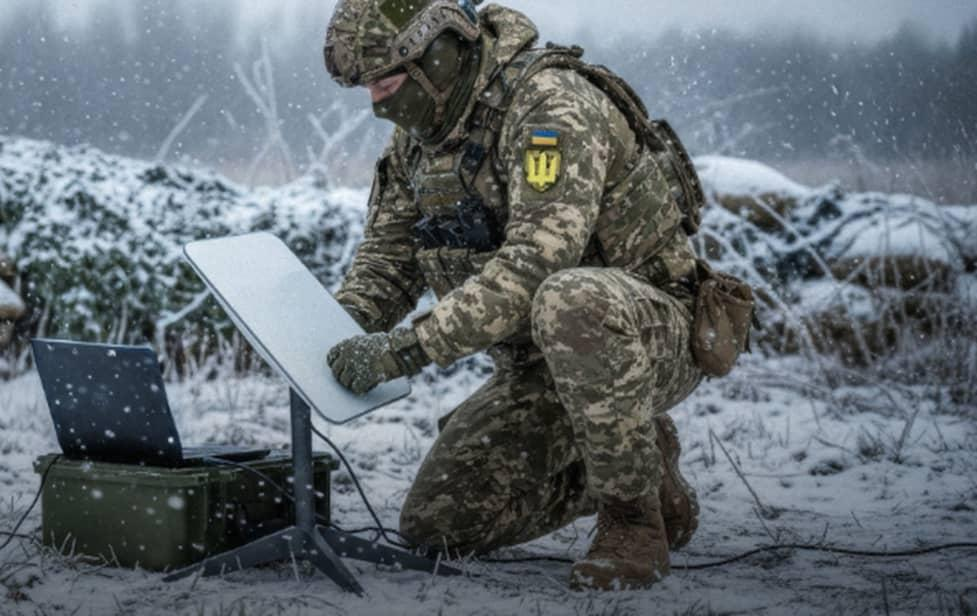
Since the full-scale Russian invasion in February 2022, Starlink has become foundational to Ukrainian military operations. The constellation of thousands of low-Earth orbit satellites provides resilient, high-bandwidth connectivity in areas where traditional cellular networks and fibre have been destroyed or jammed. Units in remote or contested sectors rely on it for real-time command and control, artillery coordination, medical evacuation requests, and the mass employment of first-person-view (FPV) and longer-range drones that have defined the war’s tactical character.
The October restrictions demonstrated how tightly these systems are integrated. Interceptor drones optimised for speed against jet-powered Shaheds became far less effective when forced to operate under legacy radio links or slower parameters. Offensive drone campaigns against Russian logistics nodes—already a major Ukrainian effort—saw diminished tempo. Frontline logistics and communications suffered degraded reliability precisely when Russia intensified drone and missile strikes on Ukrainian energy and civilian infrastructure.
Analysts noted that the temporary loss of high-speed capability eroded an edge Ukraine had cultivated carefully. Earlier in 2026, Ukrainian forces had leveraged superior communications to support operations such as those north of Lyman. The sudden imposition of limits forced rapid improvisation: greater use of alternative radios, mesh networks, and ground-based systems, though these lack Starlink’s range, bandwidth, and resistance to certain forms of electronic warfare.
The restoration on October 24 returned speeds above 400 km/h with reported stability, allowing testing and a return to prior operational envelopes. Yet the ten-day window left a tangible cost in lost missions, expended or captured drones, and temporary gaps in air defence coverage. Ukrainian officials continued monitoring to confirm consistency across sectors; early reports from some eastern areas suggested residual variation before full normalisation.
Political and Strategic Context
The episode unfolded against a backdrop of strained U.S.-Ukraine relations under the Trump administration. Trump has publicly criticised Ukrainian strikes on Russian energy infrastructure, linking them to global fuel prices, and has taken steps such as waiving certain sanctions while pursuing negotiations. Russia and Ukraine have agreed to resume three-way talks with Washington, with meetings anticipated in the coming weeks. A localised ceasefire arrangement involving the area around Oleshky was also reported.
Musk’s role has long been dual-edged. SpaceX’s decision in 2022 to activate and expand Starlink service in Ukraine, often at high cost, was widely credited with preventing a collapse of Ukrainian command networks in the early months of the war. Subsequent expansions, donations of terminals, and the introduction of Starshield capabilities cemented the system’s centrality. At the same time, Musk has repeatedly voiced reservations about offensive uses, previously restricting coverage in certain scenarios and publicly debating the ethics and strategic wisdom of deep strikes.
The latest restrictions amplified existing debates in Kyiv and European capitals about over-reliance on a single private provider whose owner holds strong political views and close ties to the U.S. administration. Ukraine has responded by accelerating efforts to diversify. Zelenskyy announced agreements with Finnish companies, including Nokia and ICEYE, aimed at developing more independent satellite communications and reconnaissance capabilities. Officials have stressed the need for systems under Ukrainian or allied control that cannot be throttled by external commercial or political decisions.
Russia, meanwhile, continues developing its own satellite communications alternatives, though these remain less mature and more vulnerable to Ukrainian and Western countermeasures. The asymmetry in resilient connectivity has been one of Ukraine’s persistent advantages; any sustained degradation would favour Moscow’s attritional approach.
Historical Role and Broader Lessons
Starlink’s wartime debut in Ukraine marked a novel chapter in military communications. Traditional satellite systems are fewer in number, more expensive, and often more susceptible to jamming or physical attack. The dense LEO mesh offers lower latency and greater redundancy. Ukrainian forces adapted rapidly, mounting terminals on vehicles, integrating them into drone control stations, and using them for everything from video feeds of FPV strikes to coordinating HIMARS and other precision fires.
Over four years, the system has survived Russian electronic warfare attempts, physical targeting of ground terminals, and political pressures. Earlier disputes—over coverage in contested zones or specific operational limitations—were managed through dialogue. The October 2026 speed restrictions represented a more abrupt and operationally consequential intervention.
The restoration does not erase the demonstration of leverage. Ukrainian military planners are already incorporating greater redundancy: dual-path communications, autonomous drone modes that reduce continuous connectivity needs, and accelerated domestic and European satellite programs. European partners have shown increased interest in sovereign alternatives precisely because of such episodes.
Looking Ahead
As of late October 2026, Ukrainian forces report that Starlink and Starshield are again supporting high-speed drone operations and frontline logistics at required performance levels. The immediate crisis has passed, yet the underlying dependencies remain. Russia continues large-scale drone and missile attacks; Ukraine continues its intermediate-range strike campaign against energy and military targets. Negotiations involving Washington, Kyiv, and Moscow are scheduled to resume, adding a diplomatic overlay to the kinetic and technological contest.
The episode serves as a case study in the double-edged nature of commercial space technology in modern warfare. Capabilities that once seemed purely enabling can become points of friction when ownership, terms of service, or political priorities diverge from operational needs. For Ukraine, the priority is clear: restore and maximise current systems while building resilience against future interruptions. For allies and observers, the lesson is equally pointed—strategic communications in high-intensity conflict cannot rest solely on the goodwill or commercial policies of any single provider.
Ukrainian officials continue testing and monitoring. Soldiers on the front, who have come to treat Starlink terminals as essential equipment alongside radios and batteries, will be watching the connection indicators as closely as any other battlefield variable. The war’s communications backbone is back online at full capacity for now. How durable that restoration proves, and how quickly alternatives mature, will shape the next phase of the conflict.